• Global Root Collapse Crisis: Scientific Reasons, Soil Degradation, Crop Failure, and Worldwide Solutions

    Root Collapse Crisis

    Across the world from Asia’s rice belts to Africa’s maize zones and Europe’s horticulture regions farmers are witnessing a silent but devastating crisis: root system collapse. Crops that once developed deep, strong, nutrient-absorbing roots are now showing shallow, fragile, and nutrient-deficient root structures. This shift did not happen overnight; it is the cumulative outcome of decades of soil mismanagement, fertilizer imbalance, biological decline, and chemical over-dependence.

    Modern agriculture has unintentionally pushed plants toward weak rooting habits. High nitrogen availability near the surface stops roots from going deep. Soil organic matter has declined because residues are burned or soils remain bare. Heavy machinery has compacted millions of hectares. Chemical dominance has reduced microbial populations that once supported roots naturally.

    This article provides the world’s most comprehensive, original, science-based explanation of why root systems are collapsing globally and what agriculture must change to restore deep-rooted, resilient crops.

    1. THE SCIENCE OF ROOT FORMATION

    Crop roots grow based on five primary forces:

    1. Soil structure
    2. Soil moisture distribution
    3. Nutrient profile
    4. Microbial activity
    5. Chemical stress or support

    Healthy soils encourage roots to explore deeply. But unhealthy soils force the plant to survive only at the surface.

    1. GLOBAL REASONS FOR ROOT COLLAPSE

    2.1 Excess Nitrogen at the Soil Surface

    Continuous surface placement of urea and ammonium fertilizers leads to:

    nitrogen concentration only in top 5–7 cm

    reduced need for deep exploration

    shallow feeder roots instead of structural roots

    weak anchoring

    This is now a global phenomenon.

    2.2 Declining Soil Organic Matter

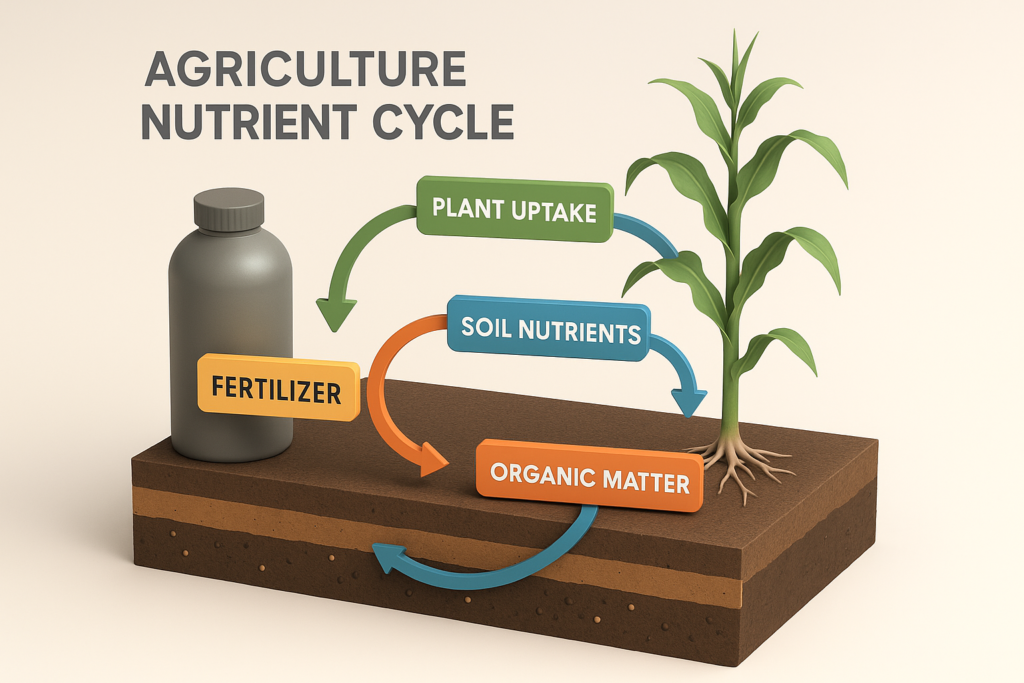
    Organic matter binds soil, creates pores, and feeds microbes. Its destruction leads to:

    compact, airless soil

    loss of aggregation

    reduced root penetration capacity

    Soils with <1% organic carbon cannot sustain strong root architecture.

    2.3 Chemical Stress on Root Tips

    High salt fertilizers, pesticides, and herbicide residues burn fine root hairs.
    The plant responds by:

    reducing new root formation

    avoiding deeper horizons

    redirecting energy into shallow survival growth

    2.4 Weak Soil Biology

    Healthy soil hosts millions of organisms:

    mycorrhizal fungi

    nitrogen-fixing bacteria

    phosphorus-solubilizing microbes

    These microorganisms enlarge the nutrient-absorbing capacity of roots.
    Their collapse = root collapse.

    2.5 Hardpan Formation

    Mechanical compaction forms a dense layer at 15–25 cm depth.
    Roots hit the barrier and stop immediately.

    2.6 Global Overuse of Nitrogen Fertilizers

    Countries like India, China, Pakistan, Bangladesh, and parts of Africa rely heavily on nitrogen fertilizers.
    This leads to:

    nutrient imbalance

    stunted root elongation

    reduced secondary root branching

    1. WORLDWIDE IMPACT OF ROOT COLLAPSE

    3.1 Yield Instability

    Crops cannot access water below 20 cm, making them highly sensitive to heat and drought.

    3.2 High Fertilizer Requirement

    Shallow roots mean low nutrient foraging → farmers apply more fertilizer.

    3.3 Lodging Increase

    Weak structural roots cannot support plant height.

    3.4 Decline in Crop Quality

    Everything from protein content to fruit size reduces.

    3.5 Poor Response to Irrigation

    Water stays above instead of entering deeper layers.

    1. GLOBAL CASE STUDIES

    4.1 Indian Wheat & Rice Belt

    High urea application → shallow roots → low organic matter → yield stagnation.

    4.2 African Maize Systems

    Soil mining + low organic matter → extremely fragile root systems.

    4.3 European Horticulture

    Chemical dependence → weakened root hair viability.

    1. SOLUTIONS FOR GLOBAL ROOT RESTORATION

    5.1 Deep Nutrient Placement

    Farmers who shift nitrogen 10–15 cm deep gain:

    stronger axial roots

    lower lodging

    higher yields

    5.2 Organic Matter Regeneration

    Additions of compost, manure, cover crops, and crop residues rebuild the soil’s physical structure.

    5.3 Mycorrhizal Recovery

    Restoring mycorrhiza can increase root surface area by up to 500%.

    5.4 Biofertilizers & Biological Inputs

    These re-establish microbial partners.

    5.5 Subsoil Breaking

    Breaking compacted layers increases root depth dramatically.

    1. LONG-TERM GLOBAL STRATEGY

    Countries must shift toward:

    regenerative agriculture

    balanced fertilization

    soil life restoration

    deep nutrient tools

    organic carbon rebuilding

    Only then will root collapse reverse.

    10 FAQs

    Q1. Why are root systems becoming shallow worldwide?

    Because nutrients, especially nitrogen, are concentrated near the soil surface.

    Q2. Does high urea cause root damage?

    It does not damage, but it prevents deep rooting by satisfying the plant at the surface.

    Q3. What is the main sign of root collapse?

    Plants lodge easily, wilt fast, and show nutrient deficiency despite fertilizer use.

    Q4. How does soil organic matter affect roots?

    It improves soil structure, moisture, aeration, and microbial support.

    Q5. Can roots recover after collapse?

    Yes, but requires organic matter rebuilding and biological restoration.

    Q6. How does compaction stop root growth?

    Roots cannot penetrate dense layers; they turn sideways.

    Q7. Why do vegetables suffer more?

    They are sensitive to chemical stress and shallow nutrient patterns.

    Q8. How do microbes help roots?

    They expand nutrient access and protect root tips.

    Q9. What fertilizer practice is most harmful?

    Repeated surface nitrogen application.

    Q10. What global model can fix this?

    Regenerative soil management with deep nutrient placement.

    The global root collapse crisis is one of the biggest hidden threats to modern agriculture. Years of excessive nitrogen, declining organic matter, soil compaction, and biological loss have pushed crops toward shallow, weak root systems. The solution lies in restoring soil structure, rebuilding organic carbon, reviving microbial networks, and rethinking fertilizer placement. Without strong roots, crop yields, climate resilience, and global food security cannot be maintained.

    ✍️ Farming Writers Team
    Love farming Love Farmers.

    Read A Next Post 👇

    https://farmingwriters.com/global-nitrogen-efficiency-complete-guide/
  • Record Climate Extremes Leave Farmers Across the World Facing Steep Losses in 2024–25, Global Assessment Warns

    The latest global climate-risk

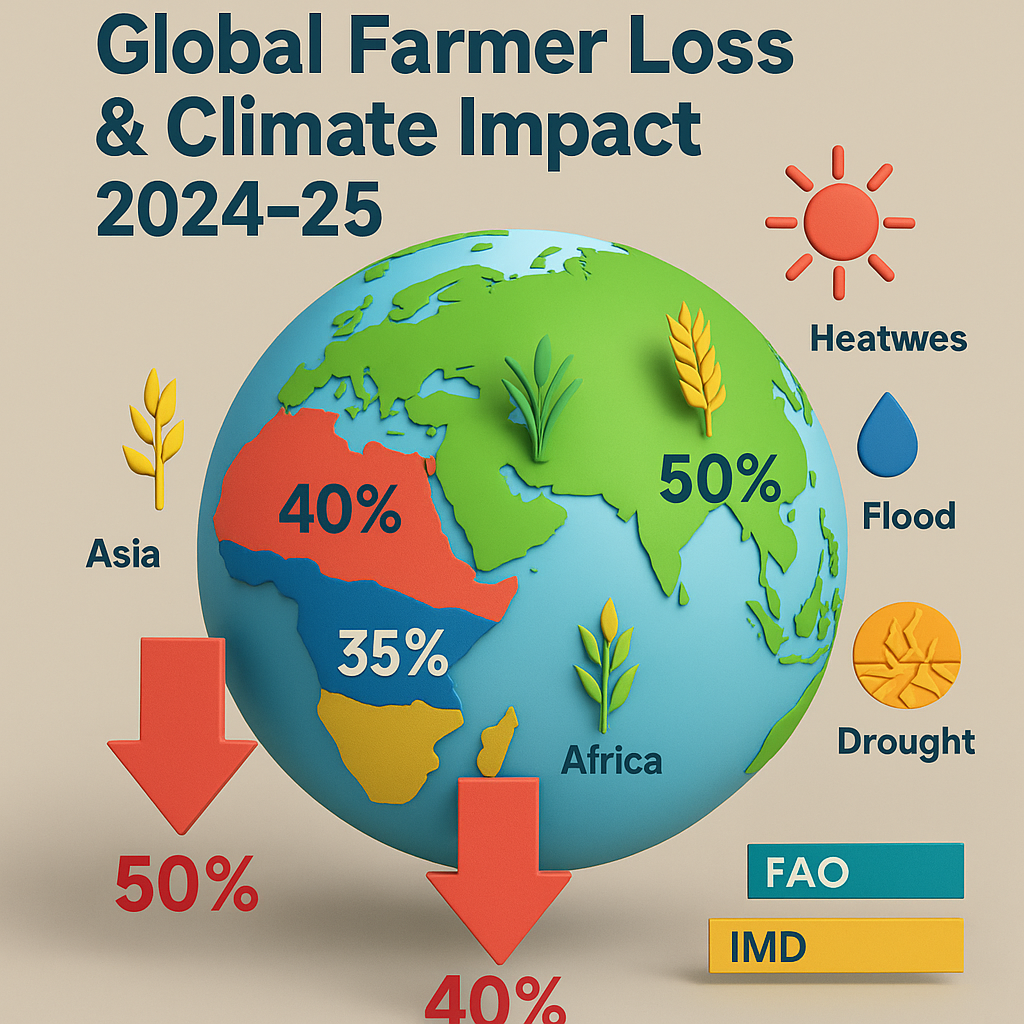
    The latest global climate-risk assessment compiled by multiple agriculture authorities — including FAO, IMD, USDA and national weather agencies — indicates that 2024–25 has become one of the most damaging periods for farmers worldwide, with extreme heat, unexpected floods, prolonged droughts and rising input costs causing widespread crop losses, income decline and food-system stress.

    1) Asia: Heatwaves, Dry Spells, and Groundwater Collapse

    Asia 2024–25 me sabse zyada impact wala region raha.
    Authorities report:

    • North India, Pakistan & Bangladesh me winter dryness + heat spikes ne wheat aur mustard belts ko affect kiya.
    • Southeast Asia me El Niño ke effect ne paddy sowing delay ki.
    • China ke northern grain belts me groundwater depletion ne irrigation demand double kar diya.

    Agriculture ministries ki field assessments ke mutabik, farmer income me 10–35% tak decline record hua.

    2) Africa: Drought–Flood Cycle Destroying Crops

    Africa me climate pattern unstable ho gaya hai:

    • East Africa me prolonged drought ne maize & sorghum yield ko damage kiya.
    • West Africa me sudden flooding ne groundnut, cassava aur millet fields ko wash-out kar diya.
    • Southern Africa me input cost inflation + dry spells ne small farmers ko heavy loss me dala.

    FAO’s Africa desk ne warn kiya ke repeated climate shocks long-term food security ko risk me daal rahe hain.

    3) Europe: Low Prices + Climate Pressure = Double Crisis

    Europe me dual impact:

    • Commodity prices crash
    • Frequent storms & cold spells

    Many European regions me sugar beet, wheat, barley aur oilseed growers cost-recovery tak nahi pahunch paye.

    Agriculture departments ke data ke mutabik,
    machinery auctions, delayed repayments aur planting reductions badh rahe hain.

    4) North & South America: Wildfires + Drought + Market Volatility

    • US me heatwaves + wildfire smoke ne corn & soybean belts ko disturb kiya.
    • Brazil & Argentina me drought-driven yield stress ne global soybean supply ko tighten kiya.
    • Export demand fluctuations ki wajah se farmers ko unstable price returns mil rahe hain.

    US agriculture bodies warn kar rahe hain ki long-term climate volatility production planning ko disturb karegi.

    5) Australia: Water Scarcity & Heat Spikes Continue

    Australia me heatwaves + low water storage:

    • Wheat aur barley belts me flowering-stage heat stress
    • Livestock grazing lands me fodder shortage
    • Irrigation cost record level par

    National agencies recommend drought-resilient seeds & rotational grazing.

    MARKET IMPACT

    Global climate events ki wajah se:

    • Wheat volatility
    • Rice procurement pressure
    • Oilseed output fluctuations
    • Sugar supply tighten
    • Maize demand-side instability

    Commodity markets 2025 me uncertain ban rahe hain.

    FARMER INCOME IMPACT (Global Snapshot)

    RegionLoss RangeAsia10–35%Africa15–40%Europe20–50%Americas8–30%Australia12–28%

    KEY RISKS

    • Rising heatwave frequency
    • Increasing flood severity
    • Soil degradation & water crisis
    • Input cost inflation
    • Weak market returns NEXT STEPS
    • Drought-resistant seeds
    • Early-warning digital systems
    • Crop-insurance expansion
    • Micro-irrigation
    • Market stabilization
    • Farmer financial safety nets

    Source Verified – Authority

    • FAO – Global climate & agriculture disaster assessment
    • IMD – Seasonal climate outlook
    • USDA – Crop condition & supply indicators
    • National Agriculture Ministries – Field loss reports
    • State Agriculture Departments – Region-wise assessments
    • Market Boards / APMC – Commodity trend data

    ✍️Farming Writers Team

    Love Farming Love Farmers

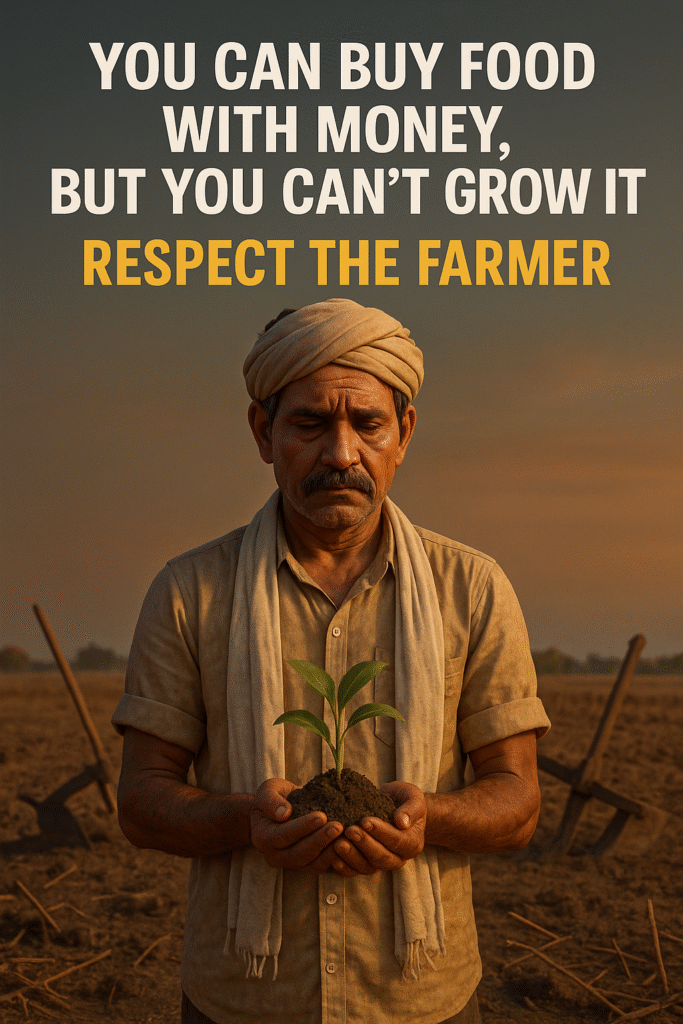
  • Farmers as Future Leaders: The Global Revolution Rooted in Soil

    Farmers as Future Leaders

    Introduction: A New Era of Farming Leadership

    In every corner of the world, from the vast wheat fields of Canada to the rice terraces of the Philippines, from African cocoa farms to European vineyards — a silent revolution is growing. This revolution is not led by politicians or industrialists, but by farmers — the true leaders of tomorrow.

    Farming, once seen as a humble profession, is now emerging as the backbone of sustainability, innovation, and survival. In a time when climate change, food insecurity, and mental stress dominate global headlines, the world is waking up to a profound truth: our future leaders are those who work with the Earth, not against it.

    1. The Farmer: A Leader Beyond Titles

    Leadership is not about speeches; it’s about creation, resilience, and vision. Farmers have always been silent leaders — creating life, sustaining communities, and guiding humanity toward survival.

    When others chase short-term profit, farmers chase growth — not just in crops, but in life. They teach patience, humility, and balance. A seed does not grow overnight, and neither does true success. Farmers live this truth daily.

    In this way, farming is not just an occupation — it’s leadership training at its purest form.

    1. Why Farming Matters More Than Ever

    Food Security

    By 2050, the global population will exceed 9 billion. Without farming innovation, there will not be enough food to sustain life. Farmers are the first line of defense against global hunger.

    Environmental Stability

    Agriculture contributes to environmental healing when done responsibly — through regenerative practices, organic cultivation, and smart irrigation. The soil captures carbon, trees restore oxygen, and farmers maintain the planet’s lungs.

    Economic Sustainability

    A thriving agricultural system creates employment, reduces migration, and balances national economies. Every farm job sustains multiple lives beyond the field.

    1. Farming and Technology: The New Green Revolution

    Farming is no longer about plows and oxen. It’s about AI-driven irrigation systems, drone surveillance, satellite weather mapping, and precision agriculture.

    Countries like Japan and the Netherlands are leading examples — showing how technology can multiply output while preserving resources. Young innovators across Africa, India, and South America are turning farms into smart ecosystems.

    From solar-powered greenhouses to blockchain-based food tracking, the fusion of farming and tech is shaping a global movement. The modern farmer is not just a grower — he is an engineer, economist, and environmentalist.

    1. Youth and the Return to Soil

    The youth of the world face a crisis — stress, job insecurity, and digital overload. But a quiet shift is happening. Educated young people are leaving cities and returning to farming.

    They’re building organic startups, eco-villages, and community-supported agriculture (CSA) networks. For them, farming is not regression — it’s evolution.

    It offers balance — a connection between mind, body, and nature. Farming teaches that the value of life is not measured in bank balances but in the ability to nurture life.

    1. The Global Economy and the Farmer’s Role

    Farming contributes nearly 4% of global GDP but supports over 27% of the world’s workforce. Yet, farmers remain undervalued.

    In reality, no industry exists without agriculture. Technology, medicine, and even space exploration depend on food security. The global economy runs on soil, and the sooner the world recognizes this, the stronger our collective future will be.

    Governments must promote fair pricing, crop insurance, and global trade equality — ensuring that the hands feeding the world never go hungry themselves.

    1. Mental Health and the Farmer’s Strength

    Farmers face harsh realities — climate unpredictability, debts, and isolation. But their resilience is unmatched.

    Unlike corporate workers who burn out chasing deadlines, farmers learn to synchronize with nature’s rhythm. Every sunrise is a new chance, every failure a lesson, every harvest a celebration.

    The world can learn mental wellness from farmers — how to stay calm in uncertainty and hopeful in hardship.

    1. Farming as a Path to Global Peace

    Food has no religion, soil has no borders, and rain belongs to all. Farming unites humanity in its purest form.

    In regions divided by politics, shared agricultural projects have restored trust and cooperation. When countries exchange seeds instead of weapons, humanity grows together.

    Farming could become the foundation of global peace, where collaboration replaces competition, and the Earth becomes our shared home again.

    1. The Future: From Farmers to Visionaries

    The farmer of the future will not just feed the world — they will lead it.

    They will use data to predict climate, robots to plant crops, and satellites to monitor soil health. But most importantly, they will preserve the ancient wisdom of balance and patience — something no machine can replicate.

    As we move toward 2050, the leaders who matter will not be those sitting in glass towers but those standing in open fields, with soil-stained hands and sunlit vision.

    Conclusion: The Soil Is Calling

    The world needs to redefine success. It is not about power or possessions, but about purpose.

    Farmers carry that purpose. They lead with heart, not ego. They work silently, but their impact echoes globally.

    If humanity is to survive — and thrive — it must follow the footsteps of those who listen to the Earth. Because the future doesn’t grow in offices or factories.
    It grows in the soil.

    ✍️Farming Writers

    Love farming Love farmers

    Read A Next Post 👇

    https://farmingwriters.com/the-power-of-never-giving-up/