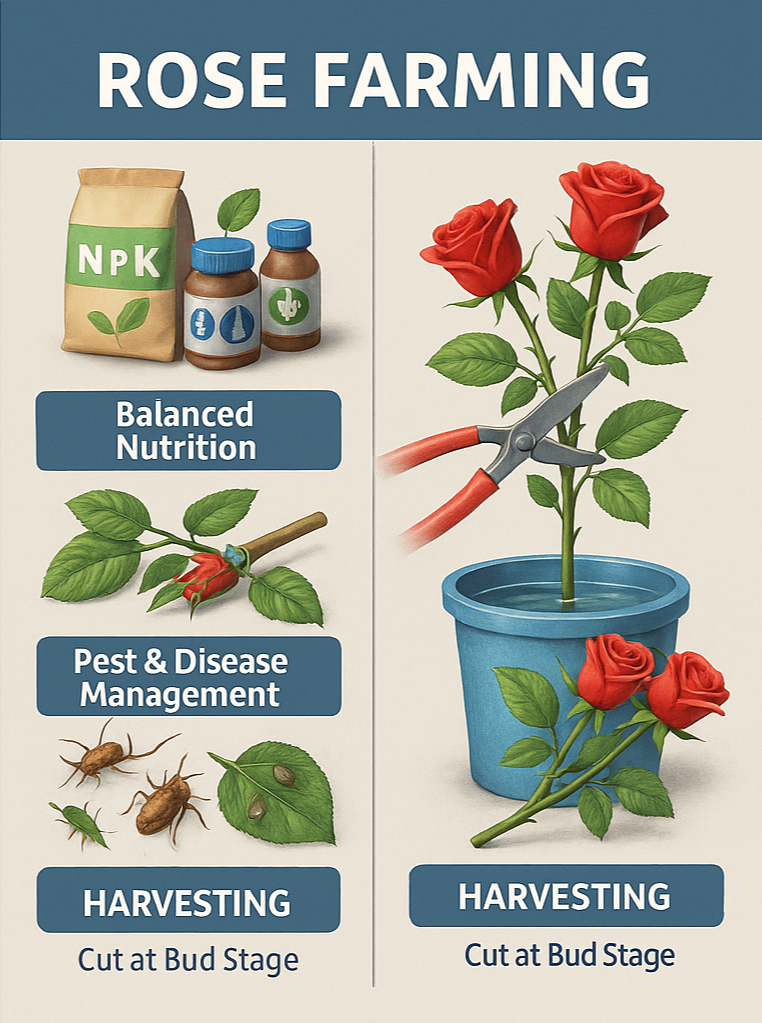
Rose farming is one of the most refined and profitable segments of global floriculture. Unlike many seasonal crops, roses are cultivated year-round for the international cut-flower industry, perfume manufacturing, cosmetics, essential oil extraction and ornamental landscaping. The rose is not only a symbol of beauty but also a high-value commercial crop that supports large agricultural economies in Europe, Africa, South America and Asia. Countries such as the Netherlands, Kenya, Ethiopia, Ecuador, Colombia, India and China dominate global rose production and export.
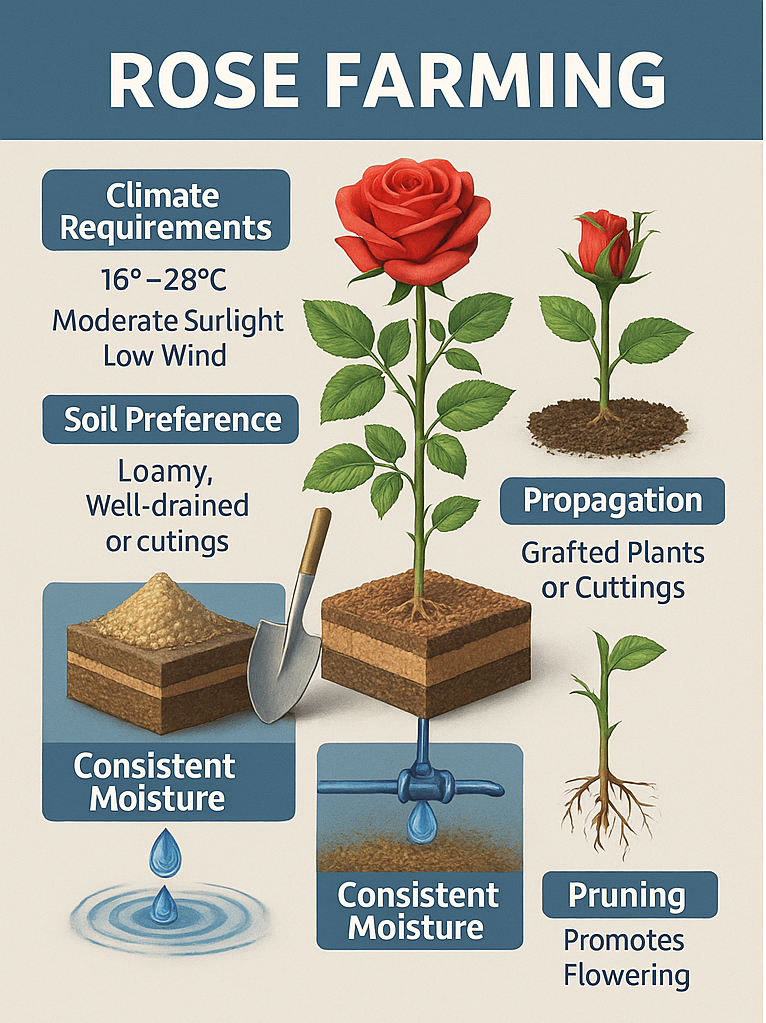
Roses require a carefully controlled environment. Climate stability directly influences stem length, bud size, color intensity and vase life. Ideal temperatures range between sixteen and twenty-eight degrees Celsius. Night temperatures matter as much as day temperatures; excessively warm nights reduce bud quality, while low temperatures slow growth. Regions with moderate sunlight and low wind stress produce premium-quality roses. In tropical countries, modern rose farming relies heavily on greenhouses and polyhouses to control temperature, humidity and light exposure.
Soil selection forms the foundation of successful rose cultivation. Roses flourish in fertile, well-drained loamy soils rich in organic matter. Heavy clay soils restrict root respiration and increase fungal disease risk, while extremely sandy soils drain nutrients too quickly. A soil pH between six and seven provides ideal nutrient uptake. Commercial rose farms often prepare raised beds to ensure drainage and uniform root development. Organic compost, cocopeat and sand are commonly mixed to create a soft but stable growing medium.
Land preparation begins with deep soil loosening to break compact layers and improve root penetration. Beds are sterilized either naturally using solar heat or with safe microbial treatments to eliminate soil-borne pathogens. In greenhouse farming, raised beds or grow-bags are arranged with precise spacing to optimize airflow and light penetration. Soil preparation remains one of the most decisive factors affecting long-term rose yield and plant longevity.
Propagation in commercial rose farming is done through grafted plants or cuttings. Grafted plants provide uniform growth, disease resistance and strong flower quality. The rootstock determines tolerance to salinity, nematodes and soilborne diseases. Planting density depends on variety and production system. Greenhouse roses are planted at higher density to maximize stem output per square meter, while open-field systems maintain wider spacing.
Irrigation management in rose farming requires precision rather than volume. Roses need consistently moist soil but suffer immediately under waterlogging. Drip irrigation delivers controlled moisture directly to the root zone, preventing leaf wetness and fungal outbreaks. Frequency increases during flowering and reduces during cooler months. Over-irrigation dilutes nutrient concentration and weakens stems, directly impacting flower quality.
Nutrient management plays a critical role in determining stem length, bloom size and color brilliance. Roses demand balanced nutrition throughout their growth cycle. Nitrogen encourages vegetative growth but must be carefully controlled to avoid weak stems. Phosphorus strengthens root systems and supports flower initiation. Potassium improves bud size, color intensity and vase life. Micronutrients like magnesium, calcium, iron and boron maintain leaf health and prevent physiological disorders. Most commercial farms combine organic inputs with precise fertigation programs.
Pruning is a defining practice in rose cultivation. Proper pruning stimulates new shoot development and ensures continuous flowering. Roses are pruned periodically to remove weak, diseased or overcrowded stems. Correct pruning pattern ensures uniform stem length and synchronizes flowering flushes, which is essential for meeting market demand during peak seasons such as Valentine’s Day and international flower festivals.
Pest and disease management requires constant monitoring. Aphids, thrips, spider mites and whiteflies are common rose pests worldwide. Diseases such as powdery mildew, black spot and botrytis cause severe losses under high humidity. Integrated pest management strategies reduce dependency on chemicals. Good air circulation, sanitation, resistant varieties and biological controls form the backbone of sustainable rose farming.
Harvesting roses is an art that directly affects vase life and export value. Flowers are cut at specific bud stages depending on destination markets. Export markets prefer tight buds that open gradually during transit, while local markets accept semi-open blooms. Harvesting is done during early morning or late evening to preserve freshness. Stems are immediately placed in clean water and transferred to cold storage to maintain quality.
Post-harvest handling determines profitability. Roses undergo grading based on stem length, bud size and freshness. Cold chain management preserves flower quality for international shipping. Packaging must protect buds from mechanical damage while allowing airflow. Major exporters use temperature-controlled logistics to transport roses to global auction markets and wholesale buyers.
Global rose markets are highly organized. The Netherlands serves as the world’s primary flower trading hub through its auction system. African and South American countries export millions of stems daily to Europe, the Middle East and North America. Premium roses sell at prices ranging from twenty to forty cents per stem at wholesale level, while exotic varieties and off-season supplies command higher prices. Greenhouse rose farming offers strong profitability due to year-round harvest cycles.
Sustainability is increasingly shaping rose farming. Many farms adopt water-efficient irrigation, recyclable growing media and biological pest controls to meet environmental standards. Buyers prefer sustainably grown roses, especially in European markets. Certification programs improve market access and pricing.
In conclusion, rose farming represents a sophisticated and lucrative agricultural enterprise. Success depends on precision climate management, soil preparation, nutrition balance, harvesting timing and post-harvest care. Farmers who master these factors produce world-class roses capable of competing in global markets and achieving consistent long-term income.
FAQ — ROSE FARMING
Growers often ask how long rose plants remain productive, and commercial roses typically yield high-quality flowers for four to six years under good management. Questions about greenhouse necessity arise frequently, and while open-field roses work in mild climates, premium exports require greenhouse control. Many farmers ask how often roses are harvested, and healthy plants can be cut every thirty to forty-five days depending on growth conditions. Soil drainage remains a common concern, and roses fail quickly in waterlogged soil. Pest pressure concerns growers worldwide, but integrated pest management significantly reduces losses. Nutrient imbalance often causes weak stems, highlighting the importance of balanced feeding. Export pricing depends on stem length, vase life and seasonal demand. Temperature control is critical; extreme heat or cold directly affects flower quality. Growers often ask about water frequency, and roses perform best under consistent, moderate moisture. Finally, rose profitability remains high when quality meets international standards.
✍️Farming Writers Team
Love farming Love Farmers