• Ginseng Farming Complete World Guide Climate, Soil, Root Development, Harvesting & USD Profit

    Ginseng Farming

    Ginseng stands among the world’s most valuable medicinal plants, often considered the crown jewel of herbal agriculture. For centuries, ginseng has been treasured across Asian, American and European wellness systems for its powerful adaptogenic properties. It is one of the rare crops where a single mature root can hold more value than an entire acre of conventional crops. The global herbal industry treats ginseng as a premium, life-enhancing ingredient used in medicines, supplements, teas, energy drinks, tonics and wellness formulations. Unlike many fast-growing herbs, ginseng demands patience; it often requires four to six years to develop market-grade roots. But once harvested, the returns can be extraordinary, making it one of the most profitable long-term agricultural investments in the world.

    Its botanical identity roots in the genus Panax, a word derived from the Greek term meaning “cure-all.” Panax ginseng, native to Korea, China and Russia, represents the classical Asian variety known for its strong aroma and high ginsenoside content. Panax quinquefolius, or American ginseng, thrives in North America and is widely used in global medicinal supply chains. Over the years, commercial ginseng production expanded into Canada, the United States, parts of China, Korea, Europe and some high-altitude tropical regions where temperature cycles align with ginseng physiology.

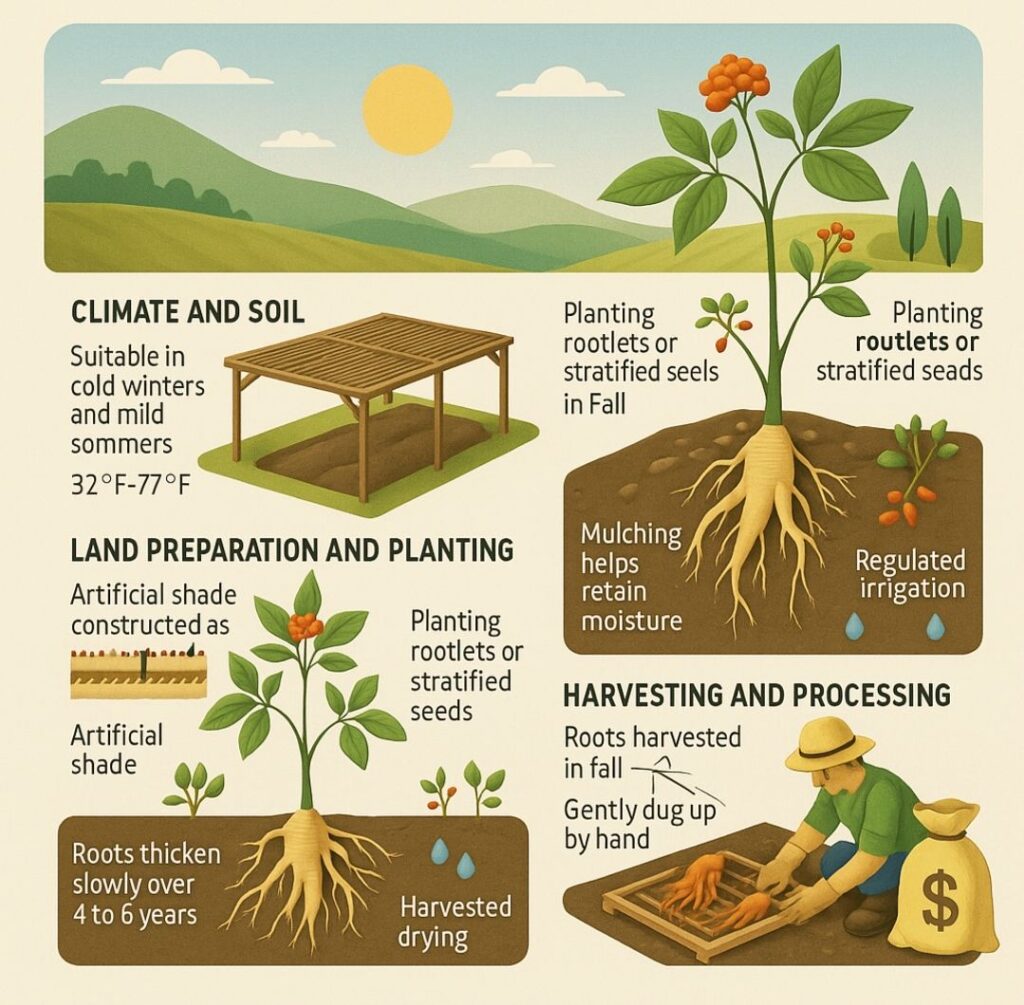
    Ginseng is not an easy crop, nor is it a crop suited to all climates. It requires cold winters, mild summers and deep dormancy cycles. The plant grows in a temperate climate where temperatures fall below freezing during winters. This cold period activates dormancy, allowing the root to store energy for the following season. Warm summers, but not excessively hot, allow the plant to produce broad leaves that fuel root growth. Ginseng behaves like a forest understory plant, preferring roughly seventy to ninety percent shade. Direct sunlight burns its delicate leaves, while insufficient shade reduces root development. For this reason, traditional ginseng farms mimic natural forests using artificial shade structures resembling tree canopies.

    Soil requirements for ginseng cultivation are precise and unforgiving. The plant grows best in deep, porous, humus-rich loam soils with excellent drainage. Slightly acidic soils, ideally between pH five and six point five, support optimal growth. Ginseng roots are extremely sensitive to fungal pathogens, which thrive in poorly drained soil. Farmers must ensure that moisture remains consistent but never excessive. In the wild, ginseng grows in forest floors enriched with decaying leaves. Commercial growers replicate this by adding leaf mold, composted bark and organic matter that mirrors natural woodland conditions. The presence of calcium in soil is beneficial, and forests with naturally high organic activity tend to produce thicker, healthier roots.

    Land preparation for ginseng farming begins months before planting. Farmers loosen the soil deeply, incorporate organic material and shape the land into raised beds to improve drainage. Shade houses or artificial canopies are constructed using wooden frames, bamboo mats or synthetic shade cloth. These structures reduce sunlight and maintain cool soil temperature. The shade environment is crucial for ginseng; even a small lapse in shade during peak summer can destroy leaves and stall root growth.

    Ginseng propagation relies heavily on high-quality seeds and rootlets. Seeds must undergo stratification—a natural chilling cycle—before germination. This reflects the plant’s dependency on winter dormancy. Rootlets, which are young roots grown for one or two years, offer a faster route to production. They shorten the time to maturity and reduce the early-stage risk. However, both seeds and rootlets must come from disease-free sources because ginseng farms worldwide face threats from fungal diseases such as root rot and leaf blight.

    Planting takes place in autumn. This aligns with ginseng’s natural cycle because seeds germinate during spring when temperatures rise. Growers plant them shallowly on raised beds covered with leaf mulch. Rootlets are placed slightly deeper, ensuring their crown remains just below the soil line. Once planted, ginseng begins an annual growth cycle where leaves emerge in spring, expand through summer and senesce in autumn. During winter, the plant retreats into dormancy, allowing the root to mature quietly underground.

    Irrigation management plays a careful balancing act. Ginseng cannot tolerate dryness during leaf expansion or early root formation. Yet, too much moisture leads to fatal diseases. Drip irrigation systems provide controlled moisture without splashing leaves because wet leaves invite fungal infections. Mulching with compost or forest leaves regulates soil temperature, suppresses weeds and conserves moisture. Clean water sources, disease-free tools and proper spacing reduce pathogen spread.

    Pest and disease management in ginseng farming requires constant vigilance. Fungal diseases such as Phytophthora root rot, Alternaria leaf blight and damping-off cause major losses globally. Since ginseng grows in dense shade and humid conditions, air movement becomes essential. Farmers maintain spacing, prune shade covers and monitor humidity levels. Crop rotation is also crucial. Soil used for ginseng cannot be reused for several years because pathogen loads increase over time. This is why farmers often treat ginseng land as long-term investment sites where careful hygiene and soil rest play critical roles.

    As ginseng ages, the root slowly thickens, developing wrinkles and branching patterns known as “wild shape.” Older roots fetch higher prices because they contain more ginsenosides and hold greater medicinal value. Wild-simulated ginseng, grown under natural forests, can command extremely high prices in international markets. Even cultivated roots, if grown for five or six years, can earn substantial revenue compared to other medicinal crops.

    Harvesting takes place in autumn when leaves turn yellow and begin to die back. Workers carefully dig around each plant using hand tools because mechanical harvesters can damage roots, reducing commercial value. The harvested roots are washed gently to remove soil. Their shape, age rings and size determine their quality grade. Premium roots have smooth but naturally wrinkled skin, uniform branching and strong aroma.

    Processing involves sorting roots into size grades and drying them. Ginseng can be sold fresh, air-dried or steam-cured (producing red ginseng). Each type carries different medicinal properties and market preferences. Red ginseng, produced by steaming and then drying, is widely prized in East Asian wellness industries. Dried roots store for years if protected from moisture and pests. Powders, capsules, extracts and fortified beverages all use ginseng as a primary ingredient.

    Global market demand for ginseng remains extremely strong and continues to grow. Consumers worldwide increasingly turn to natural wellness supplements to improve energy, immunity, cognitive performance and stress resilience. Asia remains the heart of ginseng commerce, especially South Korea and China. North America and Europe rely heavily on cultivated American ginseng. Prices vary, but mature roots often sell between forty and one hundred fifty USD per kilogram. Wild-simulated roots may reach thousands of dollars per kilogram depending on age and shape.

    Economically, ginseng stands among the highest-value medicinal crops because of its long-term returns. Although initial costs are high—shade houses, land preparation and disease control—the cumulative value of harvested roots, plus the premium grades, easily surpasses most agricultural crops. Ginseng farming is considered a heritage investment for families because a well-managed plot provides stability and multi-year returns.

    Sustainability involves soil conservation, organic nutrition and reduced pesticide use. Ginseng’s dependence on forest-like conditions naturally aligns it with eco-friendly farming systems. The crop fits well within woodland farming models where biodiversity remains intact and soil ecology thrives.

    In conclusion, ginseng farming reflects a unique blend of botanical science, patience, ecological sensitivity and long-term vision. Farmers who commit to the crop with discipline and precision eventually produce roots that hold exceptional value in global markets. This long-form guide offers growers and world agricultural investors a complete understanding of how ginseng can be cultivated with excellence, yielding both economic and medicinal rewards.

    FAQ – FOR GINSENG FARMING

    Many new growers ask how many years ginseng takes to mature. Typically, four to six years are needed before roots gain commercial grade, though rootlets can shorten this timeline. Another question is about shade. Ginseng absolutely requires shade similar to forest floors, and without it, leaves burn quickly. Soil questions arise frequently because the plant cannot tolerate poor drainage. Only loose, organic-rich soil supports healthy root development. Irrigation questions also come up often, and the answer is controlled moisture—never dryness, never excess. Growers also worry about diseases; ginseng fields face strong fungal pressure, so hygiene and spacing matter deeply. Finally, growers ask about profitability, and mature ginseng roots remain among the world’s highest-value herbal crops when grown correctly.

    ✍️Farming Writers
    Love Farming Love Farmers

  • Ashwagandha Farming Complete Guide  Climate, Soil, Planting, Irrigation, Harvesting & Global Profit

    Ashwagandha Farming

    INTRODUCTION

    Ashwagandha (Withania somnifera) is one of the world’s most important medicinal plants, widely recognized for its adaptogenic and therapeutic properties. Used for more than 3,000 years in Ayurveda, Unani, Siddha, Persian, Tibetan, and modern herbal medicine, Ashwagandha has become a leading global ingredient in the wellness, nutraceutical, mental-health and fitness industries.

    The global Ashwagandha market has crossed USD 1.4 billion and is projected to grow significantly due to rising demand for natural stress-relief supplements, immunity boosters, sports nutrition products, cognitive-enhancement formulas, and herbal treatments. The plant is widely consumed in the USA, Europe, the Middle East, East Asia, and India.

    Ashwagandha is a hardy, drought-tolerant, low-maintenance plant ideally suited to arid and semi-arid climates. It grows well even in poor, light soils, requiring minimal irrigation and fertilizers. The roots are the main commercial product, although leaves and berries are also used pharmaceutically.

    This guide presents a complete A-Z scientific, practical, and commercial cultivation blueprint for farmers, exporters, herbal companies, startups, and global agribusiness investors.

    CHAPTER 1 — BOTANY, PLANT SCIENCE & CHEMISTRY

    Scientific Name: Withania somnifera
    Family: Solanaceae
    Common Names: Winter Cherry, Indian Ginseng, Poison Gooseberry

    Plant Type:
    Perennial herb (grown as an annual commercial crop)
    Height: 60–120 cm
    Root: Thick, cylindrical, fleshy root—main economic part
    Flowers: Greenish-yellow
    Fruits: Red berries

    Key Bioactive Compounds:

    – Withanolides
    – Withaferin-A
    – Alkaloids
    – Saponins
    – Flavonoids

    These compounds are responsible for anti-stress, anti-anxiety, anti-inflammatory, antioxidant, anti-tumor, and immune-modulation effects.

    Root quality strongly depends on: – Soil type
    – Climate
    – Harvest maturity
    – Drying method
    – Withanolide content

    CHAPTER 2 — GLOBAL VARIETIES

    Commercial varieties should have: – High root yield
    – High withanolide concentration
    – Good drought adaptation

    Major Global Varieties:

    Jawahar Ashwagandha-20

    PUSA Ashwagandha-1

    NMITLI-101

    Rakshit Variety

    Poshita

    ACL-1 (High Withanolide Strain)

    World Preference:

    – USA & European market → High withanolide content
    – India & Asia → High root volume + medium withanolides
    – Supplement industry → Root powder purity + soil-free roots

    CHAPTER 3 — CLIMATE REQUIREMENTS

    Ashwagandha thrives in warm, dry climates.

    Optimal Conditions:

    – Temperature: 20–35°C
    – Rainfall: 300–600 mm
    – Sunshine: Full sun required
    – Humidity: 20–40%
    – Altitude: 0–1500 meters

    Unsuitable Conditions:

    – Heavy rainfall
    – Waterlogging
    – Very high humidity areas
    – Frost zones (kills young plants)

    Ashwagandha performs best in regions with dry winter and mild summer.

    CHAPTER 4 — SOIL REQUIREMENTS

    Ashwagandha grows best in: – Light red soils
    – Sandy loam
    – Loam

    It does poorly in heavy clay soils.

    Soil Conditions:

    – pH: 6.0–8.0
    – Good drainage
    – Low fertility soil is ideal
    – Slight alkaline soils are acceptable

    Excessively fertile or nitrogen-rich soil reduces withanolide concentration.

    CHAPTER 5 — LAND PREPARATION

    Ashwagandha does not require heavy tillage.

    Steps:

    One deep plough

    Rotavation

    Remove stones and weeds

    Create flat beds or ridges

    Maintain light tilth for seed germination

    Too loose or too hard soil reduces root formation quality.

    CHAPTER 6 — SEED RATE, SOWING & GERMINATION

    Seed Rate:

    – 4–5 kg per hectare
    (1.5–2 kg per acre)

    Sowing Time:

    – June–July (rainfed)
    – October (irrigated winter sowing)

    Sowing Method:

    – Line sowing is preferred
    – Row spacing: 45–60 cm
    – Plant spacing: 20–25 cm
    – Seed depth: 1–2 cm

    Seed Treatment:

    – Trichoderma
    – Neem seed extract

    Germination starts within 10–15 days.

    CHAPTER 7 — IRRIGATION MANAGEMENT

    Ashwagandha is a drought-loving plant. Excess irrigation reduces root quality.

    Irrigation Requirement:

    – Only 3–4 irrigations required in entire season
    – Rainfed areas: No irrigation needed
    – Avoid waterlogging at all costs

    Irrigation Schedule (If Needed):

    After sowing

    At branching stage (30–40 days)

    At flowering

    Light irrigation before root enlargement

    Over-irrigation → low withanolides + fungal diseases.

    CHAPTER 8 — NUTRIENT MANAGEMENT

    Ashwagandha requires very low fertility.

    Basal Application (Optional):

    – FYM: 1–2 tons per acre
    – Wood ash: Improves soil structure
    – Avoid nitrogen fertilizers

    Top Dressing:

    Not required
    (High nitrogen → weak roots, low medicinal value)

    Organic Boosters:

    – Panchagavya
    – Jeevamrut
    – Vermiwash

    These may improve plant vigour without reducing withanolide content.

    CHAPTER 9 — WEED, DISEASE & PEST CONTROL

    Weed Management:

    – Critical stage: 30–60 days
    – 2 hand weedings are enough
    – Mulching beneficial in irrigated systems

    Major Diseases:

    1. Leaf Spot

    – Fungal outbreak under humidity
    Control: Neem oil, copper sprays

    1. Root Rot

    – Caused by waterlogging
    Control:
    – Good drainage
    – Trichoderma application

    Major Pests:

    – Aphids
    – Mealybugs
    – Red mites

    Control: Neem-based sprays and sticky traps.

    CHAPTER 10 — CROP PHYSIOLOGY & GROWTH STAGES

    1. Germination Stage (0–15 Days)

    Seedling emergence begins.

    1. Vegetative Stage (15–60 Days)

    Branching begins; plants grow 30–40 cm.

    1. Flowering Stage (70–100 Days)

    Plant height reaches 50–70 cm.

    1. Maturity & Root Development (100–150 Days)

    Roots gain weight, thickness, and medicinal compounds.

    1. Harvest Stage (150–180 Days)

    Roots ready for commercial harvest.

    CHAPTER 11 — HARVESTING & YIELD

    Harvest Time:

    – 150–180 days after sowing
    – When leaves turn yellow
    – Roots become thick and hard

    Harvesting Method:

    – Uproot entire plant
    – Remove soil
    – Wash roots gently
    – Cut into 8–10 cm pieces
    – Sun-dry for 4–7 days

    Yield:

    – 300–600 kg dried roots per acre
    – Leaves: 400–600 kg (additional)
    – Seeds: 50–70 kg (optional)

    Root yield depends heavily on soil type and climate.

    CHAPTER 12 — POST-HARVEST PROCESSING

    Drying:

    – Sun drying
    – Low-temperature chamber drying (premium quality)

    Grading:

    – Large cylindrical roots fetch highest price
    – Soil-free, clean roots preferred for export

    Powder Processing:

    – Clean → dry → pulverize → sieve → pack
    Used in capsules, tablets, teas, extracts.

    Root Extract Manufacturing:

    – Hydro-alcoholic extraction
    – Standardized to 2.5%–5% withanolides

    High-value export product.

    CHAPTER 13 — GLOBAL MARKET & EXPORT VALUE

    Top Importing Countries:

    – USA
    – Germany
    – France
    – UK
    – Japan
    – South Korea
    – UAE

    Export Quality Requirements:

    – High withanolide content
    – Clean roots
    – No pesticide residue
    – Low moisture (<10%)

    Price Range (Worldwide):

    – Raw dried roots: USD 2.5 – 5.0 per kg
    – Powder: USD 8 – 14 per kg
    – Extracts: USD 30 – 120 per kg

    The extract industry is booming, driven by supplement demand.

    CHAPTER 14 — COST OF CULTIVATION (1 ACRE)

    Cost Breakdown:

    – Land preparation: USD 20–30
    – Seeds: USD 30–50
    – Labor: USD 60–80
    – Weeding: USD 40
    – Organic inputs: USD 20–30
    – Misc: USD 20

    Total Cost: USD 180–220 per acre

    Very low cost compared to most crops.

    CHAPTER 15 — PROFIT ANALYSIS (USD)

    Income:

    300–600 kg × USD 3 average = USD 900 – 1800

    Net Profit:

    USD 700 – 1600 per acre per season

    With value addition (powder/extract):

    Profit can reach USD 2500 – 6000 per acre.

    Ashwagandha is one of the highest profit per acre medicinal crops in the world.

    CHAPTER 16 — BUSINESS MODELS

    1. Raw Root Farming

    Low cost, steady market.

    1. Powder Production Unit

    Investment: USD 2,000 – 5,000
    High margin: 3× profit

    1. Extract Manufacturing

    High-value export product.

    1. Contract Farming

    Pharma companies buy standardized root grades.

    CHAPTER 17 — ADVANCED AGRONOMY PRACTICES

    – Drip irrigation in dry regions
    – Soil microbes (Trichoderma, Azospirillum)
    – Low-nitrogen cultivation
    – Organic-certified production
    – Intercropping with millets

    These practices improve quality and international market acceptance.

    CHAPTER 18 — RISKS & SOLUTIONS

    Risk: Excess rains

    Solution: Raised beds, drainage channels

    Risk: Root rot

    Solution: Soil solarization, Trichoderma

    Risk: Poor root size

    Solution: Light soil + proper spacing

    Risk: Low withanolides

    Solution: Avoid nitrogen fertilizers

    CONCLUSION

    Ashwagandha is a globally demanded medicinal crop that offers remarkable economic returns with very low investment. Its adaptability to poor soils, drought tolerance, short duration, and extensive export demand make it ideal for farmers, startups, and herbal product manufacturers. With proper scientific practices—right variety, correct spacing, low irrigation, and careful root processing—Ashwagandha farming becomes a high-profit, low-risk, world-class agribusiness.
    Ashwagandha farming, Withania somnifera cultivation, medicinal root crop, herbal plant farming, ashwagandha global market, ayurvedic farming, organic medicinal plants

    ✍️farming Writers

  • Aloe Vera Farming Complete World Guide  Climate, Planting, Irrigation, Processing, Profit

    Aloe Vera Farming

    INTRODUCTION

    Aloe vera is one of the world’s most commercially valuable medicinal plants, forming the backbone of the global herbal, pharmaceutical, nutraceutical, cosmetic, beverage, and skincare industries. Known scientifically as Aloe barbadensis miller, the plant has gained international significance due to its high gel content, rich bioactive compounds, and multipurpose usage. More than 200 active substances, including vitamins, minerals, enzymes, amino acids, antioxidants, and anti-inflammatory chemicals, make aloe vera a premium crop for wellness industries worldwide.

    Global demand for aloe vera has been consistently rising. The herbal sector exceeded USD 250 billion in 2024, and aloe vera’s market share alone is estimated above USD 20 billion. The plant is widely cultivated in India, China, Mexico, the United States, Thailand, Vietnam, Kenya, Egypt, and South Africa. Consumption is high in the United States, Japan, Germany, South Korea, and the Gulf countries.

    Aloe vera’s popularity among farmers is due to its low maintenance nature, drought adaptability, year-round harvesting ability, and suitability for organic cultivation. Once planted, aloe continues to produce for 4–5 years, making it a lucrative perennial crop with stable income. This guide provides a comprehensive international standard blueprint for aloe vera cultivation, from soil and climate to planting, management, processing, and export.

    BOTANICAL PROFILE AND PLANT SCIENCE

    Aloe vera is a perennial succulent belonging to the Liliaceae family. Succulents store water in their fleshy tissues, enabling the crop to survive harsh dry climates. Its leaves grow in a rosette form with thick gel inside and a yellow latex layer under the skin containing aloin.

    Scientific Classification:
    Kingdom: Plantae
    Family: Liliaceae
    Genus: Aloe
    Species: Aloe barbadensis miller

    Morphological Characteristics:
    – Height: 50–80 cm
    – Leaves: Thick, fleshy, 45–55 cm long
    – Leaf texture: Smooth surface with serrated margins
    – Growth habit: Rosette-forming, perennial
    – Root system: Fibrous and shallow

    Active Ingredients:
    Acemannan (immunity booster), Aloin (pharmaceutical use), Vitamins A, C, E, B12, Calcium, Magnesium, Zinc, Amino acids, Lignin, and Polysaccharides.

    These compounds make aloe vera highly valuable for medicinal, cosmetic, and nutraceutical purposes.

    GLOBAL VARIETIES

    Worldwide, more than 400 aloe species exist, yet only a few varieties dominate commercial cultivation.

    1. Aloe barbadensis miller

    Most widely grown variety, rich in gel content. Preferred by cosmetic and food industries.

    1. Aloe perryi

    Higher in aloin content; used mostly in pharmaceutical extraction.

    1. Aloe vera chinensis

    Used primarily for beverage production; high purity and smooth gel quality.

    Leading Indian Varieties:

    – IC111269
    – AL-1
    – AL-2
    – Barbadensis Premium Strain

    The choice of variety depends on the targeted industry (cosmetic, medicinal, or beverage).

    CLIMATE REQUIREMENTS

    Aloe vera thrives in warm climates. It grows in tropical, subtropical, arid, semi-arid, and coastal regions.

    Optimal Climate Conditions:

    – Temperature: 15–40°C
    – Rainfall: 650–1200 mm
    – Sunshine: 6–8 hours daily
    – Humidity: 40–60%
    – Altitude: Up to 2000 m

    Frost is extremely damaging and can kill the plant. Therefore, frost-prone regions must use a polyhouse or protective low tunnel in winter.

    Excess rainfall or water stagnation promotes fungal growth and reduces leaf gel quality.

    SOIL REQUIREMENTS AND FIELD PREPARATION

    Aloe vera prefers soil that drains well. Since roots are shallow, heavy clay or waterlogged soils are unsuitable.

    Ideal Soil Conditions:

    – Soil type: Sandy loam or loam
    – pH: 6.0–8.0
    – Organic matter: Medium
    – EC tolerance: Up to 3 dS/m (fairly salt tolerant)

    Land Preparation Steps:

    Deep ploughing to break hardpan

    Rotavation for fine tilth

    Design ridges and furrows for drainage

    Add 5 tons FYM and 1 ton vermicompost per acre

    Mix neem cake to reduce soil pathogens

    Laser leveling to avoid water stagnation

    Soil Solarization:

    Covering soil with clear plastic for 25–30 days eliminates nematodes, fungal spores, and weed seeds.

    PROPAGATION AND PLANTING MATERIAL

    Aloe vera is propagated vegetatively using suckers or root divisions.

    Quality Sucker Characteristics:

    – From 1.5–2-year-old mother plant
    – 3–4 large, healthy leaves
    – No disease or yellowing
    – Strong root development

    Plant Population

    12,000–14,000 plants per acre

    Spacing:

    – Row spacing: 1.5 feet
    – Plant spacing: 1 foot

    Ideal Planting Time:

    – Spring: February–March
    – Monsoon: July–August

    Planting during monsoon improves survival and reduces irrigation requirement.

    IRRIGATION MANAGEMENT

    Aloe vera tolerates drought but responds well to controlled irrigation.

    Irrigation Intervals:

    – First month: Water every 7–8 days
    – After establishment: Irrigate every 15 days
    – Winter: Once every 25–30 days
    – Rainy season: No irrigation required

    Recommended System:

    Drip irrigation
    Benefits:
    – Saves 40% water
    – Prevents fungal attack
    – Increases leaf thickness
    – Supports fertigation

    Avoid flood irrigation because aloe is extremely sensitive to waterlogging.

    NUTRIENT MANAGEMENT

    Although aloe vera has modest nutritional requirements, balanced nutrition enhances plant growth and gel recovery.

    Basal Dose:

    – FYM: 5 tons per acre
    – Vermicompost: 1 ton
    – Neem cake: 100 kg
    – Bone meal or phosphate source

    Organic Foliar Sprays:

    – Panchagavya (15 days interval)
    – Jeevamrut
    – Seaweed extract
    – Vermiwash

    Chemical Nutrition (Optional):

    A light annual dressing:
    – NPK: 50:25:25
    – Micronutrients: Zn, Mg, Fe

    Organic aloe has higher market demand, especially for export.

    WEED, DISEASE & PEST MANAGEMENT

    Aloe vera is not highly disease-prone, but management is essential in humid climates.

    Major Diseases:

    1. Root Rot (Fusarium spp.)

    Waterlogging is the primary cause.
    Solution:
    Improve drainage, apply Trichoderma, reduce irrigation.

    1. Leaf Spot (Alternaria)

    Brown patches on leaf surface.
    Solution:
    Copper fungicides, neem extract, proper spacing.

    1. Anthracnose

    Common in high humidity.
    Solution:
    Carbendazim rotation, reduce leaf wetness.

    Common Pests:

    1. Mealy Bugs

    Appear as cotton-like clusters.
    Control: Neem oil, soap solution, predatory insects.

    1. Aphids

    Transmit viral diseases.
    Control: Yellow sticky traps, imidacloprid (last option).

    1. Mites

    Cause leaf discoloration.
    Control: Wettable sulfur, neem extracts.

    GROWTH STAGES

    Aloe vera follows a long-term multi-stage growth cycle:

    Year 1 — Establishment Phase

    Roots develop, plants stabilize, little yield.

    Year 2 — Vegetative Expansion

    Leaf size increases, first commercial harvest possible.

    Year 3–5 — Peak Production

    Highest yield and best gel quality.

    After Year 5

    Yield gradually drops; plantation renewal recommended.

    HARVESTING AND YIELD

    Commercial harvesting begins 8–10 months after planting.

    Harvest Method:

    – Use sterilized knives
    – Cut only outer leaves
    – Do not touch the central shoot
    – Keep leaves flat to avoid mechanical damage

    Yield Parameters:

    – Average per leaf weight: 600–800 grams
    – Yield per plant: 1.5–2 kg annually
    – Yield per acre: 15–20 tons per year
    – High-yield strains: 20–25 tons per year

    POST-HARVEST HANDLING

    Aloe vera leaves deteriorate quickly.

    Handling Guidelines:

    – Keep in shade
    – Avoid stacking
    – Process within 4–6 hours
    – Wash gently

    Shelf Life:

    – Fresh leaves: 3–5 days
    – Stabilized gel: 6–12 months
    – Aloe powder: 2–3 years

    PROCESSING & VALUE ADDITION

    Aloe vera value addition drastically increases profitability.

    Main Product Categories:

    Raw aloe gel

    Stabilized gel

    Aloe juice

    Aloe powder (spray-dried)

    Herbal cosmetics

    Nutraceuticals

    Small-Scale Processing Unit:

    Investment: USD 10,000–20,000
    Machinery:
    Gel extraction unit
    Pasteurizer
    Grinder
    Bottling machine
    Spray dryer (optional)

    Profit increases 3–10× through processing.

    COST AND PROFIT ANALYSIS

    Initial Cost (1 Acre):

    – Land prep: USD 60–70
    – Suckers: USD 150–180
    – Organic manure: USD 100
    – Drip setup: USD 250
    – Labor: USD 150
    – Miscellaneous: USD 100
    Total: USD 750–850

    Annual Maintenance:

    USD 200–300

    Revenue:

    15–20 tons × USD 0.12 average = USD 1800–2400

    Net Profit:

    USD 1000–1600 annually

    With processing:

    Profit rises to USD 3000–7000 annually.

    GLOBAL MARKET & EXPORT

    Major Export Countries:

    India
    China
    Mexico
    South Africa
    Kenya

    Major Import Countries:

    USA
    Germany
    Japan
    South Korea
    UAE

    Export Certifications:

    Organic Certificate
    GMP
    HACCP
    Phytosanitary Certificate
    ISO-22000

    CONCLUSION

    Aloe vera is one of the most promising medicinal crops in global agriculture. Its versatility, drought tolerance, low input requirement, strong international demand, and long-term productivity make it ideal for commercial herbal farming. Whether cultivated for raw leaves, gel extraction, powder, drinks, or cosmetics, aloe vera consistently delivers profitable returns. With scientific managementdrip irrigation, organic nutrition, proper spacing, and timely harvesting—farmers can achieve world-class yields and long-term sustainable income.

    Aloe vera farming, medicinal plant farming, aloe vera cultivation guide, herbal crop profit, aloe vera processing, aloe vera global market

    ✍️Farming Writers

    Love farming Love Farmers