If there is any oil crop whose identity has been shaped equally by memory, mythology, medicine, and agriculture, it is Nigella sativa, known across continents as “black seed,” “kalonji,” “habbat al-baraka,” or “the seed of blessing.” Few plants have lived so deeply in the imagination of civilizations. You find traces of it in ancient Egyptian burial chambers, in dusty manuscripts of Greek physicians, in the medical notebooks of scholars from the Golden Age of Islamic civilization, and in the domestic rituals of South Asian families who keep small jars of these seeds in their kitchens for purposes that stretch from simple seasoning to the management of illness. Yet when one shifts from cultural memory to agricultural reality, the plant reveals a character quite different from its mystical aura. It is surprisingly delicate at the seedling stage, fragile under excess rain, particular about sunlight, and sensitive to soil texture. But once established in the right climate rhythm, it transforms into a sturdy, resilient crop capable of producing seeds whose oil carries one of the most complex biochemical signatures known in medicinal plants.
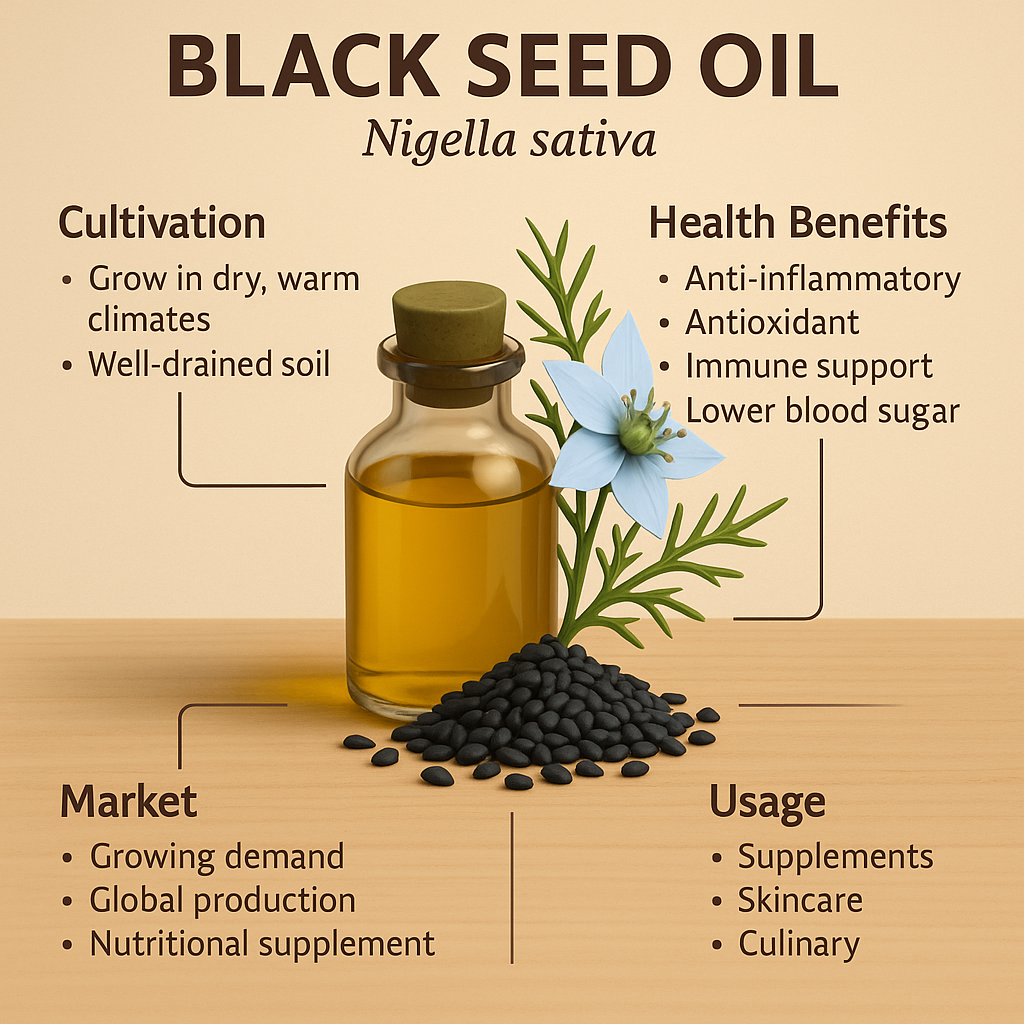
To truly understand black seed oil, one must first observe the landscapes where Nigella sativa evolved naturally. The plant belongs not to the lush tropics but to the dry, temperate regions spanning the Middle East, North Africa, and parts of Central and South Asia. These regions share a climate pattern marked by cool winters, warm springs, and summers that test the endurance of most annual herbs. Nigella’s life cycle is carefully synchronized with these seasonal transitions. It germinates during cool conditions, establishes itself slowly, and then races into flowering once temperatures rise. This adaptation allowed ancient farmers to cultivate it without elaborate irrigation systems. The plant learned to survive on modest rainfall and the residual moisture of early spring.
In old villages of Anatolia, elders speak of Nigella as a “quiet crop,” a plant that does not announce its presence the way wheat fields shimmer in the wind or poppy blossoms catch the sun. Its foliage is feathery, almost fragile, and the flowers appear in gentle shades of pale blue or white, carrying a quiet beauty that resembles a breath rather than a bloom. Yet inside each dried capsule lies a cluster of seeds that are anything but mild. Their aroma is sharp, spicy, complex—a blend of peppery warmth and smoky undertones. Their flavor is equally assertive, and this combination of medicinal power and culinary vigor has made black seed a part of everyday life across regions as diverse as Egypt, Iran, Afghanistan, Turkey, India, Sudan and Ethiopia.
But the true journey of black seed oil begins once the seeds are crushed. The oil that emerges is thick, slightly bitter, intensely fragrant. It carries within it a biochemical identity dominated by thymoquinone, a molecule that modern science has spent decades trying to understand. Thymoquinone is not simply another antioxidant. It interacts with the human body in ways that have intrigued researchers—modulating inflammation, supporting immune responses, influencing cellular processes involved in metabolism, and showing promise in neuroprotective research. Yet the communities who used black seed oil for centuries did not speak in biochemical language. They called it “healing oil,” an oil that “awakens strength,” an oil “for every ailment except death,” a phrase often associated with prophetic tradition in Islamic cultures.
Such cultural reverence does not arise without reason. Across centuries, healers used black seed oil for respiratory issues, digestive discomfort, skin conditions, joint pain, fatigue, and general immunity. Its medicinal value traveled through trade routes, carried by merchants who moved between Cairo, Damascus, Baghdad and Delhi. Along these routes, the crop itself spread, adapting to local ecologies, shaping local farming traditions. In South Asia, Nigella fields appear in small patches at the edges of wheat farms or tucked into spaces between mustard and lentils. Farmers appreciate that it does not demand much: a tilled bed, mild winter temperatures, and a dry harvest period. But they also note that the crop behaves differently depending on the soil. In clay-heavy soils, germination struggles. In coarse sandy soils, water drains too quickly. The plant prefers a delicate balance—loamy earth that holds moisture without suffocating the tender roots.
When one visits villages in Pakistan’s Khyber region or Iran’s Kermanshah province during the growing season, Nigella appears almost as a whisper between other crops. Yet, when harvest time comes, it reveals its value. The seed capsules are collected by hand or by gentle threshing. Each pod must be handled carefully because over-drying causes seeds to scatter. The labor might seem disproportionate for a crop whose yield per acre is modest compared to cereals, but traditional farmers understand value differently. They do not measure Nigella by the ton but by the potency stored in every kilogram of seeds.
Modern agricultural scientists have begun revisiting this crop with renewed interest. As the pharmaceutical world explores plant-based anti-inflammatory compounds, Nigella has emerged as a candidate for deeper study. Agricultural researchers are working to identify varieties with higher thymoquinone levels. Plant breeders are examining how different climates influence oil composition. They have found that seeds grown in colder regions tend to accumulate slightly different chemical ratios than seeds grown in warm valleys, suggesting that the plant’s medicinal power is intertwined with its ecological history.
Extraction methods for black seed oil vary widely. Traditional household presses in rural regions still use slow manual methods. Seeds are lightly heated to release oil more easily, but this heat can alter the oil’s medicinal value. In contrast, modern cold-press units maintain strict temperature control to preserve the oil’s natural chemistry. Facilities in Turkey and Egypt specialize in producing high-quality therapeutic-grade black seed oil, which is then exported to markets in Europe, North America and East Asia. The global wellness industry has discovered black seed oil and integrated it into capsules, tinctures, skincare, haircare and nutraceutical formulations. This surge in demand, however, has created challenges: adulteration, overprocessing, and inconsistent quality in poorly regulated markets.
Economically, black seed farming is deceptively complex. The crop itself requires minimal inputs, but achieving high oil yield and medicinal quality depends on careful timing: sowing before winter cold becomes severe, irrigating lightly during establishment, and ensuring that harvest occurs before late-spring humidity spoils the capsules. Countries like India and Ethiopia have begun to establish structured supply chains, connecting small farmers to processing companies. But the true economic potential remains highest in countries with established medicinal oil industries—Turkey, Iran, Egypt—where traditional knowledge supports quality control.
One of the most fascinating aspects of black seed oil is the way its cultural identity overlaps with its medicinal reality. In many Muslim-majority regions, black seed oil carries spiritual significance. It appears in home remedies, in postpartum care, in winter immunity routines, and even in certain ritual contexts. In Ethiopia’s Oromo and Somali communities, black seed is used in a form of herbal smoking therapy to address respiratory congestion. In India’s old Unani medical system, black seed oil is included in oils that treat migraines and joint stiffness. These uses may seem folkloric, yet modern research often finds biochemical explanations for effects that healers observed through practice alone.
From an ecological viewpoint, Nigella sativa offers lessons in adaptive agriculture. It demonstrates how a crop of modest size and quiet presence can carry significant nutritional and medicinal power. It also shows how long-term human relationships with plants evolve naturally, without industrial intervention. Nigella does not dominate landscapes; it integrates into them. It does not demand heavy irrigation; it grows with seasonal rhythms. It does not exhaust soils; it coexists with rotational patterns that have sustained communities for centuries.
Climate change, however, poses questions. The crop’s sensitivity to excessive rain may become more problematic in monsoon-driven regions where rainfall patterns are shifting. Researchers are studying whether certain landraces are more tolerant of moisture fluctuations. Meanwhile, countries in Central Asia and Eastern Europe, where winters remain cool and dry, may emerge as future producers of high-quality Nigella seeds.
The sensory world of black seed oil is another domain that fascinates chefs, perfumers, and therapists. When freshly pressed, the oil has a complexity unmatched by most plant oils. It carries notes that resemble anise, oregano, pepper and smoke. When inhaled, it has a grounding, almost ancient aroma. This unique fragrance profile is a result of volatile compounds that degrade quickly if the oil is exposed to air or sunlight. This is why traditional storage practices—dark bottles, cool rooms, tightly sealed containers—remain essential even today.
In culinary traditions, black seed holds a cherished place. In North Indian breads like naan and kulcha, the seeds provide not only flavor but also digestive balance. In Arab cuisine, they appear in pickles, cheese coatings, and spice blends. In Turkish cooking, they are sprinkled over pastries where their aroma blooms under heat. Chefs who work with black seed oil argue that its bitterness is not a flaw but a signature — a reminder of its medicinal nature.
The future of black seed oil is tied to both agriculture and science. Clinical research exploring its anti-inflammatory, immunomodulatory, and antioxidant effects is accelerating. As consumers seek natural alternatives to synthetic supplements, black seed oil is emerging as a serious contender. Yet the greatest challenge remains authenticity. Only well-cultivated, properly extracted oil carries the complexity that makes black seed truly powerful. Poorly processed oil, stripped of its volatile compounds, loses both its aroma and its medicinal value.
If one travels through an old Egyptian herb market, the vendors still store Nigella seeds in wide sacks, each seed carrying the scent of centuries. If one visits a rural clinic in Afghanistan, a healer may still prescribe black seed oil for respiratory discomfort. If one watches a baker in Turkey, he will sprinkle Nigella on bread with an instinctive understanding of its taste. These scattered images show how deeply black seed has entered human life. It is not a crop that depends on advertising. It is a crop that has sustained civilizations quietly, through memory and experience.
Thus, Nigella sativa stands today at an unusual crossroads: ancient yet modern, humble yet powerful, local yet global. Its oil embodies this duality. It smells like history but speaks clearly to modern science. It grows with simplicity but carries biochemical sophistication. It belongs to old stories yet fits perfectly into modern nutritional frameworks.
In a world where agriculture is often shaped by industrial needs, black seed reminds us of a different relationship: one in which plants and people co-evolve slowly, organically, respectfully. And perhaps this is why its oil continues to matter — not only for its medicinal potential but for the cultural and ecological wisdom it represents.
✍️Farming Writers Team
Love Farming Love Farmers
Read A Next Post 👇
https://farmingwriters.com/sacha-inchi-oil-global-human-investigation/