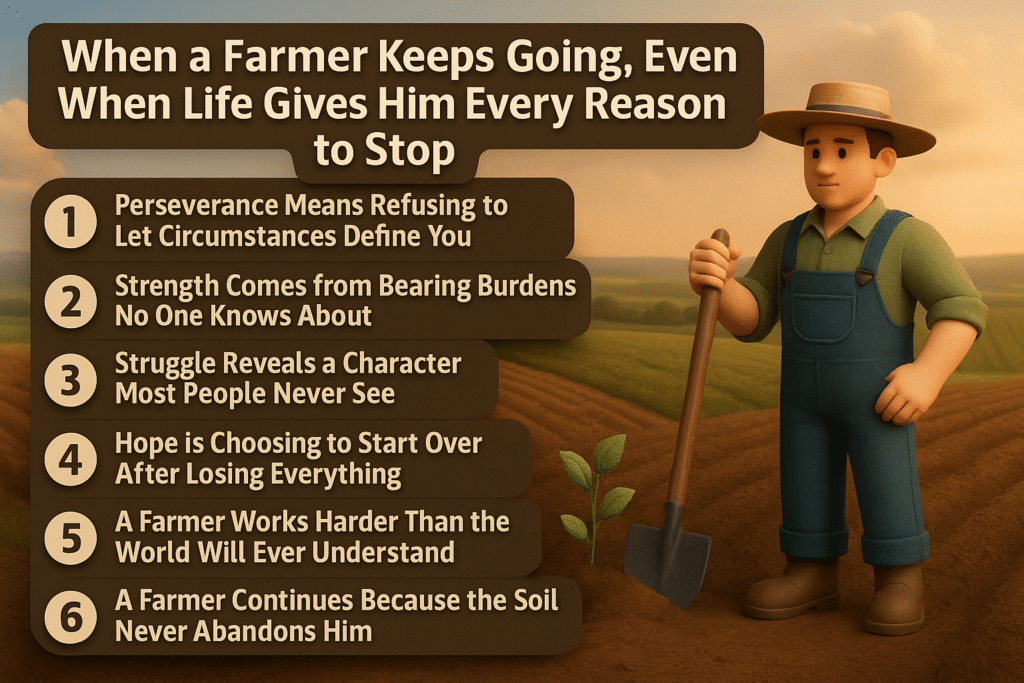
There are moments in a farmer’s life when the world becomes quiet—not peacefully quiet, but the kind of silence that grows heavy inside your chest. The kind of silence that arrives when the monsoon changes its mind without warning, or when the soil cracks earlier than expected, or when the market decides to betray the very people who feed it.
In that silence, a farmer stands alone with questions that don’t have simple answers.
A city person might imagine farming as just a cycle of sowing and harvesting. They see photos of green fields and assume nature works like a machine—predictable, dependable, comforting. But a farmer knows better. Nothing in farming is guaranteed. Not the weather. Not the seeds. Not the price. Not even tomorrow.
And yet, every morning, a farmer wakes up before dawn.
Not because the sun demands it.
Not because someone is watching.
Not because success is assured.
But because not waking up is not an option.
A farmer’s day does not begin with motivation.
It begins with responsibility—heavy, unavoidable, unromantic responsibility.
The kind that pulls you out of bed when your legs hurt, when sleep was short, when the previous day was unfair, when life has handed you more than you can carry but expects you to carry it anyway.
There’s a particular sound that fields make at dawn—an almost invisible whisper rising from the soil when the darkness is thin but the light isn’t fully awake yet. A journalist once described it as “the earth breathing before speaking.” Farmers hear that sound every morning. They don’t talk about it. They don’t write poems about it. But they understand it in ways the world never will.
It is the soil reminding them: “I saw your effort yesterday. Let’s try again today.”
People often wonder where farmers get their strength from.
Is it inherited?
Is it trained?
Is it built through difficulty?
Or is it simply the only way to survive?
The truth is more complex.
A farmer’s strength is not a single thing—it is a combination of scars, memories, responsibilities, and tiny pieces of courage stitched together through years of unpredictable seasons.
A farmer becomes strong because life does not allow him the luxury of weakness.
Weakness in other professions can be covered, postponed, restructured.
But weakness in farming means a field left unattended, animals unfed, irrigation delayed, sowing missed, harvest threatened.
Life in farming does not wait for emotional recovery.
You grow strong because you have to.
And yet, this strength is not the loud kind—the kind that shouts, or brags, or demands applause.
Farmer strength is quiet, invisible, internal.
It shows itself not in celebration, but in continuation.
One of the most profound truths about farming is this:
A farmer often continues even when hope doesn’t.
When a crop fails, the farmer doesn’t just lose profit.
He loses months of effort.
He loses strength he cannot get back.
He loses nights of sleep that no one saw.
He loses risks that only he understood.
He loses a part of his life that he cannot redo.
But he does what the world rarely does—
He starts again.
The world might see it as stubborn persistence.
But to a farmer, restarting is not bravery.
It is survival.
When a season goes wrong for a corporate worker, they feel stress.
When a season goes wrong for a farmer, they feel fear.
Fear not for themselves,
but for what their land means—
their children, their parents, their village, their history, their identity.
The farmer’s life is not measured in months or years.
It is measured in seasons.
A farmer remembers the year when the rain cheated early.
The year when the locusts came unexpectedly.
The year when the market crashed without warning.
The year when a field produced more than expected.
The year when everything went wrong at once.
And the year when a single decision saved the entire farm.
Behind every meal, behind every grain, behind every bite of food that reaches any table in the world, there exists an invisible timeline of these seasons—each shaped by a farmer who refused to break.
I once met an old farmer who told me something I’ve never forgotten.
He said, “The soil doesn’t teach you how to farm. It teaches you how to live.”
He explained that farming is simply the visible part of a much deeper emotional and psychological journey:
“The soil tests your patience before it rewards your effort.
The rain tests your faith before it fills your land.
The sun tests your endurance before it gives you strength.
The crop tests your timing before it becomes your reward.
Nature tests you completely before it trusts you with abundance.”
Farmers do not learn life from books.
They learn it from watching small changes that most people never notice—
the color of a leaf,
the thickness of a stem,
the smell of wet soil,
the movement of insects,
the temperature of the morning air,
the silence after a long day of effort.
These tiny observations are not part of a job.
They are part of survival.
A farmer’s mind is constantly occupied with quiet calculations—
How much water does the field need today?
Is the soil too warm to sow?
Is the wind telling a story about tomorrow’s weather?
Will this seed survive if the night is too cold?
Should this land be rested this year?
Will this crop’s demand remain stable in the coming season?
These thoughts don’t stop.
Not at night.
Not during meals.
Not even during sleep.
But here is the extraordinary thing:
Farmers rarely complain.
Not because life is easy,
but because complaining doesn’t make the field grow.
Their silence is not weakness.
It is wisdom.
And in that silence, something remarkable happens—
They grow emotionally stronger than most people will ever become.
A farmer does not need motivational quotes,
expensive seminars,
or textbooks filled with life advice.
His life IS the advice.
The ground he walks on tells him
that everything—no matter how broken—
can grow again.
The sky tells him
that uncertainty is not a threat—
it is simply nature’s rhythm.
The wind tells him
that change will always come—
and you must bend before you break.
The seeds tell him
that progress begins invisibly—
long before anyone notices it.
Every particle of nature
becomes a teacher to the farmer.
And because of these teachings,
farmers develop a strength
that the modern world cannot manufacture.
This strength is not visible in their arms.
It is visible in their decisions.
They take risks others avoid.
They work hours others cannot.
They stand alone where others collapse.
They hope when others doubt.
They rise when others surrender.
Which brings us to the heart of this story:
Why does a farmer continue when life gives him every reason to stop?
The answer is simple and profound:
A farmer does not live only for himself.
He lives for generations before him
and generations after him.
His identity is not in his name.
It is in his land.
His pride is not in recognition.
It is in responsibility.
His motivation is not achievement.
It is continuity.
And perhaps the most beautiful truth—
A farmer knows that even when life turns its back,
even when situations become unbearable,
even when everything feels lost,
the soil still welcomes him every morning
as if saying:
“I know you’re tired,
but I’m with you.
Let’s grow again.”
That is why a farmer refuses to break.
Not because he is unbreakable—
but because his spirit heals every time
he places his foot on the land that raised him.
CONCLUSION
Farmers are not symbols of struggle.
They are symbols of courage.
They are proof that human beings can endure,
rebuild,
restart,
and rise
again and again,
no matter how many times life tries to stop them.
The world survives
because farmers persist.
And every farmer carries a message
that the world desperately needs to hear:
“Strength is not about winning.
Strength is about continuing.”
✍️Farming Writers Team
Love farming Love Farmers
Read A Next Post 👇
https://farmingwriters.com/soil-stands-with-you-farmer-unshakeable-strength/