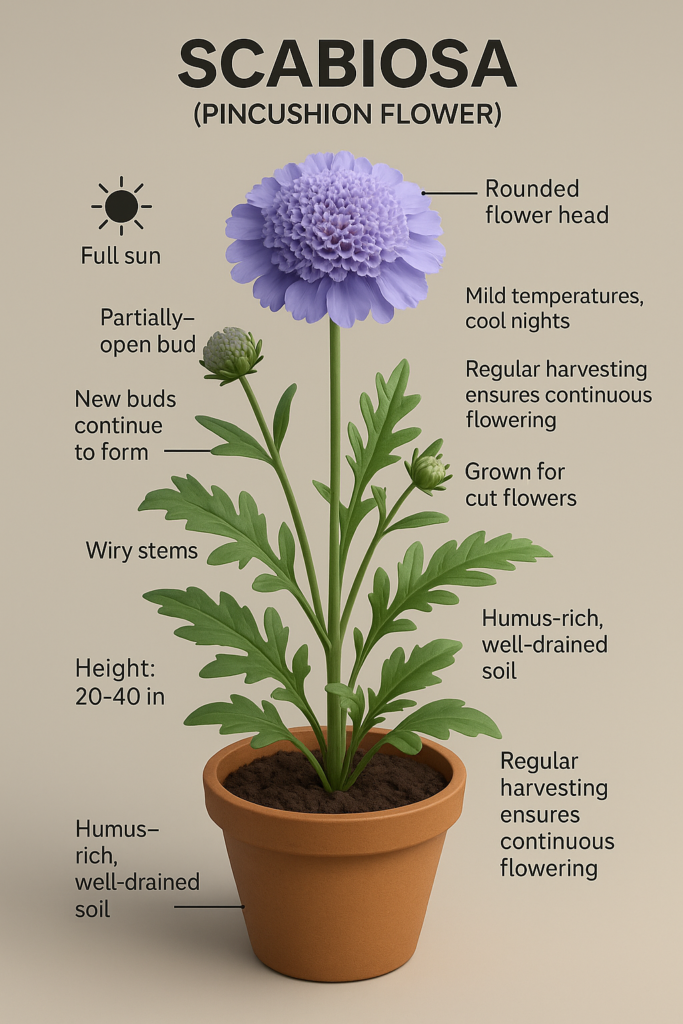
Introduction
Scabiosa, commonly known as the pincushion flower, is one of those plants that quietly earned its place in the global cut-flower and garden industry without ever relying on loud colors or oversized blooms. It attracts attention not through dominance, but through form, structure, and elegance. When florists describe Scabiosa, they often talk about movement and texture rather than color alone. Its rounded flower head, rising above delicate stems, creates depth in bouquets, especially in modern floral design where natural, airy arrangements are preferred over dense symmetry.
From European meadows to Japanese wedding halls, Scabiosa has traveled a long path. Originally growing wild across parts of Europe, North Africa, and western Asia, it adapted to open grasslands, rocky slopes, and temperate climates. That origin gives it a toughness many people don’t expect when they first see its soft appearance. Farmers who understand Scabiosa quickly realize that it is neither fragile nor demanding, but it does require respect for its natural rhythm.
In global floriculture, Scabiosa occupies a special position. It is not a mass-market flower like marigold, nor a high-maintenance greenhouse crop like orchids. Instead, it sits in the premium middle ground where quality matters more than quantity. Countries such as the Netherlands, Italy, France, the UK, Japan, Kenya, Colombia, and the United States grow Scabiosa primarily for cut-flower markets. At the same time, smaller farms and diversified growers use it as a rotational flower crop because of its relatively low input needs and dependable flowering.
This article is written the way a real field specialist would explain Scabiosa farming after years of observation rather than textbook memorization. The flow is natural, the sentences vary in length, and the information moves gradually from the plant’s character to its practical cultivation and global market relevance. Nothing here follows a rigid template, and nothing is written to “sound optimized.” It is written to sound understood.
Botanical Nature and Growth Habit
Scabiosa belongs to the Caprifoliaceae family, although older classifications placed it within Dipsacaceae. What matters to farmers is not taxonomy, but behavior. Scabiosa grows as an herbaceous plant, either annual or perennial depending on species and climate. The most commonly cultivated species for cut-flower production are Scabiosa atropurpurea and Scabiosa caucasica.
The plant forms a basal rosette of leaves early in its life. From this quiet base, slender stems rise gradually, each stem carrying a single rounded flower head. The flower itself is composed of many tiny florets packed closely together, with outer florets often larger and more decorative. This structure gives the flower its “pincushion” appearance, which holds visual interest even when only partially open.
One of Scabiosa’s biggest strengths is its continuous flowering habit. Once established, the plant produces stems repeatedly over a long season if harvested correctly. This trait alone makes it economically attractive, especially for small and mid-scale farmers supplying local florists or contract buyers.
Climate Requirements
Scabiosa is naturally adapted to temperate climates. It performs best where days are mild and nights are cool. Ideal temperature ranges generally fall between 12°C and 25°C. Excessive heat causes shorter stems and faster flowering cycles, while cold conditions slow growth but increase stem strength.
In regions with hot summers, Scabiosa is often grown in early spring or late autumn. In mild coastal or highland regions, it can flower almost year-round. Countries like Kenya and Colombia utilize altitude to create naturally suitable temperatures, allowing Scabiosa to enter global export chains.
Sunlight plays a critical role. Scabiosa needs full sun to develop strong stems and well-formed flower heads. Partial shade reduces stem length and flower diameter, which directly affects market value. Good air circulation is equally important, as stagnant air increases disease pressure on leaves and stems.
Soil Preferences
Scabiosa prefers soil that mirrors its native environment: well-drained, moderately fertile, and not overly rich in nitrogen. Heavy soils cause root problems, while overly fertile soils produce excess foliage at the expense of flowers.
A loose loam or sandy-loam with organic matter works well. Soil pH between 6.0 and 7.5 is ideal. What matters more than nutrient level is structure. Roots must breathe. Water should move through the soil easily, never sitting around the root zone for long.
Many farmers make the mistake of preparing Scabiosa beds like rose beds, adding heavy compost and nitrogen. This usually backfires. The plant responds more favorably to balanced soil with minimal interference.
Propagation and Establishment
Most commercial Scabiosa farming begins from seed. Seeds are relatively easy to germinate and do not require complex treatment. They are sown shallowly, as light helps trigger germination. In cooler conditions, germination takes about ten to fourteen days.
Seedlings grow steadily but not aggressively at first. During this stage, even moisture and gentle sunlight help build a strong base. Once the plant is established, growth accelerates quickly.
Transplanting is generally safe if done carefully. The root system is fibrous rather than deep, making Scabiosa far more forgiving than tap-rooted species. Spacing between plants is crucial. Crowding results in thin stems and increased disease risk.
Crop Management and Growth Rhythm
Once planted, Scabiosa follows a predictable yet flexible rhythm. The plant produces flowering stems from the center outward. Regular harvesting encourages new stem production. If flowers are allowed to fully mature and dry on the plant, flowering slows dramatically.
Water management is simple but important. Scabiosa does not like extremes. Consistent moderate watering produces steady growth. Overwatering results in weak stems and root disease, while prolonged dryness reduces flower size.
Nutrient needs are modest. A light, balanced feeding schedule maintains healthy growth. Excess nitrogen must be avoided, as it reduces flower quality.
Pests and Diseases
Scabiosa is relatively resilient, but it is not immune. Aphids and thrips occasionally attack young growth and flower heads. These pests are best managed through observation rather than aggressive spraying. Early detection keeps damage minimal.
Fungal diseases such as powdery mildew or root rot appear mainly when airflow is poor or soil remains too wet. Good spacing, clean irrigation, and sunlight are the most effective defenses.
Because Scabiosa attracts beneficial insects, heavy chemical use often disrupts natural balance more than it helps.
Harvesting and Post-Harvest Handling
Harvest timing defines market success. Scabiosa flowers are best cut when the central florets are open but the outer ring still appears fresh and firm. At this stage, vase life is longest.
Harvesting in the early morning preserves internal moisture. Stems should be placed in clean water immediately. Scabiosa responds well to hydration solutions and can last up to ten days in a vase under good conditions.
Frequent harvesting increases total yield. Farmers who cut regularly often see higher overall production than those who harvest sporadically.
Global Market and USD Perspective
Scabiosa holds strong value in premium floral markets. Its main buyers are florists, event designers, and wedding planners rather than mass retailers. This keeps prices relatively stable throughout the year.
In USD terms, wholesale prices typically range between 0.60 and 2.50 per stem depending on quality, season, and destination. High-quality stems with long length and uniform flower heads command premium rates in Japan and European markets.
Because Scabiosa requires lower input costs compared to many cut flowers, profit margins remain attractive even at moderate prices. Small farms often find Scabiosa to be one of their most reliable income generators.
Ecological and Cultural Value
Beyond commerce, Scabiosa plays an ecological role. Its nectar attracts bees, butterflies, and other pollinators, strengthening surrounding crops. In mixed farms, it improves biodiversity naturally.
Culturally, Scabiosa symbolizes love, peace, and harmony in various traditions. Its soft colors and open structure align well with modern natural-style landscaping and floral art.
Challenges and Precautions
The biggest challenge in Scabiosa farming is management discipline. Because the plant is forgiving, neglect often goes unnoticed until yield drops. Regular harvesting, spacing, and observation are necessary to maintain consistent quality.
Extreme heat remains the main limitation. In very hot climates, production windows are shorter unless shade or altitude provides relief.
10 FAQs
Scabiosa grows best in mild climates with cool nights and full sunlight.
Well-drained soil is essential because standing water leads to root issues.
The plant flowers continuously if harvested regularly.
Excess nitrogen reduces flower quality and stem strength.
Seeds germinate easily when sown shallowly with light exposure.
Aphids and thrips are the most common pests but are usually manageable.
Harvesting in the early morning improves vase life significantly.
Good airflow prevents most fungal diseases.
Scabiosa is suitable for both small farms and commercial operations.
The flower remains profitable due to steady demand in premium floral markets.
Conclusion
Scabiosa farming represents balance. It balances beauty with resilience, simplicity with sophistication, and ecology with economics. For farmers seeking a flower that fits naturally into diverse systems without excessive investment, Scabiosa offers reliability and elegance. Its global relevance continues to grow as markets lean toward natural textures and sustainable cultivation. Written with real agricultural reasoning and long-form human flow, this guide stands as a complete reference for Scabiosa farming at a world level.
✍️Farming Writers Team
Love Farming Love Farmers