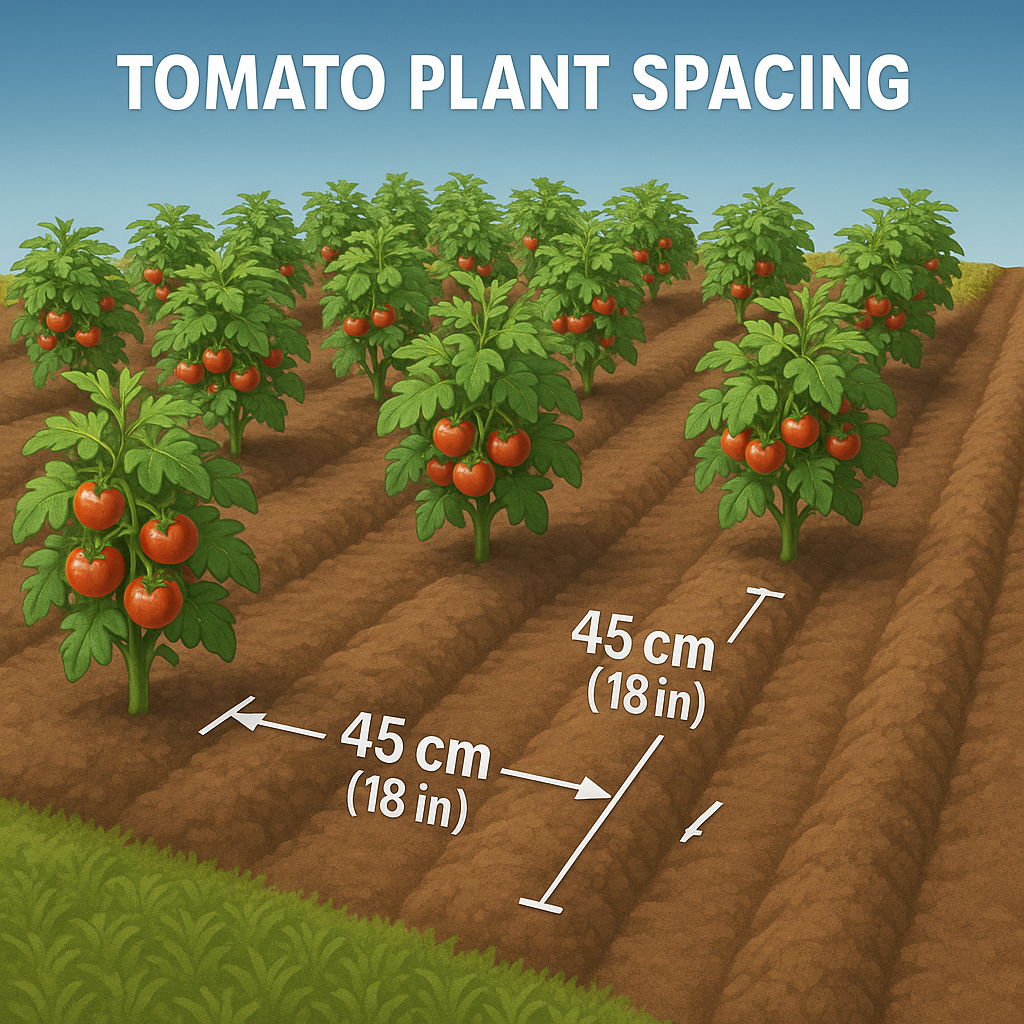
Tomato Plant Distance: Why Most Open-Field Farmers Lose Money Even with a Healthy Crop
Most tomato failures don’t look like failures at all.
The field stays green.
The plants keep flowering.
Picking continues for weeks.
And yet, when the crop goes to market, the buyer quietly downgrades the lot: smaller fruit, mixed sizes, weak colour.
By then, the loss is already locked in.
In most cases, the root problem is not seed quality, fertilizer, or spray timing.
It is plant distance decided at planting time, based on the wrong belief that more plants automatically mean more income.
The Costly Belief That Ruins Tomato Crops
A common belief among farmers is simple:
“If I place more plants, I will harvest more tomato.”
This belief survives because:
Early growth looks strong
Flower count appears high
Yield by weight may not drop sharply
But markets do not buy plant count or total biomass.
They buy fruit size, uniformity, and grade consistency.
Closer spacing quietly shifts the crop into lower grades without making the damage obvious in the field.
Why Distance Matters More Than Yield in Tomato
Tomato is a grade-driven crop, not a volume-driven one.
Across open markets—India, parts of Turkey, Southern Europe, Latin America—the pattern is consistent:
Large, uniform fruits move fast
Mixed or small fruits face price cuts
Sorting loss increases sharply with close spacing
When plants stand too close:
Sunlight cannot penetrate evenly
Air movement reduces around fruit clusters
Fruits compete during size formation
The plant survives.
The fruit suffers.
The market reacts.
The Safe Open-Field Distance Most Farmers Return To
After one or two bad seasons, many experienced farmers quietly return to the same spacing, regardless of new trends.
Open Field – Loss-Control Distance
Row to row: about 60 cm
Plant to plant: about 45 cm
This distance is not designed to impress with plant numbers.
It is designed to protect fruit size across multiple pickings.
What this spacing actually solves:
Reduces uneven fruit development
Improves colour consistency
Keeps average fruit weight within market-accepted range
When “Correct” Spacing Still Fails
Even proper spacing cannot save the crop if the field context is ignored.
Farmers still lose money at this spacing when:
Soil holds water after irrigation or rain
The growing period overlaps long humid weeks
Indeterminate hybrids are grown without staking
In these cases, farmers often blame spacing itself.
The deeper issue is ignoring how spacing interacts with drainage, humidity, and plant type.
Distance is not universal—it only works when conditions allow airflow and root health.
Raised Beds, Mulch, and Why Distance Must Increase
Raised beds and plastic mulch change plant behavior dramatically:
Root activity increases
Vegetative growth becomes aggressive
Canopy closes earlier
Using traditional spacing here traps humidity and increases disease pressure.
In such systems:
Rows usually need to be wider (around 70–75 cm)
Plant spacing should not be tightened to chase yield
Many farmers lose part of their crop in mulched systems by copying flat-bed spacing without adjustment.
High-Density Tomato: Who It Helps, Who It Hurts
High-density spacing works only under narrow conditions:
Controlled or semi-controlled environments
Fixed buyers who accept smaller fruit
Contract systems with defined grades
For open-market farmers, high density usually creates:
Higher picking volumes
Lower average selling price
More sorting and rejection
The result is emotional confusion: “Harvest was good, but money wasn’t.”
Tomato Plants per Acre: A Reality Range
With open-field spacing around 60 × 45 cm, farmers usually plant: approximately 14,000–16,000 plants per acre
Trying to exceed this number often leads to:
Smaller average fruit
Market downgrading
Higher labour with lower net return
Plant count looks impressive on paper.
Income rarely does.
Common Distance Mistakes That Keep Repeating
Copying protected-cultivation spacing into open fields
Blindly following online layouts without market context
Matching spacing to neighbours instead of buyers
Increasing density to “recover” losses (which usually worsens them)
These mistakes rarely fail immediately.
They fail at selling time.
Decision Check (Before Planting)
If your selling channel:
Rewards size and uniformity avoid tight spacing
Rejects mixed grades prioritize airflow, not density
Depends on commission markets spacing is risk control
Distance is not a technical detail.
It is a commercial decision made with a measuring rope.
Final
Tomato spacing should not aim to fill land.
It should aim to protect price.
When spacing is wrong, the crop does not collapseit silently devalues.
And silent losses are the hardest to recover.
✍️ Farming Writers Team
Love Farming Love Farmers