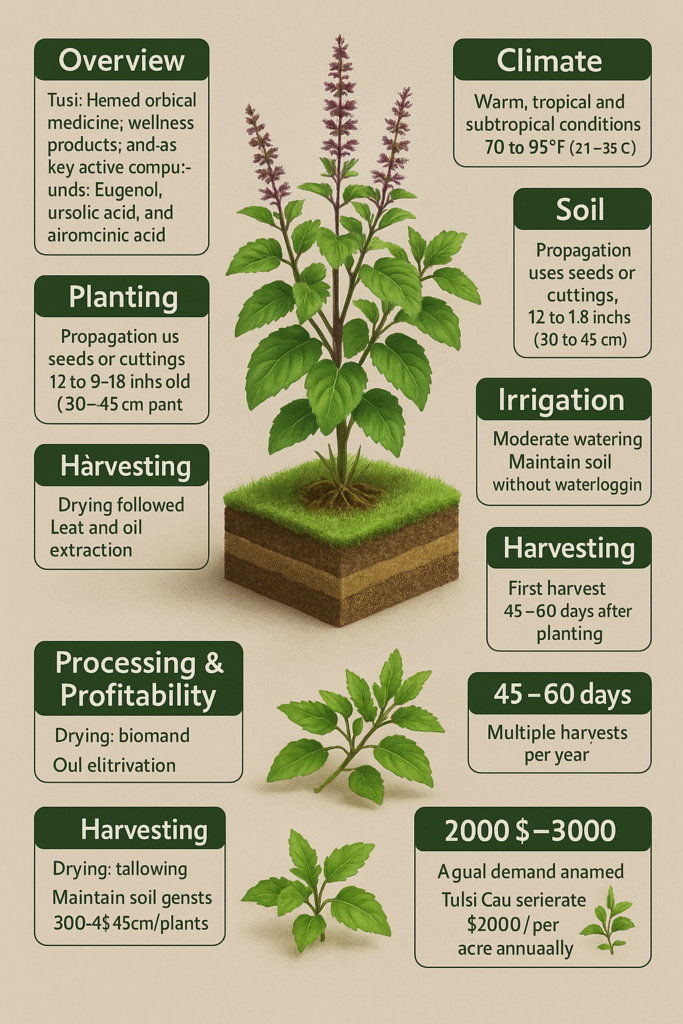
Tulsi, known globally as Holy Basil, holds a special place in the botanical world as one of the most powerful medicinal herbs ever cultivated. Across ancient Indian traditions, Tulsi was regarded as a sacred plant, revered for its healing aura and calming fragrance. Over centuries, its significance extended beyond cultural and religious fields into medicine, wellness, aromatherapy, cosmetics and pharmaceutical industries. Today, Tulsi is no longer confined to the courtyards of Indian homes; instead, it stands proudly as a world-demand medicinal crop cultivated across continents.
The global wellness boom pushed Tulsi into international markets with unprecedented momentum. Modern researchers have identified an impressive spectrum of bioactive compounds in Tulsi — eugenol, caryophyllene, ursolic acid, rosmarinic acid and a broad range of flavonoids. These compounds define Tulsi’s antiviral, antibacterial, anti-inflammatory, antistress, adaptogenic and respiratory-supporting effects. As health brands continue exploring natural solutions for immunity and stress resilience, Tulsi has emerged as a hero ingredient in capsules, teas, extracts, essential oils, syrups, powders, energy blends and herbal tonics.
Tulsi grows naturally in tropical and subtropical climates, flourishing in regions with warm temperatures and abundant sunlight. Ocimum sanctum, or Rama Tulsi and Krishna Tulsi varieties, are the most commercially important. Modern cultivation also includes Vana Tulsi and hybrid variants suited for essential oil extraction. Tulsi’s adaptability makes it one of the easiest herbal crops to cultivate, yet commercial-scale farming requires scientific understanding for yield optimization and essential oil quality.
Climate plays an essential role in Tulsi physiology. The crop thrives in warm conditions where temperatures remain between twenty and thirty-five degrees Celsius. Extreme cold harms the plant, and frost instantly damages stems and leaves. Tulsi prefers moderate humidity and long daylight hours that stimulate aromatic compound production. Regions with distinct wet and dry seasons support vigorous growth, but excessive rainfall reduces essential oil concentration. For global farmers, selecting regions with consistent sunlight and warm air circulation ensures that Tulsi expresses its strongest aroma and medicinal potency.
Soil requirements for Tulsi farming emphasize aeration, drainage and organic content. Tulsi grows best in loose loamy soil enriched with compost. The roots demand oxygen and cannot tolerate compacted soil. Excessive clay leads to water stagnation, while extremely sandy soil drains too quickly and reduces nutrient availability. Organic matter, such as farmyard manure, leaf compost or neem cake, improves soil structure and supports microbial life. A neutral to slightly alkaline soil pH between six and seven point five ensures optimal growth.
Land preparation begins with deep tilling to break the soil and allow root penetration. Once ploughed, the land is leveled and shaped into raised beds to prevent waterlogging during heavy rain. Weeds must be removed completely because Tulsi seedlings are sensitive to early competition. Before planting, farmers enrich the field with organic compost, allowing microorganisms to activate the soil. Tulsi responds strongly to organic nutrition, and chemical-heavy soils disturb its natural chemistry.
Propagation of Tulsi can be done through seeds or vegetative cuttings. Seed propagation remains the most common method for large farms. Seeds are tiny and require carefully prepared nursery beds with light, moist soil. Germination occurs within one to two weeks. Seedlings are nurtured in controlled shade for three to four weeks until they develop enough strength for transplantation. Vegetative propagation using stem cuttings suits farmers focusing on essential oil production because it ensures uniform genetics and higher oil yield.
Transplanting typically occurs at the onset of monsoon or during early irrigation seasons. Young seedlings need soft soil, moderate moisture and strong sunlight after the initial establishment period. Farmers maintain spacing of thirty to forty centimeters between plants and sixty centimeters between rows. Proper spacing ensures adequate air circulation, reducing fungal pressure and helping the plant spread naturally. Tulsi forms a dense canopy that suppresses weeds once mature, but early manual weeding is essential to avoid nutrient competition.
Irrigation for Tulsi farming demands balance. The plant requires consistent moisture during early growth but dislikes waterlogged conditions. Over-irrigation reduces essential oil content and triggers fungal infections on stems and leaves. Most farmers prefer light irrigation once every few days depending on climate. In arid regions, drip irrigation offers excellent moisture control, delivering water directly to the root zone while keeping foliage dry. Mulching with dry leaves or organic materials helps stabilize soil temperature and reduce evaporation during hot periods.
Nutrient management focuses on sustaining soil vitality through organic methods. Tulsi responds strongly to natural fertilizers like vermicompost, cow dung manure and neem cake. Farmers often apply organic liquid sprays such as jeevamrut or compost tea to enhance leaf aroma and immunity. Excess nitrogen reduces aromatic compound concentration, so nutrient application must remain balanced. Tulsi’s medicinal quality depends more on soil biodiversity and sunlight than on chemical fertilization.
Pest and disease management in Tulsi farming is relatively manageable. The plant contains natural antibacterial properties that deter many pests. However, in humid climates, leaf spot diseases, damping-off in seedlings, and fungal stem infections appear occasionally. Preventive strategies include well-spaced planting, controlled irrigation, clean nursery practices and removal of infected plant material. Neem-based sprays, cow urine solutions and microbial inoculants manage most issues effectively without chemicals.
As Tulsi grows, its canopy expands into a dense green cover with aromatic leaves that release fragrance whenever touched by wind. Flowering begins after two to three months depending on climate and variety. Farmers cultivating Tulsi for leaves avoid allowing full flowering because excessive flowering reduces leaf growth. Pruning helps maintain vegetative growth and improves leaf density. In essential oil farming, flowering plays a role in oil composition, and farmers adjust harvesting time according to oil profiles.
Harvesting Tulsi involves cutting leaves or whole above-ground biomass depending on the market. For leaf-based markets, harvesting begins when plants reach forty-five to sixty days of age. Farmers harvest early morning when essential oil levels are highest. Leaves are spread in thin layers under shade for drying, ensuring slow dehydration that preserves color and aroma. For essential oil extraction, entire plants are harvested at peak oil concentration, and fresh biomass is sent directly for steam distillation. Good quality Tulsi oil appears pale yellow with strong clove-like aroma dominated by eugenol.
Processing Tulsi into dried leaf, powder, tea blends or extracts requires careful drying and grading. Shade-dried leaves retain their medicinal potency better than sun-dried ones. Powder preparation involves fine grinding of dried leaves in hygienic units. Extract manufacturers use solvent extraction or steam distillation to isolate pure bioactive compounds. Tulsi oil is used in perfumes, herbal balms, therapeutic oils and aromatherapy blends worldwide.
The global market for Tulsi continues to grow rapidly as herbal wellness becomes mainstream. Markets in the United States, Europe, Canada, Australia, Japan, South Korea and UAE import large quantities of Tulsi leaf, powder and oil. Ayurvedic brands across India, Nepal and Sri Lanka consume massive domestic volumes. Tulsi powder sells between three and eight USD per kilogram in bulk markets, while essential oil ranges from sixty to one hundred twenty USD per kilogram depending on quality. Organic-certified Tulsi commands premium prices.
Economically, Tulsi farming offers excellent profitability due to short crop cycles, low input costs and strong global demand. Unlike long-duration medicinal crops, Tulsi yields multiple harvests in a year. Farmers can harvest three to four cycles annually under proper management. Low water requirement and minimal pest pressure make Tulsi suitable for sustainable and organic farming models.
Sustainability aligns naturally with Tulsi cultivation because the crop thrives in organic systems, improves soil health and supports biodiversity. Tulsi’s ability to grow with minimal chemicals makes it ideal for eco-conscious farming. Mixed cropping, agroforestry and intercropping systems integrate well with Tulsi farming, especially when combined with ginger, lemongrass or aloe vera.
In conclusion, Tulsi farming stands as a powerful opportunity for growers worldwide. Its medicinal heritage, modern scientific validation and global wellness demand make it one of the most rewarding herbal crops. Farmers who understand the crop’s ecological preferences — sunlight, moisture balance, organic soil, controlled flowering and precise harvesting — can reliably produce world-class Tulsi suitable for international markets. This guide covers every essential aspect of Tulsi cultivation, ensuring farmers approach the crop with clarity, confidence and long-term vision.
FAQ FOR TULSI FARMING
Growers often ask how long Tulsi takes to mature, and most varieties reach a good harvest stage within forty-five to sixty days. Another frequent question concerns irrigation; Tulsi needs moderate watering without waterlogging because excess moisture reduces essential oil content. Soil questions come often because Tulsi performs best in loose, organic-rich, well-drained loam. Climate suitability remains a major topic, and Tulsi thrives in warm regions with abundant sunlight. Many farmers wonder about profitability, and Tulsi stands among the most economically attractive medicinal crops due to short cycles and high demand. Finally, growers worry about diseases, but proper spacing and controlled irrigation prevent most fungal problems naturally.
✍️farming writers Team
Love Farming Love Farmers