• Advanced Applications of Cocopeat in Global Agriculture: A Complete Guide

    Cocopeat in Global

    Cocopeat, once treated simply as a by-product of coconut processing, has now become one of the world’s most demanded cultivation substrates. Countries across Asia, Europe, North America, Latin America, Africa, and Oceania now rely on cocopeat as a reliable, renewable, and scientifically stable growing medium. Its unique properties such as high porosity, excellent water-holding capacity, customizable EC, and biodegradable structure allow it to perform in diverse farming systems ranging from open-field amendments to ultra-high-tech controlled environment agriculture.

    This post explores the advanced, commercial, research-level, and future-facing applications of cocopeat in global farming, including systems where cocopeat is not just a medium, but the backbone of precision agriculture.

    1. The Scientific Foundation Behind Cocopeat Performance

    Cocopeat performs exceptionally well due to its natural structural architecture. Each fiber particle contains millions of capillary channels formed through lignocellulosic composition. This allows cocopeat to behave as a dynamic water reservoir, making it ideal for regions facing irrigation limitations.

    1.1 Physical and Chemical Advantages

    Natural pH stability between 5.5 and 6.8

    High air-filled porosity enabling oxygen movement

    Strong cation exchange capacity allowing nutrient retention

    Slow biological degradation due to lignin content

    Reusability when managed through sterilization and buffering

    Light weight for easy transport and vertical installations

    These properties lay the foundation for advanced agricultural systems that depend on predictable substrate performance.

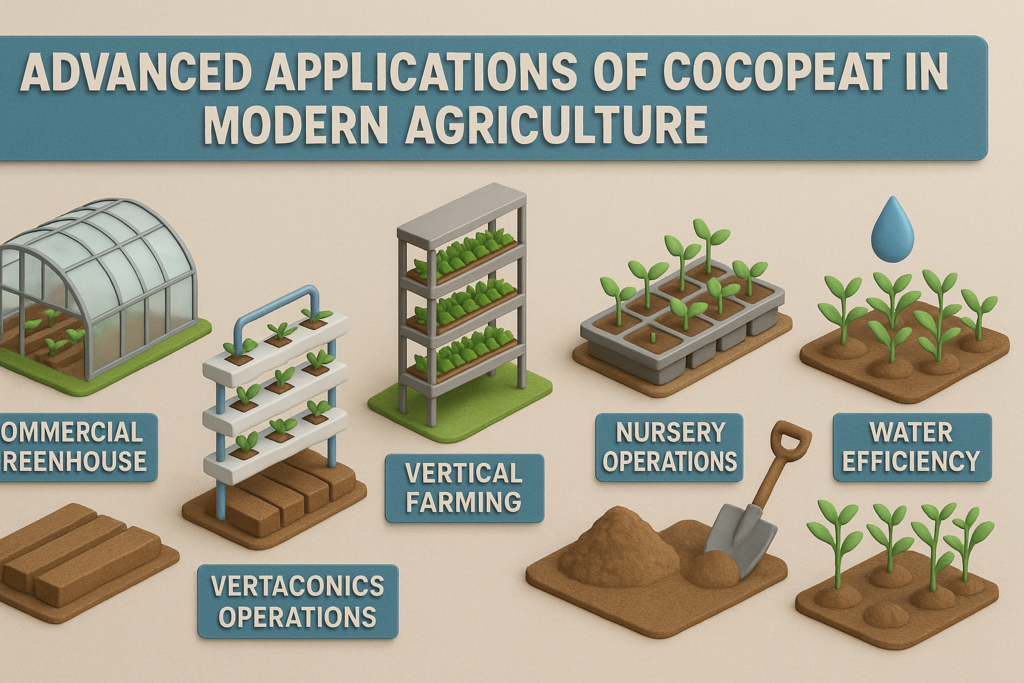
    1. Cocopeat in Commercial Greenhouse Agriculture

    Modern greenhouses—used widely in the Netherlands, Spain, Turkey, India, Australia, Mexico, and Canada—depend heavily on substrate uniformity. Cocopeat slabs, open-top grow bags, and loose-fill trays provide consistent results.

    2.1 Slab and Grow Bag Cultivation

    Cocopeat slabs are used for:

    Tomato

    Cucumber

    Capsicum

    Strawberry

    Lettuce and leafy greens

    Floriculture crops such as gerbera

    Grow bags allow root-zone monitoring, fertigation control, and integrated drainage systems.

    2.2 Precision Fertigation in Cocopeat

    Greenhouses use sensor-driven fertigation to maintain:

    EC between 1.8–2.5 mS/cm (crop dependent)

    pH within 5.8–6.2

    Drainage at 15–30 percent

    These parameters maintain root-zone stability, preventing nutrient lockout or oxygen deprivation.

    1. Cocopeat in Hydroponics and Soilless Systems

    Hydroponic agriculture has grown from niche to mainstream. Cocopeat’s stable water–air ratio is considered one of the most crop-friendly hydroponic media.

    3.1 Deep Root Zone Hydroponics

    Cocopeat is used in containers where constant moisture availability is required.

    3.2 Bucket Hydroponics (Dutch Bucket Systems)

    Used for:

    Brinjal

    Peppers

    Tomatoes

    Melons
    Cocopeat mixed with perlite achieves balanced drainage.

    3.3 Nutrient Film and Drip Hydroponics

    Although the roots are primarily in nutrient-rich water films, cocopeat blocks support seedlings and microbial ecosystems that stabilize early plant life.

    1. Cocopeat in Vertical Farming and Urban Agriculture

    As cities expand and arable land shrinks, cocopeat has become indispensable in vertical farming facilities.

    4.1 Advantages in Vertical Farming

    Lightweight media reduces structural load

    Sterile and pest-free substrate prevents infestations

    Uniformity allows predictable modelling of plant growth curves

    High capillary action supports multi-level drip irrigation

    Compatible with AI and IoT-driven cultivation systems

    4.2 Use in Vertical Towers and Modular Systems

    Vertical towers often use cocopeat as a core medium due to its water movement efficiency, allowing gravity-fed hydration cycles without oversaturation.

    1. Nursery Propagation and Seedling Production

    Cocopeat is now the global standard for nurseries—vegetables, fruit trees, ornamental plants, medicinal herbs, forestry, and plantation crops.

    5.1 Why Nurseries Prefer Cocopeat

    High germination success

    Sterile, pathogen-free environment

    Easy root plug removal

    Balanced moisture for uniform seed hydration

    Root stimulation due to enhanced oxygenation

    5.2 Plug Tray Production

    In vegetable nursery industries of China, India, Japan, the USA, the Netherlands, Chile, and South Africa, plug trays filled with fine-grade cocopeat ensure:

    Controlled root ball formation

    Zero transplant shock

    Faster flowering and fruiting

    1. Soil Amendment in Open-Field Agriculture

    In drought-prone regions such as sub-Saharan Africa, Australia, the Middle East, and Rajasthan, cocopeat is integrated into soil to improve long-term resilience.

    6.1 Benefits in Field Conditions

    Enhances sandy soil moisture retention

    Improves clay soil aeration

    Buffers saline soils when pre-treated

    Supports microbial diversity

    Reduces irrigation frequency by 30–50 percent

    1. Cocopeat for Perennial and Plantation Crops

    Long-duration crops such as:

    Coconut

    Banana

    Papaya

    Cocoa

    Coffee

    Vanilla

    Grapes

    benefit greatly from cocopeat integration.

    7.1 Root-Zone Performance

    Cocopeat increases root mass volume, promoting extensive feeder root formation, improving nutrient uptake efficiency throughout the crop cycle.

    1. Application in Mushroom Cultivation

    Cocopeat serves as a casing layer material for species like:

    Button mushrooms

    Oyster mushrooms

    Shiitake

    Its moisture stability reduces contamination risk and produces uniform flushes.

    1. Cocopeat in Floriculture and High-Value Ornamentals

    Gerbera, roses, orchids, and anthuriums are known to respond strongly to substrate oxygenation. Cocopeat ensures maximum floral diameter, stem elongation, and vase-life improvement.

    1. Global Market Trends and Industry Growth

    The global cocopeat industry exceeded major growth milestones due to:

    High demand from hydroponics

    Rise of vertical farming startups

    Climate-resilient agriculture adoption

    Sustainability regulations limiting peat extraction

    Countries leading cocopeat production:

    India

    Sri Lanka

    Vietnam

    Philippines

    Indonesia

    Countries leading cocopeat consumption:

    Netherlands

    USA

    Japan

    South Korea

    Spain

    Turkey

    Kenya and Ethiopia in floriculture

    1. Quality Parameters for Advanced Use

    To ensure global scalability, the following parameters are monitored:

    11.1 Electrical Conductivity (EC)

    Low EC cocopeat (<0.5 mS/cm) is preferred for sensitive hydroponic crops.

    11.2 Particle Size Distribution

    Fine grade: nurseries

    Medium grade: vegetables

    Coarse grade: vertical farming and hydroponics

    11.3 Fiber Ratio

    Balanced fiber improves drainage and structure.

    11.4 Buffering

    Proper treatment removes excess potassium and sodium.

    1. Environmental Influence and Climate Impact

    Cocopeat supports sustainable agriculture because:

    It is renewable

    It reduces extraction pressure on natural peat bogs

    It improves drought resilience

    It reduces fertilizer leaching

    1. Future of Cocopeat in Global Agriculture

    Emerging innovations include:

    AI-managed root-zone analytics in cocopeat slabs

    Smart cocopeat blends with controlled EC release

    Biochar–cocopeat hybrids for carbon sequestration

    Reusable modular cocopeat blocks for urban agriculture

    Cocopeat will likely remain a cornerstone of sustainable farming for decades.

    Frequently Asked Questions

    1. Can cocopeat replace soil completely?
      Yes, in hydroponics, nurseries, and vertical farms it can fully replace soil. In open fields, it is mostly used as an amendment.
    2. How long can cocopeat be reused?
      1–3 cycles depending on crop type, sterilization, and structural integrity.
    3. Does cocopeat work for fruiting crops?
      Yes, tomatoes, strawberries, cucumbers, melons, and peppers perform exceptionally well in cocopeat-based systems.
    4. Is cocopeat suitable for dry countries?
      Cocopeat reduces water consumption by 30–60 percent, making it ideal for arid regions.
    5. Which grade of cocopeat is best for nurseries?
      Fine-grade, washed, low-EC cocopeat.

    Conclusion

    Cocopeat has transitioned from a simple horticultural amendment to a global agricultural essential. Its compatibility with high-tech, climate-resilient, water-efficient systems makes it one of the most influential substrates in modern farming. From nurseries to vertical skyscraper farms, from hydroponic strawberry units to plantation crops, cocopeat has become the core of precision agriculture.

    ✍️Farming Writers Team
    Love farming Love Farmers.

    Read A Next Post 👇

    https://farmingwriters.com/cocopeat-nutrient-management-complete-guide/
  • Cocopeat Farming Guide: Complete Scientific & Practical Explanation for Global Growers

    Cocopeat Farming

    Introduction

    Agriculture across the world is entering a phase where precision, sustainability, and resource efficiency are more important than tradition alone. One of the most significant shifts in modern farming has been the movement away from exclusive dependence on natural soil toward engineered growing media. Among all alternatives tested globally, cocopeat, derived from coconut husk, has emerged as one of the most reliable, scalable, and environmentally responsible solutions.

    Cocopeat is no longer limited to home gardening or small nurseries. It is now widely used in commercial greenhouse operations, terrace farming systems, plant nurseries, vertical farms, and high-value vegetable and flower production units across Asia, Europe, the Middle East, and parts of North America.

    This post is written for farmers, agri-entrepreneurs, researchers, and serious growers who want a clear, complete, and practical understanding of cocopeat from the ground level to advanced farming applications.

    What Is Cocopeat?

    Cocopeat, scientifically referred to as coconut coir pith, is the fine particulate material obtained as a byproduct during the extraction of coconut fibers from coconut husks. Unlike peat moss, which comes from slow-growing wetlands, cocopeat is derived from a renewable agricultural residue, making it environmentally sustainable.

    It is composed mainly of:

    Lignocellulosic fibers

    Micro-porous organic particles

    Stable carbon-rich compounds

    Cocopeat does not decompose quickly, retains moisture exceptionally well, and provides high oxygen availability to plant roots when managed correctly.

    Raw Material Source and Global Production

    Coconut Husk as a Resource

    Coconut-growing regions produce millions of tons of husk annually. Major cocopeat-producing countries include:

    India

    Sri Lanka

    Indonesia

    Philippines

    Vietnam

    In these regions, coconut husk was traditionally considered agricultural waste. Modern processing transformed it into a globally traded growing medium.

    Manufacturing Overview

    Cocopeat production involves:

    Husk collection and aging

    Crushing and fiber separation

    Repeated washing to remove excess salts

    Drying under controlled conditions

    Screening by particle size

    Compression or slab formation

    Each step affects final quality, water retention, EC stability, and structural performance.

    Physical Properties of Cocopeat

    Water Holding Capacity

    Cocopeat can retain five to eight times its own weight in water, allowing consistent moisture supply to crops.

    Porosity and Aeration

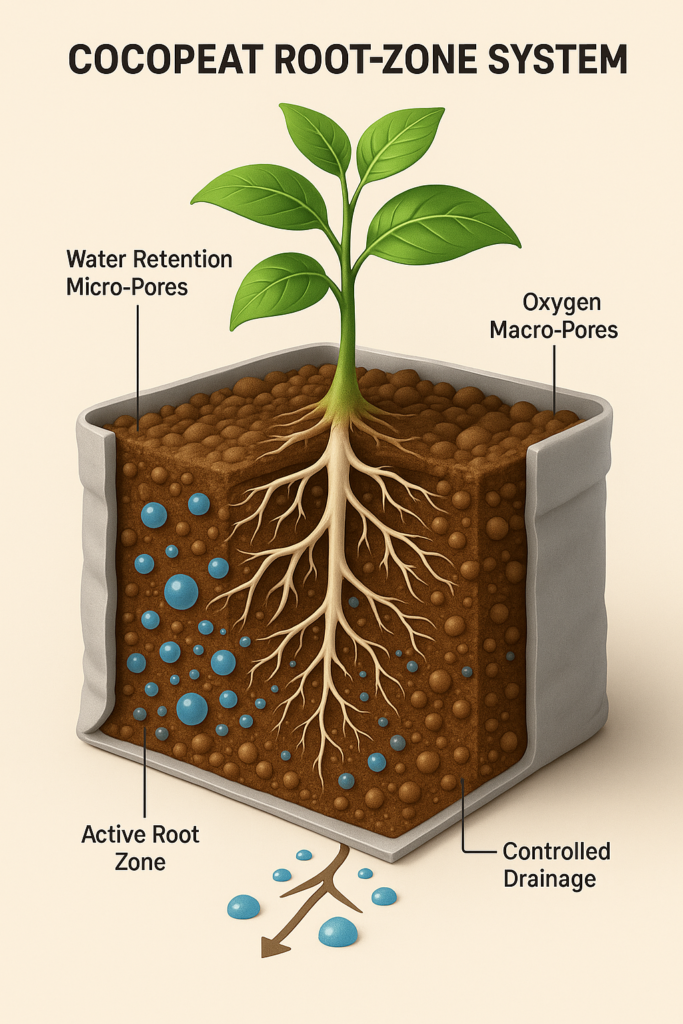
    Its internal structure consists of macro- and micro-pores that:

    Hold water in micro-pores

    Maintain oxygen in macro-pores

    This balance supports healthy root respiration and reduces anaerobic stress.

    Bulk Density

    Cocopeat is lightweight, reducing structural load on terraces, greenhouses, and vertical systems.

    Chemical Properties of Cocopeat

    pH Range

    Typically ranges between 5.5 and 6.8, ideal for most horticultural crops.

    Electrical Conductivity (EC)

    High-quality cocopeat maintains EC below 0.6 mS/cm after proper washing and buffering.

    Cation Exchange Capacity

    Cocopeat has moderate cation exchange capacity, allowing it to:

    Hold potassium naturally

    Bind calcium and magnesium when buffered correctly

    Without buffering, calcium and magnesium imbalance can occur.

    Biological Characteristics

    Cocopeat is:

    Free from soil-borne pathogens when properly processed

    Resistant to fungal buildup compared to organic soils

    Biologically stable with slow microbial breakdown

    This stability ensures consistent root environment across cropping cycles.

    Why Cocopeat Is Preferred Over Soil in Modern Systems

    Traditional soil farming faces challenges such as inconsistent texture, compaction, pathogen load, and nutrient variability. Cocopeat addresses these issues by offering:

    Uniform structure

    Predictable root-zone conditions

    Easy nutrient management

    Compatibility with fertigation

    For high-value crops, cocopeat allows farmers to control growth variables with precision.

    Applications of Cocopeat in Farming

    Nursery and Seed Germination

    Cocopeat ensures:

    High germination rate

    Uniform seedling growth

    Easy transplanting with minimal root damage

    Greenhouse and Polyhouse Cultivation

    Widely used in grow bags and slabs for:

    Tomatoes

    Peppers

    Cucumbers

    Lettuce

    Strawberries

    Terrace and Urban Farming

    Lightweight nature prevents structural stress and enables:

    Container farming

    Rooftop gardens

    Modular grow systems

    Hydroponic and Soilless Systems

    Cocopeat acts as an inert support medium, allowing precise nutrient solution control.

    Crop Suitability

    Cocopeat is suitable for:

    Leafy vegetables

    Fruit vegetables

    Herbs

    Flowers

    Nursery plants

    It is not recommended for cereal crops or large-scale field farming without modification.

    Nutrient Reality of Cocopeat

    One of the most misunderstood aspects is nutrients.

    Cocopeat:

    Contains negligible nitrogen and phosphorus

    Naturally high in potassium

    Requires external nutrient supplementation

    Successful cocopeat farming depends on:

    Balanced nutrient solution

    Proper fertigation schedule

    Monitoring pH and EC

    Without nutrients, plants will survive briefly but fail to produce economically.

    Cocopeat Buffering Explained

    Unbuffered cocopeat binds calcium and magnesium aggressively, causing deficiency symptoms. Buffering involves:

    Treating cocopeat with calcium nitrate or calcium chloride

    Replacing excess sodium and potassium

    Stabilizing root-zone chemistry

    Buffered cocopeat ensures long-term nutrient availability.

    Cocopeat Reuse and Lifecycle

    Cocopeat can be reused for two to three crop cycles when:

    Old roots are removed

    Media is washed and disinfected

    EC and pH are corrected

    Proper reuse lowers production cost significantly.

    Environmental and Sustainability Impact

    Compared to peat moss:

    Cocopeat is renewable

    Saves wetland ecosystems

    Utilizes agricultural waste

    Its carbon footprint is lower when sourced responsibly.

    Limitations and Risk Management

    Despite benefits, cocopeat has limitations:

    Requires technical understanding

    Poor quality products cause salinity problems

    Nutrient dependency increases management responsibility

    Professional results demand discipline and consistency.

    Economic Perspective

    Cocopeat farming:

    Reduces water use by up to 60 percent

    Improves yield uniformity

    Enables off-season production

    Supports premium-quality produce

    Initial setup is higher but returns justify investment in controlled systems.

    Future of Cocopeat in Global Agriculture

    With rising urbanization and land pressure, cocopeat supports:

    Vertical farming

    Climate-resilient agriculture

    Export-quality horticulture

    It is becoming a global standard growing medium, not a temporary trend.

    Frequently Asked Questions

    Is cocopeat a complete soil replacement?

    It replaces soil structurally but requires nutrient solutions.

    Can cocopeat be mixed with soil?

    Yes, for improved aeration and moisture control.

    How long does cocopeat last?

    Two to three cropping cycles with proper handling.

    Is cocopeat organic?

    It is natural but requires nutrient inputs for farming.

    Does cocopeat attract pests?

    No, when properly processed and maintained.

    Final Conclusion

    Cocopeat is not a shortcut or miracle solution. It is a scientific growing medium that rewards growers who understand its behavior. When managed correctly, it allows farmers to move from guesswork-based agriculture to precision-driven, sustainable production.

    This foundation post sets the technical and conceptual base for all future cocopeat-focused articles. Every next post will expand on one practical dimension, building a complete global knowledge system for modern farming.

    ✍️Farming Writers Team
    Love farming Love Farmers.