• Progress Is Quiet: Why Farmers Move Forward Even When Life Offers No Applause

    Progress Is Quiet

    Most progress in life makes no noise.

    There is no announcement when a farmer decides to continue. No banner when he chooses effort over exhaustion. No applause when he steps into the field on a day that already feels heavier than yesterday. The world celebrates outcomes, but farming is built on movement long before outcomes exist.

    A farmer understands something early in life that many people learn late, if at all. Progress does not always look like success. Sometimes it looks like repetition. Sometimes it looks like showing up again without improvement visible yet. Sometimes it looks like doing the same work with quieter hope.

    This is where farming and life intersect most honestly.

    In farming, the seed does not announce when it starts working. There is no sound when roots begin to form beneath the soil. Nothing dramatic happens on the surface. And yet, if conditions are right and effort continues, life begins anyway. Farmers learn to trust processes they cannot see. That trust shapes the way they live beyond the field.

    Modern life teaches people to chase validation. Farming teaches people to chase alignment. The soil does not reward effort instantly, but it never forgets it either. A farmer knows that every small correction, every improved habit, every better decision stacks quietly until one day the field responds.

    This mindset carries into life.

    When life does not improve immediately, many people stop. Farmers rarely do. Not because they are more optimistic, but because they understand time differently. Farming trains patience without promising reward. It demands responsibility without guarantees. It teaches that motion itself is meaningful even when results lag behind effort.

    There are seasons when the field looks unchanged for weeks. The farmer still waters. Still observes. Still protects. He knows that interference born of impatience causes more damage than restraint born of discipline. This awareness becomes a life philosophy. Do not overreact to silence. Do not abandon effort just because progress whispers.

    Science supports this reality. Biological systems respond to consistency, not bursts. Soil health improves gradually. Root systems strengthen invisibly before crops stand firm. Farming aligns human behavior with biological truth. What grows strong does so quietly first.

    This is why farmers often appear calm during uncertainty. They have lived inside it their entire lives. Uncertainty is not an emergency in agriculture; it is the default state. Weather shifts. Markets fluctuate. Inputs change. Outcomes remain unknown until harvest. Yet work continues.

    That discipline transfers to life decisions.

    Farmers do not wait to feel motivated. They move because responsibility does not negotiate. Livestock needs care whether morale is high or low. Crops need timing regardless of personal emotion. Over time, this builds a character that acts independently of mood. That may be farming’s most powerful gift to a human being.

    In life, many people wait for clarity before action. Farmers act while clarity develops. They understand that information is always incomplete, but action cannot be delayed forever. This creates a practical courage rooted not in confidence, but in acceptance.

    Acceptance does not mean surrender. It means recognizing reality without resentment. A failed crop does not create bitterness in a farmer who understands systems. It creates analysis. What changed. What was missed. What must adjust next season. This problem-solving orientation replaces emotional paralysis.

    Life becomes manageable when viewed through this lens.

    Progress does not require applause. It requires continuity. Farmers rarely receive recognition for preventing loss, yet prevention is most of their work. Preventing soil degradation. Preventing disease. Preventing erosion. Preventing long-term damage that outsiders never notice. In life, the same principle applies. Quiet improvements matter more than visible wins.

    A farmer improves his land inch by inch. He does not expect transformation overnight. This expectation management protects mental health. Disappointment often comes not from failure, but from unrealistic timelines. Farming forces realism. Realism breeds resilience.

    When people observe farmers from a distance, they often romanticize hardship or glorify struggle. Farmers themselves do neither. They treat hardship as data. Struggle is not a badge. It is feedback. Adjustments follow.

    This grounded relationship with difficulty is what makes farming such a powerful teacher of life.

    Even hope is treated differently. Farming hope is not blind. It is conditional. Hope exists because effort exists. A farmer does not hope without preparation. He does not pray without planning. Hope is a companion to work, not a replacement for it.

    That lesson applies everywhere.

    When life feels stagnant, farmers do not panic. They ask one question: what can still be done today. Not what will guarantee success, but what maintains alignment with progress. That question keeps movement alive during uncertainty.

    Movement sustains identity.

    A person who continues working remains connected to purpose even when results disappear temporarily. Farming teaches that identity should not depend solely on outcomes. A farmer is still a farmer in a bad year. Just as a person remains valuable during unproductive phases of life.

    This distinction saves people from self-collapse during setbacks.

    Progress often returns suddenly after long silence. Crops emerge almost overnight after weeks of nothing visible. Life improvements can feel similar. But they only arrive if effort never stopped during the quiet phase.

    Farmers know this not because they read it, but because they live it.

    They wake early not because mornings guarantee reward, but because discipline creates opportunity. They observe not because observation always prevents loss, but because ignorance guarantees it. They prepare not because preparation ensures success, but because lack of preparation ensures failure.

    These are life principles disguised as farming routines.

    The world often celebrates innovation, but farming honors refinement. Slightly better timing. Slightly better spacing. Slightly improved soil condition. Life improves the same way. Through adjustments that seem insignificant alone but transformative together.

    This is why farmers do not rush judgment. They wait for patterns. They watch cycles complete. They understand that isolated moments rarely define truth. This patience in evaluation protects them from emotional extremes.

    In a world addicted to instant feedback, farming remains one of the few professions anchored in delayed response. That delay trains emotional stability. It builds people who can withstand ambiguity without collapsing.

    Progress remains quiet because noise is not necessary for growth.

    At the end of the day, a farmer walks home knowing the field may not show gratitude tomorrow. That knowledge does not discourage him. It frees him. His commitment is not dependent on praise. It is rooted in responsibility.

    Life becomes steadier when lived this way.

    When people learn to measure progress by consistency rather than applause, they stop quitting prematurely. Farming teaches that survival belongs to those who stay aligned with effort longer than others stay motivated.

    That is the real motivation behind farming life.

    Not inspiration. Not excitement. But an understanding that stopping helps no one, while continuing quietly builds futures others will rely on without ever knowing who carried the weight.

    That is progress.

    Silent. Uncelebrated. Powerful.

    ✍️Farming Writers Team
    Love farming Love Farmers.

    Read A Next Post 👇

    https://farmingwriters.com/when-the-land-teaches-you-to-continue/
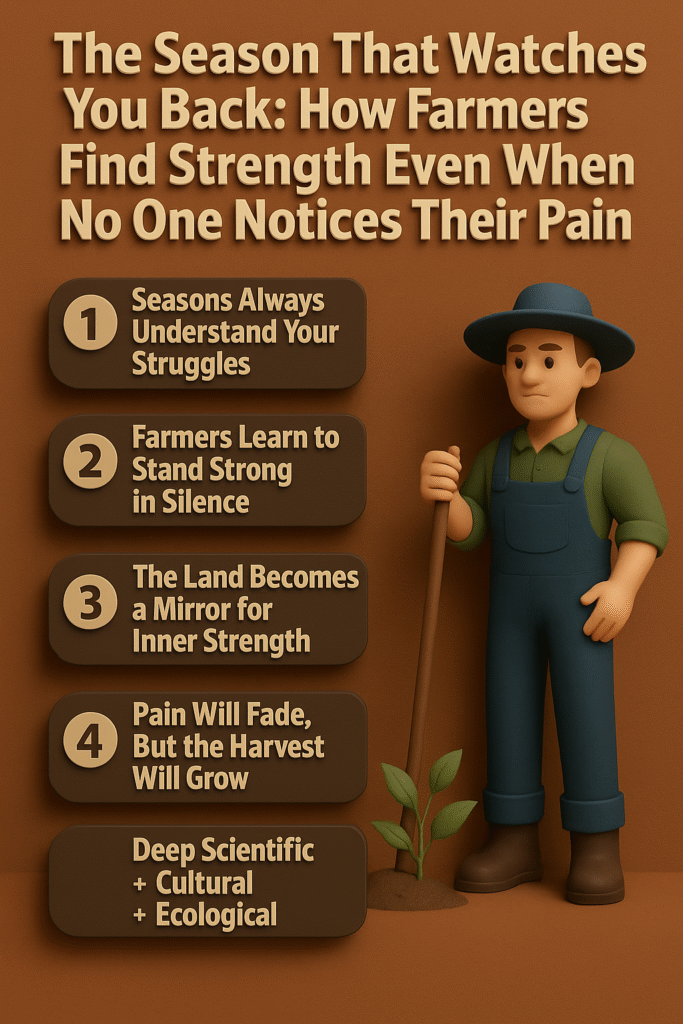
  • The Season That Watches You Back: The Hidden Courage of Farmers

    There are days in a farmer’s life when the field feels like the only place that understands him.
    Not because it answers his questions,
    but because it holds his silence without judgment.

    When a farmer stands alone among crops in the early morning,
    before the noise of the world begins,
    the land watches him the way an old friend watches someone who is hurting but trying to stay strong.
    There is something ancient, almost spiritual, in this exchange.
    The farmer does not speak; the land does not reply.
    Yet both understand each other perfectly.

    Most people think strength comes from confidence.
    Farmers know strength is born out of uncertainty.

    A farmer wakes up with a thousand unknowns.
    He does not know if the weather will honor his decisions.
    He does not know if the soil still remembers last season’s struggle.
    He does not know if the seeds will respond to care or choose their own fate.
    He does not know whether the market will respect his months of effort.
    But he moves forward anyway,
    and that movement is where his courage hides.

    There is a strange honesty in farming —
    life does not pretend to be fair here.
    If you make a mistake, the land shows it.
    If you skip a responsibility, the crop remembers it.
    If you delay effort, the season doesn’t wait for you to catch up.

    And still, farmers don’t hate the land for being honest.
    They trust it more because of that honesty.

    Every season becomes a teacher.
    Not through lectures or instructions,
    but through consequences.
    Farmers don’t learn from success; they learn from the things that go wrong.
    Failure on a farm isn’t the end;
    it is simply part of the conversation between a human being and nature.

    Farming does something to a person’s heart over time.
    It removes illusions.
    It strips away arrogance.
    It reveals the difference between what is important and what is noise.
    A farmer cannot afford emotional drama; the field does not tolerate it.
    So he becomes quieter, deeper, sharper —
    not because life is calm,
    but because calmness is the only way to survive a life so unpredictable.

    People often imagine farmers as strong because of their physical work.
    But their true strength is emotional.
    Imagine caring for something for months,
    giving it everything you have,
    and still knowing you may lose it all to a weather change that lasted less than an hour.

    Farmers live with this reality daily —
    yet they plant again.
    That is not just resilience.
    That is a form of faith the world rarely recognises.

    Standing in a recovering field after a damaging season teaches a farmer something profound:
    effort is not a guarantee,
    but surrender is a loss before the failure even arrives.

    So he chooses effort.

    Sometimes effort feels like hope.
    Sometimes effort feels like desperation.
    Sometimes effort feels like responsibility.
    Sometimes effort feels like the only thing left to hold on to.

    But effort always feels human.

    Farmers often carry burdens they don’t speak about.
    The health of their animals.
    The future of their children.
    The debts that don’t sleep at night.
    The soil that is slowly losing strength because the world demands more than it replenishes.
    The climate that shifts faster than their training ever prepared them for.
    And yet, they continue — one season at a time.

    A farmer’s relationship with time is different.
    He cannot rush it,
    cannot slow it,
    cannot suspend it.
    He works with it.
    He listens to it.
    He respects it.

    And in return, time teaches him patience the world envies.

    Farming also forces a person to see life without filters.
    A seed never lies.
    A plant never pretends.
    The soil never praises.
    The weather never negotiates.

    In a world full of noise,
    farming is brutal honesty —
    and that honesty shapes character.

    You can tell when a farmer has lived many seasons.
    There is a certain softness in his eyes,
    but beneath that softness lives a steel that life could not bend.
    He has walked through fears that city minds cannot picture.
    He has stood in fields that felt like graveyards of effort.
    He has experienced silence that feels heavier than any human voice.
    But he has also seen life return from places that once looked dead.

    That is why farmers carry something the world desperately needs —
    wisdom born from witnessing rebirth.

    Planting seeds in a field that failed last year is not optimism.
    It is bravery.
    It is belief in possibility.
    It is proof that humans can create hope with their own hands.

    When the world looks for motivation,
    it looks outward.
    Farmers look inward.
    Because everything they need to continue lies inside them —
    the memory of the last harvest,
    the discipline of routine,
    the responsibility of land,
    the faces of their families,
    and the silent promise that tomorrow deserves another attempt.

    The farmer knows something most people don’t:
    you cannot control life,
    but you can strengthen the person who faces it.

    A seed does not grow because conditions are perfect.
    It grows because it tries.
    Farmers are the same.

    When a farmer returns to his field after a season of pain,
    he is not returning to land.
    He is returning to possibility.

    And that possibility is what keeps humanity alive.

    Farming is the only profession where giving up is more painful than trying again.
    And that is why farmers continue —
    season after season,
    storm after storm,
    loss after loss,
    hope after hope.

    They don’t stand tall because life is kind.
    They stand tall because the earth refuses to let them fall.

    And somewhere in that quiet partnership
    between human effort and soil’s memory,
    the world finds its food,
    its lessons,
    its survival,
    and its meaning.

    ✍️Farming Writers
    Love farming Love Farmers

    Read A Next Post 👇

    https://farmingwriters.com/the-day-effort-became-a-prayer-farmer-strength/

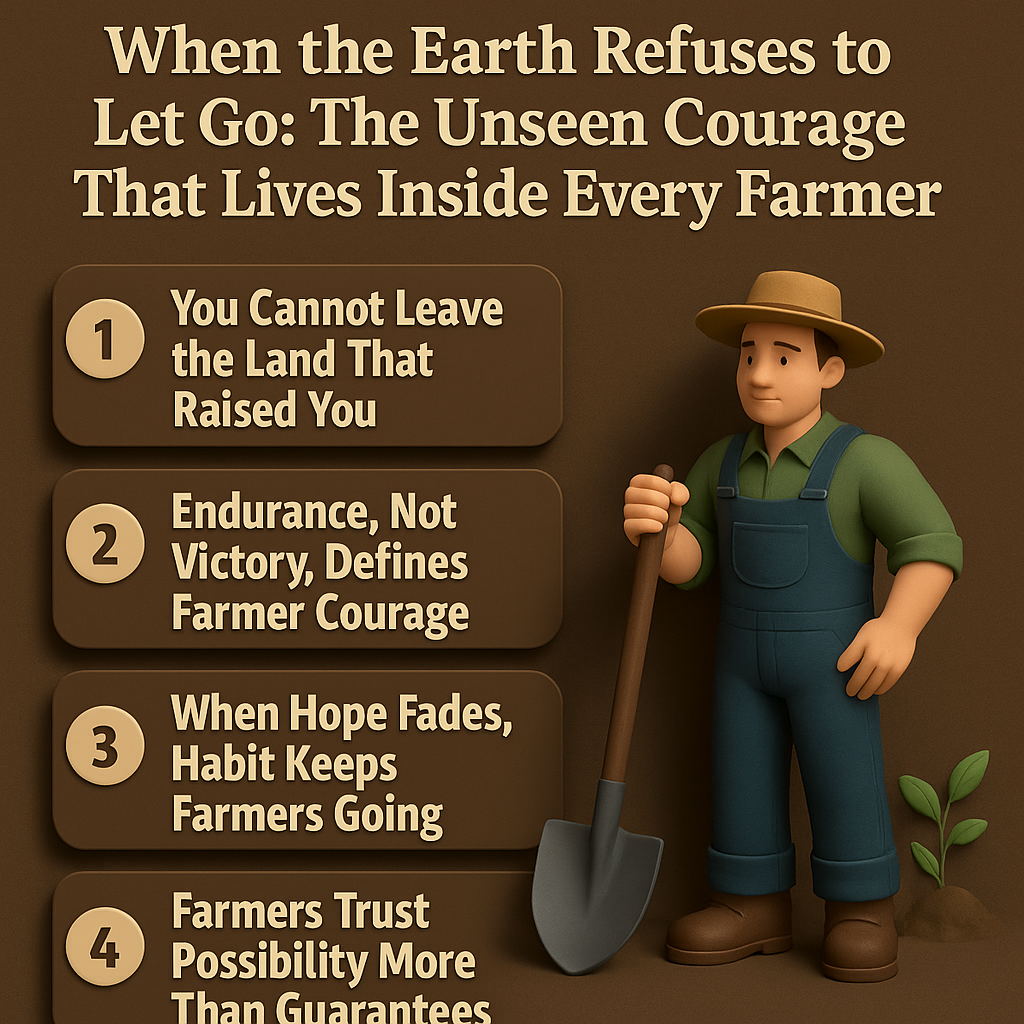
  • When the Earth Refuses to Let Go: The Hidden Courage of Farmers

    When the Earth Refuses to Let Go

    There are places in this world where time moves differently.
    Not slowly, not quickly, but with a kind of patience that feels ancient.
    A farm is one of those places.

    A farmer walks through his field long before the sun rises, and long before the rest of the world decides what kind of day it wants to be. The air at this hour carries a weight that cannot be photographed or explained. It holds memories of yesterday’s work, predictions of tomorrow’s weather, and truths that farmers learn without words.

    People imagine farming as a profession.
    Farmers know it is an identity.

    A factory worker can leave the factory.
    A teacher can leave the classroom.
    A businessman can switch ventures.

    But you cannot leave the land that raised you.
    Not truly.
    Even if you travel far, the soil stays inside you like a stubborn heartbeat.

    Farmers carry this connection quietly.

    Not as a speech.
    Not as pride.
    Not as a statement of identity.
    But as a simple understanding:
    “I belong to this land, and this land belongs to me.”

    The courage of farmers is often misunderstood.
    It does not come from victory.
    It comes from endurance.
    Endurance built from years of uncertainty, loss, responsibility, and hope mixed together in unpredictable proportions.

    A farmer does not get stronger in the good years.
    He gets stronger in the bad ones.

    The years when rain played games.
    The years when markets betrayed expectations.
    The years when pests destroyed months of careful planning.
    The years when everything seemed to collapse at once.

    Those are the years that plant courage deeper than roots.

    Ask a farmer why he keeps going and he will rarely give a poetic answer.
    He’ll shrug.
    He’ll smile.
    He’ll say something simple like “What else can I do?”

    What he really means is:

    “Stopping would break me more than trying.”

    There are days when a farmer walks through his field and the silence feels heavier than the land itself. Not the peaceful silence of nature, but the silence of consequences — the silence that arrives after a season has gone wrong.

    A farmer stands there not as a defeated man, but as someone calculating the next step. His mind does not dwell on loss; it searches for solutions. This is not optimism. This is survival.

    Most people break when life becomes unpredictable.
    Farmers expect unpredictability.

    They don’t collapse when nature changes its mind.
    They adapt.
    They adjust the rhythm of their work.
    They change the direction of hope.
    They reimagine the coming weeks.
    They restart.

    Farming is a constant rehearsal for tomorrow.

    But it is also something deeper — a kind of agreement with the earth:

    “I will give you my effort.
    You will give me your possibility.”

    Not a guarantee.
    Not a promise.
    Just a possibility.

    And farmers accept that possibility is enough to keep going.

    There is a moment in the life of every farmer when he realises that land is not just soil — it is memory.
    Generational memory.
    Emotional memory.
    Survival memory.

    Every corner of a farm carries a story.
    Where his father planted his first crop.
    Where his grandfather stood during the monsoon of a legendary year.
    Where harvest once saved the entire household.
    Where failure taught the harshest lesson.
    Where an animal used to wait every morning.
    Where a child took its first steps.
    Where hope returned after it was almost lost.

    These memories do not fade.
    The earth doesn’t forget.

    Farmers often look like they are working the land.
    But the truth is the land is working on them too.

    It shapes their thinking.
    It teaches patience.
    It softens anger.
    It sharpens observation.
    It humbles ego.
    It deepens responsibility.
    It strengthens emotional endurance.

    Most people break under pressure because they are not used to living with the unknown.
    Farmers live with the unknown every day.

    People fear failure.
    Farmers plant in uncertainty.

    People expect comfort.
    Farmers expect challenge.

    People crumble when plans collapse.
    Farmers rebuild plans from the soil up.

    Farmers do not fear storms.
    They fear giving up.

    There is a difference between fear that stops you and fear that shapes you.
    Farmers carry the second kind.

    Stand with a farmer during sunset and you will hear the honesty of life in his voice — not bitterness, not complaint, not regret, but acceptance. Acceptance that life is unpredictable, but effort is not. The field does not need perfection; it needs participation. The land does not ask for guarantees; it asks for commitment.

    Farmers understand that you cannot control everything.
    But you can continue through anything.

    This is why the spirit of a farmer is almost unbreakable.
    Not because he has not faced suffering —
    but because suffering has taught him endurance.

    A crop may fail.
    A season may collapse.
    A storm may destroy what months built.
    But a farmer always finds a reason to return.

    Even when hope fades, habit remains.
    Even when clarity disappears, responsibility stays.
    Even when doubt grows louder, the soil remains patient.

    And that patience becomes the farmer’s motivation.

    People search for motivation in books, videos, speeches.
    Farmers find it in silence.
    In the sound of footsteps on dry soil.
    In the chill of morning air.
    In the emptiness of a field waiting to be planted.
    In the whisper of wind predicting the next change.
    In the memory of harvests that once felt impossible.

    Farming teaches a truth that the modern world forgets:

    You don’t become stronger by avoiding difficulty.
    You become stronger by walking through it.

    And farmers walk through difficulty every day.

    But the greatest strength of a farmer is not his hard work.
    It is his ability to hope again after hope has already broken.

    The world survives because farmers believe in tomorrow even when today feels like an enemy.
    They do not trust fate; they trust effort.
    They do not trust luck; they trust land.
    They do not trust guarantees; they trust possibility.

    Farmers carry humanity forward quietly, season after season, without applause, without spotlight, without reward — only responsibility.

    And perhaps that is why the earth refuses to let go of farmers.
    Because the earth knows who respects it the most.

    Farmers survive storms, losses, and impossible seasons.
    But they rise.
    They always rise.

    And when they rise, the world rises with them.

    Because farming is not the story of crops.
    It is the story of courage.

    ✍️Farming Writers Team

    Love farming Love Farmers

    Read A Next Post 👇

    https://farmingwriters.com/the-wind-remembers-everything-farmers-move-forward/

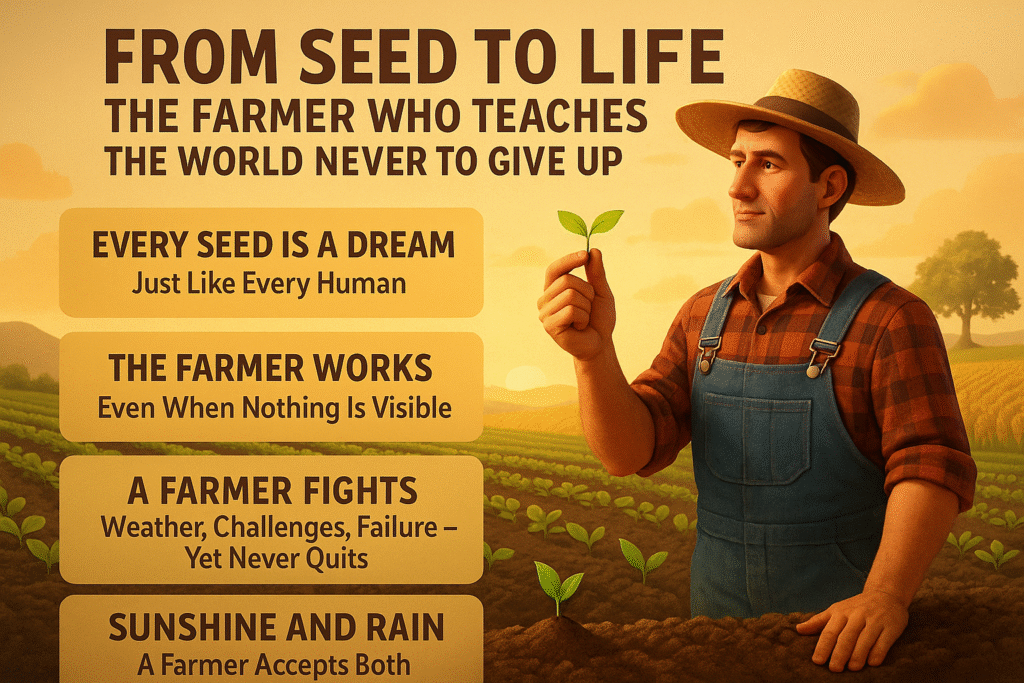
  • From Seed to Life: A Farmer’s Journey That Teaches the World Never to Give Up


    Seed to Life

    Introduction

    There are two kinds of heroes in this world one that the world sees and celebrates, and one that the world depends on silently every single day. The second hero is the farmer.

    A farmer doesn’t just grow crops.
    He grows hope, strength, courage, life, and the future.

    And the truth is — farming is the greatest teacher of life.
    If the world wants to learn how to live, how to survive, how to stay strong, and how to never give up… they must watch a farmer.

    This blog is for the entire world — so they understand the soul of farming, the journey of seeds, the value of farmers, and the lessons that can transform any life.

    1. Every Seed Is a Dream — Just Like Every Human

    A seed is tiny, weak, invisible, and almost nothing to the eye.
    But inside that small shell lies a whole universe waiting to grow.

    A farmer never judges a seed.
    He believes in it.
    He nurtures it.
    He protects it.
    He waits for it.

    That is how we must treat our dreams.
    At first they look small… useless… impossible.
    But with care, time, and patience — they grow into miracles.

    A seed teaches the world:

    “Don’t underestimate small beginnings.”

    “Everything magnificent starts from something tiny.”

    “Growth takes time, but growth is guaranteed.”

    1. The Farmer Works Even When Nothing Is Visible

    When a seed is planted, the field looks empty.
    No leaves, no green, no progress.

    But beneath the soil, magic is happening —
    roots are forming, life is rising, strength is building.

    A farmer knows this.
    He doesn’t stop watering.
    He doesn’t stop caring.
    He doesn’t stop believing.

    This is the biggest lesson of life:
    “Just because you can’t see progress doesn’t mean progress isn’t happening.”

    Whether it’s your career… your dreams… your health… your goals —
    most growth happens unseen, just like roots.

    1. A Farmer Fights Weather, Challenges, Failure — Yet Never Quits

    Farmers face storms, droughts, pests, diseases, losses, debts, pain, and disappointment.
    Yet every season, they stand again in their fields.

    Why?

    Because quitting is not in their blood.
    Because they know that life goes on.
    Because they believe in tomorrow more than they fear today.

    If the world adopts the courage of a farmer —
    no dream will die,
    no person will break,
    no hope will fade.

    1. Sunshine and Rain: A Farmer Accepts Both

    Life is not always bright.
    Life is not always dark.
    Life is balance.

    A farmer understands this beautifully:

    Some days are sunshine

    Some days are storms

    Some days bring joy

    Some days bring struggle

    But he keeps going.
    He accepts everything — and still continues the work.

    This is the greatest lesson of inner peace:
    “You don’t control the weather, but you control your effort.”

    1. The World Eats Because a Farmer Doesn’t Give Up

    Every grain on a plate is a story.
    A story of someone’s sweat, pain, waiting, worry, and hard work.
    A story of a farmer who rises at 4 AM.
    A story of someone who is often unseen — but always indispensable.

    Farmers feed the world.
    If farmers stop, the world stops.

    It is time the world respects farming not as a job —
    but as humanity’s heart.

    1. Farming Teaches Patience — Life Needs the Same

    Seeds don’t grow in a day.
    Neither do humans.

    Modern life is full of rush —
    people want fast money, fast success, fast results.

    Farming says:
    “Good things grow slowly.”

    Just like crops:

    your success takes time

    your skills take time

    your healing takes time

    your dreams take time

    Patience is not waiting.
    Patience is understanding that growth is happening, even if you can’t see it.

    1. A Farmer Doesn’t Plant One Seed — He Plants Many

    One crop may fail.
    One season may break him.
    One storm may destroy everything.

    But he plants again.

    And again.

    And again.

    Because he knows —
    “One failure cannot stop a farmer who believes in the next seed.”

    That is how life must be lived.
    People give up after one heartbreak… one disappointment… one setback.
    But farmers show us —
    not every seed will fail.
    Your time will come.

    1. Life = Farming: Grow Yourself Like a Seed

    If you want to build a stronger life, follow the farmer’s formula:

    Prepare your soil

    Create a good environment — positive people, positive learning.

    Plant your seeds

    Start your dreams, even if they’re small.

    Water daily

    Work every day, even if it is a small step.

    Protect your plant

    Stay away from negativity, laziness, and fear.

    Trust the process

    Don’t rush the growth.

    Harvest when the time is right

    Success will come — at the perfect season.

    1. The Farmer’s Life Is Not Easy — But It Is Beautiful

    Yes, he struggles.
    Yes, he worries.
    Yes, he gets tired.

    But he also smiles.
    He stands proud in fields he built with his own hands.
    He feels joy when the first sprout appears.
    He feels alive when the wind touches the wheat.
    He sees God in nature.
    He sees hope in the soil.

    That is why farming is not just work —
    it is a spiritual journey.

    Conclusion: The World Needs Farming + Farmers + Their Wisdom

    A farmer teaches the world:

    Never give up

    Believe in small beginnings

    Trust the process

    Accept challenges

    Work silently

    Stay patient

    Grow stronger

    Hope always

    Rise every season

    If humanity learns farming wisdom,
    life on earth will become peaceful, strong, and full of growth — just like a field filled with golden crops.

    Remember this line, bhai:

    A seed never loses hope.

    A farmer never quits.
    And life never stops growing for those who keep going

    FAQ

    1. What life lessons can the world learn from farmers?

    Farmers teach patience, consistency, hope, and the power of starting again. Their journey shows that success takes time and strong foundations.

    1. Why does farming inspire people to never give up?

    Because farmers continue working even after failures, losses, and harsh seasons. Their courage teaches that one tough season does not end your future.

    1. How does a seed represent human life?

    A seed starts small and invisible — just like dreams. With nurturing, time, and protection, both seeds and dreams grow into something powerful.

    1. Why is unseen effort important in life?

    Just like roots grow underground before a plant appears, most success happens through silent effort, preparation, and discipline before results show.

    1. How does farming teach patience?

    Nothing in farming grows overnight. Nature takes its own time. This teaches us that real success requires waiting, trust, and steady effort.

    1. Why is the farmer considered the backbone of the world?

    Because without farmers, there is no food, no harvest, and no life. The world survives because farmers never stop working for humanity.

    1. How do farmers stay motivated during tough times?

    They focus on the next seed, the next season, and the next opportunity. Hope is their biggest strength.
    farming motivation story
    farmer never give up
    life lessons from farmers
    seed to life motivation
    farmer struggle inspiration
    agriculture life motivation
    never give up farming story
    farmer strength and courage
    farming mindset blog
    motivational agriculture article

    ✍️Farming Writers