• One Acre Kiwi Farming: Complete High-Income Global Farming Business Guide

    One Acre Kiwi Farming


    1. Introduction: Why Kiwi Is the Future of High-Profit Farming

    Kiwi is one of the most profitable fruits worldwide.
    It grows best in:

    India (Himachal, Uttarakhand, NE states)

    Italy

    New Zealand

    Chile

    Turkey

    China

    USA

    Kiwi consumption is increasing globally due to:

    High vitamin C
    Immunity boosting
    Low calories
    Premium fruit segment
    High storage life (up to 60 days)

    Kiwi sells 3 to 10 times higher than apple or orange.

    If youth start kiwi farming even on one acre, they can earn huge sustainable income for 20–25 years.

    2. Climate & Soil Needed for Kiwi Farming

    Kiwi requires:

    Climate

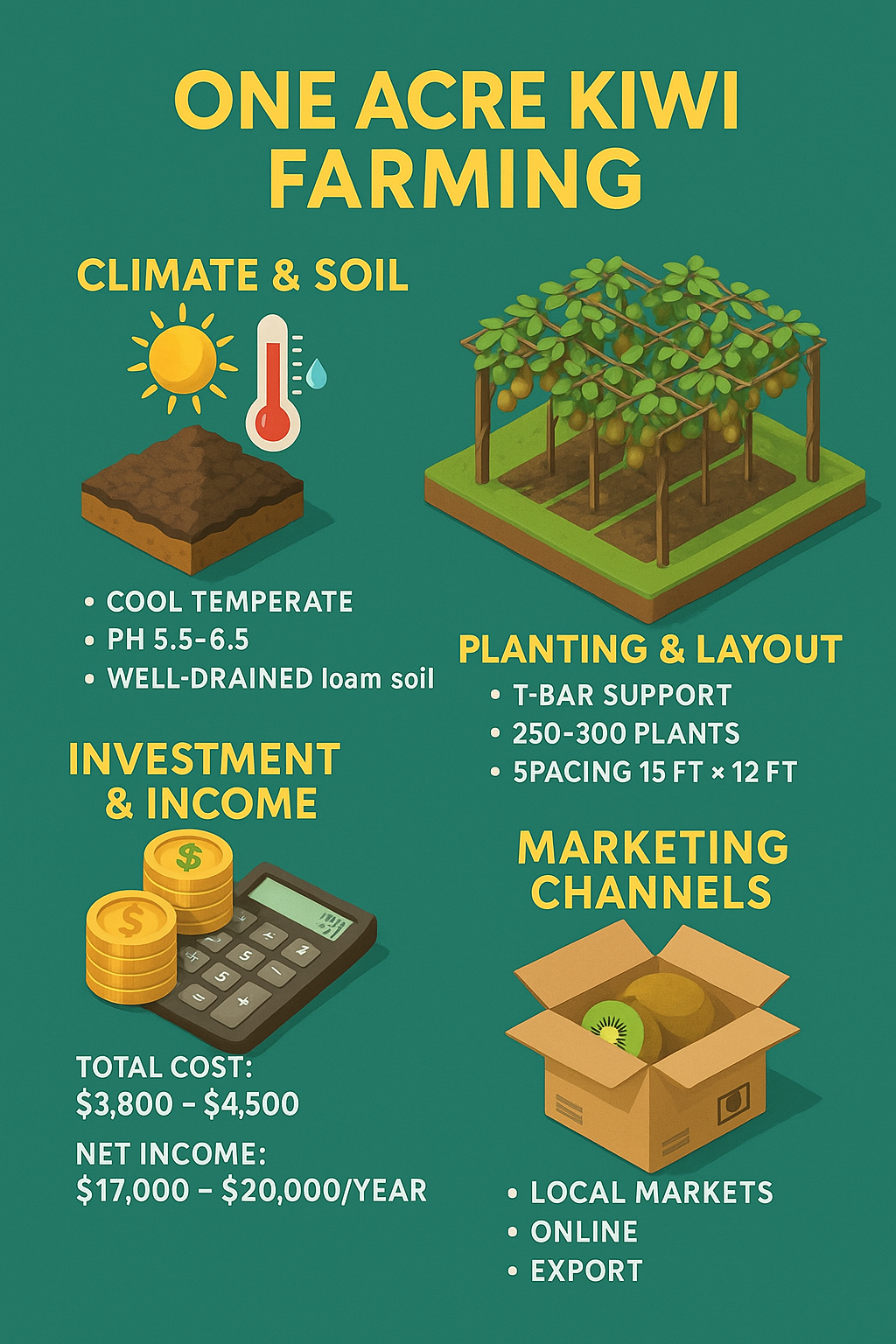
    Cool temperate region

    1000–1500 mm rainfall

    10–30°C temperature

    Frost-free winters

    Humidity 60–75%

    Soil

    pH: 5.5–6.5

    Sandy-loam / loam soil

    Rich organic matter

    Deep-well drained soil

    3. One-Acre Kiwi Orchard Layout (Professional Design)

    Plant Spacing:

    12×10 ft or 15×12 ft

    Plants Needed:

    Total plants in 1 acre: 250–300

    Male : Female Ratio = 1:6

    Support System:

    Kiwi needs a T-Bar/Pergola System:

    Costly but long-life (20–25 years)

    Best for heavy fruiting

    Height: 6–7 feet

    Wire gauge: 2–4 mm

    4. Investment Cost for 1 Acre Kiwi Farming (Professional Budget)

    ItemCost (USD)Cost (INR)Land preparation$250₹20,000High-quality plants (300)$900₹75,000T-Bar Support System$1,500₹1,20,000Drip irrigation$350₹30,000Organic fertilizers$200₹16,000Labor cost$300₹25,000Mulching$120₹10,000Plant protection$80₹6,500Maintenance$150₹12,000

    Total Investment:

    $3,800 – $4,500
    ₹3.1 – ₹3.8 lakh

    5. Planting Method (Step-by-Step Professional Instructions)

    Step 1 — Dig Pits

    Size: 2×2×2 ft

    Fill with compost, FYM, sand, neem-cake

    Step 2 — Planting

    Plant female on trellis wires

    Male plants after every 6 female plants

    Step 3 — Training

    Kiwi must be trained in cordon system

    Maintain single main stem

    Side branches evenly spaced

    Step 4 — Mulching

    Keeps moisture

    Reduces weeds

    6. Irrigation Requirement

    Kiwi needs regular moisture

    Drip irrigation recommended

    Summer: daily light watering

    Winter: once in 3–4 days

    Critical period:
    Flowering
    Fruit enlargement

    7. Manure & Fertilizer Schedule (One-Acre Orchard)

    Organic

    FYM 10–12 kg per plant annually

    Vermicompost 2 kg per plant

    Chemical

    NPK 1 kg per plant (split in 3 cycles)

    Boron spray

    Micronutrient spray every 30 days

    8. Flowering & Pollination

    Flowering Time:

    April–May

    Pollination:

    Bees are required
    You can keep bee boxes for better fruit set

    Pollination efficiency determines fruit size, weight & quantity.

    9. Kiwi Fruit Yield (Realistic Per Acre Production)

    Year 1:

    Vegetative growth (no yield)

    Year 2:

    Light yield: 1–2 tons

    Year 3:

    Medium yield: 3–4 tons

    Year 4 onwards (Full Production):

    5–7 tons per acre

    10. Kiwi Selling Price (World Market)

    MarketPrice per kgIndia retail$2.5 – $4 (₹180–₹300)India wholesale$1.8 – $2.5UAE$4 – $6Europe$4 – $7USA$5 – $8

    Premium varieties (Zespri-level) sell higher.

    11. Income & Profit Calculation (Per Acre)

    Production:

    6,000 kg (6 tons)

    Selling Price:

    Average global = $4/kg

    Total Revenue:

    $24,000 per year (₹19–20 lakh)

    Net Profit (After expenses):

    $17,000 – $20,000 (₹13–16 lakh)

    Profit increases every year as orchard matures.

    12. Value-Added Kiwi Products

    You can earn 200–400% more by selling:

    Kiwi juice

    Kiwi jam

    Kiwi squash

    Dehydrated kiwi chips

    Kiwi fruit powder

    Kiwi wine (Europe/USA legal)

    13. Worldwide Marketing Channels (Global Selling Strategy)

    A. Local Markets

    Supermarkets

    Fruit shops

    Hotels & resorts

    B. Online Selling

    Your own website

    Instagram store

    WhatsApp business

    ONDC (India)

    C. Export Markets

    Best countries:

    Dubai

    Bahrain

    Qatar

    Saudi Arabia

    Europe

    Singapore

    Japan

    14. Kiwi Farming as a Youth Startup

    Youth can create:

    Kiwi brand

    Kiwi nursery

    Kiwi juice brand

    Export kiwi supplier

    Cold-storage kiwi dealer

    Kiwi farming has huge global demand and very few suppliers.

    15. Risk & Disease Management

    Common Problems:

    Root rot

    Canker

    Sun scorch

    Low pollination

    Solutions:

    Good drainage

    Copper fungicide

    Shade nets in peak summer

    Bee keeping for pollination

    16. Conclusion

    Kiwi is among the top premium fruits globally.
    One-acre kiwi farming can generate:

    6–7 tons yield
    ₹13–16 lakh yearly profit
    Massive export opportunities
    20 years of continuous income

    Youth can easily build a long-term farming career with kiwi.

    17. FAQs

    1. Is kiwi farming profitable in 1 acre?

    Yes, extremely profitable.

    2. Can kiwi grow in hot regions?

    Need cooler climates; but high-altitude hot regions can work.

    3. How long does kiwi plant survive?

    20–25 years.

    4. Do kiwi need support system?

    Yes, T-bar or pergola is essential.

    5. Is export business easy?

    Yes, kiwi has stable international

    Read A Next Post 👇

    https://farmingwriters.com/one-acre-dragon-fruit-farming-profit-guide/

    ✍️Farming Farmers

    Love Farming Love Farmers
  • One Acre Dragon Fruit Farming: High Profit & Export Business Guide

    Dragon Fruit Farming


    1. Introduction: Why Dragon Fruit Is the Best One-Acre Crop

    Dragon fruit is one of the world’s top high-value fruits.
    It grows in:

    India

    Vietnam

    Thailand

    Malaysia

    UAE

    South America

    Africa

    And sells at premium rates globally.

    Dragon fruit is:

    Low water crop
    Heat tolerant
    High yielding
    Grows for 20+ years
    100% export friendly

    1 acre = lifelong income if managed properly.

    2. Why Dragon Fruit Is Perfect for Youth

    Low maintenance

    Works even on poor soils

    Easy pruning

    One-time pole setup

    High profit (₹10–15 lakh per acre)

    Easy online selling

    Youth can easily convert this into a startup farming business.

    3. One-Acre Perfect Dragon Fruit Layout

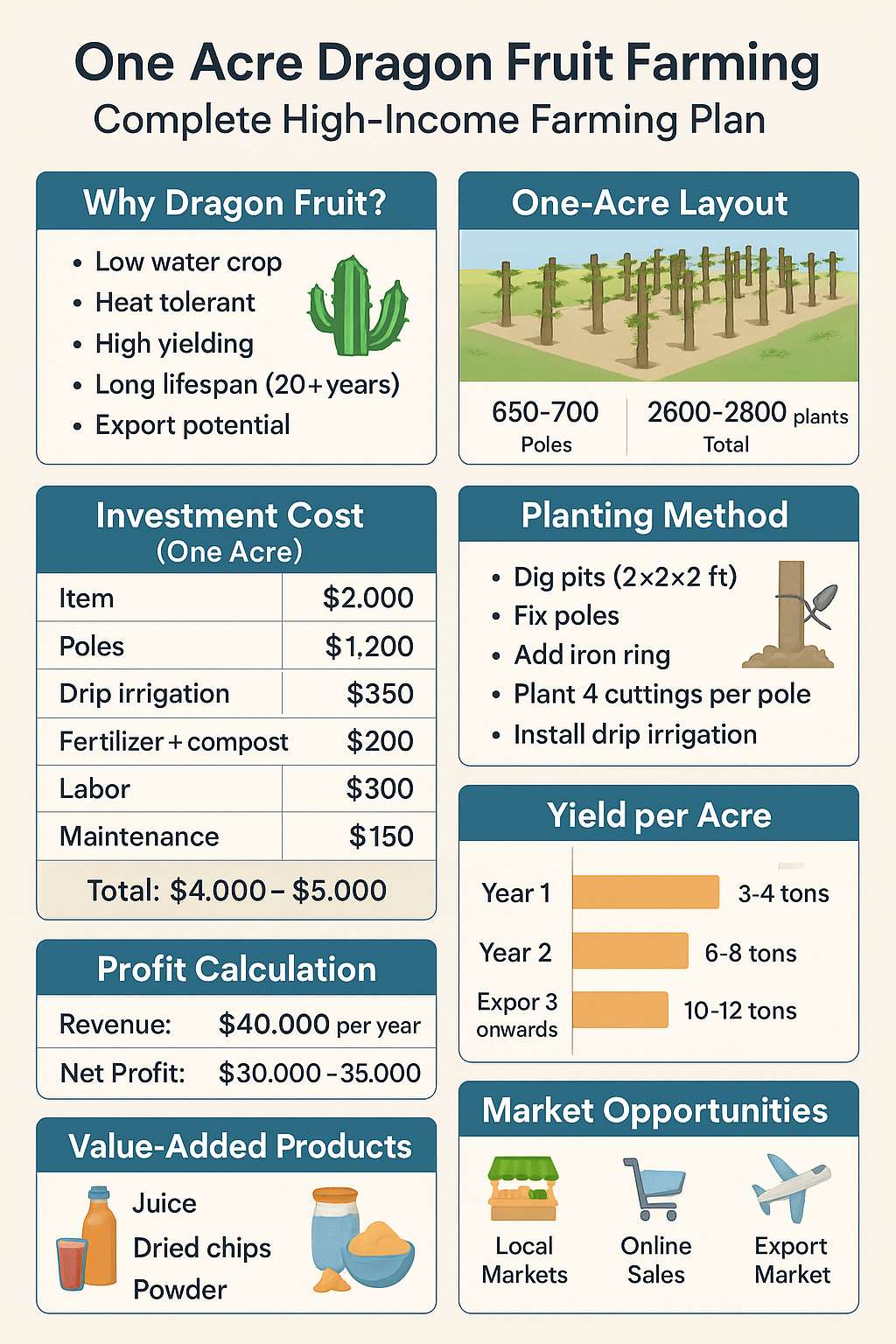
    Total poles needed: 650–700 poles
    Plants per pole: 4 cuttings

    Total plants: 2600–2800

    Spacing:

    Row: 10 ft

    Pole gap: 8 ft

    4. Climate & Soil Requirement

    Best climate:
    Hot & dry regions
    20–35°C temperature
    Full sunlight

    Soil:
    pH 6–7.5
    Well-drained

    Doesn’t need fertile soil — grows even in rocky areas.

    5. Investment Cost (One Acre)

    ItemCost (USD)Cost (INR)Poles (700)$2,000₹1,60,000Plants$1,200₹95,000Drip irrigation$350₹30,000Fertilizer + compost$200₹16,000Labor$300₹25,000Maintenance$150₹12,000

    Total Investment:

    $4,000 – $5,000
    ₹3.3 – 4.2 lakh

    One-time setup, income comes for 20 years.

    6. Planting Method

    Dig pits: 2×2×2 ft

    Add compost + sand + cow dung

    Fix cement poles (6–7 ft tall)

    Add iron ring on top

    Plant 4 cuttings per pole

    Install drip irrigation

    Mulch the area

    Growth starts within 20–25 days.

    7. Irrigation Schedule

    Summer: 20–25 minutes daily

    Winter: 10–15 minutes daily

    Rainy: Stop irrigation

    Dragon fruit hates overwatering.

    8. Manure & Fertilizer

    Apply every 45 days:

    Vermicompost

    NPK 10:10:10

    Neem cake

    Micro-nutrients

    Spray organic fungicide monthly.

    9. Flowering & Fruit Development

    First fruiting: 8–10 months

    Commercial yield: 18–20 months

    Full production: Year 2 onwards

    5–6 cycles per year

    10. Yield Calculation (1 Acre)

    Year 1:

    3–4 tons fruit

    Year 2:

    6–8 tons

    Year 3 onwards:

    10–12 tons

    11. Selling Price (Global Market)

    MarketPrice per kgIndia wholesale$2 – $3India retail$4 – $5UAE Export$6 – $7Europe$7 – $10

    12. Profit Calculation (One Acre)

    Production:

    10,000 kg (10 tons)

    Selling Price (avg): $4/kg

    Total Revenue:

    $40,000 per year
    = ₹32 lakh

    Net Profit (after expenses):

    ₹25–28 lakh per acre per year
    $30,000 – $35,000

    And income increases each year.

    13. Global Market Selling Strategy

    A. Local Market

    Fruit shops

    Hotels

    Supermarkets

    B. Online Market

    Use:

    Instagram

    Facebook

    WhatsApp

    ONDC

    Amazon (for dried dragon fruit)

    C. Export Market

    Top buyers:

    UAE

    Bahrain

    Qatar

    Singapore

    Malaysia

    Europe

    Start with:

    APEDA (India exporters)

    Farm-to-export companies

    Cold-chain logistics

    14. Value-Added Products

    You can convert unsold fruit into:

    Dragon fruit juice

    Dried chips

    Powder for smoothies

    Ice cream flavour

    Dragon fruit jam

    These earn 3× more profit.

    15. Risk Management

    Use drip irrigation

    Avoid overwatering

    Maintain pruning

    Add mulch

    Use biofencing

    Keep poles strong

    16. Conclusion

    Dragon fruit is one of the most profitable one-acre crops in the world.
    Low water + high price + long life + export demand = perfect business for youth.

    With proper market strategy, one acre can generate ₹25–30 lakh yearly, making it a global agribusiness model.

    17. FAQs

    1. Does dragon fruit need a lot of water?

    No, it is a drought-tolerant crop.

    2. Can beginners grow dragon fruit?

    Yes, it is one of the easiest fruit crops.

    3. How long does one plant survive?

    20+ years.

    4. Is export possible from one acre?

    Yes, even 4–5 tons can be exported.

    5. Is it profitable?

    Extremely — one of the highest-income crops.


    Read A Next Articals 👇

    https://farmingwriters.com/one-acre-farming-business-profit-guide/

    ✍️Farming Writers

    Love Farming Love Farmers

  • One Acre Farming Business Guide: High Profit Crops & Smart Agriculture for Youth

    One Acre Farming Business

    1. Introduction: The Future of Farming Is Smart Farming

    Today, the world is shifting from traditional agriculture to business-oriented smart farming. Whether you live in India, Africa, Europe, South America, or Asia — one acre of land is enough to build a profitable agriculture enterprise.

    Youth across the world can start farming with:

    Low investment

    High-value crops

    Smart irrigation

    Digital marketing

    Direct selling

    Modern storage & packaging

    This guide explains how to use one acre to build a powerful farming business that works anywhere in the world.

    2. Step-by-Step Guide: How to Start Farming on One Acre

    Step 1: Test Your Soil & Water

    Before choosing crops, test:

    Soil pH

    Organic matter

    Water quality

    Drainage

    This helps select the right crop that suits your land.

    Ideal pH for profitable crops:

    6.0 to 7.5 → Best for vegetables & fruits

    5.5 to 7.0 → Herbs, flowers, stevia

    6.0 to 6.8 → Moringa, medicinal crops

    Step 2: Select the Most Profitable Crop Mix (Global Model)

    Below is the best worldwide one-acre layout to maximize profit:

    0.35 Acre → Dragon Fruit

    High demand in UAE, Europe, Malaysia, Singapore.

    0.25 Acre → Stevia (Natural Sweetener)

    Used in global beverages & health products.

    0.20 Acre → Moringa (Leaves + Powder)

    USA & Europe “superfood market”.

    0.15 Acre → Protected Vegetables (Capsicum, Lettuce, Cucumber)

    Year-round production.

    0.05 Acre → Bee-keeping for Honey

    Bonus income, zero maintenance.

    Optional → Biofloc Fish Farming

    High return from small space.

    Step 3: Prepare Your Land

    Use the following methods:

    Plough 2–3 times

    Add organic compost

    Install drip irrigation

    Create proper rows and beds

    Add mulch to reduce weeds

    Step 4: Planting & Management

    Dragon Fruit

    Use concrete poles

    4-arm support

    Proper sunlight

    Prune regularly

    Stevia

    Plant in line spacing

    Irrigate every 2–3 days

    Harvest leaves after 70–90 days

    Moringa

    Fast-growing

    Highly drought-tolerant

    Leaves can be dried and powdered

    Vegetables (Net house)

    Use hybrid or organic seeds

    Maintain humidity

    Keep pests controlled

    Bee-keeping

    Place boxes near flowering crops

    Collect honey every 15–20 days

    3. How to Sell Your Farm Products (World Market Guide)

    This is the most important part. Yuva ko farming tab pasand aayegi jab unhe earning ka clear system mile.

    A. Local Direct Selling

    Sell directly to customers

    Create WhatsApp broadcast list

    Deliver fresh vegetables & fruits

    B. Retail Shops & Hotels

    Approach restaurants, cafes, organic stores

    Offer weekly supply contracts

    C. Online Selling

    Sell via:

    Facebook Marketplace

    Instagram store

    Farm-fresh website

    Google Maps listing

    Indians → ONDC / Flipkart / Meesho

    USA/Europe → Etsy (moringa, herbs)

    D. Export Markets

    High-demand export items:

    Moringa powder

    Stevia leaves

    Dragon fruit

    Honey

    Dried vegetables

    You can sell to:

    UAE

    Oman

    Qatar

    Europe

    USA

    Singapore

    E. Bulk Buyers

    Pharma companies (for stevia + moringa)

    Supermarkets

    Herbal product companies

    Juice & beverage companies

    4. Branding: How to Build a Farm Brand (Worldwide)

    This is where youth farming becomes startup.

    Brand Name Ideas:

    NatureRoot Farms

    GreenPulse Organics

    PureLeaf Naturals

    DragonFresh Farms

    OneAcre Harvest

    Branding Steps

    Use attractive packaging

    Add QR code origin details

    Use social media for story branding

    Create “chemical-free” or “organic” identity

    Logo + Color Ideas

    Green & white = purity

    Yellow = organic

    Blue = export-quality freshness

    5. Profit Calculation (Full Breakdown)

    CropAnnual ProfitDragon fruit$12,000–$16,000Stevia$7,500–$9,000Moringa$4,000–$6,000Vegetables$4,000–$6,000Honey$1,250–$2,000Biofloc fish$1,400–$2,500

    Total Profit:

    $30,000 – $42,000+ per year
    ₹25 – 35 lakh per acre per year

    Depends on marketing + yield + location.

    6. Youth: How to Make Farming a Career

    Youth want:

    Profit
    Technology
    Branding
    Market access
    Online selling
    Simple start

    You can start farming like a startup:

    Use solar pumps

    Use drip irrigation

    Use sensor irrigation systems

    Keep digital records

    Sell online

    Build your own brand

    7. Most Profitable Crops for Any Country (Top 10 List)

    Dragon fruit

    Saffron

    Stevia

    Moringa

    Ginger + Turmeric

    Mushrooms

    Aloe vera

    Lemongrass

    Organic vegetables

    Medicinal herbs

    8. FAQs

    1. Can I start farming with low investment?

    Yes, start with 1–2 high-value crops, then expand.

    2. How to get buyers?

    Use Instagram, WhatsApp, local shops, hotels, online platforms.

    3. Can farming be done without experience?

    Yes, basic training and practical guidance is enough.

    4. What is the best crop for one acre?

    Dragon fruit + vegetables + herbs combination.

    5. Can youth make farming a business?

    Yes, farming is now a high-income startup.

    Conclusion

    One-acre farming is not small. With smart planning, it becomes a global income model.
    Youth can easily make ₹25–35 lakh per year if they follow:

    Right crops
    Right marketing
    Brand building
    Technology
    Diversified farming

    Farming is not just a tradition — it is now one of the most powerful business careers worldwide.

    Read A Next Post 👇

    https://farmingwriters.com/one-acre-dragon-fruit-farming-profit-guide/

    ✍️Farming Writers

    Love farming Love Farmers

  • Soil to Sky: How Farmers Build Nations and Shape the Future

    Soil to Sky

    In a world racing toward technology, artificial intelligence, and digital advancement, one truth remains unshaken: no invention can replace the hands that feed the world. Farming is not a backup plan; it is the original profession of humanity — the source of survival, culture, economy, and peace. From the soil beneath our feet to the sky above our heads, a farmer’s work touches every aspect of life. Yet, too often, the world forgets the silent strength of agricultural heroes.

    This blog is a reminder — to the youth, to the world, and to future generations — that agriculture is not just necessary; it is extraordinary. It is one of the greatest opportunities of the 21st century, a profession filled with dignity, prosperity, and purpose. Let us explore why farmers are the true creators of nations and why farming is the rightful path for a strong, sustainable global future.

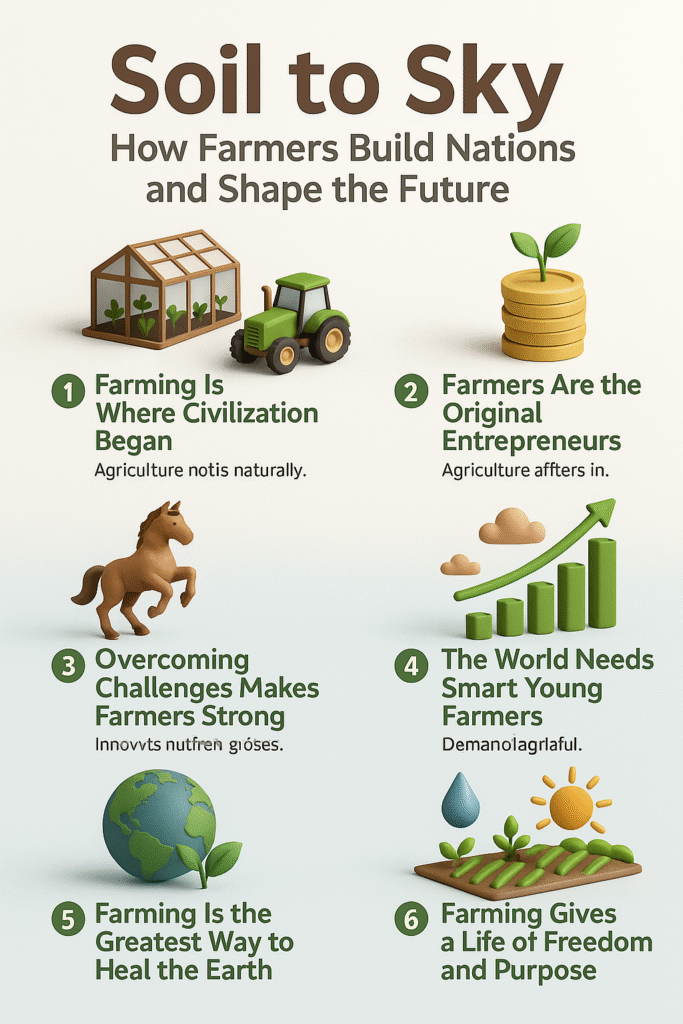
    1. Farming Is Where Civilization Began — And Where The Future Begins

    Every great civilization — India, Egypt, Mesopotamia, Rome, China — was built on agriculture. Kingdoms rose on fertile lands, cultures flourished around rivers, and communities formed where crops grew. Farming is not “old” — it is eternal.

    Even today:

    Food decides political stability

    Agriculture defines national strength

    Countries with strong farms have strong economies

    The world may advance, but survival will always begin in the soil.

    In the future, farming will become even more important because population will increase, food demand will rise, and climate will change. The nations that invest in agriculture today will lead tomorrow.

    1. Farmers Are the ORIGINAL Entrepreneurs

    Long before modern business started, farmers were:

    Managing resources

    Predicting markets

    Observing nature

    Adapting strategies

    Handling risk

    Innovating for survival

    Every season is a business cycle. Every harvest is a product launch. Every field is a factory.

    A farmer is not a laborer — he is a strategist, manager, scientist, and entrepreneur rolled into one.

    Today, agriculture is transforming faster than ever:

    Global export markets

    Organic premium industries

    Agritech startups

    Processed food brands

    Farm-to-table businesses

    Hydroponics and greenhouse farming

    A young farmer can build an empire starting with just a few acres of land.

    1. Overcoming Challenges Makes Farmers the Strongest People on Earth

    Most people give up when circumstances change.
    Farmers adapt when:

    Rain falls too much

    Rain doesn’t fall at all

    Heat rises

    Prices crash

    Pests attack

    Profit becomes uncertain

    Farming builds resilience that no other profession teaches.

    A farmer wakes up every day not knowing the outcome — but still works with faith and courage.

    That is what makes farmers real warriors.

    The world respects soldiers who fight at the borders. Farmers fight every day on the fields — with climate, with nature, with uncertainty — to protect food security for the entire world.

    1. The World Needs Smart Young Farmers Now More Than Ever

    The average age of farmers globally is increasing:

    USA: 58 years

    Europe: 57 years

    India: 50+ years

    Japan: 67 years

    This is dangerous.
    If youth do not take over, the world will face massive food shortages.

    Young farmers bring:

    Technology

    Modern education

    Digital tools

    Data-driven solutions

    Climate awareness

    Business mindset

    The future of farming depends on youth.
    The world needs smart farmers, educated farmers, digital farmers — not just traditional workers.

    A young mind in a field can change an entire nation.

    1. Farming Is the Greatest Way to Heal the Earth

    When the world talks about climate change, sustainability, carbon emissions, global warming — farming becomes the center of every solution.

    Sustainable agriculture can:

    Restore soil health

    Reduce carbon footprint

    Increase biodiversity

    Save water

    Rebuild nature

    Protect future generations

    A farmer can do more for the planet in one season than many industries can do in decades.

    Planting a single tree.
    Using organic compost.
    Saving water through drip irrigation.
    Growing climate-resilient crops.

    These small actions create a global impact.

    Farmers are not just feeding the planet — they are healing it.

    1. Farming Gives a Life of Freedom, Peace, and Purpose

    Many people chase jobs, money, schedules, and office pressure. Farming offers something far more valuable:

    Freedom.
    Sunlight.
    Nature.
    Health.
    Family.
    Purpose.

    A farmer works under the open sky, not under artificial lights.
    He breathes fresh air, not air-conditioned stress.
    Every day, he builds something real — life itself.

    There is no greater peace than watching seeds sprout because of your care.
    No greater joy than feeding the world through your own effort.

    Farming gives a life that is grounded, simple, meaningful, and deeply satisfying.

    1. The Next Billionaire Will Be a Farmer — or an Agriculture Innovator

    Yes, it is happening.

    The world’s biggest markets are shifting toward:

    Organic superfoods

    Export-grade fruits

    Spices and herbs

    Medicinal crops

    Plant-based protein

    Eco-friendly products

    Smart farming equipment

    Agritech AI and robotics

    The next decades will be dominated by food production and sustainability.
    People who enter agriculture today will become pioneers of tomorrow.

    This is why global investors are pouring money into agriculture.

    Land is the only asset that always appreciates.
    Food is the only business that never loses demand.

    Farming is not “low income.”
    Farming is generational wealth.

    1. A Message for Every Farmer in the World

    If you are a farmer reading this —
    You are the backbone of your nation.
    You are the guardian of the earth.
    You are the protector of humanity.

    You work early so the world can wake up.
    You work late so the world can sleep peacefully.

    You don’t just grow crops —
    You grow dreams, health, and hope.

    You deserve respect, pride, and honor.

    1. A Message for Youth: Farming Is Not Backward — It Is the Future

    Young brother, young sister —
    Don’t run away from the soil that feeds you.

    Farming is modern.
    Farming is scientific.
    Farming is global.
    Farming is profitable.
    Farming is respected.

    The world doesn’t need more followers.
    The world needs creators — farmers.

    If you choose agriculture, you choose leadership.

    The world is waiting for the next generation of farming heroes.

    FAQs

    1. Is farming still profitable today?
      Yes. With modern technology, organic markets, and export opportunities, farming is more profitable than ever.
    2. Why should young people join agriculture?
      Because the world needs innovation, technology, and fresh ideas in farming to solve future food challenges.
    3. Is modern farming difficult?
      Not with smart tools. Drones, sensors, drip irrigation, and hybrid crops make farming efficient and scalable.
    4. Can farming make someone financially stable?
      Absolutely. Agriculture offers long-term wealth, land appreciation, and growing market demand.
    5. What is the future of farming?
      Tech-driven, sustainable, organic, climate-friendly, and globally connected agriculture.

    Conclusion

    From the soil that gives life to the sky that nourishes every field, farming remains the strongest pillar of humanity. In a world driven by speed, technology, and competition, agriculture stands as the quiet power that feeds every nation and sustains every life. The future will belong not to those who chase trends, but to those who build foundations — and no foundation is stronger than farming.

    Farmers are more than workers; they are creators of tomorrow.
    They sow hope, nurture dreams, and harvest the food that keeps the world alive.

    For youth, agriculture is not a step back — it is a giant leap forward.
    A chance to innovate, to lead, and to shape a more sustainable world.

    The next era of greatness will rise not from corporate towers but from green fields, strong hands, and brave hearts. The future of food, climate, and global stability lies with those who choose to farm.

    From soil to sky — the world is nourished by farmers, and the future will shine in their hands.

    ✍️Farming Writers

    Love farming Love Farmers

    Read A Next Post 👇

    https://farmingwriters.com/the-farmers-courage-growing-in-tough-conditions/

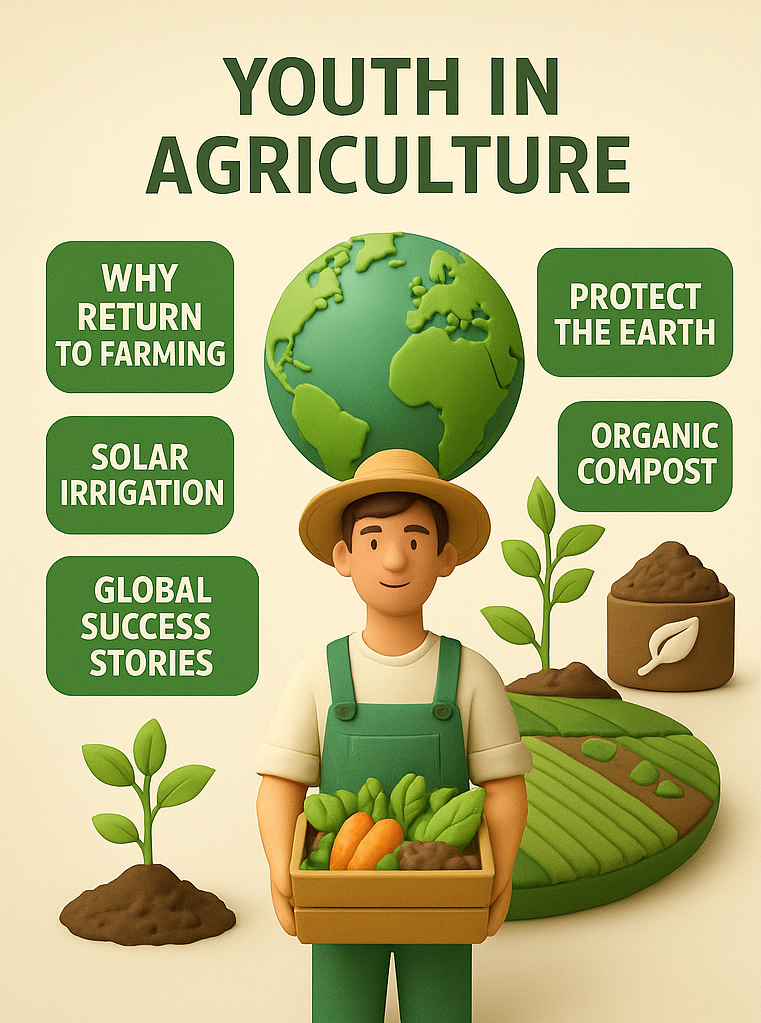
  • Youth in Agriculture Why the Next Generation Must Return to Farming

    Youth in Agriculture


    1: Introduction: The Future of Farming Depends on the Youth

    For the first time in history, the world is facing three simultaneous crises:

    1. Farmland is shrinking.


    2. Population is rising rapidly.


    3. Youth are moving away from agriculture.


    Without young people entering agriculture, the world will face a serious food crisis. Elder farmers cannot alone handle climate change, technology, soil degradation, and global food demand.

    The world needs the next generation urgently.
    Not for tradition.
    Not for survival.
    But because farming is now the most important profession for the future of humanity.


    Why Are Young People Leaving Farming?

    1. Lack of Awareness and Respect

    Many youth believe farming is backward or low-status.
    But the truth is: farming is now a science-driven, technology-powered global industry.

    2. Urban Attraction

    Cities pull youth with jobs, lifestyle, and opportunities.
    But cities cannot exist without farms.

    3. Climate Challenges

    Extreme weather, drought, and soil problems scare new farmers.

    4. No Inspiration

    Young people are not shown the value of farming in school, media, or society.

    This must change.


    Why the Youth Are the Only Hope for Agriculture

    1. Youth Understand Technology

    Modern farming requires:

    Drones

    AI tools

    Soil sensors

    Big data

    Smart irrigation

    Apps

    Robotics

    Satellite guidance


    Old farmers do not have this skillset.
    Youth can master this easily.

    2. Youth Bring New Ideas

    Young minds bring innovation:

    Vertical farms

    Hydroponics

    Organic markets

    Brand-based farming

    Direct-to-customer sales

    Agri-startups


    3. Youth Can Save Soil

    Soil degradation is the biggest threat to global food production.
    Youth can restore soil using:

    Organic farming

    Compost

    Cover crops

    Mulching

    Minimum tilling


    4. Youth Can Build a Sustainable Future

    Climate change will decide Earth’s future.
    Farmers are on the front line.
    Youth farmers = climate warriors.


    Global Success Stories of Young Farmers

    India: Young Farmers Using AI & Organic Farming

    Indian youth are building modern farms using technology, mobile apps, and organic methods.
    They are earning more than traditional jobs.

    Africa: Youth Using Solar Farming

    Solar-powered pumps and drip irrigation created thousands of young entrepreneurs in Kenya.

    Japan: Youth-Driven Robot Farming

    Japan’s young engineers use AI and robotics to grow food efficiently.

    Brazil: Young Coffee & Fruit Entrepreneurs

    Brazilian youth are converting farms into global brands.

    USA: Data-Driven Young Farmers

    American youth run farms using satellites, sensors, and climate modeling.


    The Real Meaning of Farming for the Next Generation

    Farming is not just growing crops.
    Farming is:

    Protecting the Earth

    Healing the soil

    Feeding humanity

    Creating sustainability

    Building economy

    Balancing climate

    Giving life


    Without farming, cities collapse.
    Without soil, no food.
    Without food, no future.


    Why Returning to Farming Is a Responsibility of Youth

    1. To Protect the Soil

    Soil is disappearing faster than it is being created.
    Youth must restore it.

    2. To Save Water

    Smart irrigation reduces water usage by 60–90 percent.

    3. To Fight Climate Change

    Sustainable farming captures carbon and cools the environment.

    4. To Feed the Growing Population

    By 2050, global food demand will rise by 70 percent.

    H3: 5. To Secure Their Future

    Agriculture is the industry with the highest long-term stability.


    What Will Happen If Youth Ignore Farming?

    Food prices will rise

    Soil will degrade

    Hunger will increase

    Countries will become dependent on imports

    Climate disasters will intensify

    Rural economy will collapse


    The world cannot survive without new farmers.


    Conclusion: The Future Farmer Is a Leader, Not a Labourer

    Youth must understand:
    Farming is not a low-class job.
    Farming is life.
    Farming is science.
    Farming is a mission.
    Farming is the backbone of Earth.

    If the youth return to farming, the world will have:

    Health

    Climate balance

    Food security

    Strong economy

    Clean soil

    Clean water

    A living planet


    Agriculture is not just work.
    It is the future of humanity.


    FAQs (English)

    Q1. Why should youth return to farming?

    Because farming is essential for future food, climate protection, and sustainable living.

    Q2. Is farming profitable for youth?

    Yes. Tech-based modern farming can earn more than many jobs.

    Q3. Can agriculture solve climate change?

    Yes. Sustainable farming captures carbon and restores Earth.

    Q4. Why is soil important?

    Healthy soil = healthy food = healthy future.

    Q5. What skills do young farmers need?

    Technology, marketing, soil knowledge, and sustainable practices.

    youth in agriculture, future farming, young farmers, farming motivation, global agriculture future, soil future, climate farming, new generation farming

    ✍️Farming Writers

    Love farming Love Farmers

    Read A Next Post 👇

    https://farmingwriters.com/smart-farming-around-the-world-technology-feeding-earth/

  • Farming Is the Future: Why the World Needs a New Generation of Farmers

    Farming writers

    Introduction: The World’s Silent Backbone

    When we think of innovation, we often imagine skyscrapers, satellites, and AI — but the true foundation of human survival remains farming. Every bite of food, every thread of cotton, every drop of milk — all come from the soil. Yet, today’s youth are drifting away from it.
    This post is a call — to the next generation — to see farming not as “old work,” but as the future’s most powerful profession.


    1. The Global Need for Farmers

    The United Nations predicts that by 2050, the world’s population will exceed 9.7 billion. Feeding this growing population requires at least 70% more food production than today.
    But here’s the crisis: the number of farmers is declining every year. In many countries, the average farmer’s age is above 55.
    Without young minds, agriculture risks collapsing under its own weight.

    The world doesn’t just need farmers.
    It needs educated, tech-driven, climate-aware farmers.
    It needs dreamers who grow food as a mission, not as a burden.


    2. Youth and the Power of Change

    Today’s generation holds something older farmers never had — technology, global awareness, and connection.
    A farmer with a smartphone can access:

    Real-time weather data

    Crop disease detection via AI

    Global market prices

    Organic certification systems


    Young people can blend ancient wisdom with modern tools — and make farming cool, sustainable, and profitable.


    3. Farming: The New Tech Frontier

    Agriculture is not just soil and seeds anymore  it’s drones, robotics, data analytics, hydroponics, and biotechnology.
    Countries like Japan and Israel are leading with innovation — turning deserts into green fields through technology.
    Meanwhile, in India, Africa, and South America, young entrepreneurs are proving that farming startups can be as exciting as tech startups.

    Imagine a youth from Kenya using drones to spray crops, or an Indian farmer using solar-powered irrigation.
    That’s the future — farming powered by innovation.


    4. Why the World Needs You — The New Farmer

    The modern farmer is not just a grower.
    He/She is a:

    Scientist – testing new seeds and soil methods

    Technologist – using IoT and AI for better yield

    Entrepreneur – building farm brands and exports

    Environmental hero – saving water, soil, and biodiversity


    When a youth becomes a farmer, the world gains not only food, but sustainability, employment, and balance.

    5. Reconnecting Humanity with Nature

    Urbanization has created a gap — between humans and the soil. The new generation must rebuild that bridge.
    Farming reconnects us to nature’s rhythm — sunrise, seasons, rain, and renewal.
    It teaches patience, gratitude, and teamwork with the planet.


    6. Farming as Freedom, Not Obligation

    In many parts of the world, farming was once seen as a burden — something people did because they had no choice.
    But today, farming is a lifestyle of freedom:

    Freedom to work with nature

    Freedom to create your own food

    Freedom to be self-reliant

    Freedom to innovate and lead sustainability


    Farming is not “backward.” It’s forward to roots.


    7. Global Examples of Young Farmers

    In Japan, young farmers use robots to harvest rice.

    In Brazil, agro-entrepreneurs grow organic coffee for world markets.

    In India, startups like KisanKonnect link farmers directly to urban consumers.

    In Africa, young women are turning wastelands into solar farms with crop cultivation.


    These stories show one truth farming belongs to the future, not the past.


    8. Conclusion: The Future Is in Your Hands

    The next 50 years will define whether humanity thrives or starves.
    We need youth who can feed the world  wisely, sustainably, and passionately.

    If you’re young and searching for meaning, look no further than the soil beneath your feet.
    Because the hands that touch the soil today will shape the future of the Earth tomorrow.

    Farming is not just work — it’s world-building.

    farming future, youth in agriculture, global farming, sustainable farming, modern agriculture, farmers motivation

    ✍️Farming Writers

    Love farming Love Farmers

    Read A next post 👇

    https://farmingwriters.com/farming-motivation-global-inspiration/

Subscribe