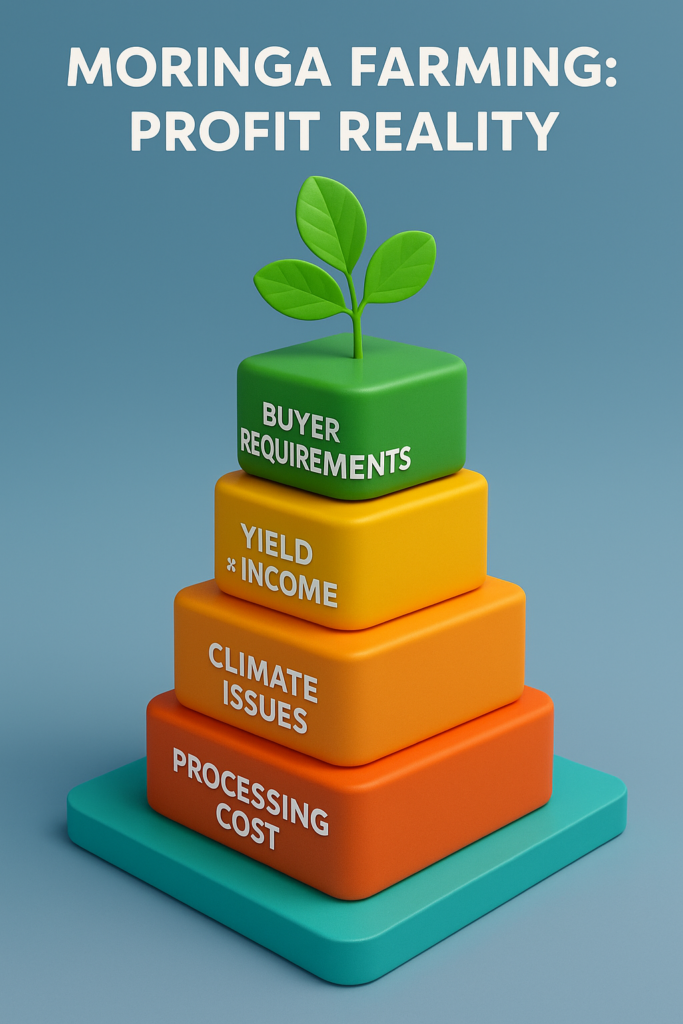
• Moringa Farming Profit Reality Why many farmers fail after good yield

    Moringa Farming Profit

    Many farmers enter moringa farming after seeing one simple claim repeated everywhere: “high demand, miracle tree, export profit.” What they don’t see is how many moringa growers end up with good harvests but no serious buyers, or worse, bulk buyers who push prices so low that drying and transport cost more than the sale value.

    The first loss usually doesn’t happen in the field. It happens after harvest, when farmers realise that moringa is not sold as “leaf” or “pod” in the way vegetables are sold. It is sold as quality-controlled material, and most first-time growers do not meet that standard.

    A common mistake is assuming that yield equals income. Moringa can grow aggressively, even on poor land. Leaves come fast, pods form easily, and trees look healthy. That visual success hides the real question buyers ask: consistency, moisture control, contamination level, and processing discipline. Farmers who don’t plan for these from day one usually lose money even with high biomass.

    Another wrong belief is that moringa leaf powder is easy money. In reality, most powder gets rejected due to colour loss, microbial count, improper drying temperature, or mixing of old and new leaves. Buyers don’t care how much you harvested. They care whether your powder matches lab parameters. One rejected batch can wipe out months of effort.

    Climate suitability matters, but not in the textbook way. Moringa survives heat and drought, yes. But survival does not equal market quality. In very humid regions, leaf drying becomes a major problem. High humidity increases fungal risk and darkens leaf colour, which reduces export value sharply. Farmers in such areas often underestimate drying infrastructure cost and end up selling fresh leaves locally at vegetable prices, not medicinal prices.

    Soil fertility is another misunderstood area. Moringa grows even in poor soil, which makes people think fertilisation doesn’t matter. But nutrient imbalance directly affects leaf thickness, colour, and nutrient density. Buyers test for protein content and mineral profile. Leaves grown under nutrient stress may pass visually but fail nutritionally.

    Harvest timing is where many losses quietly occur. Cutting too late reduces softness and increases fibre. Cutting too early reduces yield and increases processing cost. Most online guides skip this nuance. In real trade, harvest cycles are planned backward from buyer delivery schedules, not forward from planting date.

    Processing is where moringa farming becomes either profitable or pointless. Sun-drying without temperature control causes nutrient degradation. Over-drying causes brittleness and colour loss. Under-drying causes mold. Manual sorting is labour-heavy but mandatory for export grade. Farmers who don’t calculate this labour cost beforehand often realise too late that margins are thinner than expected.

    Market reality is harsh but clear. Local markets buy moringa fresh at low prices. Domestic supplement manufacturers buy only from consistent suppliers. Export buyers demand certification, batch traceability, and stable volumes. There is a big gap between “global demand exists” and “your product qualifies for it.”

    Many farmers also ignore price volatility. When moringa becomes popular in a region, oversupply follows quickly. Prices crash, especially for fresh leaves. Powder prices remain stable only for certified quality. Those without processing capability suffer the most during these cycles.

    This crop is not for everyone. Farmers without drying infrastructure, labour management capacity, or buyer linkage should avoid moringa despite the hype. It works best for those who think like processors, not just growers.

    Moringa farming succeeds when approached as a quality manufacturing system, not a leafy crop. Those who treat it casually often exit quietly after one or two seasons.

    TOP 10 FAQ – REAL QUESTIONS FARMERS ASK AFTER LOSSES

    Is moringa farming really profitable for small farmers?
    Only if processing and buyer linkage are planned before planting. Without that, profits are usually low.

    Why do buyers reject moringa leaf powder?
    Most rejections happen due to moisture, colour degradation, or microbial contamination.

    Is fresh moringa leaf selling sustainable?
    Only for local vegetable markets. It does not generate medicinal-grade margins.

    Does moringa grow in all climates equally?
    It grows everywhere, but quality differs sharply with humidity and soil balance.

    Is organic moringa easier to sell?
    Organic helps, but certification and consistency matter more than labels.

    How often should moringa be harvested for best quality?
    Harvest timing must match buyer quality standards, not just plant growth speed.

    What is the biggest hidden cost in moringa farming?
    Labour during sorting, drying, and quality control.

    Can moringa pods be more profitable than leaves?
    Only in specific fresh markets. Export demand is stronger for leaf products.

    Is moringa a good crop for beginners?
    Not unless they understand processing and quality management.

    When should a farmer avoid moringa completely?
    When there is no drying facility, no buyer contract, and no quality testing access.

    ✍️Farming Writers Team
    Love farming Love Farmers

    Read A Next Post 👇

    https://farmingwriters.com/goat-farming-profit-risks-and-market-reality/

  • One Acre Farming Business Guide: High Profit Crops & Smart Agriculture for Youth

    One Acre Farming Business

    1. Introduction: The Future of Farming Is Smart Farming

    Today, the world is shifting from traditional agriculture to business-oriented smart farming. Whether you live in India, Africa, Europe, South America, or Asia — one acre of land is enough to build a profitable agriculture enterprise.

    Youth across the world can start farming with:

    Low investment

    High-value crops

    Smart irrigation

    Digital marketing

    Direct selling

    Modern storage & packaging

    This guide explains how to use one acre to build a powerful farming business that works anywhere in the world.

    2. Step-by-Step Guide: How to Start Farming on One Acre

    Step 1: Test Your Soil & Water

    Before choosing crops, test:

    Soil pH

    Organic matter

    Water quality

    Drainage

    This helps select the right crop that suits your land.

    Ideal pH for profitable crops:

    6.0 to 7.5 → Best for vegetables & fruits

    5.5 to 7.0 → Herbs, flowers, stevia

    6.0 to 6.8 → Moringa, medicinal crops

    Step 2: Select the Most Profitable Crop Mix (Global Model)

    Below is the best worldwide one-acre layout to maximize profit:

    0.35 Acre → Dragon Fruit

    High demand in UAE, Europe, Malaysia, Singapore.

    0.25 Acre → Stevia (Natural Sweetener)

    Used in global beverages & health products.

    0.20 Acre → Moringa (Leaves + Powder)

    USA & Europe “superfood market”.

    0.15 Acre → Protected Vegetables (Capsicum, Lettuce, Cucumber)

    Year-round production.

    0.05 Acre → Bee-keeping for Honey

    Bonus income, zero maintenance.

    Optional → Biofloc Fish Farming

    High return from small space.

    Step 3: Prepare Your Land

    Use the following methods:

    Plough 2–3 times

    Add organic compost

    Install drip irrigation

    Create proper rows and beds

    Add mulch to reduce weeds

    Step 4: Planting & Management

    Dragon Fruit

    Use concrete poles

    4-arm support

    Proper sunlight

    Prune regularly

    Stevia

    Plant in line spacing

    Irrigate every 2–3 days

    Harvest leaves after 70–90 days

    Moringa

    Fast-growing

    Highly drought-tolerant

    Leaves can be dried and powdered

    Vegetables (Net house)

    Use hybrid or organic seeds

    Maintain humidity

    Keep pests controlled

    Bee-keeping

    Place boxes near flowering crops

    Collect honey every 15–20 days

    3. How to Sell Your Farm Products (World Market Guide)

    This is the most important part. Yuva ko farming tab pasand aayegi jab unhe earning ka clear system mile.

    A. Local Direct Selling

    Sell directly to customers

    Create WhatsApp broadcast list

    Deliver fresh vegetables & fruits

    B. Retail Shops & Hotels

    Approach restaurants, cafes, organic stores

    Offer weekly supply contracts

    C. Online Selling

    Sell via:

    Facebook Marketplace

    Instagram store

    Farm-fresh website

    Google Maps listing

    Indians → ONDC / Flipkart / Meesho

    USA/Europe → Etsy (moringa, herbs)

    D. Export Markets

    High-demand export items:

    Moringa powder

    Stevia leaves

    Dragon fruit

    Honey

    Dried vegetables

    You can sell to:

    UAE

    Oman

    Qatar

    Europe

    USA

    Singapore

    E. Bulk Buyers

    Pharma companies (for stevia + moringa)

    Supermarkets

    Herbal product companies

    Juice & beverage companies

    4. Branding: How to Build a Farm Brand (Worldwide)

    This is where youth farming becomes startup.

    Brand Name Ideas:

    NatureRoot Farms

    GreenPulse Organics

    PureLeaf Naturals

    DragonFresh Farms

    OneAcre Harvest

    Branding Steps

    Use attractive packaging

    Add QR code origin details

    Use social media for story branding

    Create “chemical-free” or “organic” identity

    Logo + Color Ideas

    Green & white = purity

    Yellow = organic

    Blue = export-quality freshness

    5. Profit Calculation (Full Breakdown)

    CropAnnual ProfitDragon fruit$12,000–$16,000Stevia$7,500–$9,000Moringa$4,000–$6,000Vegetables$4,000–$6,000Honey$1,250–$2,000Biofloc fish$1,400–$2,500

    Total Profit:

    $30,000 – $42,000+ per year
    ₹25 – 35 lakh per acre per year

    Depends on marketing + yield + location.

    6. Youth: How to Make Farming a Career

    Youth want:

    Profit
    Technology
    Branding
    Market access
    Online selling
    Simple start

    You can start farming like a startup:

    Use solar pumps

    Use drip irrigation

    Use sensor irrigation systems

    Keep digital records

    Sell online

    Build your own brand

    7. Most Profitable Crops for Any Country (Top 10 List)

    Dragon fruit

    Saffron

    Stevia

    Moringa

    Ginger + Turmeric

    Mushrooms

    Aloe vera

    Lemongrass

    Organic vegetables

    Medicinal herbs

    8. FAQs

    1. Can I start farming with low investment?

    Yes, start with 1–2 high-value crops, then expand.

    2. How to get buyers?

    Use Instagram, WhatsApp, local shops, hotels, online platforms.

    3. Can farming be done without experience?

    Yes, basic training and practical guidance is enough.

    4. What is the best crop for one acre?

    Dragon fruit + vegetables + herbs combination.

    5. Can youth make farming a business?

    Yes, farming is now a high-income startup.

    Conclusion

    One-acre farming is not small. With smart planning, it becomes a global income model.
    Youth can easily make ₹25–35 lakh per year if they follow:

    Right crops
    Right marketing
    Brand building
    Technology
    Diversified farming

    Farming is not just a tradition — it is now one of the most powerful business careers worldwide.

    Read A Next Post 👇

    https://farmingwriters.com/one-acre-dragon-fruit-farming-profit-guide/

    ✍️Farming Writers

    Love farming Love Farmers