Neem, known scientifically as Azadirachta indica, stands as one of the most versatile medicinal and agricultural trees in the world. The ancient civilizations of India and Southeast Asia regarded Neem as a “village pharmacy,” and modern science continues to validate that belief. Every part of the Neem tree — leaf, bark, twigs, seeds, flowers and oil — possesses extraordinary therapeutic and agricultural value. Its antibacterial, antiviral, antifungal, anti-inflammatory, insect-repellent and immune-supporting properties have made Neem a global commodity across industries including herbal medicine, natural cosmetics, organic pesticides, pharmaceuticals, veterinary care and sustainable agriculture.
In recent decades, the global shift toward organic farming has dramatically increased demand for Neem seeds and Neem oil. The world has finally recognized that chemical pesticides have caused widespread soil degradation and ecological imbalance. As a result, Neem-based bio-pesticides have emerged as the most reliable and eco-friendly solution for crop protection. Export markets in the United States, Europe, Africa, Middle East and Southeast Asia purchase large quantities of cold-pressed Neem oil, Neem cake, powdered leaf and standardized extracts. With climate change affecting global farming systems, Neem’s resilience and multifunctionality make it a highly strategic crop for farmers and industry alike.
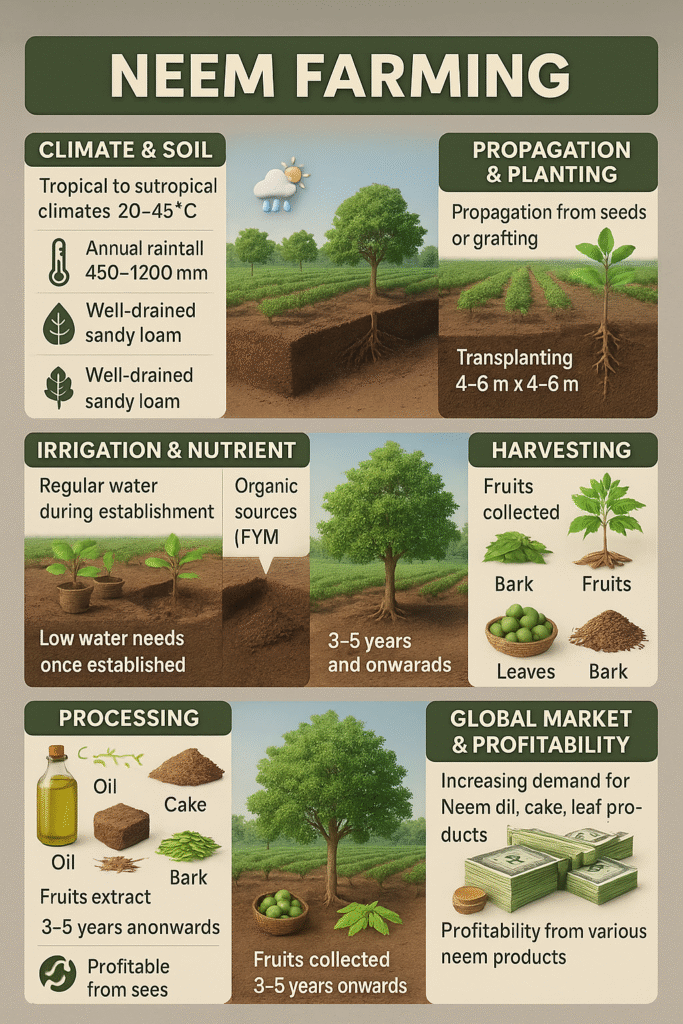
Neem grows naturally in arid to semi-arid tropical climates, thriving in regions with temperatures between twenty and forty-five degrees Celsius. The tree tolerates extreme heat, prolonged drought and poor soil fertility, making it one of the most adaptable agroforestry trees. Although Neem prefers warm tropical climates, it survives well in subtropical zones and withstands moderate winter chills, provided frost does not occur. The tree grows rapidly during warm seasons and requires very little care once established. Its deep taproot system penetrates dry soils and draws moisture from deep underground, making Neem one of the best drought-resilient trees for low-rainfall regions.
Soil requirements for Neem farming reflect the tree’s natural adaptability. Neem grows in almost any soil type except waterlogged clay. The tree prefers well-drained sandy loam or loamy soils with good aeration. Slightly alkaline or neutral pH between six point five and eight supports strong root development. In dry regions, Neem thrives in soils where very few crops can survive. Farmers often plant Neem along farm boundaries, degraded lands or unused wastelands, turning unproductive zones into income-generating assets.
Land preparation for Neem farming is minimal compared to other crops. Deep ploughing is done only during initial plantation to loosen the soil and help young saplings establish roots. Once planted, Neem requires little maintenance. Farmers clean the land of stones, weeds or debris and prepare small pits enriched with compost or farmyard manure. Although Neem thrives in poor soils, the addition of organic matter in early stages accelerates growth and improves biomass.
Propagation of Neem can be achieved through seeds or vegetative methods. Seed propagation is the most common method because Neem produces abundant seeds annually. Fresh seeds germinate quickly, but stored seeds lose viability rapidly due to high oil content. Therefore, farmers collect seeds immediately after fruit ripening, remove pulp and sow them in nursery beds. Germination occurs within ten to twenty days. Seedlings remain in the nursery for two to three months until they develop strong root systems. Vegetative propagation, including root cuttings and grafting, is used when farmers want genetically uniform high-oil-yielding trees.
Transplanting Neem seedlings usually takes place during the monsoon season when soil moisture helps quick establishment. Saplings are planted in pits spaced four to six meters apart depending on the plantation purpose. Dense plantations are preferred for leaf and bark production, while wider spacing suits seed and oil production. Farmers often integrate Neem into agroforestry models alongside crops like millets, pulses or fodder grasses because its light canopy allows filtered sunlight, improving soil microclimate.
Irrigation requirements for Neem are minimal. The tree needs water only during the first year for establishment. Once roots penetrate deep soil layers, Neem becomes almost independent of external irrigation. Over-irrigation harms young saplings and encourages fungal diseases. In rain-fed zones, Neem grows naturally without supplemental water. This drought resilience makes Neem ideal for climate-smart agriculture and long-term ecological restoration.
Nutrient management for Neem farming emphasizes organic inputs. Although Neem tolerates poor soils, balanced nutrition during early years enhances growth. Farmers apply compost, vermicompost or cow dung manure around the root zone annually. Chemical fertilizers are unnecessary and often avoided because Neem’s value lies in its purity and organic nature. The tree’s fallen leaves decompose naturally, enriching soil fertility and creating a self-sustaining nutrient cycle.
Pest and disease management in Neem farming requires minimal intervention. Ironically, the tree renowned for its bio-insecticidal properties rarely faces severe pest attacks. Young saplings may experience termite attack or fungal wilt in overly moist soils, but organic pest control such as Neem cake or Neem leaf extract resolves these issues effectively. Mature Neem trees are naturally resistant to insects and diseases due to their bioactive compounds.
As Neem trees mature, they begin to flower and produce fruits. Flowering occurs in warm months, followed by fruit development. Neem fruits resemble small olives, turning yellow when ripe. Inside lies a seed rich in oil. Farmers collect fruits manually or allow them to fall naturally. After collecting, fruits are depulped by washing and rubbing, leaving behind the kernels. These kernels are dried before oil extraction.
Neem oil extraction requires careful processing. The highest quality oil comes from cold-pressing dried kernels. Cold-pressed oil retains azadirachtin, nimbin and other active compounds responsible for Neem’s bio-pesticidal and medicinal effects. Mechanical expellers are used in large-scale farms, while small farmers use traditional pressing methods. Neem cake, the by-product of oil extraction, remains extremely valuable as an organic nitrogen-rich fertilizer that also acts as a natural pest repellent.
Neem leaves, bark and twigs also hold significant commercial value. Dried Neem leaves are used in herbal formulations, teas, powders and cosmetics. Bark is used in traditional medicine for digestive and immune-supportive remedies. Tender twigs, traditionally used as herbal toothbrushes, are sold in herbal health markets worldwide. Every part of the Neem tree contributes to its economic potential.
Processing Neem for the herbal and organic agriculture markets involves cleaning, drying, grinding and grading. Leaf powder must be shade-dried to maintain medicinal compounds. Bark and twigs undergo similar processing. Neem oil is filtered to remove impurities and standardized for agricultural or cosmetic use. Products derived from Neem include bio-pesticides, skin creams, soaps, shampoos, face packs, veterinary sprays, organic fertilizers and herbal supplements. Global cosmetic brands use Neem extract for anti-acne and antibacterial skincare lines, giving Neem a strong presence in beauty markets.
Global demand for Neem continues to rise sharply due to increasing adoption of organic farming and sustainable pest management. Countries such as the United States, Germany, Japan, Australia and UAE import large quantities of Neem oil for organic farming. Neem cake exports remain strong for soil improvement in horticulture industries. The medicinal and cosmetic sectors also rely heavily on Neem extracts. Prices depend on quality, season and oil concentration. High-grade cold-pressed Neem oil ranges from three to eight USD per liter in bulk markets, while Neem cake sells between two and four USD per kilogram. With rising environmental concerns, demand for Neem-based products is expected to grow for decades.
Economically, Neem farming offers exceptional long-term profitability. Unlike seasonal crops, Neem provides income year after year with minimal maintenance. Once established, trees produce seeds annually for decades. The multi-purpose nature of Neem — leaves, bark, oil, cake, twigs — ensures multiple income streams. Farmers using agroforestry systems integrate Neem with other crops, creating sustainable land use patterns and increasing total farm income. Because Neem thrives in dry and marginal lands, it turns low-value land into a profitable asset.
Sustainability forms the core of Neem farming. The tree improves soil organic matter, prevents erosion and supports biodiversity. Its deep roots stabilize land in drought-prone areas and restore degraded soils. Neem is a cornerstone of natural farming, chemical-free pest control and eco-friendly agriculture. The tree also absorbs large quantities of carbon dioxide, contributing to climate mitigation efforts.
In conclusion, Neem farming is one of the most strategic agricultural investments for the future. Its unparalleled medicinal and agricultural value, global market demand, ecological resilience and long-term profitability make it a must-have crop in the world of herbal and sustainable farming. Farmers who understand Neem’s ecological requirements, oil extraction methods, organic processing and market dynamics can build a stable and highly profitable enterprise while contributing to global environmental health.
FAQ FOR NEEM FARMING
Farmers often ask how long Neem takes to mature, and trees begin producing seeds within three to five years, with full production after seven years. Another common question concerns water, and Neem requires irrigation only during early establishment; afterward, it grows independently even in drought. Soil suitability is frequently asked, and Neem grows well in almost any soil except waterlogged clay. Many growers ask about profitability, and Neem provides multiple income streams through leaves, bark, seeds, oil and cake. Disease concerns remain low because Neem naturally resists most pests, and problems appear only in poorly drained soil.
✍️Farming Writers Team
Love Farming Love Farmers