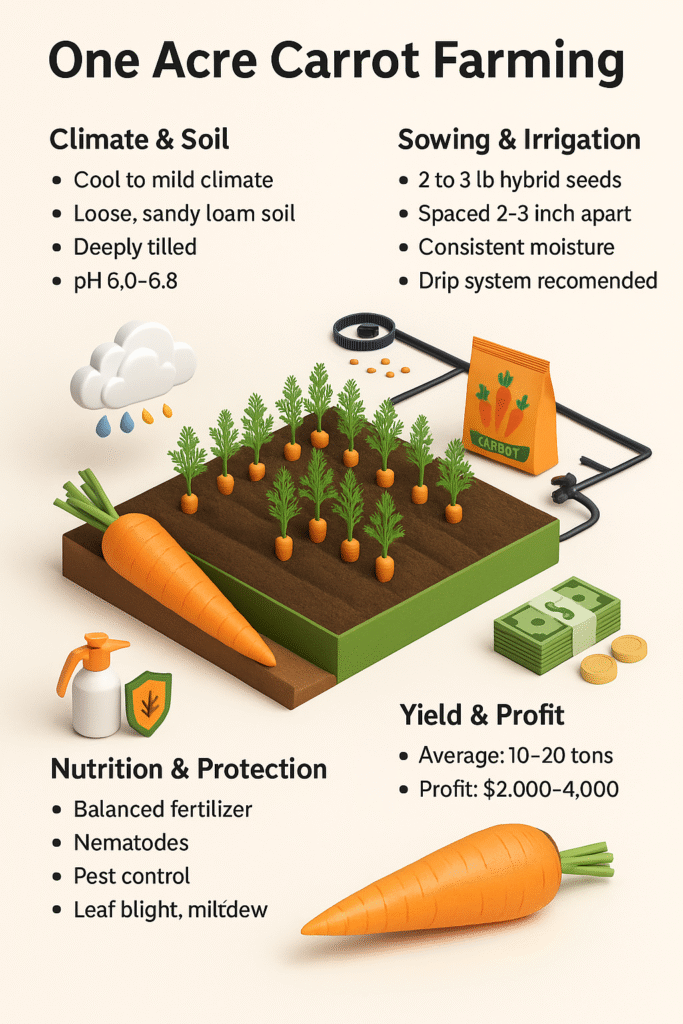
The first thing you notice when you step into a carrot field in the early morning is the smell—fresh, wet, cool, and earthy in a way that very few crops can create. Carrot leaves hold dew like a memory of the night, tiny droplets sitting on fine lace-like foliage. When the farmer walks between the rows, the fragrance of disturbed soil mixes with a scent that is unmistakably carrot, even though the root still stays hidden under the earth. Carrot farming is one of agriculture’s quiet arts. Unlike large leafy crops that announce their growth loudly, carrots develop in silence beneath the surface, revealing their success only when the time is right.
The story of growing carrots on one acre is a story about trust—trust in soil, trust in timing, and trust in the invisible growth happening underground. Carrots are among the few vegetables where the most important part grows entirely hidden from the farmer’s eyes. This demands a different kind of skill, one where observation is done through leaves, soil texture, moisture feel, and climate rhythm. Farmers who master carrots develop a kind of intuitive eyesight—an ability to “see” underground without digging.
Around the world, carrots behave differently in every region.
In Europe, they grow slowly, forming firm, sweet, brightly coloured roots.
In Japan, carrots grow with almost surgical perfection—uniform, smooth, long, and aesthetically flawless.
In Africa, carrots grow rapidly but need constant moisture to avoid cracking.
In India, carrots shift personality with seasons—the winter carrots grow deep, sweet, and flavourful; summer varieties grow shorter but faster.
In the US and Canada, cold climates produce some of the best storage carrots on Earth.
One acre of carrot farming begins with soil. Carrot soil must feel soft, airy, and forgiving. If you close your fist around perfect carrot soil, it should crumble gently like warm sand mixed with fine flour. Carrots hate stones, hard chunks, and compaction. Even a single small stone can cause a carrot to fork—splitting into two or three roots, reducing value instantly. This is why farmers sieve or deeply plough soil before sowing. A carrot’s shape is a reflection of soil freedom. The straighter the root, the better the soil.
Climate decides carrot sweetness. Carrots grown in cooler temperatures store sugar, developing deeper flavour and better colour. Carrots grown in hotter climates grow faster but often less sweet. This is why the best carrot seasons worldwide align with winter or mild spring.
Sowing carrots is not like transplanting seedlings. It is an act of precision. Seeds are tiny and lightweight, almost dust-like. They must be spaced carefully, either by hand, seed drill, or fine distribution methods. Too many seeds in one place create overcrowding, producing thin, weak roots. Too few seeds leave empty patches. The farmer walks slowly, lowering seeds into soft beds, knowing that the next three months of growth depend on this quiet moment.
Once seeds sprout, the field enters its most delicate stage. Carrot seedlings look like thin green threads barely able to face the world. A single weed can overshadow them. A strong wind can uproot them. Too much water can bury them. Too little water can dry them. The farmer must maintain balance—soft moisture, clean soil, and gentle sun.
As the plants grow, the first carrot leaves appear—feathery, bright green, and light in texture. The plant remains humble above the soil, giving little indication of what is happening beneath. Farmers rely on leaf density, leaf height, and soil rise near the root zone to judge underground growth. If leaves appear lush and upright, roots are usually forming well. If leaves remain too small or pale, the soil is either too hard or nutrient-deficient.
Irrigation forms the true heartbeat of carrot farming.
Carrots demand consistent moisture.
Not flooding, not dryness—just a steady rhythm.
Uneven watering causes roots to crack.
Shallow watering causes short, stubby carrots.
Overwatering causes rot.
Farmers often test moisture by pressing fingers into the soil. If the soil feels cool and moist an inch below, the plants are happy. If the surface dries but the inner zone stays moist, the crop grows with confidence. Carrots never want sudden emotional watering—they want calm, predictable hydration.
Nutrition for carrots is a dialogue between soil and plant. Too much nitrogen produces leafy plants but small roots. Too much potassium gives colour but reduces size if given early. Carrots respond well to organic-rich soils, where nutrients release slowly. Farmers who dump heavy fertilizers early often end up with patchy growth. Carrots ask for balance—not excess.
As days pass, the field begins to thicken. Leaves sway with even the slightest wind. Farmers may pull a single plant occasionally—not for harvest, but for inspection. This tiny act tells everything: shape, colour, uniformity, moisture balance, soil softness, and potential yield.
Pests rarely attack carrots aggressively above ground, but below ground, nematodes can distort roots terribly. Wireworms and root maggots also appear depending on region. Farmers who rotate crops and avoid planting carrots after solanaceous crops prevent most underground pest issues.
Diseases start when humidity stays trapped between foliage. Alternaria leaf blight creates patchy brown spots. Powdery mildew appears when nights stay cool and dry. But in well-spaced fields with good airflow, disease pressure stays low.
Carrots reach maturity differently in every climate. In cold regions, they mature slowly but beautifully. In warm environments, they grow fast but require closer attention. Farmers judge maturity by touching the crown—if the top of the carrot pokes slightly above soil and feels firm, it is nearly ready. Colour also deepens near harvest.
Harvesting carrots feels like uncovering treasure. The farmer pulls the leaf bunch gently; if the root resists slightly and then slides out cleanly, the soil was just right. Each carrot comes out with a distinct earthy scent—sweet, damp, and alive. Some carrots emerge long and slender; others thick and bold. Every single root is a story of underground patience.
The field after harvest looks like a textured landscape—small holes everywhere, traces of orange left behind, soil disturbed like memory. Farmers spread harvested carrots in shade, washing lightly and sorting based on size and shape. Premium roots go to supermarkets and export. Medium roots go to local markets. Small ones often go to processing units.
Worldwide carrot prices depend heavily on season.
USA: $0.8–3.0/kg
Europe: $1.0–4.0/kg
Middle East: $0.5–2.0/kg
Asia: $0.2–1.0/kg
Africa: $0.1–0.5/kg
Carrots sell unbelievably well in winter across all climates.
In summer, only strong storage varieties maintain supply.
One acre yield varies widely:
Low care: 6–8 tons
Good management: 10–14 tons
High performance: 15–20 tons
Exceptional: 22–30 tons
Profit from one acre reflects yield + season:
Average profit: $2,000–$4,000
High-season profit: $5,000–$7,000
Off-season profit: $7,000–$10,000
Carrot farming teaches humility.
It hides progress underground.
It tests patience without showing growth.
It demands trust, balance, rhythm, and subtle observation.
Carrots reward farmers who listen—listen to soil, water, climate, and silence.
Standing in a mature carrot field before harvest feels like standing on a secret. Beneath the soil lie thousands of roots—each shaped by the quiet decisions the farmer has made for months. And when those roots finally emerge, the field reveals that no silent growth is ever wasted.
One acre of carrots is a story of invisible growth, patient waiting, and final reward.
✍️Farming Writers Team
Love Farming Love Farmers
Read A Next Post 👇