• One Acre Blueberry Farming High Profit, Export Oriented Complete Guide

    Blueberry Farming
    1. Introduction: Why Blueberry Is One of the Most Profitable One-Acre Crops Worldwide

    Blueberry is not just a fruit — it is a global superfood industry.
    Rich in antioxidants, vitamin K, polyphenols, and anti-aging properties, blueberry prices stay premium in every international market.

    Blueberries are massively grown in:

    USA

    Canada

    Peru

    Poland

    Netherlands

    Spain

    Japan

    China

    And now spreading to:

    India (Himachal, Uttarakhand, Kashmir)

    Middle East (Controlled farming)

    Africa (Kenya, South Africa)

    Blueberry demand > Supply
    Yeh ek ultra-premium crop hai jo 1 acre me ₹20–35 lakh yearly kama sakta hai agar scientific farming follow ki jaye.

    1. Climate Suitability for Blueberry Farming (World Regions Classification)

    Blueberries need specific climate, so regional accuracy is important.

    A. Temperate Climate (Best)

    Perfect regions:

    USA North

    Canada

    Europe North

    Himalayan belts

    Requirements:

    Winter chilling hours: 800–1200

    Summer: 18–26°C

    Frost tolerance: good

    B. Sub-tropical (Moderate)

    India Northeast

    China South

    Japan warmer zones

    Requirements:

    Winter chilling: 400–600

    Summer: <30°C

    Shade nets required

    C. Controlled Environment (Polyhouse)

    Areas:

    UAE

    Qatar

    Saudi Arabia

    Africa arid regions

    India plains (polyhouse only)

    Requirements:

    Temperature control: 18–28°C

    Soil pH adjustment

    Drip + fertigation essential

    1. Soil Requirements (MOST IMPORTANT PART)

    Blueberries have very unique soil needs:

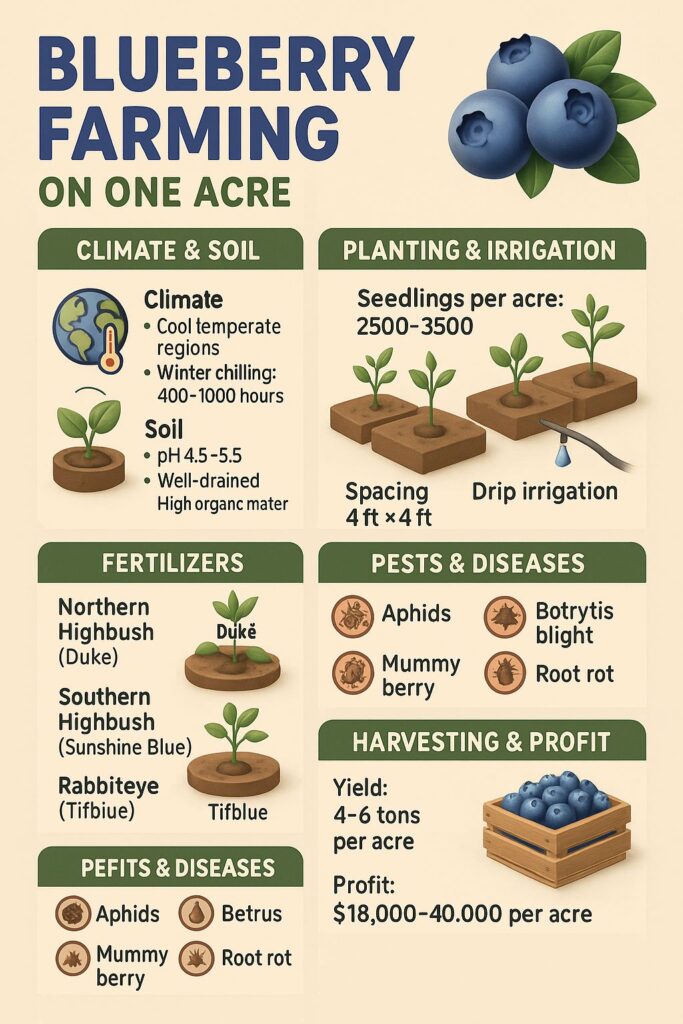
    pH = 4.5 to 5.5 only (Acidic)

    Normal soil pH = 6–8 hota hai → blueberry fail ho jata hai.

    Soil must be:

    Light sandy

    Organic-rich

    Moisture-retentive

    Well-drained

    High peat content

    Ideal Soil Mix for Blueberry Beds Per Acre

    40% Cocopeat

    30% Pine bark / sawdust

    20% Sand

    10% Compost

    Add Sulphur granules to lower pH

    Without this mix, blueberries do not grow.

    1. One-Acre Plantation Layout (Exact Professional Blueprint)

    Plant Spacing:

    4 ft × 4 ft

    OR 4 ft × 3 ft (high density)

    Plant Population in One Acre:

    Standard density → 2500 plants/acre

    High density → 3500 plants/acre

    Bed Preparation:

    Height: 18–24 inches

    Width: 3–4 ft

    Length: full row

    Mulch: pine bark, dry leaves

    Drip Irrigation Layout:

    2 lateral lines per bed

    4L/hr drippers

    Watering twice daily

    1. Blueberry Varieties (WORLDWIDE SELECTION GUIDE) Northern Highbush

    Best for cold climates
    Top varieties:

    Duke

    Bluecrop

    Chandler

    Southern Highbush

    Best for warmer regions
    Top varieties:

    Misty

    Star

    Sunshine Blue

    Legacy

    Rabbiteye Blueberries

    Best for hot climates
    Top varieties:

    Brightwell

    Tifblue

    Premier

    India Special Varieties:

    Biloxi

    Sharpblue

    Misty

    1. Exact Seedling Requirement & Nursery Guide

    One Acre Plantation Needs:

    2500–3500 tissue culture plants

    Preferably 1-year old

    Height: 6–12 inches

    Root system: must be fibrous, healthy

    Best Planting Time by Countries:

    RegionBest Planting TimeUSA/CanadaSpring (Feb–April)EuropeApril–MayIndia (Hills)Feb–MarchIndia (Plains Controlled)Anytime under polyhouseMiddle EastOctober–February

    1. One-Acre Blueberry Farming Investment Breakdown

    A) Land Preparation Cost

    Bed formation: $600

    pH adjustment chemicals: $200

    Soil mixture: $800

    B) Plant Cost

    2500 plants × $1–$2 = $2,500 – $5,000

    C) Drip Irrigation

    $350 – $450

    D) Mulching Material

    $300 – $500

    E) Fertilizers + Micro Nutrients

    $250 – $400 yearly

    F) Pest & Disease Control

    $120 – $200 yearly

    G) Labor Cost

    $300 – $500

    Total Investment (1st Year):

    $5,000 – $8,000 (₹4.1 – ₹6.8 lakh)

    From year 2, cost reduces massively.

    1. Irrigation Schedule (Exact Water Requirement)

    Blueberry roots are shallow → they need constant moisture.

    Season-wise irrigation need:

    SeasonWater RequirementSummer3–4 L per plant/dayWinter1.5–2 L per plant/dayRainyStop or reduce

    Best Techniques:

    Drip irrigation (mandatory)

    Moisture sensors

    Mulching for water retention

    1. Fertilizer Schedule (Month-by-Month FULL PROGRAM)

    Base Feeding (per plant per year)

    Vermicompost: 2 kg

    Peat moss: 500 g

    Sulphur: 30 g

    Bone meal: 100 g

    NPK Schedule (Year 1–2)

    March: NPK 12:10:10 – 40g

    April: NPK 19:19:19 – 20g

    June: NPK 0:52:34 – 30g

    August: NPK 13:00:45 – 30g

    Micro Sprays

    Boron

    Magnesium

    Zinc

    Calcium nitrate

    1. Pest & Disease Management (WORLD STANDARD)

    Common Pests:

    Aphids – Spray Neem oil 3% or Imidacloprid
    Thrips – Spinosad
    Mites – Abamectin
    Stem borer – Copper oxychloride paste

    Diseases:

    Root rot → Trichoderma
    Anthracnose → Copper fungicide
    Rust → Mancozeb
    Powdery mildew → Sulphur spray

    1. Flowering to Harvest Timeline (Exact PHASES)

    Year 1

    Vegetative growth

    No fruit

    Year 2

    Light flowering

    Harvest: 0.5–1 ton

    Year 3

    Good production

    2–3 ton

    Year 4 onwards

    Full production = 4–6 tons per acre

    1. Harvesting, Grading, Packing (Export Standard)

    Grading:

    Size 18 mm+ = Premium

    Size 14–18 mm = Standard

    Below 12 mm = Processing

    Packing

    125g clamshell

    250g premium box

    500g family pack

    Storage

    4°C for 14–21 days

    Controlled atmosphere: 30+ days

    1. Market Selling Guide (Complete World Map Strategy)

    A) Local Premium Markets

    Supermarkets

    Hotels

    Resorts

    Cafes

    Juice bars

    B) Online Selling (Direct Profit)

    Instagram store

    WhatsApp business

    Farm website

    Amazon (dehydrated)

    C) Export Markets (Highest Profit)

    Top countries buying blueberries:

    USA

    Canada

    Netherlands

    UK

    UAE

    Kuwait

    Singapore

    Japan

    Export price = $7–$14/kg

    1. Value Addition = 2X to 5X Profit

    You can create:

    Blueberry jam

    Dried blueberries

    Freeze-dried powder

    Blueberry juice

    Smoothie concentrate

    Blueberry wine (Europe/USA legal)

    1. Insurance & Loan (Worldwide Guide)

    India:

    PMFBY (Pradhan Mantri Fasal Bima Yojana)

    NABARD Horticulture Loan

    Agriculture Infrastructure Fund

    NHB Subsidy (up to 40%)

    USA:

    USDA Specialty Crop Insurance

    Europe:

    CAP Agriculture Fund

    UAE/Middle East:

    Hydroponic/greenhouse subsidies

    1. One-Acre Blueberry Profit Calculation

    Production:

    4–6 tons (4000–6000 kg)

    Average price:

    Local: $4–$6
    Export: $7–$14

    Total Revenue:

    $25,000 – $55,000 per acre
    (₹20 – ₹45 lakh)

    Net Profit:

    $18,000 – $40,000 per acre
    (₹14 – ₹32 lakh)

    1. Conclusion

    Blueberries are among the most profitable farming crops in the world.
    One-acre blueberry farming can transform youth into global agripreneurs with:

    High demand

    High market price

    Long-term income

    Export potential

    Anti-aging superfood industry

    Yeh crop future me gold mine ban sakta hai.

    1. FAQs

    Q1: Can blueberries grow in hot regions?
    Only in controlled conditions or with Rabbiteye varieties.

    Q2: How long do plants survive?
    20–25 years.

    Q3: Do blueberries need acidic soil?
    Yes — strong requirement.

    Q4: What is the best fertilizer?
    Acidic fertilizers + organic mix.

    Q5: Can beginners grow it?
    Yes, if soil pH maintained.

    Read A Next Post 👇

    https://farmingwriters.com/one-acre-stevia-farming-complete-profit-business-guide/

    ✍️Farming Writers

    Love Farming Love Farmers
  • One Acre Kiwi Farming: Complete High-Income Global Farming Business Guide

    One Acre Kiwi Farming


    1. Introduction: Why Kiwi Is the Future of High-Profit Farming

    Kiwi is one of the most profitable fruits worldwide.
    It grows best in:

    India (Himachal, Uttarakhand, NE states)

    Italy

    New Zealand

    Chile

    Turkey

    China

    USA

    Kiwi consumption is increasing globally due to:

    High vitamin C
    Immunity boosting
    Low calories
    Premium fruit segment
    High storage life (up to 60 days)

    Kiwi sells 3 to 10 times higher than apple or orange.

    If youth start kiwi farming even on one acre, they can earn huge sustainable income for 20–25 years.

    2. Climate & Soil Needed for Kiwi Farming

    Kiwi requires:

    Climate

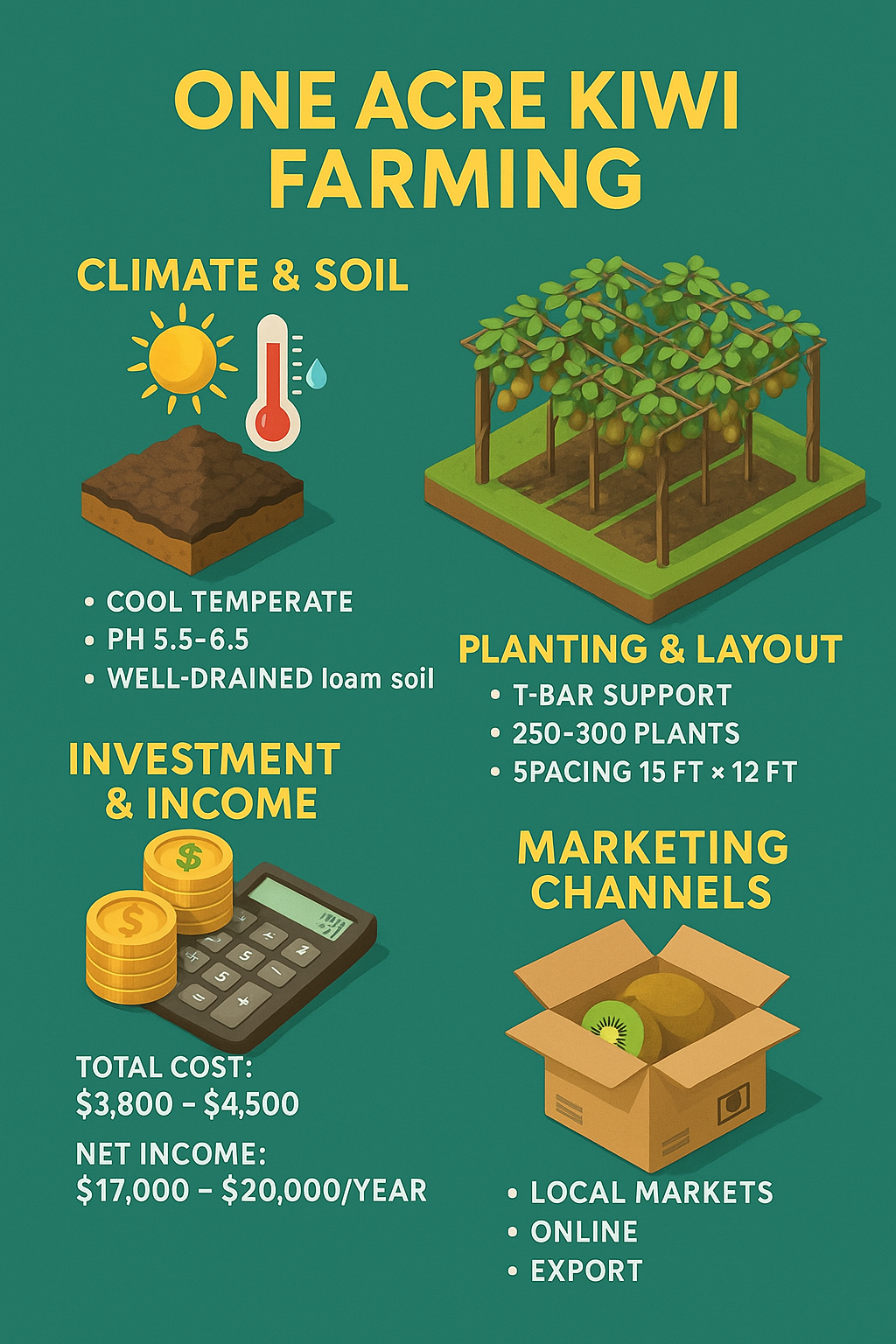
    Cool temperate region

    1000–1500 mm rainfall

    10–30°C temperature

    Frost-free winters

    Humidity 60–75%

    Soil

    pH: 5.5–6.5

    Sandy-loam / loam soil

    Rich organic matter

    Deep-well drained soil

    3. One-Acre Kiwi Orchard Layout (Professional Design)

    Plant Spacing:

    12×10 ft or 15×12 ft

    Plants Needed:

    Total plants in 1 acre: 250–300

    Male : Female Ratio = 1:6

    Support System:

    Kiwi needs a T-Bar/Pergola System:

    Costly but long-life (20–25 years)

    Best for heavy fruiting

    Height: 6–7 feet

    Wire gauge: 2–4 mm

    4. Investment Cost for 1 Acre Kiwi Farming (Professional Budget)

    ItemCost (USD)Cost (INR)Land preparation$250₹20,000High-quality plants (300)$900₹75,000T-Bar Support System$1,500₹1,20,000Drip irrigation$350₹30,000Organic fertilizers$200₹16,000Labor cost$300₹25,000Mulching$120₹10,000Plant protection$80₹6,500Maintenance$150₹12,000

    Total Investment:

    $3,800 – $4,500
    ₹3.1 – ₹3.8 lakh

    5. Planting Method (Step-by-Step Professional Instructions)

    Step 1 — Dig Pits

    Size: 2×2×2 ft

    Fill with compost, FYM, sand, neem-cake

    Step 2 — Planting

    Plant female on trellis wires

    Male plants after every 6 female plants

    Step 3 — Training

    Kiwi must be trained in cordon system

    Maintain single main stem

    Side branches evenly spaced

    Step 4 — Mulching

    Keeps moisture

    Reduces weeds

    6. Irrigation Requirement

    Kiwi needs regular moisture

    Drip irrigation recommended

    Summer: daily light watering

    Winter: once in 3–4 days

    Critical period:
    Flowering
    Fruit enlargement

    7. Manure & Fertilizer Schedule (One-Acre Orchard)

    Organic

    FYM 10–12 kg per plant annually

    Vermicompost 2 kg per plant

    Chemical

    NPK 1 kg per plant (split in 3 cycles)

    Boron spray

    Micronutrient spray every 30 days

    8. Flowering & Pollination

    Flowering Time:

    April–May

    Pollination:

    Bees are required
    You can keep bee boxes for better fruit set

    Pollination efficiency determines fruit size, weight & quantity.

    9. Kiwi Fruit Yield (Realistic Per Acre Production)

    Year 1:

    Vegetative growth (no yield)

    Year 2:

    Light yield: 1–2 tons

    Year 3:

    Medium yield: 3–4 tons

    Year 4 onwards (Full Production):

    5–7 tons per acre

    10. Kiwi Selling Price (World Market)

    MarketPrice per kgIndia retail$2.5 – $4 (₹180–₹300)India wholesale$1.8 – $2.5UAE$4 – $6Europe$4 – $7USA$5 – $8

    Premium varieties (Zespri-level) sell higher.

    11. Income & Profit Calculation (Per Acre)

    Production:

    6,000 kg (6 tons)

    Selling Price:

    Average global = $4/kg

    Total Revenue:

    $24,000 per year (₹19–20 lakh)

    Net Profit (After expenses):

    $17,000 – $20,000 (₹13–16 lakh)

    Profit increases every year as orchard matures.

    12. Value-Added Kiwi Products

    You can earn 200–400% more by selling:

    Kiwi juice

    Kiwi jam

    Kiwi squash

    Dehydrated kiwi chips

    Kiwi fruit powder

    Kiwi wine (Europe/USA legal)

    13. Worldwide Marketing Channels (Global Selling Strategy)

    A. Local Markets

    Supermarkets

    Fruit shops

    Hotels & resorts

    B. Online Selling

    Your own website

    Instagram store

    WhatsApp business

    ONDC (India)

    C. Export Markets

    Best countries:

    Dubai

    Bahrain

    Qatar

    Saudi Arabia

    Europe

    Singapore

    Japan

    14. Kiwi Farming as a Youth Startup

    Youth can create:

    Kiwi brand

    Kiwi nursery

    Kiwi juice brand

    Export kiwi supplier

    Cold-storage kiwi dealer

    Kiwi farming has huge global demand and very few suppliers.

    15. Risk & Disease Management

    Common Problems:

    Root rot

    Canker

    Sun scorch

    Low pollination

    Solutions:

    Good drainage

    Copper fungicide

    Shade nets in peak summer

    Bee keeping for pollination

    16. Conclusion

    Kiwi is among the top premium fruits globally.
    One-acre kiwi farming can generate:

    6–7 tons yield
    ₹13–16 lakh yearly profit
    Massive export opportunities
    20 years of continuous income

    Youth can easily build a long-term farming career with kiwi.

    17. FAQs

    1. Is kiwi farming profitable in 1 acre?

    Yes, extremely profitable.

    2. Can kiwi grow in hot regions?

    Need cooler climates; but high-altitude hot regions can work.

    3. How long does kiwi plant survive?

    20–25 years.

    4. Do kiwi need support system?

    Yes, T-bar or pergola is essential.

    5. Is export business easy?

    Yes, kiwi has stable international

    Read A Next Post 👇

    https://farmingwriters.com/one-acre-dragon-fruit-farming-profit-guide/

    ✍️Farming Farmers

    Love Farming Love Farmers

  • One Acre Dragon Fruit Farming: High Profit & Export Business Guide

    Dragon Fruit Farming


    1. Introduction: Why Dragon Fruit Is the Best One-Acre Crop

    Dragon fruit is one of the world’s top high-value fruits.
    It grows in:

    India

    Vietnam

    Thailand

    Malaysia

    UAE

    South America

    Africa

    And sells at premium rates globally.

    Dragon fruit is:

    Low water crop
    Heat tolerant
    High yielding
    Grows for 20+ years
    100% export friendly

    1 acre = lifelong income if managed properly.

    2. Why Dragon Fruit Is Perfect for Youth

    Low maintenance

    Works even on poor soils

    Easy pruning

    One-time pole setup

    High profit (₹10–15 lakh per acre)

    Easy online selling

    Youth can easily convert this into a startup farming business.

    3. One-Acre Perfect Dragon Fruit Layout

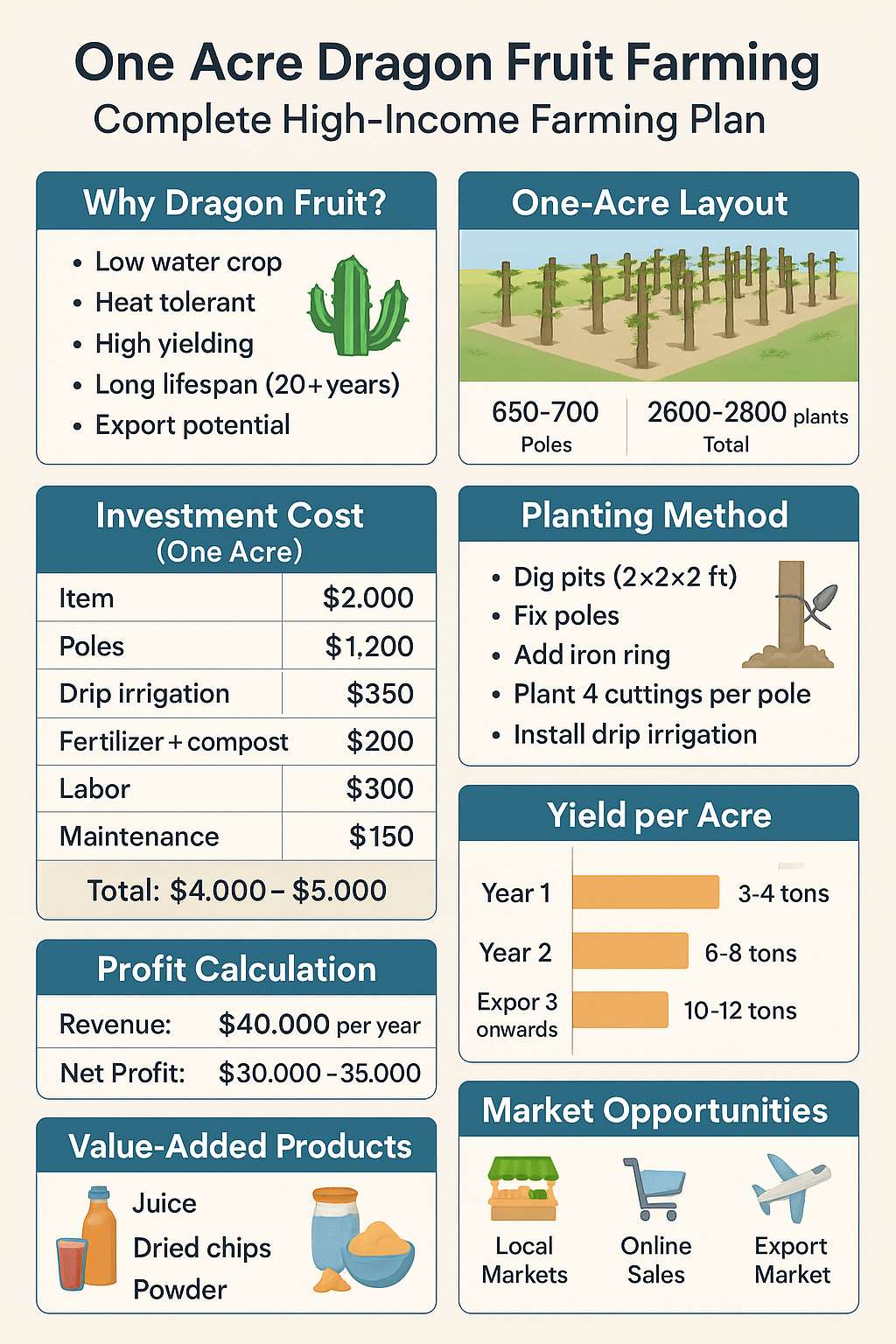
    Total poles needed: 650–700 poles
    Plants per pole: 4 cuttings

    Total plants: 2600–2800

    Spacing:

    Row: 10 ft

    Pole gap: 8 ft

    4. Climate & Soil Requirement

    Best climate:
    Hot & dry regions
    20–35°C temperature
    Full sunlight

    Soil:
    pH 6–7.5
    Well-drained

    Doesn’t need fertile soil — grows even in rocky areas.

    5. Investment Cost (One Acre)

    ItemCost (USD)Cost (INR)Poles (700)$2,000₹1,60,000Plants$1,200₹95,000Drip irrigation$350₹30,000Fertilizer + compost$200₹16,000Labor$300₹25,000Maintenance$150₹12,000

    Total Investment:

    $4,000 – $5,000
    ₹3.3 – 4.2 lakh

    One-time setup, income comes for 20 years.

    6. Planting Method

    Dig pits: 2×2×2 ft

    Add compost + sand + cow dung

    Fix cement poles (6–7 ft tall)

    Add iron ring on top

    Plant 4 cuttings per pole

    Install drip irrigation

    Mulch the area

    Growth starts within 20–25 days.

    7. Irrigation Schedule

    Summer: 20–25 minutes daily

    Winter: 10–15 minutes daily

    Rainy: Stop irrigation

    Dragon fruit hates overwatering.

    8. Manure & Fertilizer

    Apply every 45 days:

    Vermicompost

    NPK 10:10:10

    Neem cake

    Micro-nutrients

    Spray organic fungicide monthly.

    9. Flowering & Fruit Development

    First fruiting: 8–10 months

    Commercial yield: 18–20 months

    Full production: Year 2 onwards

    5–6 cycles per year

    10. Yield Calculation (1 Acre)

    Year 1:

    3–4 tons fruit

    Year 2:

    6–8 tons

    Year 3 onwards:

    10–12 tons

    11. Selling Price (Global Market)

    MarketPrice per kgIndia wholesale$2 – $3India retail$4 – $5UAE Export$6 – $7Europe$7 – $10

    12. Profit Calculation (One Acre)

    Production:

    10,000 kg (10 tons)

    Selling Price (avg): $4/kg

    Total Revenue:

    $40,000 per year
    = ₹32 lakh

    Net Profit (after expenses):

    ₹25–28 lakh per acre per year
    $30,000 – $35,000

    And income increases each year.

    13. Global Market Selling Strategy

    A. Local Market

    Fruit shops

    Hotels

    Supermarkets

    B. Online Market

    Use:

    Instagram

    Facebook

    WhatsApp

    ONDC

    Amazon (for dried dragon fruit)

    C. Export Market

    Top buyers:

    UAE

    Bahrain

    Qatar

    Singapore

    Malaysia

    Europe

    Start with:

    APEDA (India exporters)

    Farm-to-export companies

    Cold-chain logistics

    14. Value-Added Products

    You can convert unsold fruit into:

    Dragon fruit juice

    Dried chips

    Powder for smoothies

    Ice cream flavour

    Dragon fruit jam

    These earn 3× more profit.

    15. Risk Management

    Use drip irrigation

    Avoid overwatering

    Maintain pruning

    Add mulch

    Use biofencing

    Keep poles strong

    16. Conclusion

    Dragon fruit is one of the most profitable one-acre crops in the world.
    Low water + high price + long life + export demand = perfect business for youth.

    With proper market strategy, one acre can generate ₹25–30 lakh yearly, making it a global agribusiness model.

    17. FAQs

    1. Does dragon fruit need a lot of water?

    No, it is a drought-tolerant crop.

    2. Can beginners grow dragon fruit?

    Yes, it is one of the easiest fruit crops.

    3. How long does one plant survive?

    20+ years.

    4. Is export possible from one acre?

    Yes, even 4–5 tons can be exported.

    5. Is it profitable?

    Extremely — one of the highest-income crops.


    Read A Next Articals 👇

    https://farmingwriters.com/one-acre-farming-business-profit-guide/

    ✍️Farming Writers

    Love Farming Love Farmers
  • One Acre Farming Business Guide: High Profit Crops & Smart Agriculture for Youth

    One Acre Farming Business

    1. Introduction: The Future of Farming Is Smart Farming

    Today, the world is shifting from traditional agriculture to business-oriented smart farming. Whether you live in India, Africa, Europe, South America, or Asia — one acre of land is enough to build a profitable agriculture enterprise.

    Youth across the world can start farming with:

    Low investment

    High-value crops

    Smart irrigation

    Digital marketing

    Direct selling

    Modern storage & packaging

    This guide explains how to use one acre to build a powerful farming business that works anywhere in the world.

    2. Step-by-Step Guide: How to Start Farming on One Acre

    Step 1: Test Your Soil & Water

    Before choosing crops, test:

    Soil pH

    Organic matter

    Water quality

    Drainage

    This helps select the right crop that suits your land.

    Ideal pH for profitable crops:

    6.0 to 7.5 → Best for vegetables & fruits

    5.5 to 7.0 → Herbs, flowers, stevia

    6.0 to 6.8 → Moringa, medicinal crops

    Step 2: Select the Most Profitable Crop Mix (Global Model)

    Below is the best worldwide one-acre layout to maximize profit:

    0.35 Acre → Dragon Fruit

    High demand in UAE, Europe, Malaysia, Singapore.

    0.25 Acre → Stevia (Natural Sweetener)

    Used in global beverages & health products.

    0.20 Acre → Moringa (Leaves + Powder)

    USA & Europe “superfood market”.

    0.15 Acre → Protected Vegetables (Capsicum, Lettuce, Cucumber)

    Year-round production.

    0.05 Acre → Bee-keeping for Honey

    Bonus income, zero maintenance.

    Optional → Biofloc Fish Farming

    High return from small space.

    Step 3: Prepare Your Land

    Use the following methods:

    Plough 2–3 times

    Add organic compost

    Install drip irrigation

    Create proper rows and beds

    Add mulch to reduce weeds

    Step 4: Planting & Management

    Dragon Fruit

    Use concrete poles

    4-arm support

    Proper sunlight

    Prune regularly

    Stevia

    Plant in line spacing

    Irrigate every 2–3 days

    Harvest leaves after 70–90 days

    Moringa

    Fast-growing

    Highly drought-tolerant

    Leaves can be dried and powdered

    Vegetables (Net house)

    Use hybrid or organic seeds

    Maintain humidity

    Keep pests controlled

    Bee-keeping

    Place boxes near flowering crops

    Collect honey every 15–20 days

    3. How to Sell Your Farm Products (World Market Guide)

    This is the most important part. Yuva ko farming tab pasand aayegi jab unhe earning ka clear system mile.

    A. Local Direct Selling

    Sell directly to customers

    Create WhatsApp broadcast list

    Deliver fresh vegetables & fruits

    B. Retail Shops & Hotels

    Approach restaurants, cafes, organic stores

    Offer weekly supply contracts

    C. Online Selling

    Sell via:

    Facebook Marketplace

    Instagram store

    Farm-fresh website

    Google Maps listing

    Indians → ONDC / Flipkart / Meesho

    USA/Europe → Etsy (moringa, herbs)

    D. Export Markets

    High-demand export items:

    Moringa powder

    Stevia leaves

    Dragon fruit

    Honey

    Dried vegetables

    You can sell to:

    UAE

    Oman

    Qatar

    Europe

    USA

    Singapore

    E. Bulk Buyers

    Pharma companies (for stevia + moringa)

    Supermarkets

    Herbal product companies

    Juice & beverage companies

    4. Branding: How to Build a Farm Brand (Worldwide)

    This is where youth farming becomes startup.

    Brand Name Ideas:

    NatureRoot Farms

    GreenPulse Organics

    PureLeaf Naturals

    DragonFresh Farms

    OneAcre Harvest

    Branding Steps

    Use attractive packaging

    Add QR code origin details

    Use social media for story branding

    Create “chemical-free” or “organic” identity

    Logo + Color Ideas

    Green & white = purity

    Yellow = organic

    Blue = export-quality freshness

    5. Profit Calculation (Full Breakdown)

    CropAnnual ProfitDragon fruit$12,000–$16,000Stevia$7,500–$9,000Moringa$4,000–$6,000Vegetables$4,000–$6,000Honey$1,250–$2,000Biofloc fish$1,400–$2,500

    Total Profit:

    $30,000 – $42,000+ per year
    ₹25 – 35 lakh per acre per year

    Depends on marketing + yield + location.

    6. Youth: How to Make Farming a Career

    Youth want:

    Profit
    Technology
    Branding
    Market access
    Online selling
    Simple start

    You can start farming like a startup:

    Use solar pumps

    Use drip irrigation

    Use sensor irrigation systems

    Keep digital records

    Sell online

    Build your own brand

    7. Most Profitable Crops for Any Country (Top 10 List)

    Dragon fruit

    Saffron

    Stevia

    Moringa

    Ginger + Turmeric

    Mushrooms

    Aloe vera

    Lemongrass

    Organic vegetables

    Medicinal herbs

    8. FAQs

    1. Can I start farming with low investment?

    Yes, start with 1–2 high-value crops, then expand.

    2. How to get buyers?

    Use Instagram, WhatsApp, local shops, hotels, online platforms.

    3. Can farming be done without experience?

    Yes, basic training and practical guidance is enough.

    4. What is the best crop for one acre?

    Dragon fruit + vegetables + herbs combination.

    5. Can youth make farming a business?

    Yes, farming is now a high-income startup.

    Conclusion

    One-acre farming is not small. With smart planning, it becomes a global income model.
    Youth can easily make ₹25–35 lakh per year if they follow:

    Right crops
    Right marketing
    Brand building
    Technology
    Diversified farming

    Farming is not just a tradition — it is now one of the most powerful business careers worldwide.

    Read A Next Post 👇

    https://farmingwriters.com/one-acre-dragon-fruit-farming-profit-guide/

    ✍️Farming Writers

    Love farming Love Farmers