INTRODUCTION
Azalea (botanical group: Rhododendron spp.) is one of the world’s most admired ornamental flowering shrubs, cultivated for its vibrant blooms, landscaping value, year-round greenery, and strong commercial demand in global nursery markets. Azaleas produce clusters of funnel-shaped flowers in a wide range of colors including red, pink, white, purple, orange, yellow, and bi-colors. Their striking appearance makes them essential in high-value landscaping projects, garden designs, public parks, home gardens, resorts, hotels, and botanical collections.
Azaleas belong to the Ericaceae family and are closely related to rhododendrons. Although rhododendrons include both trees and shrubs, Azaleas typically refer to the smaller shrubs with more delicate flowers and thinner leaves. Their natural habitat includes forest floors, mountainous regions, riverbanks, and temperate woodland areas. They thrive in locations with moist air, acidic soil, indirect sunlight, and well-drained organic media.
Japan, South Korea, the USA, China, Netherlands, Belgium, and Germany are the largest Azalea markets. The plant is deeply rooted in Asian culture—especially in Japan and South Korea—where it is considered a symbol of elegance, balance, and seasonal beauty. In western countries such as the USA and Europe, Azaleas are widely used in residential landscaping, public garden design, and premium nursery trade.
Commercially, Azalea farming is profitable because:
Demand is stable year-round.
Potted Azaleas sell at high prices globally.
Shrubs have long life and repeat flower cycles.
Landscaping industries require huge volumes every season.
Plants can be exported as live potted shrubs.
Azalea is a slow but profitable crop. A well-grown shrub can be sold for years, and its value increases with maturity. Large garden centers, landscaping contractors, resorts, real-estate developers, and export nurseries remain consistent buyers.
This guide provides a complete A-to-Z explanation of Azalea farming, including climate, soil, propagation, shade-house systems, irrigation, fertilization, pruning techniques, pest and disease control, post-harvest handling, global USD market insights, international demand, profit models, uses, health benefits, precautions, and 20 complete FAQs with detailed answers.
SCIENTIFIC CLASSIFICATION & ORIGIN
Common Name: Azalea
Scientific Group: Rhododendron spp.
Family: Ericaceae
Origin: Asia, North America, Europe
Plant Type: Evergreen or deciduous flowering shrub
Commercial Height: 0.5 to 2.5 meters
Natural Habitat: Forest floors, mountain slopes, moist temperate zones
Global Leading Producers: Japan, South Korea, Netherlands, USA, China, Germany
Azaleas originated in temperate woodland areas where soils are rich in leaf mold, rainfall is consistent, and sunlight is filtered. This natural setting defines the essential conditions for their successful cultivation.
There are two major groups:
Evergreen Azaleas (Rhododendron simsii group):
– Popular in Japan, China, and USA nurseries.
– Used for indoor/outdoor decorative potted plants.
Deciduous Azaleas (Rhododendron luteum group):
– Preferred in colder countries.
– Produce fragrant blooms.
Japan has shaped the commercial Azalea industry. Satsuki Azaleas and Kurume Azaleas are globally famous hybrids developed in Japan hundreds of years ago. These hybrids are now major exports.
COMPLETE CULTIVATION GUIDE
CLIMATE REQUIREMENTS
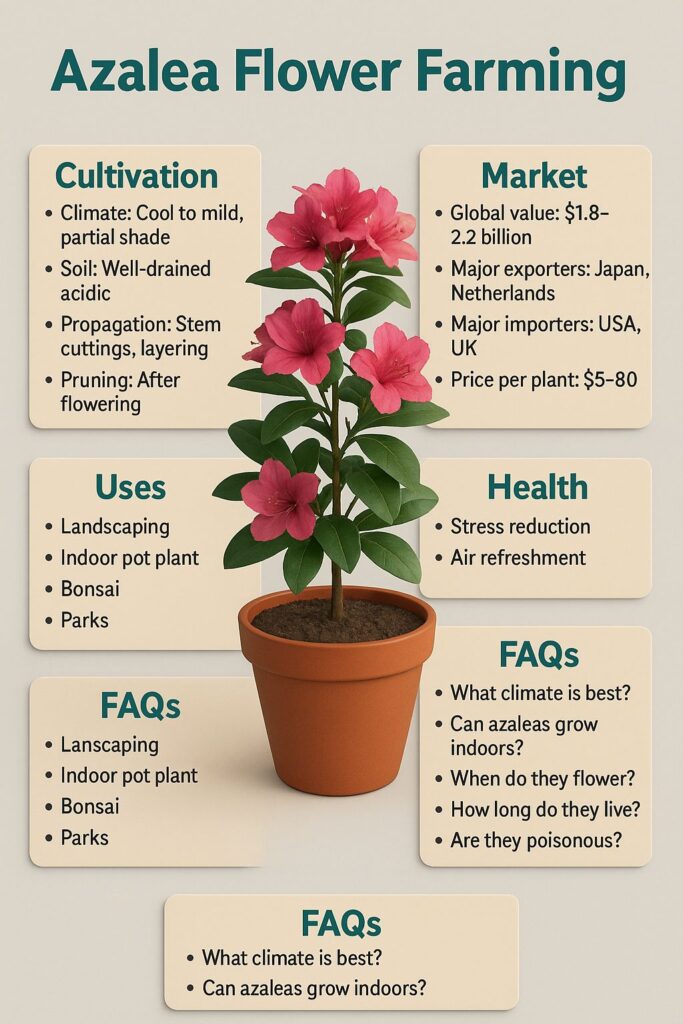
Azaleas thrive in cool to mild climates with diffused sunlight.
Ideal growing conditions include:
Temperature: 12–25°C
Humidity: 50–80%
Sunlight: Partial shade, morning sunlight only
Rainfall: 800–1500 mm annually
Altitude: Up to 2500 meters
Direct afternoon sun burns leaves. Frost damages young plants. In tropical regions, Azaleas must be grown under shade nets.
SOIL REQUIREMENTS
Azaleas require highly acidic, organic-rich soil similar to forest humus.
Ideal Soil Characteristics:
pH: 4.5–5.5
High organic content
Good aeration
Excellent drainage
Moist but not waterlogged
Best Soil Mix for Commercial Farming:
40% Pine bark or leaf mold
30% Coco peat
20% Sand
10% Compost
Azaleas cannot tolerate alkaline soil. If pH rises beyond 6.0, iron deficiency appears, leading to yellow leaves.
PROPAGATION METHODS
1. Stem Cuttings (Most Common)
Semi-hardwood cuttings of 7–10 cm root within 6–8 weeks when treated with rooting hormone.
2. Air Layering
Used for large-sized, mature plants.
3. Tissue Culture
Used for large-scale export nurseries for uniformity.
4. Seeds
Used mostly for breeding new hybrids, not for commercial plantation.
NURSERY MANAGEMENT
Mist propagation chambers for rooting
50–70 percent shade
Fungus-free environment
Bottom heat system for rooting (20–24°C)
Young plants are shifted to bigger pots or raised beds after 2–3 months.
FIELD / SHADE-HOUSE PLANTING
Spacing:
Medium varieties: 40 x 40 cm
Large varieties: 60 x 60 cm
Dwarf varieties: 30 x 30 cm
Plant Density:
20,000 to 25,000 plants per hectare (shade house)
For commercial nurseries, pot production is preferred.
IRRIGATION MANAGEMENT
Azaleas require moisture but cannot tolerate standing water.
Irrigation frequency:
– Summer: Daily light watering
– Winter: Every 2–3 days
Never wet the flowers directly
Use drip or micro-sprinklers
Rainwater is best because of natural acidity
FERTILIZATION PROGRAM
Azaleas require light but consistent feeding.
Before Planting:
2–3 kg leaf mold per plant
100–150 g bone meal
Seasonal Feeding:
NPK 12:6:8 (low nitrogen)
Apply every 30 days
Chelated iron for acidity maintenance
Magnesium sulfate to prevent leaf yellowing
Avoid heavy nitrogen — it weakens flowering.
PRUNING & TRAINING
Pruning is essential for shape, airflow, and flower production.
Prune immediately after flowering season
Remove dead twigs, inward branches
Shape plant to maintain airflow
Avoid pruning in winter
Professional nurseries practice pinching for compact shape.
PEST & DISEASE MANAGEMENT
Major Pests:
Lace bugs
Aphids
Spider mites
Caterpillars
Controls:
Neem-based sprays
Horticultural soap
Sticky traps
Diseases:
Root rot
Petal blight
Powdery mildew
Leaf gall
Preventive Measures:
Good drainage
Proper spacing
Copper fungicides
Avoid overhead irrigation
Azaleas are very sensitive to poor soil drainage.
FLOWERING & HARVESTING
Flowering Season
Main season: Spring
Some varieties bloom twice a year
Harvesting
Azaleas are sold as:
Potted flowering shrubs
Landscaping shrubs
Bonsai Azaleas
Nursery saplings
Plants are shipped with moist media and protective sleeves.
GLOBAL MARKET ANALYSIS (USD)
Global Azalea market value (2024): 1.8–2.2 billion USD
Expected CAGR: 5.2% (2025–2030)
Major Exporters: Japan, Netherlands, Germany, China
Major Importers: USA, UAE, Saudi Arabia, Singapore, UK
Price Structure:
Small potted Azalea: 6–10 USD
Medium shrub: 12–25 USD
Large shrub: 30–80 USD
Premium bonsai Azalea: 50–200 USD
Rare hybrids: 100–500 USD
Asian markets (Japan/Korea) dominate bonsai-grade Azalea demand.
USES OF AZALEA
Garden landscaping
Indoor decorative pot plant
Bonsai
Border plantations in gardens
Hotel/resort beautification
Large public parks
Flower exhibitions
House warming gifts
Corporate indoor plants
Botanical collections
HEALTH BENEFITS
Azaleas are not medicinal but provide psychological and environmental benefits:
Stress reduction due to soothing visuals
Improvement in indoor humidity
Natural air refreshment
High ornamental aesthetics improve mental relaxation
PRECAUTIONS
Many Azalea species are toxic if consumed
Keep away from pets and children
Avoid using for any medicinal purpose
Do not plant in alkaline soil
COST & PROFIT ANALYSIS (USD)
Investment per hectare (shade house):
Shade house: 25,000–40,000 USD
Planting material: 10,000–15,000 USD
Media and pots: 8,000 USD
Labor & maintenance: 6,000–10,000 USD
Total Investment: 50,000–70,000 USD
Annual Returns:
60,000–120,000 plants
Average price: 5–15 USD
Gross Revenue: 300,000–900,000 USD
Net Profit: 180,000–300,000 USD
20 FAQS WITH FULL ANSWERS (COMPLETE)
1. What climate is best for Azalea farming?
Cool to mild climates (12–25°C), with partial shade and moderate humidity.
2. Can Azaleas grow in India?
Yes, especially in hill regions, northeastern states, and shaded areas with acidic soil.
3. How often should Azaleas be watered?
Light watering daily in summer; every 2–3 days in winter.
4. Do Azaleas need acidic soil?
Yes. Ideal pH is 4.5–5.5. Alkaline soil kills the plant.
5. Can Azaleas grow indoors?
Yes, evergreen varieties grow well indoors if kept in bright, indirect light.
6. What kills Azaleas quickly?
Waterlogging, alkaline soil, direct afternoon sun, and poor ventilation.
7. How long do Azaleas live?
With proper care, 20–50 years.
8. How fast do Azaleas grow?
Slow-growing, reaching full size in 3–5 years.
9. When do Azaleas flower?
Mainly spring, some hybrids bloom twice.
10. How to make Azaleas bloom more?
Use acidic soil, proper pruning, balanced fertilizer, and filtered light.
11. Can Azaleas be grown hydroponically?
No, because they require acidic organic substrate.
12. Which countries export Azaleas most?
Japan, Netherlands, Germany, China.
13. Which countries import Azaleas most?
USA, UK, UAE, Saudi Arabia, Singapore.
14. Are Azaleas poisonous?
Yes, toxic if consumed by humans or pets.
15. What fertilizer is best?
Low-nitrogen acidic fertilizers like 12:6:8.
16. What is the price of Azalea plants?
5–80 USD depending on size.
17. Which variety is best for indoor use?
Evergreen Satsuki and Kurume hybrids.
18. How much shade is needed?
50–70 percent.
19. How to identify nutrient deficiency?
Yellow leaves indicate iron deficiency due to neutral soil.
20. Are Azaleas profitable for farmers?
Yes, extremely profitable with annual net profit of 180,000–300,000 USD per hectare.
CONCLUSION
Azalea flower farming is a powerful commercial opportunity in the global ornamental plant industry. Its strong international demand, premium landscaping value, and high nursery price make it a profitable crop for farmers, exporters, and nursery owners. With proper soil acidity, climate control, pruning, and shade management, Azaleas deliver high-quality, high-value shrubs suitable for local and international markets.
Azalea flower farming, Azalea cultivation, Rhododendron farming, Azalea market value, Azalea global demand, ornamental shrubs farming, landscaping flower plants
✍️Farming Writers
Love Farming Love Farmers