• Snapdragon Flower Farming: Complete Cultivation, Uses & Global Floriculture Guide

    Snapdragon Flower Farming

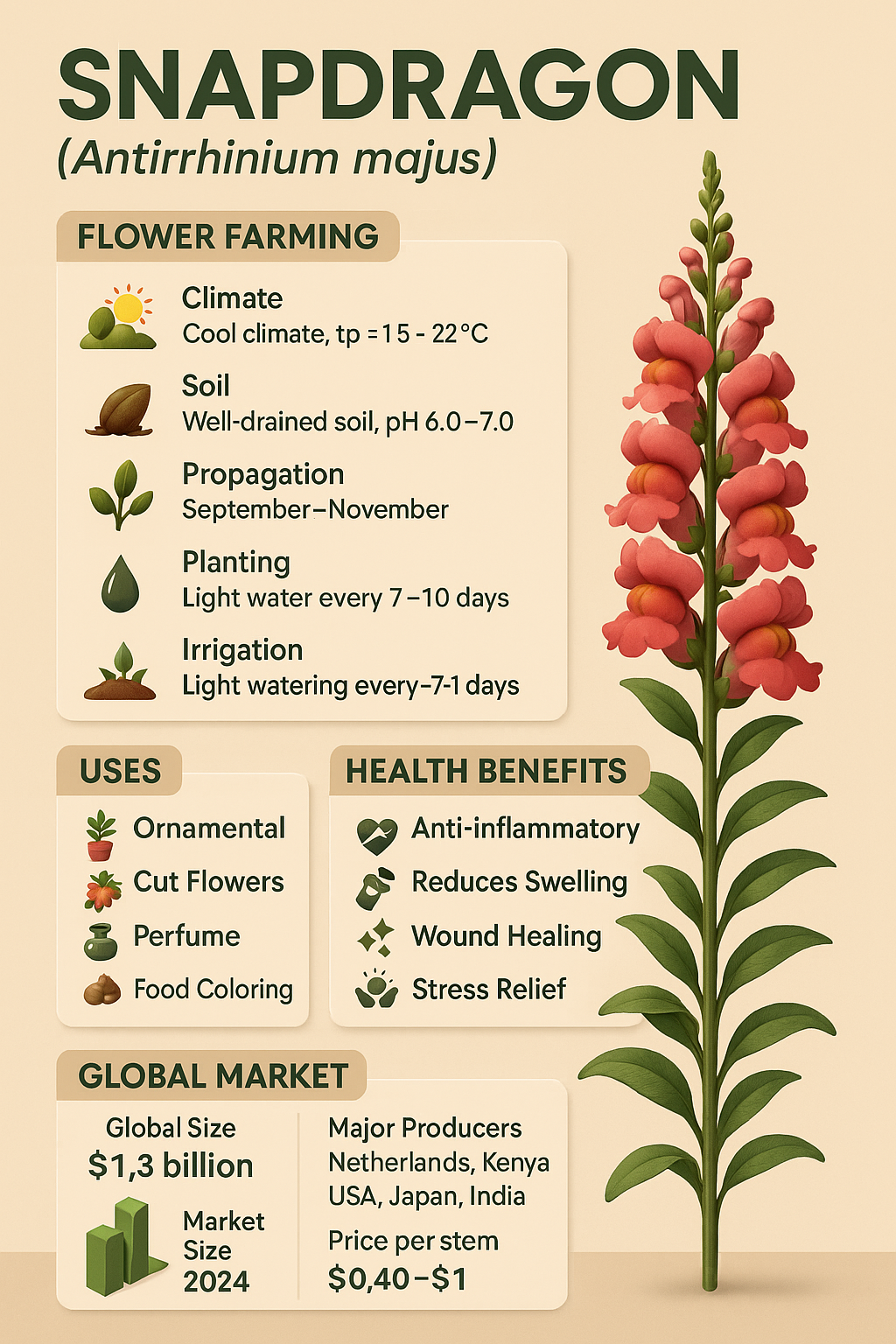
    Snapdragon (Antirrhinum majus) is one of the most famous winter-season cut flowers admired globally for its tall spikes, dragon-shaped blooms, long vase life, and rich color varieties. Known as Dog Flower in India, and “Snapdragon” in Europe and the USA, this flower gets its name because pressing the sides of its blossom makes it look like a dragon opening its mouth.

    Snapdragon is commercially cultivated across Netherlands, USA, Japan, Italy, Israel, Kenya, India, and China. It is a major flower in the cut-flower industry, especially in international flower auctions.
    It comes in a wide color spectrum like pink, red, yellow, purple, white, orange, and bi-colors, making it a favorite for:

    High-end bouquets

    Wedding decorations

    Church & festival décor

    Floral arrangements

    Indoor ornamental use

    Apart from ornamental use, Snapdragon has applications in perfume, essential oil industry, dye extraction, and natural food coloring due to the presence of anthocyanin pigments.

    Snapdragon is one of the most profitable winter-season exotic flowers because:

    High demand in flower shops & premium florists

    High vase-life of 7–14 days

    Perfect for exports

    Works well in greenhouse/polyhouse farming

    Strong demand in weddings & events

    Is blog me hum A to Z Snapdragon farming, soil, climate, seed propagation, greenhouse production, pest management, harvesting, global market, trade, uses, health benefits, FAQs, and USD profit model detail se cover karenge.

    Scientific Classification & Origin

    Common Name: Snapdragon / Dog Flower

    Scientific Name: Antirrhinum majus

    Family: Plantaginaceae

    Origin: Mediterranean & Southern Europe

    Plant Type: Annual/Biennial

    Height: 30 cm – 120 cm

    Top Producers: Netherlands, Kenya, USA, Japan, Italy, India

    Snapdragon is native to the Mediterranean mountains, where it evolved as a hardy winter flower. Its commercial adoption began in Netherlands, the world leader in flower auctions.

    Globally, Snapdragon is among the top 15 cut-flower varieties sold in floral markets due to its unique shape, color range, and premium appeal.

    Snapdragon Flower Farming Guide

    Climate Requirement

    Snapdragon is a cool-season crop.
    Best climate:

    Temperature: 15–22°C

    Humidity: 50–70%

    Cannot tolerate high temperatures above 30°C

    Prefers long-day and bright light

    Best grown in:

    Winter climates (India)

    Greenhouses (tropical countries)

    Soil Requirement

    Well-drained sandy loam soil

    pH 6.0–7.0

    Soil rich in organic matter

    Avoid heavy clay soils

    Before planting, add:

    Farmyard manure (FYM 15–20 tons/ha)

    Neem cake 300–500 kg/ha

    Propagation Methods

    Snapdragon is propagated through seeds.

    Seed germination temperature: 16–20°C

    Germination time: 8–14 days

    Transplanting after 30–35 days

    Seeds are extremely fine — mix with sand for uniform sowing

    Hybrid varieties are commercially used for export-quality flowers.

    Planting & Spacing

    Best planting time: September–November

    Spacing:

    20 × 30 cm (dwarf)

    30 × 45 cm (tall varieties)

    Plant density: 35,000–45,000 plants/ha

    Irrigation

    Light irrigation every 7–10 days

    Drip irrigation is ideal

    Avoid wet leaves to prevent fungal diseases

    Fertilizer Schedule

    Basal Dose:

    FYM: 20 tons/ha

    NPK: 60:40:40

    Top Dressing:

    Nitrogen every 25–30 days

    Micronutrients: Boron, Calcium, Magnesium

    Foliar sprays: 19:19:19 once every 15 days

    Good nutrition boosts:

    Spikes length

    Number of florets

    Color brightness

    Pest & Disease Management

    Common Pests:

    Aphids

    Thrips

    Caterpillars

    Whiteflies

    Control:

    Neem oil 2%

    Sticky traps

    Organic insecticidal soap

    Diseases:

    Damping off

    Fusarium wilt

    Powdery mildew

    Rust

    Stem rot

    Control:

    Trichoderma in soil

    Copper fungicide

    Proper ventilation

    Flowering & Harvesting

    Flowering

    Begins in 70–90 days

    Tall spikes harvested at ⅓ florets open stage

    Best quality spikes: 60–90 cm

    Harvesting

    Harvest early morning

    Cut stem at 45° angle

    Immediately keep in preservative solution

    Shelf Life

    7–14 days (due to long-lasting spikes)

    Excellent for export

    Post-Harvest Handling

    Grade by stem length and spike quality

    Bundles of 10 or 20 stems

    Cold storage at 2–4°C

    Export in corrugated boxes

    Global Market & Trade Analysis

    Snapdragon is a high-value export flower.

    Global Market Size (2024):

    USD 1.3 billion

    Major Exporters:

    Netherlands

    Kenya

    Israel

    Colombia

    Japan

    India (growing market)

    Top Importers:

    Germany

    UK

    UAE

    USA

    France

    Singapore

    Australia

    Price Trends

    Wholesale: $0.40–1 per stem

    Retail: $2–4 per stem

    Bouquets: $10–35 per bunch

    Snapdragon is a preferred winter flower in Europe & the USA due to its:

    Long vase life

    Luxury appeal

    Exotic shape

    Netherlands Flower Auctions control 60% of global Snapdragon trade.

    Uses of Snapdragon Flower

    Ornamental Uses – gardens, landscapes, balconies

    Cut Flowers – bouquets, wedding arches, arrangements

    Perfume Industry – aromatic extracts used in perfumes

    Food Coloring – anthocyanin-based natural pigment

    Ayurveda & Herbal Uses – anti-inflammatory

    Cosmetic Industry – used in creams and soaps

    Health Benefits of Snapdragon

    Anti-inflammatory

    Reduces swelling

    Used for healing minor skin wounds

    Antioxidant

    Stress-relief aroma

    Improves mood

    Traditional herbal medicine uses Snapdragon paste for skin cooling.

    Precautions & Side Effects

    Not edible

    Sensitive skin may react

    Avoid ingestion by pets

    Use gloves while pruning

    Cost & Profit Analysis (USD)

    Investment per hectare

    Land + preparation: $3,000

    Seeds: $1,200

    Fertilizer + irrigation: $1,500

    Labor: $2,000

    Total Cost: $7,000–8,500

    Revenue

    Production: 180,000–250,000 stems/ha

    Selling price: $0.40–1 per stem

    Total Revenue: $25,000–60,000

    Net Profit

    $18,000–45,000 per hectare annually

    Snapdragon = Top 5 profitable winter cut flower crops.

      FAQs

    (Ready-to-publish):

    How long does Snapdragon take to grow?

    Which climate is best for Snapdragon farming?

    Can Snapdragon grow in pots?

    What is Snapdragon used for?

    Is Snapdragon edible?

    How much profit from Snapdragon farming?

    How many stems per hectare?

    How to increase stem length?

    Which fertilizer is best for Snapdragon?

    Can Snapdragon be grown organically?

    What is Snapdragon’s vase life?

    Which country exports Snapdragon the most?

    How to control rust disease in Snapdragon?

    Can Snapdragon grow in hot climate?

    What is the spacing for Snapdragon plants?

    Is Snapdragon good for bouquets?

    How to store Snapdragon after harvest?

    Can Snapdragon be exported?

    Which Snapdragon variety is best for cut-flowers?

    What is Snapdragon’s symbolic meaning? (Strength & grace)

    Conclusion

    Snapdragon farming is a high-profit floriculture business with strong global demand in the cut-flower, wedding, festival, and perfume industries. Its long, colorful spikes and long shelf life make it a premium flower in global flower auctions.

    With proper winter farming or greenhouse systems, Snapdragon can yield excellent returns of $18,000–45,000 per hectare. This makes it one of the most profitable flowers after roses, gerberas, lilies, and carnations.

    Snapdragon is not just a beautiful flower — it is a strong business opportunity for floriculture entrepreneurs in India and worldwide.

    Snapdragon flower farming, Antirrhinum majus cultivation, Snapdragon market, Snapdragon uses, Snapdragon profits, greenhouse Snapdragon farming

    ✍️Farming Writers

    Love farming Love farmers

    Read A Next Post 👇

    https://farmingwriters.com/gardenia-flower-farming-global-business/
  • Gardenia Flower Farming: Cultivation, Uses, Health Benefits & Global Market

    Gardenia Flower Farming


    Gardenia (Gardenia jasminoides) is one of the world’s most fragrant, elegant, and luxurious white flowers, widely cultivated for perfumes, ornamental gardens, essential oils, herbal medicines, and tea production. Originating from China and later popular in Japan, Korea, Southeast Asia, Europe, and USA, Gardenia has become a global high-value flower crop.

    Gardenia is famous for its strong, sweet, jasmine-like fragrance. The flower’s rich aroma makes it a key ingredient in premium perfumes, essential oil blends, body lotions, hair oil, soaps, and aromatherapy. In herbal and traditional Chinese medicine, the fruit and flower are used for fever reduction, detoxification, skin treatments, mood enhancement, and stress relief.

    Commercially, Gardenia is cultivated in China, Thailand, Japan, India, Vietnam, USA, France, and Italy. China dominates global production, especially of Gardenia blue pigment, Gardenia fruit extract, and Gardenia essential oil.

    Gardenia’s global market growth is driven by:

    High demand in perfume & aroma industry

    Increasing use in herbal & natural skincare products

    Export demand for fruits, extracts, and oils

    Ornamental landscaping & decorative pot plant industry

    This blog provides a complete A to Z guide for Gardenia farming—from cultivation methods, soil preparation, climate requirements, irrigation, pest management, harvesting, post-harvest handling, global market analysis, USD trade insights, uses, health benefits, FAQs, and profit analysis.

    Scientific Classification & Origin

    Common Name: Gardenia

    Scientific Name: Gardenia jasminoides

    Family: Rubiaceae

    Origin: China

    Top Producers: China, Japan, Thailand, India, Vietnam, USA, Italy

    Gardenia plants are evergreen shrubs with glossy green leaves and white flowers that bloom almost year-round in tropical climates. The plant thrives in humid subtropical climates and slightly acidic soils.

    Historical Significance:

    In China, it symbolizes purity and friendship.

    In Japan, it is used in religious ceremonies and tea rituals.

    In Europe, it became a luxury flower in the Victorian era.

    Gardenia fruit (Gardenia jasminoides Ellis) is used in herbal medicine and dye production, especially for natural blue and yellow pigments.

    Gardenia Flower Farming Guide

    Climate Requirement

    Gardenia grows best in:

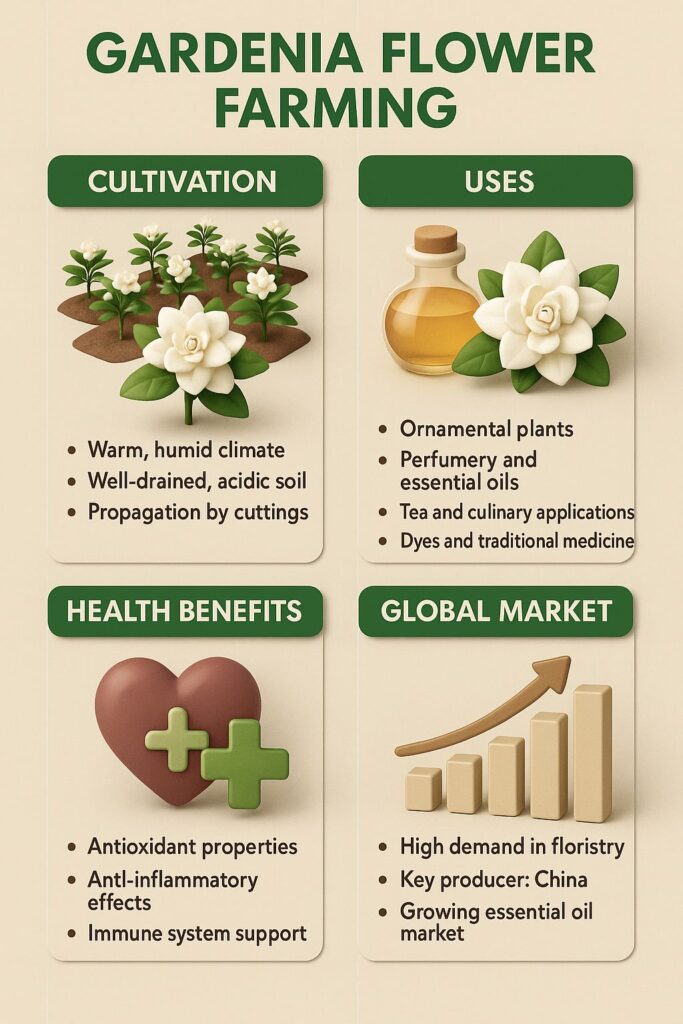
    Warm, humid climates

    Temperature: 20–30°C

    Humidity: 60–80%

    Partial sunlight (morning sun + afternoon shade)

    Cannot tolerate frost

    Gardenia prefers tropical & subtropical climates.

    Soil Requirement

    Best soil: Well-drained acidic soil (pH 5.0–6.5)

    Soil rich in organic matter

    Avoid calcareous or alkaline soils

    Mulching recommended

    Propagation Methods

    Gardenia is propagated through:

    Stem Cuttings (most common)

    Air Layering

    Tissue Culture (commercial nurseries)

    Seeds (slow, not recommended for commercial farming)

    Rooting hormones (IBA–NAA) improve success rate.

    Land Preparation

    Deep ploughing 2–3 times

    Add FYM 20 tons/ha

    Mix cocopeat, compost, and leaf mold for better aeration

    Raised beds recommended

    Planting & Spacing

    Best season: Monsoon or Spring

    Spacing:

    1.5 × 1.5 m (open field)

    1 × 1 m (greenhouse/pots)

    Plant Density: 4,000–6,000 plants/ha.

    Irrigation

    Requires regular irrigation

    Drip irrigation ideal

    Avoid overwatering—causes root rot

    Maintain consistent moisture

    Fertilization Schedule

    NPK (75:50:50 kg/ha)

    Monthly feeding of:

    Bone meal

    Vermicompost

    Magnesium sulfate (prevents yellow leaves)

    Sulfur (to maintain soil acidity)

    Pest & Disease Management

    Pests:

    Aphids

    Whiteflies

    Mealybugs

    Thrips

    Control: Neem oil, soap spray, biological predators.

    Diseases:

    Leaf spot

    Root rot

    Sooty mold

    Control:

    Copper oxychloride spray

    Trichoderma in soil

    Good aeration

    Flowering & Harvesting

    Flowering season: Spring–Summer–Monsoon

    Full bloom in 2–3 years

    Flowers hand-picked early morning

    For oil extraction, buds harvested before full bloom

    Post-Harvest Handling

    Store at 4–5°C

    Use hydrated preservatives

    Export packing: Corrugated boxes

    Essential oil extracted via steam distillation

    Global Market & USD Trade Analysis (500 Words)

    Market Size

    Global Gardenia Market (2024): USD 1.4 billion

    CAGR 2025–2030: 7.2%

    Major Producers

    China (largest grower + exporter)

    Thailand

    Japan

    India

    Italy

    USA

    Export Products

    Fresh flowers

    Dried flowers

    Essential oil

    Gardenia blue pigment

    Herbal extracts

    Gardenia fruit

    Price Analysis

    Fresh flowers: $0.50–1.50 per stem

    Gardenia oil: $1200–2000 per kg

    Gardenia fruit extract: $15–30 per kg

    Potted plant: $8–20 per plant

    Gardenia is a premium floral crop with strong demand in:

    Perfume industry (France, Italy)

    Cosmetics

    Aromatherapy

    Herbal medicine

    Tea markets (China, Japan)

    Uses of Gardenia

    1. Ornamental Uses

    Landscaping

    Gardens

    Bonsai

    Decorative pots

    Wedding bouquets

    2. Perfume & Cosmetic Uses

    High-end perfumes

    Essential oils

    Hair oils

    Skin lotions

    Natural soaps

    3. Herbal & Medicinal Uses

    Fever reduction

    Detoxification

    Anti-inflammatory treatments

    Skin healing

    Stress relief

    4. Culinary Uses

    Gardenia tea (Japan, Korea)

    Natural color pigment in food

    Health Benefits

    Relieves stress & anxiety

    Boosts immunity

    Reduces inflammation

    Improves skin glow

    Helps digestion

    Natural sedative for sleep

    Detoxifies liver

    Precautions & Side Effects

    Not safe for pregnant women in large amounts

    Essential oil must be diluted

    May cause skin irritation in sensitive people

    Cost & Profit Analysis (USD)

    Investment (per hectare)

    Land & preparation: $2,000–3,000

    Saplings: $3,000–4,000

    Fertilizers & irrigation: $1,500–2,000

    Labor: $1,500–2,000

    Total Cost: $8,000–11,000

    Returns

    Fresh flowers: $20,000–25,000

    Essential oil: $10,000–15,000

    Potted plants: $5,000–8,000

    Net Profit: $25,000+ annually per hectare

      FAQs

    1. What climate is best for Gardenia farming?

    Gardenia warm and humid subtropical climate me sabse achha grow hota hai, temperature 20–30°C ideal hota hai.

    2. How long does it take for Gardenia to bloom?

    Commercial varieties ko full bloom aane me 2–3 years lagte hain.

    3. Which soil is best for Gardenia?

    Acidic soil with pH 5.0–6.5, well-drained and organic matter rich soil best hoti hai.

    4. Can Gardenia be grown in pots?

    Haan, Gardenia pots, grow bags, aur containers me easily grow hota hai—bus soil acidic aur well-drained honi chahiye.

    5. Does Gardenia require full sunlight?

    Gardenia ko morning sunlight + afternoon shade pasand hai. Full-day harsh sunlight se flowers jal sakte hain.

    6. How often should Gardenia be watered?

    Week me 2–3 baar light irrigation. Zyada paani se root rot ho jata hai.

    7. Why do Gardenia leaves turn yellow?

    Yellow leaves ka main reason:

    Soil pH zyada alkaline

    Magnesium deficiency

    Overwatering

    Poor drainage


    8. Which fertilizer is best for Gardenia?

    Use acidic fertilizers:

    NPK 75:50:50

    Bone meal

    Magnesium sulfate

    Vermicompost


    9. How to increase Gardenia flower production?

    Acidic soil maintain karo

    Balanced NPK

    Proper sunlight

    Regular pruning

    Neem oil & fungicide sprays


    10. What are the main pests affecting Gardenia?

    Aphids, whiteflies, mealybugs, scale insects.

    11. Which diseases attack Gardenia most?

    Root rot, sooty mold, anthracnose, leaf spot.

    12. How can I control pests in Gardenia farming?

    Neem oil spray, soap solution, sticky traps, aur biological predators use karo.

    13. How is Gardenia essential oil extracted?

    Steam distillation method se premium Gardenia essential oil banta hai.

    14. What is Gardenia oil used for?

    Perfumes, skincare, aromatherapy, hair oils, soaps, lotions.

    15. Is Gardenia used in herbal medicine?

    Haan, Gardenia flower & fruit traditional Chinese medicine me:

    Fever

    Liver detox

    Anxiety

    Skin infections ke liye use hota hai.


    16. What is Gardenia tea?

    Gardenia flower aur fruit se herbal tea banti hai, jo digestion aur stress relief ke liye popular hai (Japan & China).

    17. Is Gardenia farming profitable?

    Haan, per hectare $25,000+ annual profit mil sakta hai agar flowers, potted plants, oil & extracts sale karo.

    18. Which countries import Gardenia the most?

    USA, Japan, France, UK, Italy, UAE, Singapore.

    19. How long do Gardenia plants live?

    Proper care se 10–15 saal ya usse bhi zyada zinda reh sakte hain.

    20. Can Gardenia be grown organically?

    Bilkul. Organic fertilizers, neem oil, compost, mulch aur bio-fungicides se pure organic Gardenia farming possible hai.


    Conclusion

    Gardenia farming is one of the most profitable fragrant flower businesses due to its massive demand in the perfume, cosmetic, tea, herbal, and ornamental industries. With proper farming practices, high-quality saplings, and export-focused production, Gardenia offers excellent returns and long-term sustainability.

    Gardenia flower farming, Gardenia cultivation, Gardenia jasminoides farming, Gardenia perfume industry, Gardenia tea, Gardenia market, Gardenia uses

    ✍️Farming Writers

    Love farming Love Farmers

    Read A Next Post 👇

    https://farmingwriters.com/sunflower-farming-guide/