• Potato Crop Care Complete Guide  Diseases,Pests, Nutrition & High-Yield Farming System

    Potato Crop Care

    Potato is a shallow-rooted, high-starch, cold-season crop.
    It responds dramatically to soil structure, seed quality, disease pressure and temperature.
    A small mistake in irrigation, seed treatment or blight management can destroy 60–100% yield within days.

    This guide provides world-standard potato crop care from soil to storage.

    1. Climate & Temperature Requirements

    Potato performs best when:

    Day temperature: 18–22°C

    Night temperature: 10–15°C

    Humidity: 60–70%

    Soil temperature: 15–20°C for tuber formation

    If temperature rises above 28°C, tuber formation slows or stops.
    If temperature drops below 8°C, vegetative growth becomes slow.

    High humidity → Late Blight outbreak
    High rainfall → Tuber rot + Black scurf

    1. Soil Preparation & Bed Design

    Potato needs loose, well-drained, aerated soil.
    Hard soil = deformed tubers + poor size.
    Wet soil = rotting + fungal attack.

    Ideal Soil Structure

    Sandy loam / loam

    Good organic matter

    pH 5.5–6.5

    Zero waterlogging

    Recommended Soil Boost

    Per acre:

    3–4 tons FYM

    200–300 kg neem cake

    25–30 kg gypsum (for uniform tuber shape)

    Trichoderma compost mixture

    40–50 kg biochar

    Raised beds give the best results as they:

    Prevent waterlogging

    Increase aeration

    Improve tuber expansion

    Reduce scab infection

    1. Seed Tuber Treatment: MOST IMPORTANT STEP

    Potato me disease seed ke through hi aata hai, isliye healthy seed tuber is everything.

    Select only:

    30–45 mm size

    Uniform skin

    No cracks

    No disease spots

    Sprout 0.5–1.0 cm long

    Seed Treatment (World Standard)

    Wash seed tubers

    Air dry

    Treat with:

    Trichoderma powder

    Pseudomonas fluorescens

    Light fungicide dip (if allowed in region)

    Cure seeds for 24 hours

    This step alone saves 50% disease risk.

    1. Planting & Spacing

    Spacing:

    60 cm × 20 cm

    For large tubers: 60 × 25 cm

    Depth:
    5–7 cm only.
    Too deep = delayed emergence + weak growth.

    Mulching:
    Organic mulch reduces weeds, moisture stress and early blight spread.

    1. Irrigation Management

    Potato hates:

    Excess water

    Irregular irrigation

    Irrigation schedule:

    1. Emergence stage:
      Light irrigation only.
    2. Vegetative stage:
      Regular moisture, no stress.
    3. Tuber initiation stage:
      This is the MOST IMPORTANT stage.
      Water shortage here → very small tubers.
    4. Tuber development:
      Stable moisture, no flooding.
    5. Maturity stage:
      Reduce irrigation to harden tubers before harvest.

    Overwatering signs:

    Yellowing

    Stem rotting

    Late blight outbreak

    Hollow heart in tubers

    1. Nutrient Management (Potato Nutrition Science)

    Potato absorbs nutrients fast because it has shallow roots.

    Basal Dose:

    NPK (12:32:16 or equivalent)

    FYM + neem cake

    Gypsum for shape uniformity

    Vegetative Stage:

    Nitrogen for canopy

    Micronutrients: Mg, Zn, B

    Tuber Initiation:

    Potassium-heavy feeding

    Calcium + Boron prevent cracking

    Tuber Development:

    Potassium is KING for size

    Magnesium improves starch quality

    Deficiency Symptoms:

    N deficiency = pale yellow

    K deficiency = brown edges

    Ca deficiency = tuber cracks

    B deficiency = misshaped tubers

    Mg deficiency = yellow veins

    1. Major Potato Diseases (A–Z)

    Potato is extremely disease-sensitive.
    Here are the world’s main killers:

    7.1 Late Blight (Most Dangerous Potato Disease)

    Pathogen: Phytophthora infestans

    Symptoms:

    Water-soaked dark spots

    White fungal growth underside

    Rapid leaf death

    Tuber rot

    Spread:
    Cold + humid + wet leaves

    Care:

    Perfect drainage

    Morning irrigation only

    Preventive fungicide rotation

    Remove infected leaves immediately

    Late blight can wipe out a field in 48 hours.

    7.2 Early Blight (Alternaria)

    Symptoms:

    Concentric ring spots

    Premature leaf drop

    Smaller tubers

    Care:

    Mulching

    Balanced nitrogen

    Remove old lower leaves

    7.3 Black Scurf (Rhizoctonia)

    Symptoms:

    Black crust on tubers

    Poor sprouting

    Weak plant growth

    Care:

    Seed treatment

    Soil Trichoderma

    Crop rotation

    7.4 Common Scab (Streptomyces)

    Symptoms:

    Rough scabby tuber skin

    No yield loss but poor market value

    Care:

    Maintain soil moisture

    Lower soil pH

    Avoid fresh manure

    7.5 Bacterial Soft Rot

    Symptoms:

    Mushy tubers

    Foul smell

    Care:

    Proper curing

    Dry, cool storage

    Avoid mechanical injury

    1. Potato Pests (A–Z Complete Guide)

    8.1 Potato Tuber Moth (PTM)

    Damage:

    Larvae bore tubers

    Holes + internal rotting

    Can attack storage too

    Care:

    Deep earthing up

    Remove exposed tubers

    Good storage aeration

    8.2 Aphids

    Primary virus carriers.

    Symptoms:

    Curling

    Sticky leaves

    Virus outbreak

    Care:

    Neem oil

    Yellow traps

    Keep field weed-free

    8.3 Whiteflies

    Carry potato apical leaf curl virus.

    Care:

    Reflective mulch

    Neem

    Vector-specific spray if needed

    8.4 Cutworms

    Cut seedlings at the base.

    Care:

    Deep ploughing

    Night monitoring

    Neem cake

    8.5 Wireworms

    Damage tubers inside soil.

    Care:

    Crop rotation

    Soil solarization

    Light traps

    1. Earthing Up: Potato’s Most Important Field Operation

    Earthing up does 5 major things:

    Protects tubers from sunlight

    Stops greening

    Prevents tuber moth damage

    Helps tuber enlargement

    Improves soil aeration

    Do earthing up twice:

    20–25 days

    40–45 days

    1. Weed Control & Soil Protection

    Weeds host:

    Aphids

    Whiteflies

    Mites

    Therefore:

    Keep borders clean

    Use mulch

    Manual weeding early

    1. Harvest & Storage Care

    Harvest timing:

    When 60–70% tops dry

    Tubers skin should be firm

    After harvest:

    Dry in shade for 1–2 days

    Grade properly

    Store at 8–14°C

    Zero moisture storage

    1. FAQ
    2. Why potato leaves suddenly blacken?
      Late blight outbreak due to moisture + humidity.
    3. Why tubers crack?
      Uneven watering or calcium deficiency.
    4. Why potato becomes small?
      Poor irrigation during tuber initiation.
    5. Why potato rots in soil?
      Waterlogging + fungal infection.
    6. Why sprouts become weak?
      Old tubers or black scurf.
    7. How to get big-size tubers?
      High potassium + stable moisture.
    8. Why tubers become green?
      Sun exposure (lack of earthing up).
    9. Best organic spray?
      Neem + garlic fermented extract.
    10. Best disease prevention?
      Mulching + weekly scouting + airflow.
    11. Best yield booster?
      Perfect irrigation + potassium feeding + early blight control.

    Conclusion

    Potato is a sensitive crop but highly rewarding when managed scientifically.
    Correct seed selection, proper soil preparation, ideal irrigation, balanced nutrition,
    and preventive pest–disease care ensure maximum yield and best tuber quality.
    This guide provides every major global technique a farmer needs.

    ✍️Farming Writers Team
    Love farming Love Farmers.

    Read A Next Post 👇

    https://farmingwriters.com/tomato-complete-crop-care-global-guide/
  • One Acre Potato Farming: Complete Worldwide Cultivation, Management and Export Profit Guide


    1. Introduction: Why Potato Is One of the Most Profitable Global Crops

    Potato is the 4th largest food crop in the world after rice, wheat and maize.
    It is grown in 160+ countries and consumed daily across:

    Homes

    Hotels

    Restaurants

    Chips and snacks industries

    French fries industry

    Food processing companies

    Export markets

    Frozen food manufacturers

    The global potato market exceeds $150 billion, making it one of the most stable, high-demand crops for commercial growers.

    One acre of potatoes can produce:

    10–14 tons average yield

    Up to 18–22 tons high management yield

    Potato farming provides a strong income, long-term storage stability, and high demand in every country year-round.

    2. Climate Requirement (Global Growing Zones)

    Potato prefers cool climates:

    Best temperature: 15–22°C

    Tubers stop growing above 30°C

    Frost-free climate needed

    Day length: 12–14 hours preferred

    Global Potato Regions

    USA (Idaho, Wisconsin, Washington)

    Europe (Germany, Netherlands, France, UK)

    China

    India (Punjab, UP, Gujarat)

    Russia

    Canada

    Bangladesh

    Kenya

    Peru (origin country)

    Potato is very adaptable to many regions due to its short duration growth cycle.

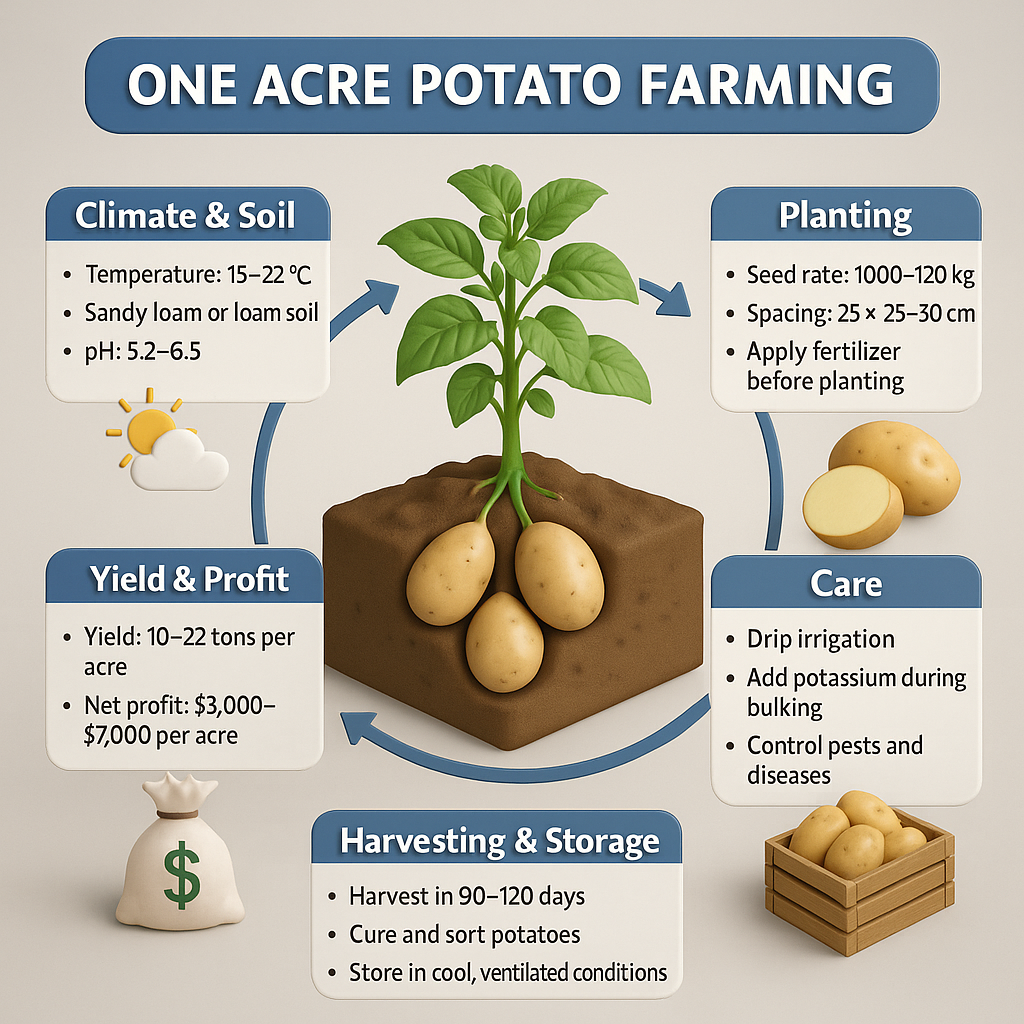
    3. Soil Requirements

    Potato thrives in:

    Sandy loam

    Loam soil

    Well-drained soil

    Deep loose soil for tuber expansion

    pH: 5.2–6.5

    Avoid heavy clay or waterlogged soils.

    Soil Preparation for One Acre

    Deep ploughing

    Add 8 tons compost

    Add 50 kg neem cake

    Prepare ridges and furrows at 2.5 ft spacing

    Install drip irrigation (optional but best)

    4. Seed Rate for One Acre (Exact Calculation)

    Potato is planted using seed tubers.

    Seed Requirement

    10–12 quintals (1000–1200 kg) per acre

    Seed size: 30–45 mm diameter

    Disease-free certified seed required

    Cut seed pieces only if tubers are large.

    Seed Treatment

    Fungicide dip (Mancozeb/Carbendazim)

    Dry under shade

    Apply Trichoderma powder

    Good seed quality = high yield.

    5. Recommended Global Potato Varieties

    Table Potatoes (Fresh Market)

    Kufri Pukhraj

    Kufri Jyoti

    Desiree

    Atlantic

    Yukon Gold

    Russet Burbank

    Processing Varieties (French Fries / Chips)

    Lady Rosetta (LR)

    Santana

    Innovator

    Frito-Lay varieties

    Hermes

    Early Maturity Varieties

    Kufri Bahar

    Kufri Khyati

    Early Rose

    6. Planting Layout for One Acre

    Spacing

    Row-to-row: 2.5 ft (75 cm)

    Plant-to-plant: 10–12 inches (25–30 cm)

    Plant Population

    14,000–16,000 plants/acre

    Planting depth: 3–4 inches.

    7. Irrigation Requirement (Precise Water Schedule)

    Potatoes require moisture but NOT standing water.

    Drip Irrigation (Best Method)

    First 20 days: 20–25 minutes daily

    Tuber initiation (most critical): 30–40 minutes daily

    Bulking stage: 40–50 minutes daily

    Maturity: Reduce irrigation

    Total Water Needed

    400–600 liters per acre per day (approx.)

    Excess water = rotting + disease.

    8. Fertilizer Schedule (Month-by-Month Program)

    Basal Dose (Before Planting)

    FYM: 8 tons

    NPK 12:32:16 → 50 kg

    Neem cake → 50 kg

    Fertigation Schedule

    Early Growth (Week 1–4)

    NPK 19:19:19 → 4 kg/week

    Urea → 4 kg/week

    Tuber Initiation (Week 5–6)

    Potassium nitrate → 5 kg/week

    Calcium nitrate → 2 kg/week

    Bulking Stage (Week 7–10)

    SOP (sulphate of potash) → 6 kg/week

    Magnesium sulphate → 2 kg/week

    Finishing (Week 11–12)

    MKP 0:52:34 → 3 kg/week

    Micronutrients

    Spray every 20–25 days:

    Boron → 0.2%

    Zinc → 0.5%

    Calcium → 0.5%

    Correct nutrient management increases tuber size and market grade.

    9. Earthing Up (Critical Operation)

    Two times required:

    First earthing: 25–30 days

    Second earthing: 45–55 days

    Earthing up prevents tubers from sun exposure and increases tuber weight.

    10. Pest & Disease Management (Global Standard)

    Major Pests

    Aphids

    Control: Imidacloprid

    Cutworms

    Control: Chlorpyrifos early soil drench

    Potato Tuber Moth

    Control: Pheromone traps + Spinosad

    Major Diseases

    Late Blight (Biggest threat)

    Control: Metalaxyl, Mancozeb

    Early Blight

    Control: Copper oxychloride + Carbendazim

    Black Scurf

    Control: Seed treatment (Trichoderma)

    Bacterial Wilt

    Control: Resistant varieties + crop rotation

    11. Harvesting Timeline

    Potato matures in:

    90–120 days depending on variety

    Signs of maturity:

    Plants dry from top

    Skins firm and not easily peeled

    Tubers uniform size

    12. Yield Per Acre

    Average yield

    10–14 tons per acre

    High yield (good management)

    18–22 tons

    13. Global Market Price (USD)

    RegionPrice per kgUSA$0.30 – $0.70Europe$0.25 – $0.80Middle East$0.20 – $0.50Asia$0.15 – $0.40Africa$0.10 – $0.30

    Processing potatoes (premium)

    $0.50 – $1.00 per kg

    14. Profit Calculation

    Revenue

    14,000 kg × $0.30 = $4,200
    22,000 kg × $0.40 = $8,800

    Cost Per Acre

    $1,200–$2,000

    Net Profit

    $3,000–$7,000 per acre

    Processing varieties may reach $8,000–$10,000 profit.

    15. Storage (Important for Higher Profit)

    Potato stores extremely well.

    Storage Conditions

    Temperature: 4°C

    Humidity: 90–95%

    Ventilated storage

    Sprout inhibitors (Chlorpropham)

    Farmers selling after 2–3 months earn 30–50% higher prices.

    16. Export Guide

    Top importing countries:

    UAE

    Malaysia

    Qatar

    Sri Lanka

    Bangladesh

    Oman

    Required documents:

    Phytosanitary certificate

    Certificate of origin

    Invoice

    Packaging list

    IEC code

    17. Value Addition

    Potato chips

    French fries

    Potato flakes

    Dehydrated potato powder

    Frozen potato products

    Value-added products give 2–5× profit.

    18. Conclusion

    Potato is a global, stable, high-demand crop ideal for commercial farming on one acre. With correct seed selection, irrigation, fertilization, and disease management, potato farming can generate consistent income with strong market stability and excellent storage potential.

    19. FAQ

    1. How many kg of potato per acre?

    10–22 tons.

    2. How many kg seed required?

    1000–1200 kg.

    3. What is the profit?

    $3,000–$7,000 (higher for processing varieties).

    4. Which fertilizer is best?

    Potassium-rich fertilizers during bulking stage.

    5. When to harvest?

    90–120 days.

    6. Best irrigation method?

    Drip irrigation.


    ✍️Read A Next Post 👇

    https://farmingwriters.com/one-acre-ginger-farming-complete-guide/

    ✍️Farming Writers

    Love farming Love farmers

  • Potato  Nutrition, Benefits, Farming, Cost, Profit and Global Market ,Farming Writers

    Potato – Nutrition,

    Potato – Nutrition, Benefits, Farming, Cost, Profit and Global Market | Farming Writers

    1. Introduction

    Potato (Solanum tuberosum) is one of the world’s most essential food crops, grown and consumed across every continent. Originating from South America, it has become a vital source of carbohydrates and nutrition for billions of people. Whether in India’s aloo sabzi, America’s fries, or Europe’s mashed potatoes, this humble tuber rules global kitchens.

    Potato farming is one of the most profitable agricultural ventures due to its short growing cycle, high yield, and continuous market demand. It can be cultivated in diverse climates, making it a reliable crop for both small and large-scale farmers.

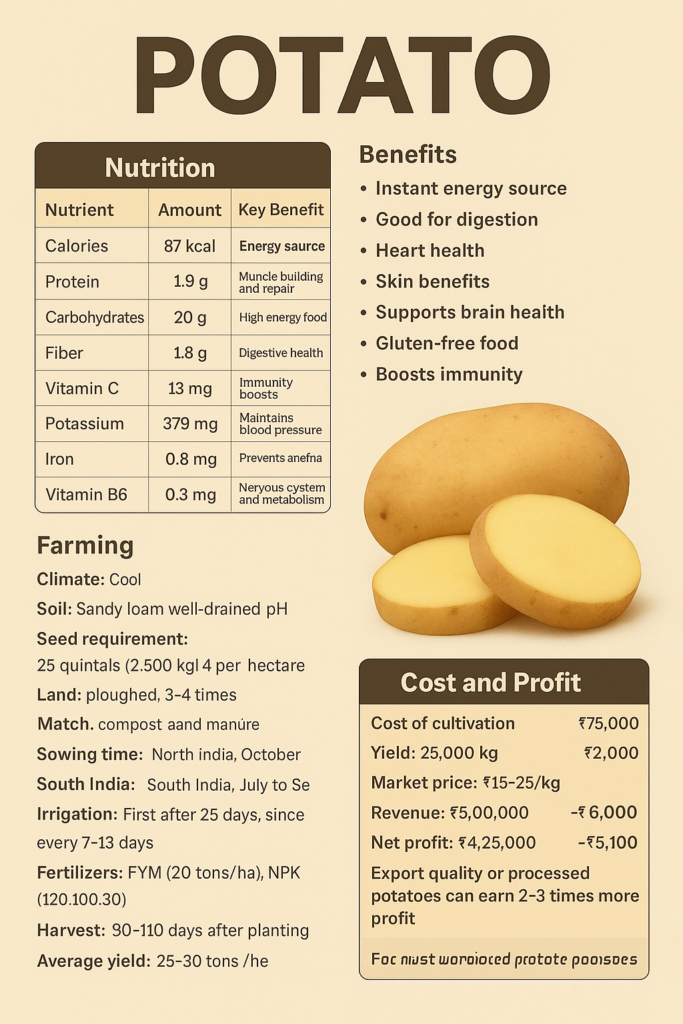
    1. Nutritional Value (per 100 g boiled potato)

    NutrientAmountKey BenefitCalories87 kcalEnergy sourceProtein1.9 gMuscle building and repairCarbohydrates20 gHigh energy foodFiber1.8 gDigestive healthVitamin C13 mgImmunity boosterPotassium379 mgMaintains blood pressureIron0.8 mgPrevents anemiaVitamin B60.3 mgNervous system and metabolism support

    1. Health Benefits of Potato

    Instant energy source – Rich in complex carbohydrates for sustained energy.

    Good for digestion – Fiber improves bowel movement and gut health.

    Heart health – Potassium lowers blood pressure.

    Skin benefits – Potato juice helps reduce dark spots and sunburn.

    Supports brain health – Vitamin B6 supports nervous system function.

    Gluten-free food – Safe for people with gluten intolerance.

    Boosts immunity – Vitamin C and antioxidants protect against infections.

    1. Uses of Potato

    Culinary Uses: Boiled, fried, baked, mashed, or processed into chips, snacks, or curries.

    Industrial Uses: Potato starch in paper, textiles, adhesives, and alcohol production.

    Medicinal Uses: Skin treatment, soothing burns, and natural facial packs.

    1. Cultivation Guide

    Climate: Cool season crop; grows best between 15°C to 25°C.

    Soil: Sandy loam soil, well-drained with pH 5.5–6.5.

    Seed Requirement: 25 quintals (2,500 kg) per hectare.

    Land Preparation: Plough 3–4 times; add compost and manure.

    Sowing Time:

    North India – October to December

    South India – July to September

    Irrigation: First irrigation after 25 days; then every 7–10 days.

    Fertilizer: FYM (20 tons/ha) + NPK (120:100:80).

    Harvest: 90–110 days after planting.

    Average Yield: 25–30 tons per hectare.

    1. Cost and Profit Analysis (INR & USD)

    Cost of Cultivation (per hectare):

    ItemCost (₹)Cost (USD)Seed potatoes35,000$420Fertilizers & Manure10,000$120Labor12,000$145Irrigation6,000$72Transportation5,000$60Miscellaneous7,000$85Total Cost₹75,000$900

    Yield and Revenue

    Average Yield: 25,000 kg per hectare

    Market Price: ₹15–25/kg (average ₹20/kg)

    Revenue: ₹5,00,000 (~$6,000)

    Net Profit:
    ₹5,00,000 – ₹75,000 = ₹4,25,000 (~$5,100) per hectare

    Export quality or processed potatoes can earn 2–3 times more profit.

    1. Global Market Overview

    Top Producers: China, India, Russia, USA, Ukraine

    Export Leaders: Netherlands, France, Germany, Canada, USA

    Import Markets: Africa, Middle East, Southeast Asia

    Average Global Price: $1.2–2 per kg depending on quality and grade

    Processing Demand: Frozen fries, chips, starch, alcohol industry

    Potato is traded in over 150 countries, making it one of the top 5 global food crops after rice, wheat, maize, and soybeans.

    1. Marketing and Selling Strategies

    Local Markets: Direct selling ensures stable income.

    Contract Farming: Partner with food companies like McCain, Haldiram, ITC.

    Cold Storage: Store potatoes and sell during high-price season.

    Export: Target Middle East, Bangladesh, and Sri Lanka for bulk exports.

    Online Sale: Supply to e-commerce grocery chains (BigBasket, Blinkit, Amazon Fresh).

    1. Frequently Asked Questions (FAQs)

    Q1. What is the average yield of potato farming?
    25–30 tons per hectare under normal conditions.

    Q2. Is potato a good profit crop?
    Yes, farmers can earn up to ₹4–5 lakh ($5,000–6,000) per hectare.

    Q3. How long does it take to grow potatoes?
    About 3–4 months from planting to harvest.

    Q4. Can potato grow in hot regions?
    It prefers cooler climates, but certain heat-tolerant varieties are available.

    Q5. Which potato variety is best for chips and fries?
    Kufri Chipsona, Kufri Jyoti, and Atlantic varieties are popular for processing.

    1. Conclusion

    Potato is not just a kitchen staple but a high-value global crop. With its short cultivation period, minimal maintenance, and wide adaptability, it ensures consistent income for farmers.

    From nutrition to profitability, potato stands as one of the most rewarding vegetables to grow. Whether sold fresh or processed, its market remains evergreen.

    In conclusion: Potato offers excellent returns, supports food security, and continues to be one of the most traded and consumed vegetables in the world.

    ✍️Farming Writers

    Read A Next Post

    https://farmingwriters.com/fish-farming-rohu/