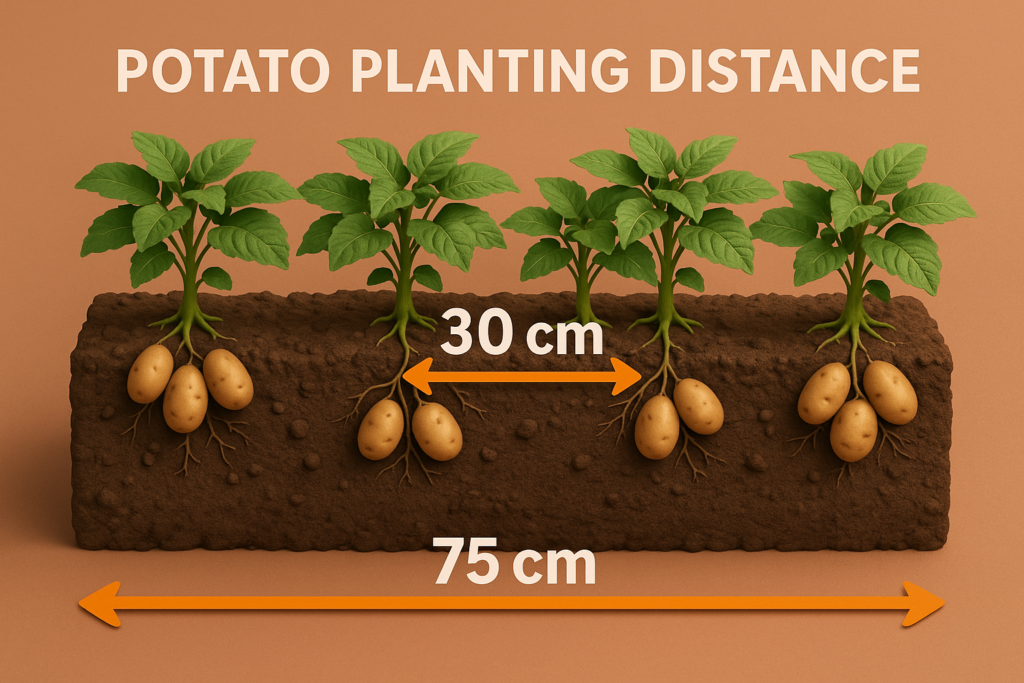
The mistake that creates “many potatoes but no money”
Potato farmers across Asia, Europe, and Africa often say the same line:
“My field produced a lot, but money was low.”
The hidden reason is almost always plant spacing.
Potato plants can survive very close spacing.
Tubers cannot.
When plants are crowded, the plant keeps growing leaves, but tuber formation gets divided into many small pieces instead of fewer large ones. Buyers don’t pay for count. They pay for grade.
Why tight spacing feels right — but fails later
Farmers use close spacing because:
Land feels fully used
Early canopy looks strong
Weed pressure reduces
But underground, something else happens:
Stolons collide early
Tubers compete for the same soil volume
Size expansion stops early
Skin remains thin and irregular
This is why crowded potato fields give:
Too many small tubers
High sorting loss
Low storage value
The spacing–tuber size relationship
Potato does not increase size at the end.
Tuber size is decided early, within the first 30–40 days.
Once spacing restricts expansion, no fertilizer can fix it.
This is why spacing matters more than:
Seed size
Extra nitrogen
Late irrigation
Field-proven spacing used by commercial growers
For table potatoes (fresh market):
Plant to plant: 20–25 cm
Row to row: 60–75 cm
For processing potatoes (chips, fries):
Plant to plant: 25–30 cm
Row to row: 75–90 cm
Wider spacing allows:
Fewer but larger tubers
Better skin finish
Uniform grading
Higher price per kilogram
Why “more plants” reduces total sale weight
This is the hardest truth for farmers to accept:
More plants = more tubers
More tubers = smaller size
Smaller size = rejected or low-priced harvest
Net result:
Total harvested weight may look similar, but marketable weight drops sharply.
Who should NOT follow wide potato spacing
Wider spacing is not ideal if:
You sell seed potatoes by count
You harvest very early baby potatoes
You grow only for home consumption
For commercial table and processing markets, spacing is non-negotiable.
Real farmer questions
Q1. Can I reduce spacing if soil is very fertile?
No. Fertility increases foliage, not tuber space.
Q2. Does variety change spacing rules?
Slightly, but tuber expansion limit remains the same.
Q3. Why do my potatoes look healthy but stay small?
Because leaf health hides underground competition.
Final judgment
Potato farming fails quietly underground.
Crowded fields reward leaves, not tubers.
If your harvest needs heavy sorting, spacing not seed is the real problem.
✍️Farming Writers Team
Love farming Love Farmers.
Read A Next Post 👇