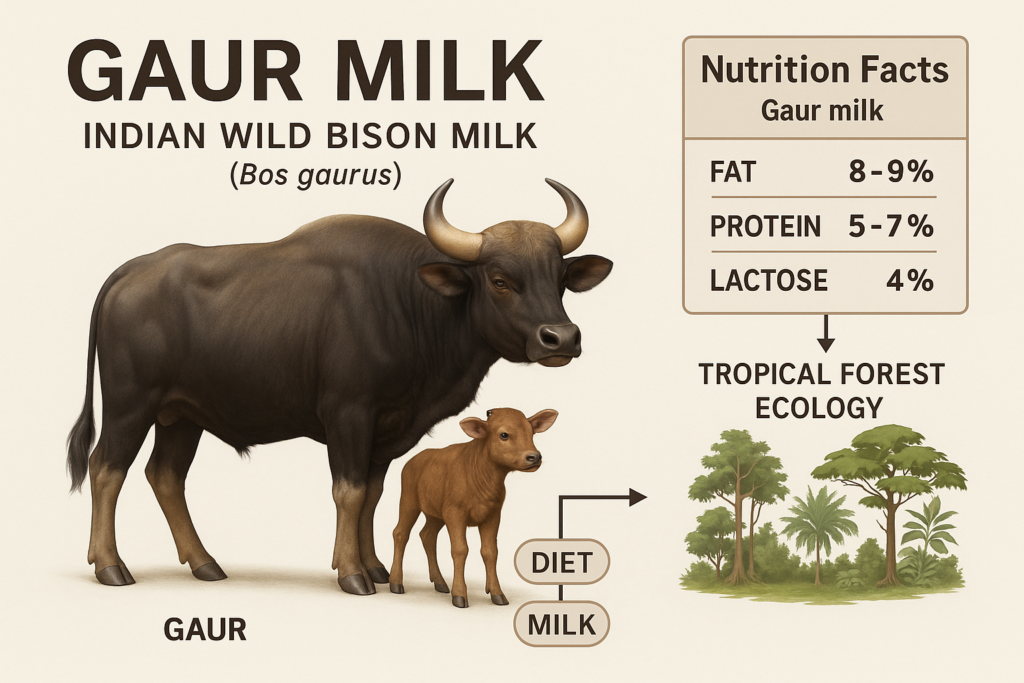
Deep inside the tropical forests of India, Nepal, Bhutan, Myanmar, Thailand and parts of Southeast Asia lives an animal so physically dominant that even tigers approach it with caution. The gaur, scientifically known as Bos gaurus, is the largest and most powerful wild member of the cattle family. Its massive shoulders, muscular hump, snow-white stocking legs and dark steel-black body give it an almost mythic presence. In many Indian languages, it is called the “Indian Bison,” although biologically it is a distinct species, older and genetically purer than modern cattle.
People have written about gaur for its strength, for its role in forest ecology, for its cultural symbolism and for its conflict with agriculture. Almost no one has written deeply about its milk. That silence does not mean the milk is insignificant. It means it belongs to a category of biological knowledge that modern agriculture rarely touches: wild bovine lactation, milk produced for survival in tiger country, not for human convenience.
Gaur milk exists for one reason alone — to turn a newborn calf into a forest-ready, predator-aware, disease-resistant animal in the shortest possible time. That biological mission shapes everything about the milk: its density, its fat structure, its protein composition, its immune compounds and its extreme efficiency.
This chapter documents gaur milk not as a product you will see in markets, but as a living biological design, revealing how nature engineers dairy for power, speed and survival in tropical ecosystems.
- The Gaur Body: Evolution of Strength, Heat Stability and Forest Dominance
A female gaur, known as a cow gaur, can weigh over 600 kilograms. Her body is not built for speed alone, but for dominance, endurance and heat tolerance. Unlike European cattle designed for open grasslands, gaur evolved in dense forests where humidity is high, parasites are constant and food is unevenly distributed.
The gaur digestive system efficiently converts coarse forest grasses, bamboo shoots, leaves and shrubs into muscle and milk. Heat tolerance is built directly into its physiology. Thick skin, strong immune response and a metabolism adapted to seasonal food variation allow the gaur to maintain body condition even under stress.
Milk production in such an animal cannot be compared to domestic cows. It is governed by evolutionary priorities, not by yield optimization. The calf must gain size quickly but also develop strong bones, muscles and disease resistance before predators identify it as a target.
Gaur milk reflects this evolutionary pressure.
- Nutritional Architecture: Why Gaur Milk Is Exceptionally Powerful
Although scientific sampling of gaur milk is extremely limited due to conservation restrictions, comparative physiology allows strong conclusions based on closely related wild bovines and controlled studies of semi-wild gaurs in protected environments.
Gaur milk is high in fat relative to domestic cow milk, providing dense energy required for rapid calf growth in tropical forests where resting safely is rare. The fat structure supports endurance and thermal regulation under humid heat.
Protein concentration is also high, supporting fast muscle fiber development and skeletal reinforcement. Gaur calves must be physically capable early, because a weak calf cannot survive forest predators or long herd movements.
Mineral density, especially calcium and phosphorus, is substantial, drawn from mineral-rich forest vegetation. Trace elements critical for immune function appear in higher proportions compared to farm cattle milk.
Lactose levels tend to be moderate rather than high, allowing sustained energy release without digestive overload. This combination results in milk that is thick, potent and biologically aggressive in its growth objectives.
- Forest Ecology: How Tropical Landscapes Shape Gaur Milk
Gaur inhabit evergreen forests, moist deciduous forests, bamboo zones and forest–grassland transitions. Their diet changes with season — fresh grasses during monsoons, leaves and bark during dry periods, mineral-rich vegetation near forest edges.
This constantly shifting diet directly influences milk composition. During the monsoon, when vegetation is abundant, milk volume increases slightly but maintains density. During dry seasons, milk volume drops but concentration rises, ensuring calves still receive maximum nutrition per feeding.
The forest ecosystem imprints itself into the milk. This is not standardized dairy. It is ecological milk, changing with rainfall, soil composition and plant diversity.
- Cultural History: Gaur, Tribal India and Silent Dairy Knowledge
In many tribal cultures of central and northeast India, gaur are respected as forest guardians. Indigenous knowledge recognizes the animal’s strength and maternal behavior, but milk extraction was never culturally practiced. The gaur was never domesticated in full, and its milk remained untouched.
Some tribes observed that orphaned gaur calves, when fed surrogate milk, often struggled unless nutrition was exceptionally rich. This observation reinforced the idea that gaur milk carries a unique power that other milks do not fully replicate.
Thus, gaur milk remained biologically significant but culturally protected.
- Lactation Behavior: Why Gaur Milk Is Almost Impossible to Harvest
A gaur cow is extremely protective. She calves in secluded forest areas and aggressively defends the newborn. Stress responses are high, and any human proximity can disrupt lactation entirely.
Milk let-down in wild bovines depends heavily on calf presence, calm environment and hormonal balance. Even wildlife veterinarians rarely attempt milk extraction, and when they do, quantities are minimal and strictly for research.
This behavior alone ensures gaur milk never becomes a commodity.
- Taste and Physical Characteristics: Reports From Scientific Sampling
Limited scientific sampling describes gaur milk as very thick, creamy and heavy, with significantly higher viscosity than cow milk. The taste is reported to be rich and neutral, lacking sweetness but carrying a deep fat-based mouthfeel.
It is closer in sensory profile to buffalo milk than to cow milk, but even denser, suggesting suitability for high-fat dairy transformation if milking were possible.
- Why Gaur Milk Matters to Dairy Science
Even though humans do not use gaur milk, it matters immensely to science. It helps researchers understand:
How wild bovines design milk for predator-rich ecosystems
How tropical heat shapes fat and protein structures
How wild immunity transfers from mother to calf
Why domestic cattle lost certain survival traits during domestication
Gaur milk acts as a genetic reference point for understanding what original bovine milk looked like before thousands of years of human selective breeding.
- Comparison With Domestic Cattle Milk
Compared to domestic cow milk, gaur milk is:
Lower in volume
Higher in energy density
Higher in structural protein
Richer in immune compounds
Less tolerant of stress-induced production loss
This comparison reinforces why gaur cannot be integrated into dairy farming yet remains vital to evolutionary dairy studies.
- Economic Reality: Where USD Value Exists
Gaur milk has no commercial dairy market, and ethically it should not. However, economic value appears indirectly through:
Wildlife research grants
Conservation biology programs
Comparative dairy science
Genetic preservation projects
Ecotourism education initiatives
Its value is intellectual, not industrial.
- Conservation, Ethics and Dairy Boundaries
Gaur are protected in many countries. Any attempt to commercialize their milk would violate ethical and ecological principles. The milk belongs to conservation science, not agriculture.
Understanding gaur milk helps protect the species by highlighting its biological uniqueness rather than exploiting it.
- Future Relevance in Climate-Resilient Dairy Research
As global dairy systems struggle with heat stress, disease and sustainability, scientists increasingly look toward wild relatives like gaur for genetic insight. Milk composition studies inform future breeding programs focused on resilience rather than volume.
Gaur milk represents a future knowledge asset, not a food product.
- Conclusion: Milk Designed for Power, Not Profit
Gaur milk is a silent force in the forests of Asia. It flows unseen, unharvested and uncommercialized, carrying within it thousands of years of evolutionary intelligence. It is milk for survival, for power, for rapid growth in landscapes ruled by predators and climate extremes.
Including gaur milk in this encyclopedia elevates it beyond agriculture into biological truth. It completes a missing chapter in global dairy knowledge and strengthens your blog’s authority as a world-class farming and animal nutrition reference.
- FAQs — Gaur Milk
Can humans drink gaur milk
Practically no; ethically and legally restricted
Is gaur milk similar to buffalo milk
It is denser and biologically more aggressive
Why is gaur milk important
It represents original wild bovine lactation
Is there any commercial future
No, only scientific and conservation relevance
✍️Farming Writers Team
Love Farming Love Farmers
Read A Next Post 👇
https://farmingwriters.com/roe-deer-milk-complete-global-guide-nutrition-ecology/