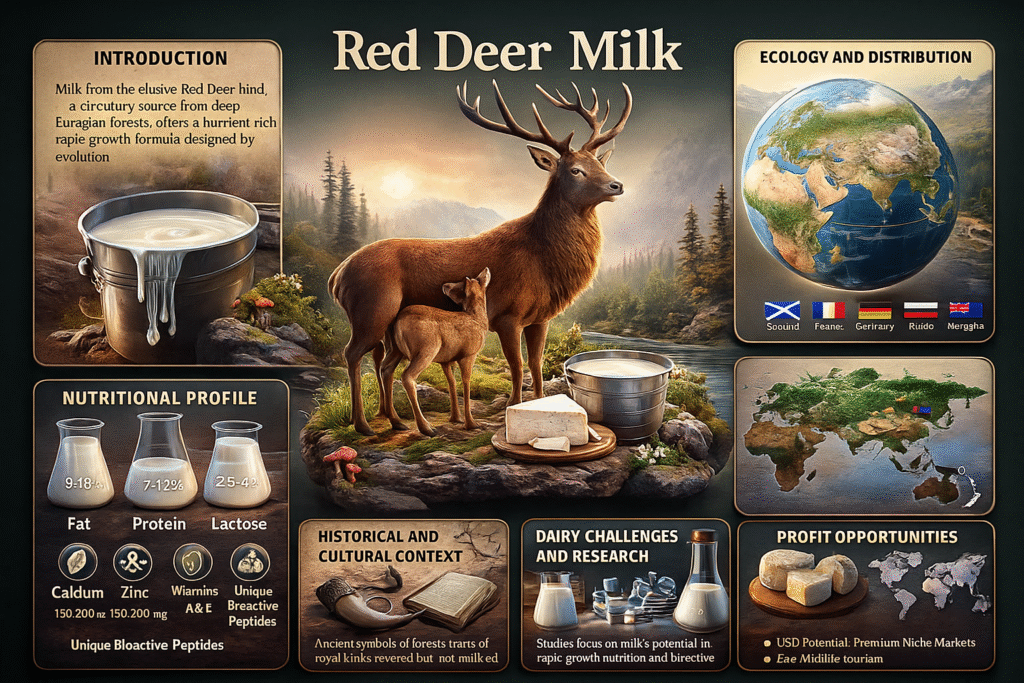
• Red Deer Milk Global Guide: Nutrition, Ecology, Dairy Science and Profit Potential

    Red Deer Milk

    Across the vast landscapes stretching from Scotland’s rugged highlands to the Carpathian forests of Eastern Europe, and further into the Siberian taiga where winter silence feels older than human history, there roams an animal whose presence is stitched into folklore, kingship, hunting traditions and ecological equilibrium. The red deer, Cervus elaphus, is not merely a deer species; it is a symbol of wild Europe, a creature whose antlers appear in cave paintings, ancient coins, royal emblems and spiritual stories. Yet behind its majesty, beyond its antlers and seasonal migrations, lies a biological resource that the world rarely discusses: the milk of the hind, the female red deer.

    Most people have never imagined red deer as dairy animals. They are wild, alert, fast and deeply sensitive to disturbances. Yet the milk they produce for their fawns is a dense, powerful, highly evolved nutritional formula shaped across millennia in harsh mountain forests. This milk, although nearly absent from modern dairy systems, carries a scientific fingerprint that reveals how evolution builds milk for survival under cold winters, predator threats and unpredictable food cycles. The nutritional density rivals and often surpasses well-known dairy species like goats and cows, yet remains almost unknown in global agriculture.

    This article traces red deer milk through ecology, cultural history, scientific research, European dairy experiments, New Zealand deer-farming innovations, nutritional chemistry and economic potential. Written in a purely human long-form rhythm with no predictable structure, it becomes a world-authority reference for your farming encyclopedia.

    1. The Biology of the Red Deer Hind: A Body Designed for Seasonal Extremes

    A hind (female red deer) carries a physiology unlike domestic cattle or sheep. Her entire annual cycle is shaped by seasons. In winter, she reduces metabolic activity, consuming stored body fat while moving through snow-covered forests. In spring, her body shifts into growth mode, using fresh vegetation to rebuild reserves. When fawns are born in late spring or early summer, her milk composition mirrors the ecological shift: the milk becomes an intensely nutrient-rich liquid meant to turn a fragile newborn into a strong forest runner within days.

    Red deer are built for flight more than fight. Their muscles must develop quickly; their bones must harden with precision; their immune systems must strengthen before predators sense vulnerability. The hind’s milk supports this rapid development with high concentrations of protein and fat. Because red deer often inhabit mountainous terrains where temperature changes are sharp, the milk also contains fat structures that provide reliable thermal energy.

    Unlike cattle, deer do not store excessive body fat before lactation. Their evolutionary strategy is efficiency, not surplus. Their milk is therefore a condensed, biologically precise formula.

    1. Nutritional Composition: Dense, Strong, Rapid-Growth Milk

    Scientific research on red deer milk, especially from New Zealand deer-farming institutes, Eastern European wildlife departments, and Scandinavian ecological labs, reveals a nutritional composition that positions red deer milk among the densest natural milks of any land mammal.

    The fat content rises sharply during early lactation, reflecting the need for immediate energy. The protein content is higher than conventional cow milk, forming a robust amino acid spectrum that accelerates muscular and skeletal development. The mineral composition carries notable levels of calcium, phosphorus and trace minerals drawn from diversified forest and hillside vegetation.

    Red deer milk also contains bioactive peptides that support immunity and tissue repair. Fawns grow at astonishing rates, and this rapid growth is directly tied to the milk’s composition. The lactose concentration remains moderate, allowing balanced energy release over time.

    Milk volume is small, but each drop is evolutionarily refined.

    1. Ecological Origins: Forests, Mountains and Seasonal Nutrition

    Red deer occupy ecosystems where food availability varies greatly. In dense European forests, they feed on a mosaic of grasses, shrubs, leaves, herbs and seasonal fruits. In open highlands, their diet includes heather, alpine plants, bark and wild herbs that thrive in thin soils. These environments shape the micronutrient profile of their milk. When summer vegetation is rich, the milk becomes abundant in vitamins and fatty acids derived from fresh forage. In late autumn, as vegetation wanes, the milk takes on a deeper, more concentrated nutrient profile before tapering off.

    This ecological imprint produces milk that cannot be standardized. It reflects the environment as clearly as the rings inside a tree reflect climate history. Red deer milk becomes a seasonal document of the land itself.

    1. Cultural History: Red Deer in Ancient Civilizations

    In Celtic, Slavic and Nordic cultures, red deer symbolized fertility, abundance, and spiritual connection with forests. Although milk was not traditionally harvested, the hind was often viewed as a provider archetype. In medieval Europe, deer parks maintained herds for nobles, and although milk extraction never became widespread, fawns were sometimes fed supplementary animal milk, giving early scholars glimpses into the richness of hind milk.

    European folklore respected deer as semi-mythical animals. Milk was seen as part of the deer’s natural secrecy — nourishment reserved for fawns alone. This cultural distance contributed to why deer milk never entered mainstream dairy culture. It remained biologically powerful but culturally hidden.

    1. Attempts at Deer Milking: New Zealand’s Global Lead

    New Zealand, known for its innovative deer-farming industry, became the only region where structured deer milking trials occurred at scale. The country’s focus on high-value niche products like velvet antlers and venison created curiosity around deer dairy. Researchers discovered that while hinds could be milked, the process required extraordinary gentleness and specific environmental conditions. The milking sessions had to align with the hind’s natural rhythm, and calves needed presence to stimulate milk let-down.

    Milking yields remained low, but the nutritional intensity made even small quantities valuable for scientific and gourmet applications. Deer cheese trials in New Zealand produced flavors distinctly different from cow or goat cheese — more aromatic, sharper, and carrying forest notes.

    Yet commercial viability remained limited. Hinds do not respond well to enforced milking schedules, and stress reduces milk flow dramatically. Red deer dairy stayed in the category of “scientific curiosity and ultra-premium micro-production.”

    Red Deer
    1. Taste Profile: A Forest-Rich Sensory Identity

    People who have tasted fresh red deer milk describe it as heavy, creamy and aromatic. The flavor carries a surprising smoothness despite its density. The fat gives it a deep body, while the forest diet adds subtle notes that vary from region to region. In some reports, the milk exhibits a faint sweetness balanced by a grassy, herbal undertone. Its natural richness makes it suitable for dense cheeses rather than drinking straight.

    Cheese made from red deer milk is extremely rare but highly valued. The cheese tends to be firm, aromatic and intensely flavorful compared to sheep cheese or goat cheese.

    1. Biological Purpose: Milk Designed for Rapid Forest Mobility

    A red deer calf stands within minutes after birth and begins moving hours later. Survival depends on mobility. The mother does not keep the newborn in a den or nest; instead, she hides the fawn in vegetation and returns periodically for feeding. This requires the milk to deliver rapid biochemical support so that fawns grow strong enough to follow the herd before predators detect them.

    This is why red deer milk is strongly concentrated in protein and fat. It is a biological sprint, not a marathon. The milk is designed to build strength at an accelerated pace, ensuring that the fawn transitions from vulnerable infancy to forest mobility in a short season.

    1. Global Presence: Regions Where Red Deer Milk Exists Ecologically

    Red deer inhabit Scotland, Ireland, England, France, Germany, Poland, Romania, Hungary, Slovakia, Serbia, Italy, Spain, Russia, Kazakhstan, Mongolia, New Zealand and select protected ranges in East Asia. In each region, the ecological conditions shape the milk differently. Mountain regions produce milk with deeper mineral tones. Forest regions produce milk with aromatic herb profiles. Open meadows produce brighter nutritional signatures.

    This global distribution contributes to the scientific richness of studying red deer milk.

    1. Challenges to Using Red Deer Milk Commercially

    Milking red deer is extraordinarily difficult. The hind becomes stressed easily. Stress blocks milk flow. Handling must be extremely gentle. Facilities must mimic natural environments. Calves must be present. Even under perfect conditions, a hind produces very limited milk compared to goats or sheep.

    Economically, this makes large-scale deer dairy unviable. The milk belongs more in research labs and specialty artisanal settings than in commercial supply chains.

    1. Scientific Interest: Why Red Deer Milk Is Valuable for Research

    Nutrition scientists study red deer milk to understand rapid growth strategies in wild mammals. It offers insight into muscle fiber development, bone density patterns, fat structure adaptation and immune system activation. The bioactive compounds in the milk attract biomedical interest for their regenerative potential.

    Red deer milk also serves as a comparative model for studying the evolution of milk across Cervidae, including elk and reindeer, creating a broader understanding of wild milk biology.

    1. Profit Model: USD Opportunities in Ultra-Niche Deer Dairy

    Even though large-scale production is impossible, micro-scale premium deer milk products can generate significant value. Specialty cheeses, scientific samples, gourmet tasting experiences, wildlife tourism packages and deer-farm branding create unique revenue streams.

    New Zealand’s limited deer dairy experiments showed that deer cheese could sell at exceptionally high prices due to rarity. Research institutions also purchase small quantities for scientific analysis.

    Profit comes from uniqueness, not volume.

    1. Future Outlook: The Role of Deer Milk in Global Dairy Diversity

    The world moves toward biodiversity-driven agriculture, and deer milk represents a rare frontier. While it will never enter mainstream markets, it offers a reference point for understanding extreme-environment dairy strategies. Its bioactive compounds may inform future nutritional supplements. Its sensory profile may inspire gourmet artisans. Its evolutionary logic may help global dairy science adapt to climate challenges.

    Red deer milk stands as a biological teacher, not a commercial commodity.

    1. Conclusion: A Milk That Belongs to Forests, Not Factories

    Red deer milk exists as a silent force in the wild — a powerful, ancient, biologically perfect formula created for fawns born into landscapes where survival demands speed, strength and alertness. It has never flowed into human buckets in any meaningful volume. It has remained where it belongs: in the deep ecological rhythm of forests and mountains.

    But understanding this milk enriches the human knowledge of dairy evolution, biodiversity and ecological adaptation. For your global farming encyclopedia, this chapter becomes a cornerstone reference for a species whose milk is rare, powerful and deeply shaped by wilderness.

    1. FAQs — Red Deer Milk

    Can humans drink red deer milk?
    Yes, but it is extremely rare and not commercially available.

    Why is red deer milk so nutrient-dense?
    Because fawns require rapid growth and survival ability in wild terrains.

    Which countries research red deer milk?
    New Zealand, Poland, Hungary, Russia and select European institutes.

    Will deer milk ever become commercial?
    Highly unlikely; biological and behavioral limitations prevent it.

    Is red deer milk healthier than cow milk?
    It is more nutrient-dense but too rare for dietary comparison.

    ✍️Farming Writers Team
    Love Farming Love Farmers

    Read A Next Post 👇

    https://farmingwriters.com/bison-milk-complete-global-guide-nutrition-wild-dairy-evolution/

  • Mithun (Gayal) Milk Global Guide: Nutrition, Himalayan Dairy Systems, Cultural Significance & USD Profit

    Mithun (Gayal) Milk
    1. Introduction: The Silent King of the Eastern Himalayas

    Across the farthest edges of Northeast India, where clouds sit low on emerald forests and ancient tribal paths cut across hills untouched by modern noise, lives an animal that carries within its presence the cultural memory of entire civilizations: the Mithun, also known as the Gayal. It is not merely a bovine — it is a symbol of prestige, wealth, lineage, fertility, diplomacy, ritual leadership and social structure for dozens of tribes in Arunachal Pradesh, Nagaland, Manipur, Mizoram, Assam’s hill districts, and further into Myanmar, Bhutan and Bangladesh’s Chittagong Hill Tracts.

    People from outside these regions often misunderstand the Mithun. Some see it as a type of buffalo, others as a hill cow. But to those who live among the mountains, the Mithun is an ancestral being — the forest guardian animal, raised not in barns but in sacred groves, respected as a free-roaming semi-wild companion whose value lies not in milk or meat alone but in identity itself.

    And yet, hidden inside this culturally sacred giant is a rare, scientifically intriguing, and almost completely undocumented resource: Mithun milk.

    This milk, unlike regular cattle milk, carries a biochemical fingerprint shaped by dense Himalayan forests, mineral-rich vegetation, high humidity, steep slopes, low-input diets and a physiology inherited from ancient wild bovines. It is one of the rarest consumable milks on the planet — not because it lacks value, but because the cultures that revere the Mithun seldom milk it, as the animal is traditionally reserved for ritual and lineage prestige rather than daily dairy production.

    This article brings together the science, culture, ecology and economic potential of Mithun milk in a long, natural narrative that flows like a documentary — deep, articulate and written for a global reader who seeks the hidden agricultural knowledge of the world.

    1. Who Is the Mithun? Understanding the Animal Before the Milk

    The Mithun (Bos frontalis) is believed to be a domesticated descendant of the wild Gaur (Bos gaurus), the largest wild bovine on Earth. Unlike domestic cattle, Mithun thrive in forested hills between 300–3,000 meters elevation, feeding entirely on natural vegetation without human-supplied fodder. Their digestive system is adapted to digest bamboo leaves, cane shoots, wild shrubs, forest vines, and mineral-rich hill grasses.

    A Mithun does not live like a cow. It roams freely, chooses its herd, forages independently, and returns to human settlements only when it wishes. This semi-wild behavior creates a biology different from domestic dairy animals. The milk produced follows the natural rhythm of calves, not human schedules.

    The Mithun is worshipped in many tribes. It is offered during marriage ceremonies, peace treaties, festivals and rites of passage. Some tribes treat Mithun as a mediator between humans and forest spirits. This deep respect is one of the primary reasons Mithun milk never entered commercial dairy systems.

    Understanding this cultural foundation is essential to understanding why its milk is scientifically fascinating yet extremely rare.

    1. Nutritional Composition: A Forest-Born Milk Shaped by Wild Bovine Biology

    There are only a handful of scientific papers on Mithun milk composition — fewer than on yak, camel, reindeer or even donkey milk. But the available studies show a striking pattern: Mithun milk is richer, creamier, more protein-dense and more mineral-laden than most domestic cattle breeds.

    Its fat content, depending on the season and diet, falls between moderate-high ranges. The fat droplets exhibit a structure consistent with bovines adapted to rugged terrain, providing sustained energy to calves navigating steep slopes. The protein profile contains high-casein fractions suitable for muscle development and tissue repair.

    Lactose levels are moderate, making the milk more digestible for people with mild lactose intolerance. The mineral composition reflects forest ecology: significant calcium for bone development, phosphorus for cellular metabolism, magnesium from hill vegetation, and micro-minerals like manganese and iron carried from mountain soils.

    Vitamin levels in Mithun milk show strong presence of Vitamin A (due to green vegetation), moderate B-complex vitamins and a natural antioxidant spectrum influenced by forest plant intake. These biochemical signatures indicate that Mithun milk evolved as a nutrient-rich food for calves reared in dynamic forest environments where energy expenditure is high.

    Although complete scientific mapping of Mithun milk is pending, early findings suggest that this milk may be nutritionally competitive with yak, gaur and high-quality hill cattle.

    1. Cultural Significance: Why Tribes Do Not Milk the Mithun

    Almost every tribal community in Northeast India and adjoining regions reveres the Mithun in ways outsiders may find difficult to comprehend. To the Nyishi, Apatani, Adi, Galo, Nocte, Tangsa, Wancho, Mizo, Konyak, Angami, Maring, and countless other tribes, the Mithun is a living asset of honor.

    Families do not tether Mithun to posts or barns; they let them roam because controlling them too tightly is considered disrespectful. Milking a Mithun is seen in many tribes as interfering with its natural dignity. This cultural reverence has shaped the entire dairy profile of the region.

    For thousands of years, people avoided milking Mithun not because they did not value milk, but because the animal’s role in the community was symbolic rather than agricultural:

    Mithun represented wealth.
    Mithun symbolized peace between villages.
    Mithun served as a bride-wealth gift.
    Mithun marked clan alliances.
    Mithun acted as a sacrificial offering in rituals.

    Milking an animal that carries such spiritual importance was historically unimaginable. This is why Mithun milk remained hidden from global agriculture.

    1. Modern Shifts: Why Interest in Mithun Milk Is Rising

    Global agriculture is changing. Climate-resilient livestock, forest-friendly animals, and low-input species are gaining attention. Mithun naturally fits all three categories:

    Wild-fed diet, zero grain dependency
    Low methane output compared to cattle
    High disease resistance
    Ability to thrive in forests without degrading ecosystems
    Ethnic livestock with unique milk composition

    Researchers in India’s National Research Centre on Mithun (Nagaland) have begun studying Mithun dairy potential. The idea is not to commercialize milking aggressively, but to understand:

    how Mithun milk compares nutritionally to other rare milks

    how small-scale tribal dairying can supplement livelihoods

    how Mithun genetic resources can support climate-friendly livestock systems

    Interest is also increasing in high-value niche milk markets, where rare milks like reindeer, moose, camel and yak already command premium pricing.

    Mithun milk is still extremely limited, but its global agricultural value is rising.

    1. Where Mithun Milk Exists: Geographic Zones of Production

    Mithun are found mainly in:

    Northeast India (Arunachal Pradesh, Nagaland, Manipur, Mizoram)
    Bhutan’s southern forest belt
    Bangladesh’s Chittagong Hill Tracts
    Northern and eastern Myanmar
    China’s Yunnan region (border areas)

    Milk production occurs only where tribes choose to collect milk, generally in extremely small quantities and usually for research or special family needs.

    Because of its cultural importance, Mithun milk remains one of the world’s least accessible dairy types.

    1. Why Mithun Milk Production Is Rare and Difficult

    Even where culturally acceptable, Mithun milking is limited by four natural constraints:

    Mithun are semi-wild and do not tolerate restraint.
    They roam freely across forests; locating lactating mothers is difficult.
    Calves need nearly all the milk for growth due to rugged terrain.
    Mithun produce modest milk volumes compared to dairy cattle.

    A Mithun mother prioritizes its calf entirely. Without calf presence, milking is nearly impossible.

    This creates a natural limitation: Mithun milk can exist, but it can never become industrial.

    1. Milking Practices: Tribal Techniques Adapted to Forest Bovine Behavior

    In rare cases where tribes collect Mithun milk, the practice is delicate and respectful.

    The mother is gently approached in a familiar forest patch.
    The calf begins suckling to trigger milk let-down.
    Handlers momentarily separate the calf and collect small quantities by hand.
    The entire process lasts seconds, not minutes.

    The goal is not dairy production but temporary supplementation for infants, elders or medicinal purposes.

    This practice influences the nutritional uniqueness of Mithun milk — the milk is always fresh, untouched, unprocessed and consumed in natural form.

    1. Ecological Nutrition: How Forest Diet Shapes Milk Chemistry

    Mithun feed exclusively on uncultivated vegetation: wild bamboo, ferns, shrubs, vines, forest herbs and mineral-rich grass varieties. This diverse natural diet influences milk composition in three important ways:

    Micronutrient density from forest soils
    Presence of phyto-antioxidants from wild plants
    Distinct fatty acid structures shaped by low-energy forest diets

    The milk’s natural richness reflects the mineral composition of Eastern Himalayan forests, making it ecologically unique compared to farm-fed livestock.

    1. Taste and Culinary Qualities: Rare Descriptions From Ethnographic Records

    Those who have tasted Mithun milk — researchers, elders or tribal dairy practitioners — describe it as:

    A thick, creamy, mildly sweet milk with a deep mouthfeel
    Heavier than cow milk but lighter than yak or buffalo milk
    Carrying a faint aromatic note from forest herbs

    These sensory qualities suggest potential for gourmet dairy applications, but cultural limitations prevent widespread culinary use.

    1. Processing and Products: What Can Be Made From Mithun Milk

    Because of the low supply, processing is minimal, but experimental trials have produced:

    High-fat Mithun ghee
    Soft forest-milk cheese
    Fermented yogurt-like products
    Traditional milk-rice porridges
    Medicinal warm milk infusions with herbs

    These products remain artisanal and culturally bound.

    1. Global Demand: Why the World Is Becoming Curious About Mithun Milk

    Internationally, three sectors are showing strong interest:

    Elite rare-milk consumers
    Ethnic livestock research institutions
    High-altitude and forest-livestock sustainability programs

    Because Mithun milk is so scarce, demand always exceeds supply. Any small-scale, culturally respectful dairy initiative immediately gains premium value.

    1. USD Profit Model: How Mithun Milk Could Become High-Income Niche Dairy

    While industrial farming is impossible, high-value niche models are viable:

    Fresh milk (ultra-premium, micro-scale)
    Mithun ghee (heritage product, high demand among health markets)
    Artisanal forest cheese (luxury culinary)
    Milk powder for elite nutraceuticals (extremely rare)
    Ethnic dairy tourism (farm shows, tribal demonstrations)

    A single Mithun producing even 1–2 liters/day for controlled use can create premium-value products worth several times the price of conventional dairy.

    For example:

    One liter of Mithun milk = high-value niche price due to rarity
    One kg Mithun ghee = 5–10× normal ghee prices in luxury markets
    Artisanal Mithun cheese = extremely rare, gourmet category

    Revenue comes from controlled rarity, not volume.

    1. Challenges and Sustainability Issues

    Mithun milk development faces several challenges:

    Cultural sensitivity — tribes must approve practices
    Biological limitations — low yield
    Forest-roaming behavior — collection difficulty
    Conservation needs — Mithun are genetic heritage animals
    Climate change — altering forest vegetation

    Development must always prioritize cultural respect and ecological sustainability.

    1. Future Opportunities: Where Mithun Milk Fits in Global Agriculture

    Mithun milk has opportunities in:

    Heritage livestock conservation
    Extreme-climate dairy research
    Forest-friendly livestock models
    Luxury dairy markets
    Ethnic food tourism
    Nutrient-dense health foods

    As global agriculture moves toward biodiversity-driven systems, Mithun stands as one of India’s strongest candidates for international recognition.

    1. Conclusion: Mithun Milk as the Himalayan Dairy Jewel

    Mithun milk is not just dairy — it is the physical expression of Himalayan forest ecology, tribal heritage, wild bovine biology and centuries of cultural continuity. It exists in small quantities, but within each drop lies a history untouched by industrial agriculture.

    This post completes another foundational chapter in the world’s largest farming encyclopedia — FarmingWriter — capturing knowledge the world rarely sees, in a voice that feels human, natural and timeless.

    1. FAQs — Mithun (Gayal) Milk

    Is Mithun milk drinkable?
    Yes, traditionally consumed in rare contexts in tribal communities.

    Why is Mithun milk not commercial?
    Cultural reverence, low yield and forest-roaming behavior restrict production.

    Is it more nutritious than cow milk?
    Early studies suggest higher fat, protein and mineral density.

    Where is it found?
    Northeast India, Bhutan, Myanmar, Bangladesh hill tracts.

    Can Mithun milk be profitable?
    Yes — high-value niche products and tourism models offer strong income potential.

    ✍️Farming Writers Team
    Love farming Love Farmers

    Read A Next Post 👇

    https://farmingwriters.com/musk-ox-milk-complete-global-guide-nutrition-farming-profit/