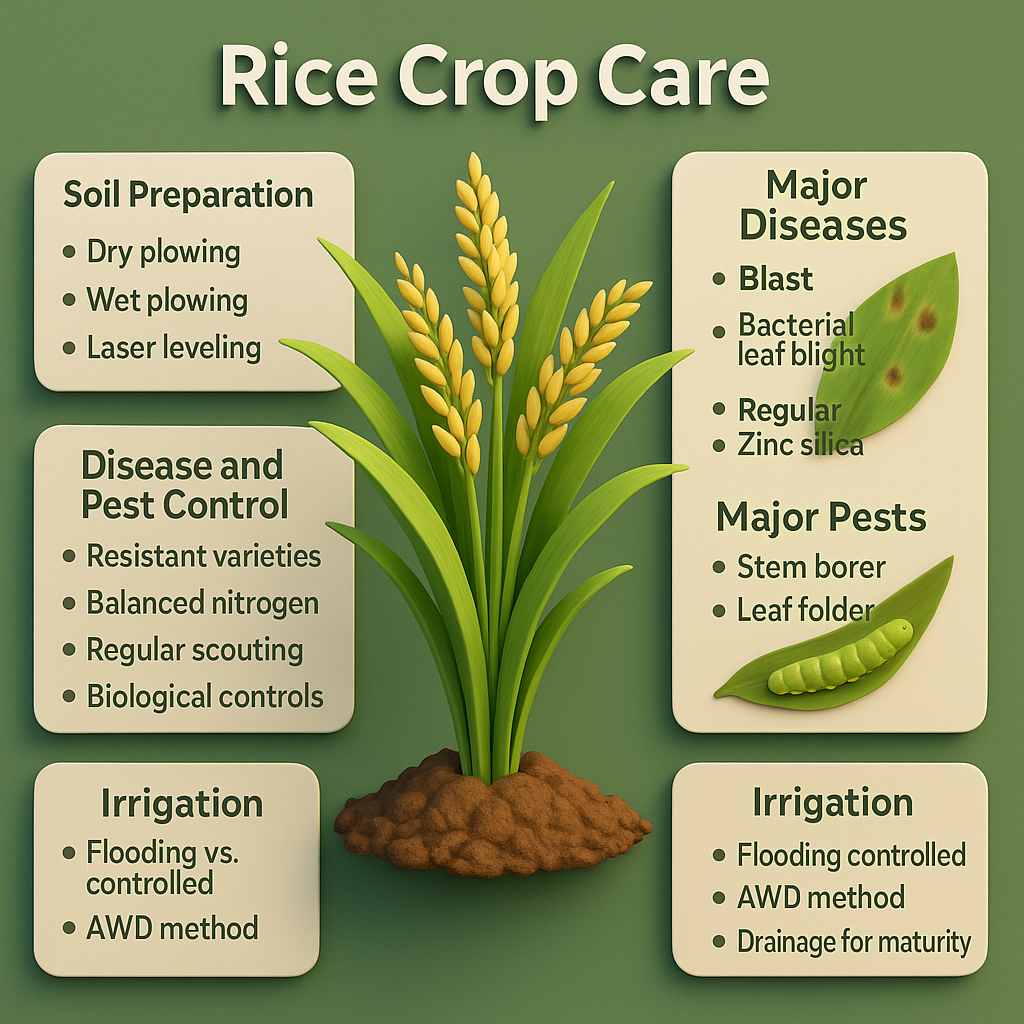
Rice is not only the world’s most cultivated cereal crop—but also the crop that responds most dramatically to correct care. When water, nutrients, climate, and disease control come together in a synchronized system, rice performs like no other crop. But if one element goes wrong—overwatering, nutrient imbalance, or delayed seedling age—then yield falls sharply.
This guide presents a complete, field-tested global rice care blueprint designed for farmers who want disease-free crops, strong tillering, uniform panicles, and high grain yield.
- Understanding Rice as a Crop
Rice is different from all other cereals because it grows in moist, anaerobic soil conditions. Unlike wheat or maize, rice can tolerate water stagnation—but this same environment becomes a breeding ground for blast, BLB, sheath blight, and hoppers.
Rice has three major sensitive phases:
Early tillering
Panicle initiation
Flowering
If these three stages are perfectly managed, the crop performs at maximum yield.
- Soil Preparation: The Foundation of a Healthy Crop
2.1 Dry Ploughing
Dry ploughing opens the soil structure, kills deep insects, exposes larvae to sunlight, and breaks hardpans. It also increases aeration—something that flooded rice fields desperately lack.
2.2 Wet Ploughing
After dry ploughing, wet ploughing or puddling stabilizes moisture. Puddling creates a soft bed for transplanting and reduces deep percolation losses. It also ensures nutrient availability in the upper soil layer.
2.3 Laser Leveling
Laser leveling is one of the most important rice-care innovations in the world. Uniform leveling ensures:
Even water depth
Less nutrient waste
Better weed control
Higher tiller uniformity
Laser leveling alone can increase productivity by 8–15%.
2.4 Soil Organic Strength
A strong soil base reduces disease pressure and increases root mass. The world standard for one acre:
2–3 tons well-rotted FYM
200–300 kg neem cake
40–50 kg biochar
Trichoderma-enriched compost
Azospirillum + PSB culture
Balanced NPK application during preparation
This combination improves soil structure, suppresses soil-borne pathogens, and enhances microbial activity.
- Nursery Care: The Stage Where Crop Success Begins
In rice, a poor nursery guarantees a poor field. Healthy seedlings = strong immunity and vigorous tillering.
3.1 Seed Treatment
The best global practice includes:
Salt water float test
Trichoderma viride coating
Pseudomonas fluorescens
Azospirillum inoculation
Light neem oil seed covering
This treatment minimizes seed rot, early blight, and nursery fungal attacks.
3.2 Nursery Soil Management
A rice nursery should be:
On raised beds
With fine, fertile soil
Well-drained
Exposed to gentle morning sunlight
Sprayed weekly with low-dose neem solution
3.3 Seedling Age Matters
Correct seedling age impacts tillering, flowering, and maturity.
Short-duration varieties: 20–25 days
Medium duration: 25–30 days
Long duration: 30–45 days
Over-aged seedlings reduce plant vigour, increase lodging, and reduce panicle size.
- Transplanting & Spacing: The Architecture of a Productive Field
4.1 Spacing
Best results are seen with:
20 × 15 cm spacing in standard farming
25 × 25 cm spacing in SRI system (single-seedling planting)
Wider spacing allows:
More sunlight
Less humidity
Less fungal spread
Better tillering
4.2 Number of Seedlings per Hill
Standard method: 2–3 seedlings
SRI method: 1 seedling
Single-seedling SRI method increases tillers per plant by 40–60%.
- Water Management: The Heart of Rice Care
Most farmers believe rice requires standing water all the time.
Modern rice science proves the opposite.
5.1 Alternate Wetting and Drying (AWD)
The AWD method is the world’s most efficient rice irrigation technique.
Process:
Let water drain until hairline cracks appear
Refill 3–5 cm water
Repeat cycle
AWD improves water efficiency and strengthens roots.
5.2 Critical Moisture Stages
Never allow stress during:
Tillering
Panicle initiation
Flowering
Grain filling
5.3 Signs of Overwatering
Yellowing
BLB outbreak
Sheath blight
Weak roots
Lodging
Proper drainage is essential to prevent disease explosions.
- Rice Nutrition: Feeding the Crop the Right Way
6.1 Nitrogen
Nitrogen increases canopy but also increases disease risk when overused.
Split application:
50% basal
25% tillering
25% panicle initiation
6.2 Phosphorus
Phosphorus is essential for early tillering and root growth.
DAP + PSB greatly improves absorption.
6.3 Potassium
Potassium is the “immunity nutrient” of rice.
Low potassium = high blast and BLB risk.
6.4 Micronutrients
Zinc → seedling vigour
Boron → panicle filling
Silicon → blast and BLB resistance
Iron → greening
Magnesium → chlorophyll production
Silicon-rich soil produces naturally disease-resistant crops.
- Rice Diseases: Global Problems and Real Solutions
7.1 Blast (Leaf, Neck, Node)
Symptoms:
Diamond spots
Neck rot
Empty panicles
Causes:
High humidity
Excess nitrogen
Dense canopy
Care:
Resistant varieties
Silicon application
Correct spacing
Preventive fungicide rotation
Weekly scouting
7.2 Bacterial Leaf Blight (BLB)
Symptoms:
Yellow streaks
Seedling wilt (kresek phase)
Care:
Nursery hygiene
No standing water
Copper-based sprays
Balanced nitrogen
7.3 Sheath Blight
Symptoms:
Lower sheath lesions
Quick vertical spread
Care:
Remove lower leaves
Improve field airflow
Avoid thick tillering
7.4 Brown Spot
Nutrient-linked disease.
Solved by potassium and silica correction.
7.5 False Smut
Care:
Timely copper spray
Avoid humidity
Clean post-harvest field
- Rice Pests: The Main Causes of Yield Loss
8.1 Stem Borer
Damage: dead hearts and white ears.
Care:
Pheromone traps
Light traps
Neem + scientific rotation
Avoid excess nitrogen
8.2 Leaf Folder
Care:
Spiders (natural predators)
Neem
Proper airflow
Targeted sprays only if required
8.3 Brown Plant Hopper (BPH)
Care:
Keep field drains open
No heavy nitrogen
Balanced airflow
Controlled irrigation
8.4 Rice Hispa
Care:
Neem
Field sanitation
Correct nitrogen use
- Weed Management
Rice weeds steal nutrients and host pests.
Best practices:
Pre-emergent herbicide (region-permitted)
Hand weeding at 20–35 days
SRI = fewer weeds due to aeration
Clean bunds and borders
- Season-Wise Rice Crop Care Program
Nursery Period
Seed treatment
Light irrigation
Neem spray
Perfect drainage
Tillering
First N split
AWD cycle
Weeding
Pest scouting
Panicle Initiation
Potassium + silicon
No excess nitrogen
Optimum moisture
Flowering
Light irrigation
No spraying at midday
Temperature monitoring
Grain Filling
Avoid water stress
Potassium application
Stop systemic sprays
- High-Yield Secrets Used by World Rice Experts
Laser leveling before sowing
Balanced nitrogen — never overuse
Wider spacing
Strong nursery
Drainage channels always open
Silicon feeding
Blast prevention—not treatment
AWD irrigation
Disease-free seed
Harvesting at ideal moisture
- 10 Important FAQs (With Real Answers)
- What is the best seedling age for rice transplanting?
20–30 days, depending on variety duration. - What causes blast disease?
High humidity, excess N, cloudy weather, low potassium. - How to prevent BLB?
Clean nursery, copper sprays, and correct nitrogen. - What causes hopper burn?
BPH outbreak due to stagnant water & humidity. - What improves root growth?
AWD irrigation + phosphorus + silicon. - How to reduce lodging?
Limit nitrogen, increase potassium, proper spacing. - Why does false smut occur?
Excess humidity + poor ventilation + over-fertilization. - Best organic spray for rice?
Neem-based weekly spray + microbial foliar. - Why does rice turn yellow suddenly?
Zinc deficiency, root rot, or overwatering. - Best way to boost rice yield?
Early disease prevention + correct irrigation + balanced nutrition.
CONCLUSION
Rice care is a systematic science.
From nursery preparation to grain maturity, every step—watering, nutrient balance, spacing, soil health, disease prevention, and pest monitoring—decides the final yield.
When farmers combine organic methods with scientific practices, rice becomes naturally strong and productive.
This complete guide gives farmers a world-class care system they can use in any region.
✍️Farming Writers Team
Love farming Love Farmers.
Read A Next Post 👇
https://farmingwriters.com/tomato-complete-crop-care-global-guide/