• Rice Polishing Machines Reality: How Milling Technology Decides Market Value

    Rice Polishing Machines

    Opening: When Technology Takes Control Away From the Field
    Rice quality is grown in fields, but it is defined inside machines.
    Once rice enters a mill, natural attributes like soil quality, cultivation care, and harvest discipline stop mattering as much.
    From that point onward, polishing machines decide what the rice becomes, how it is priced, and who earns from it.
    Most people think polishing is a single step.
    In reality, it is a chain of specialized machines, each designed not to improve food—but to control market outcomes.
    Rice Polishing Is a Machine System, Not a Single Process
    Modern rice processing uses a sequence of machines, each with a specific commercial purpose:
    Husk removal machines
    Whitening machines
    Silky polish machines
    Grading and separation systems
    Each stage removes something different:
    Physical layers
    Visual defects
    Farmer differentiation
    Market risk
    The more advanced the machine chain, the further rice moves from its agricultural identity.
    Dehusking Machines: Where Identity First Breaks
    Dehusking machines remove the outer husk and convert paddy into brown rice.
    This stage:
    Does not reduce nutrition
    Does not increase value
    Does not change market price directly
    But it standardizes rice, making all batches visually similar regardless of how they were grown.
    This is the first step where field-level differences disappear.
    Whitening Machines: Where Value Extraction Begins
    Whitening machines use abrasive surfaces to remove bran layers.
    These machines:
    Decide how much natural layer is removed
    Control breakage percentage
    Directly affect recovery ratio
    A small adjustment in pressure can:
    Increase shine
    Reduce weight
    Increase broken grain output
    This is where machine settings silently transfer value:
    Less weight → loss for farmer
    More uniform grains → gain for processor
    Silky Polishing Machines: The Illusion Creators
    Silky polish machines do not remove much material.
    They rearrange surface appearance.
    They:
    Smooth grain surface
    Seal micro-cracks
    Increase reflectivity
    These machines exist for one reason: to make rice look premium without adding substance.
    Silky polishing increases:
    Brand appeal
    Export acceptance
    Visual trust
    But it does not improve nutrition, safety, or taste.
    Machine Control vs Grain Damage
    High-speed machines increase throughput but also:
    Increase grain breakage
    Generate heat stress
    Reduce internal grain strength
    Broken grains are:
    Recycled into cheaper channels
    Used in secondary products
    Often hidden through blending
    Machines allow processors to control loss visibility, not loss itself.
    Why Milling Machines Favor Processors, Not Farmers
    Farmers are paid by weight and grade at purchase.
    Machines control:
    Final recovery
    Market segmentation
    Price positioning
    A processor with advanced machines can:
    Split one batch into multiple product categories
    Sell visually different rice from the same input
    Multiply margins without improving agriculture
    Technology concentrates power upward.
    Standardization: The Hidden Goal of Polishing Machines
    Global markets demand:
    Uniform grain color
    Predictable cooking
    Minimal defects
    Polishing machines are designed to eliminate variation, not preserve origin.
    Standardization helps:
    Logistics
    Branding
    Export contracts
    But it removes:
    Local identity
    Farming story
    Natural diversity
    Why Small Mills Cannot Compete With Large Machine Chains
    Small mills lack:
    Precision control
    Advanced polishers
    Automated grading
    As a result:
    Their rice looks inconsistent
    Their market access shrinks
    Their pricing power collapses
    Technology does not just process rice.
    It decides who survives in the market.
    Can Technology Ever Work for Farmers?
    Yes—but only if:
    Farmers control milling
    Processing transparency exists
    Market rewards honesty over shine
    Without ownership, machines remain tools of extraction, not empowerment.
    The Long-Term Risk of Machine-Dominated Processing
    As machines optimize for appearance:
    Nutrition becomes secondary
    Origin becomes irrelevant
    Farmers become raw material suppliers
    Rice turns from food into format.
    This is efficient—but fragile.
    Final Conclusion: Rice Is No Longer Shaped by Soil Alone
    Rice polishing machines do more than clean grain.
    They redesign food to fit markets, logistics, and branding.
    Once rice enters these machines:
    Farming value pauses
    Processing value accelerates
    Understanding these machines is critical for anyone who grows, processes, sells, or regulates rice.
    Because in the modern system,
    the final identity of rice is not grown—it is engineered.
    ✍️Farming Writers Team
    Love farming Love Farmers.

    Read A Next Post 👇

    https://farmingwriters.com/rice-polishing-levels-market-value/

    https://farmingwriters.com/polished-vs-unpolished-rice-reality/
  • Basmati Rice Polishing Reality: What Really Happens After It Leaves the Farm

    Basmati Rice Polishing

    Opening: The Stage Where Rice Stops Belonging to the Farmer

    Basmati rice is grown with patience. Climate, soil timing, water discipline, and harvest maturity define its true quality.
    Yet once the paddy leaves the farm gate, that natural identity no longer controls its future.

    From that moment onward, machines, polish levels, and market psychology decide everything appearance, price, branding, export value, and even how consumers judge quality.

    Most farmers believe polishing is a small finishing step.
    In reality, polishing is the most powerful value-altering process in the entire rice supply chain.

    What Polishing Actually Means in Basmati Rice

    Polishing is not cleaning.
    Polishing is controlled removal of natural grain layers.

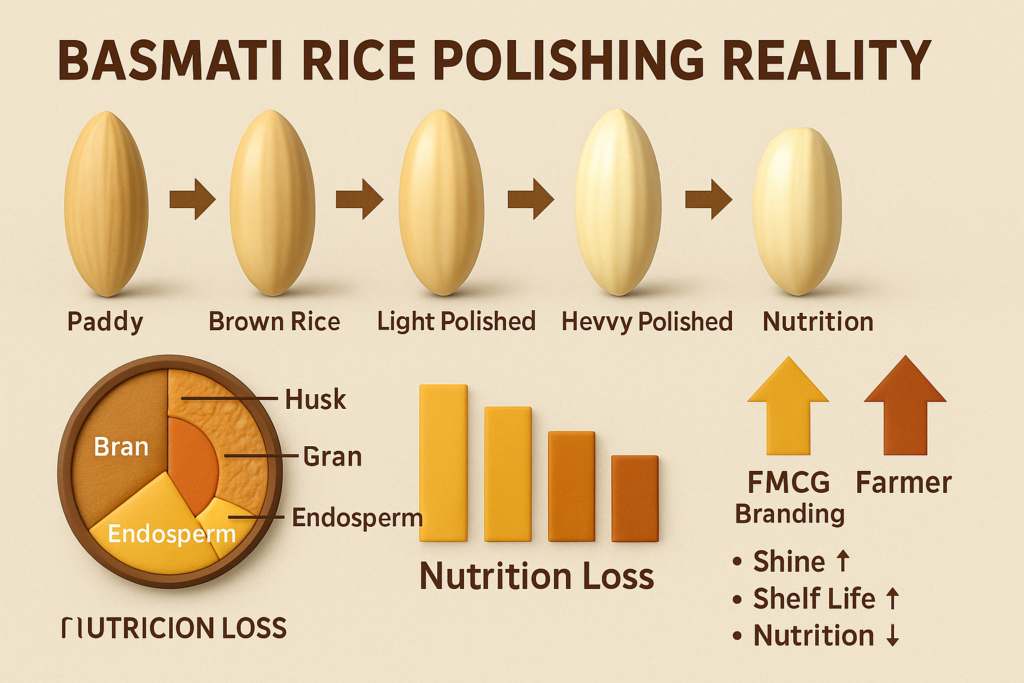
    A basmati grain has four physical layers:

    Outer husk

    Bran layer

    Germ

    Starchy endosperm

    Once the husk is removed, the rice becomes brown rice.
    From there, polishing removes the bran and partially damages the germ.

    What remains is white rice—visually attractive, stable in storage, but nutritionally reduced.

    The Real Polishing Process Used by Large Processors

    Dehusking Stage

    This step removes only the husk.
    No nutrition loss occurs here.

    Whitening Stage

    Rice passes through abrasive rollers that scrape off the bran layer gradually.
    This is where fiber, minerals, and vitamins begin to disappear.

    Fine Polishing Stage

    Silky polishers use friction and controlled moisture to:

    Increase shine

    Smooth grain surface

    Improve uniformity

    This stage does not improve food quality.
    It improves market acceptability.

    Surface Treatment (Limited but Real)

    Some processors apply minimal food-grade agents such as water mist or light glucose dusting.
    The purpose is visual consistency, not preservation.

    Why Basmati Rice Is Polished More Than Most Grains

    Basmati is sold as a premium product.
    Premium markets reward appearance more than nutritional density.

    Polishing is intensified because:

    Export buyers demand visual uniformity

    Retail consumers equate whiteness with purity

    Shelf life increases with bran removal

    Broken grains become less noticeable

    In many markets, visual trust outweighs nutritional truth.

    Nutrition Loss: What Polishing Removes

    As polishing increases:

    Dietary fiber drops sharply

    Natural oils from the germ disappear

    B-vitamins reduce significantly

    Glycemic response becomes faster

    Polished basmati feels light and cooks beautifully, but it feeds the body for a shorter duration.

    This is not a safety issue.
    It is a nutritional trade-off hidden behind branding.

    Legal Reality of Rice Polishing

    Polishing itself is legal worldwide when done mechanically and with food-grade practices.
    Harmful chemicals and non-food coatings are prohibited.

    What regulations rarely demand is clear disclosure of polishing intensity.

    This allows the same rice batch to be sold under different brand narratives without consumers understanding what changed.

    How Polishing Creates Invisible Price Layers

    One harvested basmati lot can be divided into multiple market identities:

    Light-polished rice positioned as “natural”

    Medium-polished rice sold as “premium daily”

    Heavily polished rice marketed for export

    The farmer is paid once.
    The processor monetizes the same grain repeatedly.

    Polishing does not add nutrition.
    It repackages perception.

    Why Unpolished Basmati Faces Market Resistance

    Unpolished or minimally polished basmati has:

    Shorter shelf life

    Slightly darker color

    Stronger natural aroma

    Higher cooking variability

    Without consumer education, it struggles on standard retail shelves.

    Its failure is not agricultural.
    It is psychological and logistical.

    Where Farmers Lose—and Where Opportunity Exists

    Farmers lose value because polishing control sits outside their reach.
    But opportunity exists for those who understand the system.

    Potential paths include:

    Contract supply for low-polish health brands

    Direct brown rice marketing

    Transparent processing models

    Traceable supply chains

    These markets reward knowledge, not volume.

    Export Market Shift Most Farmers Don’t See Yet

    Traditional export channels still favor heavy polish.
    However, newer consumer segments are moving toward:

    Lower processing

    Nutritional transparency

    Traceable origin

    This shift will not reward unaware producers.
    It will reward informed positioning.

    Final Conclusion: The Truth About Basmati Rice Polishing

    Polishing is not a crime.
    But it is not neutral either.

    It transforms basmati rice from a soil-grown food into a market-shaped product.
    It reduces nutrition while increasing shelf stability and visual appeal.
    It shifts value away from growers and concentrates it within processing and branding.

    Understanding polishing does not mean rejecting it.
    It means regaining awareness and choice.

    Farmers who understand polishing regain bargaining power.
    Consumers who understand polishing regain control over what they eat.

    Basmati rice deserves clarity, not just shine.

    ✍️Farming Writers Team
    Love farming Love Farmers.