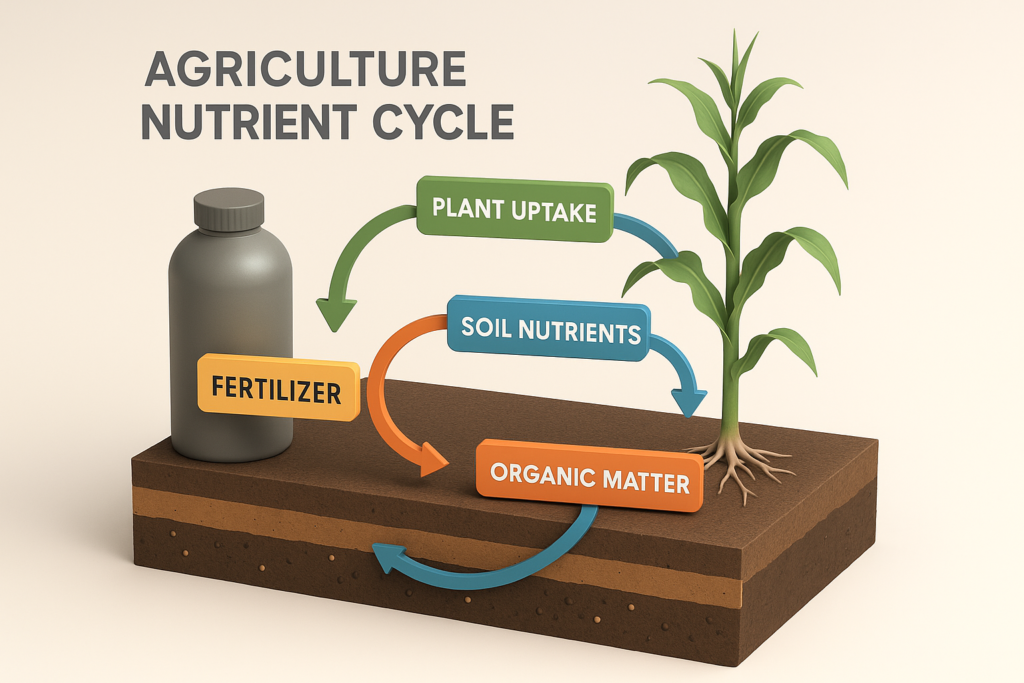
Across the world from Asia’s rice belts to Africa’s maize zones and Europe’s horticulture regions farmers are witnessing a silent but devastating crisis: root system collapse. Crops that once developed deep, strong, nutrient-absorbing roots are now showing shallow, fragile, and nutrient-deficient root structures. This shift did not happen overnight; it is the cumulative outcome of decades of soil mismanagement, fertilizer imbalance, biological decline, and chemical over-dependence.
Modern agriculture has unintentionally pushed plants toward weak rooting habits. High nitrogen availability near the surface stops roots from going deep. Soil organic matter has declined because residues are burned or soils remain bare. Heavy machinery has compacted millions of hectares. Chemical dominance has reduced microbial populations that once supported roots naturally.
This article provides the world’s most comprehensive, original, science-based explanation of why root systems are collapsing globally and what agriculture must change to restore deep-rooted, resilient crops.
- THE SCIENCE OF ROOT FORMATION
Crop roots grow based on five primary forces:
- Soil structure
- Soil moisture distribution
- Nutrient profile
- Microbial activity
- Chemical stress or support
Healthy soils encourage roots to explore deeply. But unhealthy soils force the plant to survive only at the surface.
- GLOBAL REASONS FOR ROOT COLLAPSE
2.1 Excess Nitrogen at the Soil Surface
Continuous surface placement of urea and ammonium fertilizers leads to:
nitrogen concentration only in top 5–7 cm
reduced need for deep exploration
shallow feeder roots instead of structural roots
weak anchoring
This is now a global phenomenon.
2.2 Declining Soil Organic Matter
Organic matter binds soil, creates pores, and feeds microbes. Its destruction leads to:
compact, airless soil
loss of aggregation
reduced root penetration capacity
Soils with <1% organic carbon cannot sustain strong root architecture.
2.3 Chemical Stress on Root Tips
High salt fertilizers, pesticides, and herbicide residues burn fine root hairs.
The plant responds by:
reducing new root formation
avoiding deeper horizons
redirecting energy into shallow survival growth
2.4 Weak Soil Biology
Healthy soil hosts millions of organisms:
mycorrhizal fungi
nitrogen-fixing bacteria
phosphorus-solubilizing microbes
These microorganisms enlarge the nutrient-absorbing capacity of roots.
Their collapse = root collapse.
2.5 Hardpan Formation
Mechanical compaction forms a dense layer at 15–25 cm depth.
Roots hit the barrier and stop immediately.
2.6 Global Overuse of Nitrogen Fertilizers
Countries like India, China, Pakistan, Bangladesh, and parts of Africa rely heavily on nitrogen fertilizers.
This leads to:
nutrient imbalance
stunted root elongation
reduced secondary root branching
- WORLDWIDE IMPACT OF ROOT COLLAPSE
3.1 Yield Instability
Crops cannot access water below 20 cm, making them highly sensitive to heat and drought.
3.2 High Fertilizer Requirement
Shallow roots mean low nutrient foraging → farmers apply more fertilizer.
3.3 Lodging Increase
Weak structural roots cannot support plant height.
3.4 Decline in Crop Quality
Everything from protein content to fruit size reduces.
3.5 Poor Response to Irrigation
Water stays above instead of entering deeper layers.
- GLOBAL CASE STUDIES
4.1 Indian Wheat & Rice Belt
High urea application → shallow roots → low organic matter → yield stagnation.
4.2 African Maize Systems
Soil mining + low organic matter → extremely fragile root systems.
4.3 European Horticulture
Chemical dependence → weakened root hair viability.
- SOLUTIONS FOR GLOBAL ROOT RESTORATION
5.1 Deep Nutrient Placement
Farmers who shift nitrogen 10–15 cm deep gain:
stronger axial roots
lower lodging
higher yields
5.2 Organic Matter Regeneration
Additions of compost, manure, cover crops, and crop residues rebuild the soil’s physical structure.
5.3 Mycorrhizal Recovery
Restoring mycorrhiza can increase root surface area by up to 500%.
5.4 Biofertilizers & Biological Inputs
These re-establish microbial partners.
5.5 Subsoil Breaking
Breaking compacted layers increases root depth dramatically.
- LONG-TERM GLOBAL STRATEGY
Countries must shift toward:
regenerative agriculture
balanced fertilization
soil life restoration
deep nutrient tools
organic carbon rebuilding
Only then will root collapse reverse.
10 FAQs
Q1. Why are root systems becoming shallow worldwide?
Because nutrients, especially nitrogen, are concentrated near the soil surface.
Q2. Does high urea cause root damage?
It does not damage, but it prevents deep rooting by satisfying the plant at the surface.
Q3. What is the main sign of root collapse?
Plants lodge easily, wilt fast, and show nutrient deficiency despite fertilizer use.
Q4. How does soil organic matter affect roots?
It improves soil structure, moisture, aeration, and microbial support.
Q5. Can roots recover after collapse?
Yes, but requires organic matter rebuilding and biological restoration.
Q6. How does compaction stop root growth?
Roots cannot penetrate dense layers; they turn sideways.
Q7. Why do vegetables suffer more?
They are sensitive to chemical stress and shallow nutrient patterns.
Q8. How do microbes help roots?
They expand nutrient access and protect root tips.
Q9. What fertilizer practice is most harmful?
Repeated surface nitrogen application.
Q10. What global model can fix this?
Regenerative soil management with deep nutrient placement.
The global root collapse crisis is one of the biggest hidden threats to modern agriculture. Years of excessive nitrogen, declining organic matter, soil compaction, and biological loss have pushed crops toward shallow, weak root systems. The solution lies in restoring soil structure, rebuilding organic carbon, reviving microbial networks, and rethinking fertilizer placement. Without strong roots, crop yields, climate resilience, and global food security cannot be maintained.
✍️ Farming Writers Team
Love farming Love Farmers.
Read A Next Post 👇
https://farmingwriters.com/global-nitrogen-efficiency-complete-guide/