• The Long Road Home: Why Farmers Keep Going Despite Uncertainty

    The Long Road Home

    There is a road every farmer knows, even if it never appears on a map. It begins at the edge of the village, cuts through familiar fields, bends around irrigation channels, and leads straight into uncertainty. Farmers walk this road daily, not because it always rewards them, but because it is the only road that moves life forward.

    Most people measure progress in milestones.
    Farmers measure it in seasons.

    A season does not ask whether you are ready.
    It arrives when it chooses.
    And when it arrives, a farmer must respond — tired or fresh, confident or doubtful, hopeful or discouraged.

    That response is where the true strength of farming lives.

    In cities, when plans fail, people redesign schedules.
    On farms, when plans fail, people redesign themselves.

    A farmer’s mind is constantly adjusting — sometimes hourly, sometimes silently. He revises expectations without announcing them. He absorbs disappointment without public display. He continues without applause. This quiet adjustment is not weakness; it is intelligence shaped by necessity.

    Farming has never been about certainty.
    It has always been about commitment.

    The soil never promises success.
    The sky never guarantees fairness.
    The market never assures stability.

    Yet farmers plant anyway.

    It takes a certain kind of courage to place seeds into the ground knowing full well that the future may erase months of effort without explanation. That courage doesn’t come from optimism. It comes from responsibility. Someone must take the risk, or everyone suffers.

    Farmers become risk-takers not for profit, but for survival.

    There is a myth that farmers live simple lives. In reality, they live exposed lives. Every decision is visible to nature. Every mistake is answered honestly. You cannot hide poor judgment from soil. You cannot negotiate with drought. You cannot argue with frost.

    This exposure builds a specific kind of character.

    A farmer learns early that control is an illusion. What matters is response. How quickly you adapt. How calmly you recover. How courageously you begin again.

    Beginning again is the backbone of agriculture.

    Some restarts are gentle — a change in crop, a shift in timing, a different fertilizer.
    Some restarts are painful — after floods, droughts, disease, or financial loss.
    But restarting always happens, because the land does not pause life.

    What separates farmers from others is not how often they fail, but how naturally they refuse to stay defeated.

    A farmer’s emotional strength is rarely visible. It shows up behind closed doors, during early mornings, and inside thoughts never spoken aloud. Worry is not optional in farming; it is part of the job. But worry does not stop work. It walks beside it.

    That is the difference.

    People often search for balance between life and work.
    Farmers live where life is the work.

    Their children grow up surrounded by conversations about weather, water, soil, and timing. Their understanding of life begins with interdependence — how everything affects everything else. Nothing is isolated on a farm. A mistake in one corner reaches another. A success in one patch gives hope to the rest.

    Farming builds holistic thinking.
    And holistic thinking builds resilient minds.

    There is also something deeply humbling about working in an environment where effort does not guarantee reward. It teaches farmers to respect outcomes without entitlement. They celebrate harvest not as a victory, but as gratitude — gratitude that conditions aligned long enough for effort to matter.

    That humility changes how farmers view life.

    They do not chase perfection.
    They chase improvement.

    They do not demand fairness.
    They demand opportunity.

    They do not expect ease.
    They expect movement.

    Every farmer has walked through days when continuing felt heavier than quitting. Those days do not look dramatic from the outside. They look ordinary. But internally, those are the days when character is forged.

    The farmer still wakes up.
    Still walks to the field.
    Still checks the soil.
    Still does the work.

    Not because he feels brave, but because responsibility outweighs emotion.

    This is why farming produces some of the most grounded people on earth. They learn to live with incomplete information. They act despite doubt. They adapt without panic. They accept loss without hatred. They respect nature without fear.

    If the world wants to understand resilience, it should not look to motivational speeches. It should observe a farmer who lost a crop last year and still prepares the land this year.

    That single act explains everything.

    Farming is proof that hope does not require guarantees. It requires effort. And effort, repeated over time, becomes strength.

    Farmers do not keep going because they are blind to reality.
    They keep going because they understand it better than anyone else.

    They know that stopping helps no one.

    And so they walk the long road home — day after day, season after season — carrying uncertainty in their pockets and responsibility in their hands, shaping the future of people they will never meet.

    Quietly.
    Consistently.
    Honestly.

    That is the work behind the world.

    ✍️Farming Writers Team

    Love Farming Love Farmers

    Read A Next Post 👇

    https://farmingwriters.com/where-the-heart-learns-to-work-farmer-strength/
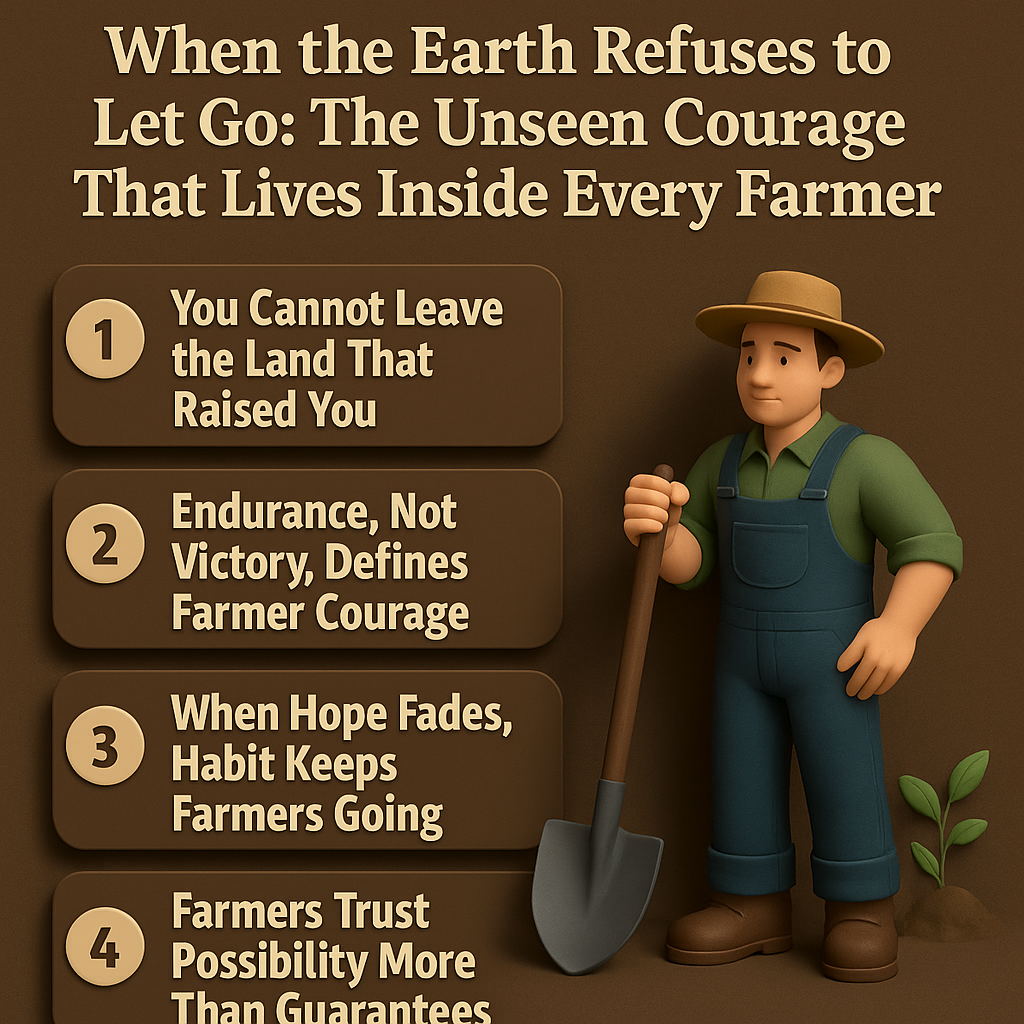
  • When the Earth Refuses to Let Go: The Hidden Courage of Farmers

    When the Earth Refuses to Let Go

    There are places in this world where time moves differently.
    Not slowly, not quickly, but with a kind of patience that feels ancient.
    A farm is one of those places.

    A farmer walks through his field long before the sun rises, and long before the rest of the world decides what kind of day it wants to be. The air at this hour carries a weight that cannot be photographed or explained. It holds memories of yesterday’s work, predictions of tomorrow’s weather, and truths that farmers learn without words.

    People imagine farming as a profession.
    Farmers know it is an identity.

    A factory worker can leave the factory.
    A teacher can leave the classroom.
    A businessman can switch ventures.

    But you cannot leave the land that raised you.
    Not truly.
    Even if you travel far, the soil stays inside you like a stubborn heartbeat.

    Farmers carry this connection quietly.

    Not as a speech.
    Not as pride.
    Not as a statement of identity.
    But as a simple understanding:
    “I belong to this land, and this land belongs to me.”

    The courage of farmers is often misunderstood.
    It does not come from victory.
    It comes from endurance.
    Endurance built from years of uncertainty, loss, responsibility, and hope mixed together in unpredictable proportions.

    A farmer does not get stronger in the good years.
    He gets stronger in the bad ones.

    The years when rain played games.
    The years when markets betrayed expectations.
    The years when pests destroyed months of careful planning.
    The years when everything seemed to collapse at once.

    Those are the years that plant courage deeper than roots.

    Ask a farmer why he keeps going and he will rarely give a poetic answer.
    He’ll shrug.
    He’ll smile.
    He’ll say something simple like “What else can I do?”

    What he really means is:

    “Stopping would break me more than trying.”

    There are days when a farmer walks through his field and the silence feels heavier than the land itself. Not the peaceful silence of nature, but the silence of consequences — the silence that arrives after a season has gone wrong.

    A farmer stands there not as a defeated man, but as someone calculating the next step. His mind does not dwell on loss; it searches for solutions. This is not optimism. This is survival.

    Most people break when life becomes unpredictable.
    Farmers expect unpredictability.

    They don’t collapse when nature changes its mind.
    They adapt.
    They adjust the rhythm of their work.
    They change the direction of hope.
    They reimagine the coming weeks.
    They restart.

    Farming is a constant rehearsal for tomorrow.

    But it is also something deeper — a kind of agreement with the earth:

    “I will give you my effort.
    You will give me your possibility.”

    Not a guarantee.
    Not a promise.
    Just a possibility.

    And farmers accept that possibility is enough to keep going.

    There is a moment in the life of every farmer when he realises that land is not just soil — it is memory.
    Generational memory.
    Emotional memory.
    Survival memory.

    Every corner of a farm carries a story.
    Where his father planted his first crop.
    Where his grandfather stood during the monsoon of a legendary year.
    Where harvest once saved the entire household.
    Where failure taught the harshest lesson.
    Where an animal used to wait every morning.
    Where a child took its first steps.
    Where hope returned after it was almost lost.

    These memories do not fade.
    The earth doesn’t forget.

    Farmers often look like they are working the land.
    But the truth is the land is working on them too.

    It shapes their thinking.
    It teaches patience.
    It softens anger.
    It sharpens observation.
    It humbles ego.
    It deepens responsibility.
    It strengthens emotional endurance.

    Most people break under pressure because they are not used to living with the unknown.
    Farmers live with the unknown every day.

    People fear failure.
    Farmers plant in uncertainty.

    People expect comfort.
    Farmers expect challenge.

    People crumble when plans collapse.
    Farmers rebuild plans from the soil up.

    Farmers do not fear storms.
    They fear giving up.

    There is a difference between fear that stops you and fear that shapes you.
    Farmers carry the second kind.

    Stand with a farmer during sunset and you will hear the honesty of life in his voice — not bitterness, not complaint, not regret, but acceptance. Acceptance that life is unpredictable, but effort is not. The field does not need perfection; it needs participation. The land does not ask for guarantees; it asks for commitment.

    Farmers understand that you cannot control everything.
    But you can continue through anything.

    This is why the spirit of a farmer is almost unbreakable.
    Not because he has not faced suffering —
    but because suffering has taught him endurance.

    A crop may fail.
    A season may collapse.
    A storm may destroy what months built.
    But a farmer always finds a reason to return.

    Even when hope fades, habit remains.
    Even when clarity disappears, responsibility stays.
    Even when doubt grows louder, the soil remains patient.

    And that patience becomes the farmer’s motivation.

    People search for motivation in books, videos, speeches.
    Farmers find it in silence.
    In the sound of footsteps on dry soil.
    In the chill of morning air.
    In the emptiness of a field waiting to be planted.
    In the whisper of wind predicting the next change.
    In the memory of harvests that once felt impossible.

    Farming teaches a truth that the modern world forgets:

    You don’t become stronger by avoiding difficulty.
    You become stronger by walking through it.

    And farmers walk through difficulty every day.

    But the greatest strength of a farmer is not his hard work.
    It is his ability to hope again after hope has already broken.

    The world survives because farmers believe in tomorrow even when today feels like an enemy.
    They do not trust fate; they trust effort.
    They do not trust luck; they trust land.
    They do not trust guarantees; they trust possibility.

    Farmers carry humanity forward quietly, season after season, without applause, without spotlight, without reward — only responsibility.

    And perhaps that is why the earth refuses to let go of farmers.
    Because the earth knows who respects it the most.

    Farmers survive storms, losses, and impossible seasons.
    But they rise.
    They always rise.

    And when they rise, the world rises with them.

    Because farming is not the story of crops.
    It is the story of courage.

    ✍️Farming Writers Team

    Love farming Love Farmers

    Read A Next Post 👇

    https://farmingwriters.com/the-wind-remembers-everything-farmers-move-forward/

  • The Wind Remembers Everything: Farmers and the Courage to Move Forward

    The Wind Remembers Everything

    The wind behaves strangely in farming villages. Unlike cities where wind passes through without leaving memories, in rural fields the wind carries stories. It moves slowly through crops, bends lightly around old trees, brushes across the quiet roofs of small homes, and finally settles into the earth as if it has something to say. Farmers learn to read this wind—its direction, its temperature, its honesty. Not because someone taught them, but because the land teaches those who stay long enough to listen.

    A farmer doesn’t stand in the field as a worker. He stands as a witness.
    A witness to seasons that don’t keep promises, to rains that forget their timing, to sunlight that sometimes burns more than it blesses. Yet every morning, he returns to the same land with a kind of fragile hope that the world rarely understands.

    Strength in farming is not the strength of muscles or machinery.
    It’s the strength of repeating effort despite repeating uncertainty.

    Sometimes the soil looks fine but hides exhaustion.
    Sometimes the sky looks generous but holds a storm.
    Sometimes a plant looks healthy but suffers silently.
    And sometimes, despite a farmer giving everything he has, nature chooses a different plan.

    But a farmer continues, not because he is unbreakable, but because stopping is harder than trying.

    People often imagine farming as a scheduled cycle: prepare → sow → irrigate → protect → harvest.
    But farmers know that reality doesn’t follow diagrams.
    Reality comes with chaos—abrupt changes in temperature, unexpected market behaviors, invisible pests, sudden nutrient imbalances, or rainfall that apologizes by coming at the worst possible time.

    Yet farmers wake up every morning with the same discipline.
    Not because motivation magically rises every sunrise,
    but because responsibility refuses to sleep.

    Every field holds invisible memories of its farmer.
    The foot-marks formed in the same direction for years.
    The places where he stood silently when life went wrong.
    The spots where he kneeled to check the soil by touch alone.
    The corners where he stored tools, hoping next season would be kinder.
    And the small shade under which he ate lunch while weather shifted without warning.

    The field remembers everything.
    The wind carries those memories.

    A farmer grows older faster than the world notices.
    But he grows wiser in ways the world cannot measure.

    Most people think wisdom comes from books, experiences, or age.
    But farmers gain wisdom from moments that are small and unnoticed—moments that never become stories but become foundations of character.

    The moment when a seed sprouts after weeks of doubt.
    The moment when a failing crop turns green after a night of rain.
    The moment when an entire field fails but one corner still survives.
    The moment when a bird sits on a fence during a long, lonely afternoon.
    The moment when silence between two seasons becomes heavier than any workload.

    These moments don’t get recorded.
    But they shape the soul of a farmer.

    Every farmer lives with a form of courage that does not shout.
    His courage is quiet, steady, unpolished.
    It grows in the corners of his life where no one is watching.

    A farmer doesn’t show fear because fear doesn’t change the soil.
    He doesn’t show anger because anger doesn’t bring rain.
    He doesn’t show despair because despair doesn’t shape harvest.
    He chooses calm, not because he is calm, but because calmness is the only way to survive a life where nothing is guaranteed.

    One of the strangest truths in farming is that loss does not stop life—it becomes part of its rhythm.

    There have been years when farmers harvested almost nothing.
    There have been seasons when pests arrived like an army and stripped green fields into brown disappointment.
    There have been nights when storms destroyed an entire year of effort.
    And mornings when farmers stood in silence, not knowing how to begin again.

    But they begin anyway.

    Beginning again is the heart of farming.
    And beginning again is the heart of life.

    The world celebrates winners.
    Farming celebrates those who refuse to quit.

    A factory can pause.
    An office can reschedule.
    A business can reorganize.
    But a field waits for no one.

    If a farmer misses a sowing window by even a few days, the season itself collapses.
    If irrigation is delayed at the wrong time, weeks of growth can freeze.
    If a pest is ignored for a single night, the damage becomes irreversible.

    This is why farmers develop a sense of time sharper than clocks.
    They don’t measure days; they measure possibilities.

    The soil adjusts slowly.
    Plants grow silently.
    Nature heals at its own pace.
    Farmers learn patience not because they choose it but because agriculture demands it.

    A farmer’s relationship with failure is different from the world’s.
    He doesn’t fear failure; he fears stopping.
    Failure is a season.
    Stopping is the end.

    There is a dignity in farming that modern life doesn’t understand.
    It has nothing to do with wealth, status, or recognition.
    It has everything to do with purpose.

    Farmers don’t feed themselves.
    They feed everyone.
    They don’t work for applause.
    They work for continuity.
    They don’t seek perfection.
    They seek possibility.

    Standing alone in a field after sunset, a farmer often reflects on things the world considers ordinary.

    Why did the clouds move differently today?
    Why did the soil feel warmer under his feet?
    Why did the wind carry a different scent?
    Why did the evening sound quieter than usual?

    These small changes shape tomorrow.
    A farmer learns to predict life not through technology alone but through awareness—raw, honest, instinctive awareness.

    A farmer is not just working on land.
    He is working with life.

    His hands are not just holding tools.
    They are holding the future.

    His eyes are not just looking at crops.
    They are looking at survival.

    His steps are not just moving across fields.
    They are walking in the footsteps of thousands of years of human history.

    Farming is the original profession.
    The first duty.
    The first science.
    The first hope humanity ever knew.

    And yet, farmers rarely receive the respect they deserve.
    Their strength is invisible.
    Their sacrifices are silent.
    Their wisdom is unspoken.
    But without them, the world would starve—literally and spiritually.

    Every farmer carries something inside his heart that the world needs desperately:

    The ability to move forward even when nothing moves with you.

    Life tries to stop farmers.
    Weather tries.
    Markets try.
    Circumstances try.
    But they continue.

    They continue because they understand a truth the world forgets:

    “You only lose when you stop trying.”

    Farmers don’t stop.
    They bend, they struggle, they restart, they rebuild—but they don’t stop.

    This is why farming is the greatest teacher.
    Not because it grows food,
    but because it grows people.

    And those who learn farming learn life.

    ✍️Farming Writers Team

    Love Farming Love Farmers

    Read A Next Post 👇

    https://farmingwriters.com/the-day-the-soil-spoke-back-farming-strength/