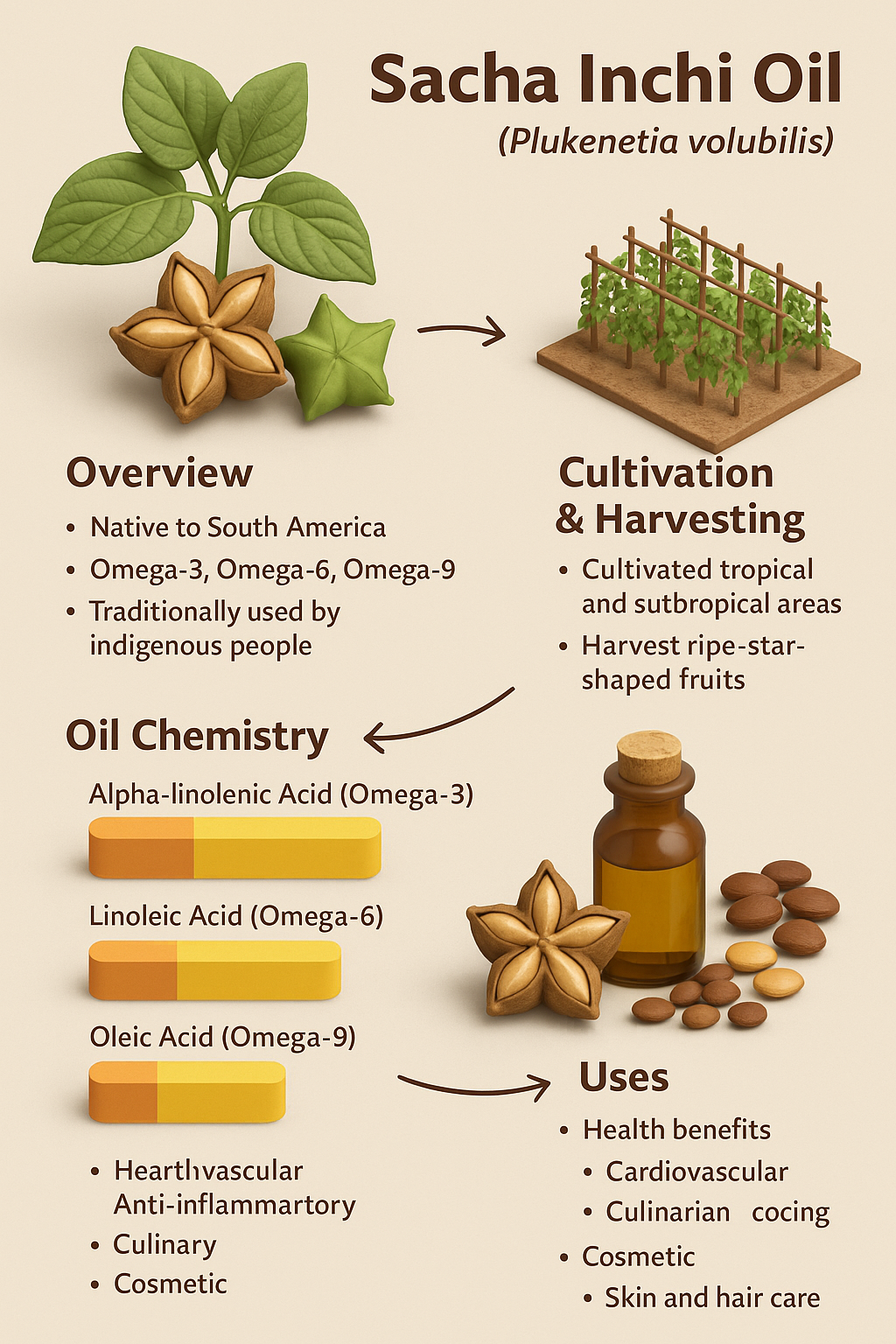
There are certain oil-bearing plants whose stories cannot be confined to agricultural manuals or chemical reports. They belong to landscapes shaped by ancient rivers, to cultures that developed entirely outside the industrial world, and to ecosystems that function through intricate ecological relationships. Sacha Inchi is one such plant. Before it became a buzzword in modern health markets or a premium oil in global nutrition shops, it existed silently in the river valleys of the Peruvian Amazon, attached to the memories and survival strategies of indigenous communities who understood its significance long before scientists assigned names to its fatty acids.
When you encounter Sacha Inchi in its natural environment, it does not appear as a conventional agricultural plant. It grows as a climbing vine, weaving itself through humid air, leaning on supports offered by surrounding trees and shrubs. The pods, shaped like star patterns with four to six pointed segments, appear almost ornamental at first glance. Inside each segment lies a seed with a remarkable biochemical identity — a seed whose oil composition rivals the most celebrated health oils in the world. But this oil did not evolve for human nutrition alone; it evolved as part of the plant’s survival mechanism in the complex web of Amazonian ecology.
Understanding the oil requires understanding its environment. The Amazon rainforest is not a stable, uniform ecosystem but a constantly shifting mosaic of microclimates. Floodplains change every season, drylands transform into moist zones, and soil fertility fluctuates in ways that puzzle conventional farmers. Sacha Inchi thrives precisely because it evolved to negotiate these shifts. It does not demand rich soils, nor does it insist on monoculture conditions. It thrives on forest margins, on riverbanks, on slopes where sunlight drifts through gaps in the canopy. It is a plant built for cooperation within a diverse ecosystem, not dominance over it.
Indigenous farmers, especially the Asháninka and other tribal groups, cultivated Sacha Inchi not as a commercial crop but as a multi-purpose plant of daily life. Its seeds provided nutrient-rich sustenance after roasting. Its oil became a remedy for skin inflammation, joint pain, and digestive issues. Its vines were used as living fences, and its flowers attracted insects that played roles in local biodiversity. For these communities, Sacha Inchi was not a commodity — it was an ecological partner.
The global world, however, discovered Sacha Inchi through a completely different lens. As nutrition science began exploring plant-based Omega sources, researchers found that Sacha Inchi seeds contain extraordinarily high levels of alpha-linolenic acid (ALA), an Omega-3 fatty acid essential for human health. Many health oils—flax, chia, walnut—carried high Omega-3 levels, but Sacha Inchi displayed a rare balance: high Omega-3 alongside stable Omega-6 and Omega-9 proportions, giving the oil an unusually harmonious lipid profile. Moreover, Sacha Inchi oil exhibited a surprising resistance to oxidation compared to other plant-based Omega oils. This stability, unusual for such unsaturated oils, attracted global interest.
But long before laboratories confirmed these biochemical qualities, indigenous farmers already knew that Sacha Inchi oil stayed fresh even in the humid rainforest climate. They stored it in simple containers without preservatives, perhaps intuitively understanding that the oil could endure where others spoiled. This knowledge, built through centuries of observation, mirrors a pattern seen across many traditional societies: long practical experience often anticipates scientific validation by generations.
Cultivating Sacha Inchi for large-scale production, however, is not as simple as planting a field of uniform vines. The plant behaves differently depending on altitude, soil type, humidity rhythm, and sunlight patterns. In its native habitat, it benefits from the partial shade provided by forest edges. When grown in full sun in open commercial farms, the vines must be trained along trellises or wires, changing their natural growth behavior. Thus, modern farmers face a paradox: Sacha Inchi yields higher in sunlight, but prolonged exposure stresses the plant unless irrigation and soil moisture are managed carefully.
In Peru, where modern Sacha Inchi cultivation has expanded significantly, farmers have developed hybrid strategies. They combine indigenous knowledge—spacing patterns, pruning styles, seed selection based on pod symmetry—with modern trellising systems that allow the vines to climb. These methods increase yield but also require an understanding of how the plant responds to stress. Sacha Inchi flowers can be sensitive to temperature fluctuations. A period of unexpected cold can reduce flowering dramatically, while excessive heat during seed set can shrink seed size.
Another complexity arises from pollination. While Sacha Inchi is capable of self-pollination, cross-pollination by insects significantly increases yield and seed quality. The biodiversity of its native rainforest provides these pollinators naturally. In commercial farms, however, bee populations may not be sufficient unless ecological corridors are maintained. This reaffirms an emerging global truth: oil crops that evolved in biodiverse ecosystems cannot simply be removed from those ecosystems without losing part of their strength.
Extraction of Sacha Inchi oil reflects its delicate chemical structure. Cold pressing preserves the Omega-3-rich composition that makes the oil nutritionally valuable. The oil emerges pale golden with a subtle, slightly nutty aroma. But the process is sensitive. If seeds are harvested too early, the oil carries grassy undertones. If dried improperly, the oil develops bitter notes indicating partial oxidation. Indigenous farmers historically roasted the seeds lightly before consuming them, but roasting for oil extraction reduces nutritional value. Thus, modern extraction facilities insist on low temperatures and controlled drying.
The oil’s sensory profile is mild enough to be used in salad dressings, smoothies, and health foods, yet rich enough in texture to be used in premium skincare. Its ability to absorb quickly without leaving a greasy film makes it popular in cosmetic formulations. The anti-inflammatory properties of the oil have gained traction in dermatological studies, showing that it may help repair the skin barrier and reduce chronic dryness. This has pushed Sacha Inchi oil into global markets far removed from the Amazon — from Korean beauty brands to European organic skincare lines.
Economically, Sacha Inchi occupies a fascinating position. It is not cheap enough to compete with bulk edible oils nor rare enough to be classified as a luxury oil. Its global expansion depends on ethical sourcing, supply chain transparency, and ecological stability. Peru leads world production, but neighboring countries like Colombia, Ecuador, and Brazil have begun investing in Sacha Inchi as a sustainable alternative to crops that harm rainforest ecosystems. The vine’s perennial nature allows farmers to harvest seeds multiple times a year, creating consistent income without clearing forests.
However, commercialization brings risks. When a rainforest plant enters global markets, monoculture temptations often follow. Planting Sacha Inchi at industrial scale in deforested land may provide income but undermines biodiversity. Indigenous communities fear that their traditional varieties may be replaced by commercial hybrids that prioritize yield over ecological integrity. Some scientists warn that large-scale Sacha Inchi plantations may require more water than anticipated in drier zones, altering hydrological patterns. These concerns highlight the need for intelligent, ecologically respectful growth.
Sacha Inchi’s cultural history is as rich as its biochemical profile. Ancient ceramic vessels from pre-Inca civilizations depict the star-shaped pods, indicating that the plant held symbolic importance. The star shape itself is distinctive enough to have become an emblem of vitality. Oral traditions in the Amazon describe Sacha Inchi as a “gift plant” given by forest spirits to maintain human strength during scarcity. These narratives, though metaphorical, capture the real nutritional power of the oil.
Today, as global populations grapple with chronic inflammation, omega deficiencies, and metabolic disorders, Sacha Inchi oil is gaining attention as a plant-based corrective agent. The high ALA content supports brain health, cardiovascular function, and hormonal balance. Nutritionists note that its digestibility is remarkably high, and unlike fish oils, it does not carry heavy-metal contamination risks.
Side effects of Sacha Inchi oil are minimal but not nonexistent. Individuals unfamiliar with high Omega-3 oils may experience mild digestive adjustments when consuming large quantities. Rare seed allergies have been documented, but overall, the oil is considered safe and beneficial. The primary challenge is ensuring that the oil remains unrefined and cold pressed. Refined variants lose the very nutrients that make Sacha Inchi valuable.
From a global agricultural perspective, Sacha Inchi embodies a new direction. It represents a future where oil crops are chosen not merely for volume but for ecological fit, nutritional density, and cultural depth. It symbolizes a shift from extractive agriculture to regenerative systems, from monoculture to agroecology, from commodity thinking to holistic resource management.
As climate change advances, crops like Sacha Inchi — resilient, adaptable, nutrient-dense — may become central to sustainable food systems. Their ability to integrate with biodiversity rather than displace it will define their long-term success. For farmers seeking diversification, for nutritionists searching for plant-based Omega solutions, for environmentalists promoting regenerative models, Sacha Inchi stands as a bridge between traditional knowledge and modern needs.
It is a plant whose oil carries not just calories but history, memory, resilience, and the quiet intelligence of ecosystems that evolved long before human agriculture began.
And perhaps that is why Sacha Inchi oil feels different from other oils. Not because of its chemical superiority alone, but because of the story it carries — a story of rivers, forests, indigenous wisdom, and a global community beginning to rediscover what ancient societies already understood: that true nourishment comes not only from what a plant contains, but from the world that shaped it.
✍️Farming Writers Team
Love Farming Love farmers
Read A Next Post 👇