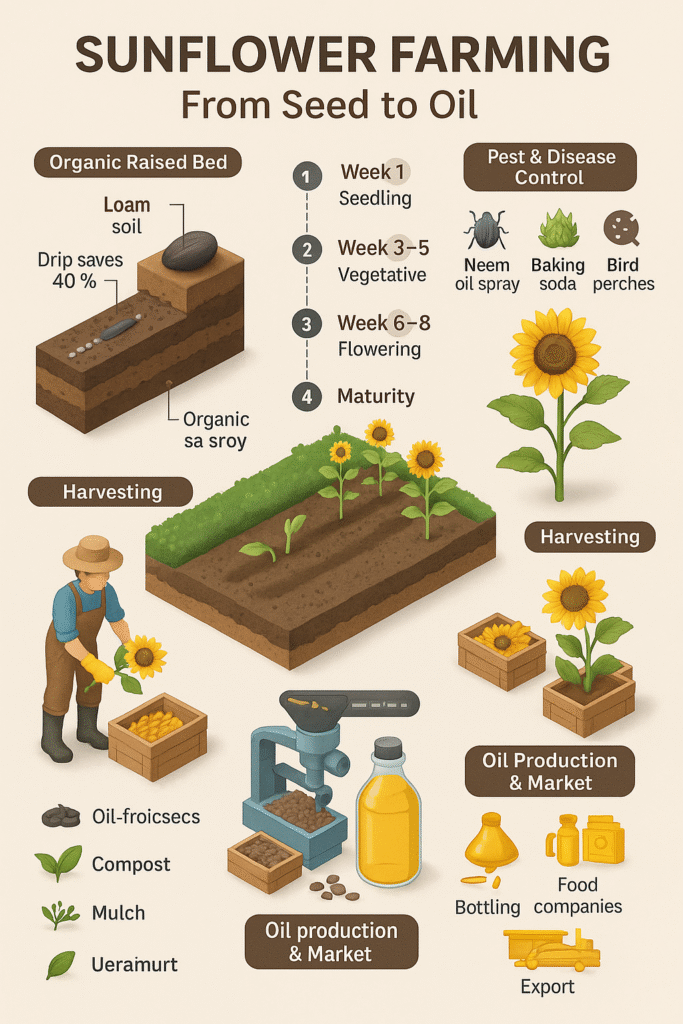
Sunflower, known scientifically as Helianthus annuus, has earned its position as one of the world’s largest oilseed crops. From North America to Africa, Europe, Russia, India and Australia, sunflower farming has become a dependable source of high-quality edible oil and protein-rich feed. The crop adapts to a wide range of climates, tolerates drought better than many oilseed plants, and produces visually striking fields with bright yellow heads that track the sun. This remarkable plant requires scientific handling to maximize its oil content and seed quality, making it both rewarding and technically interesting for farmers worldwide.
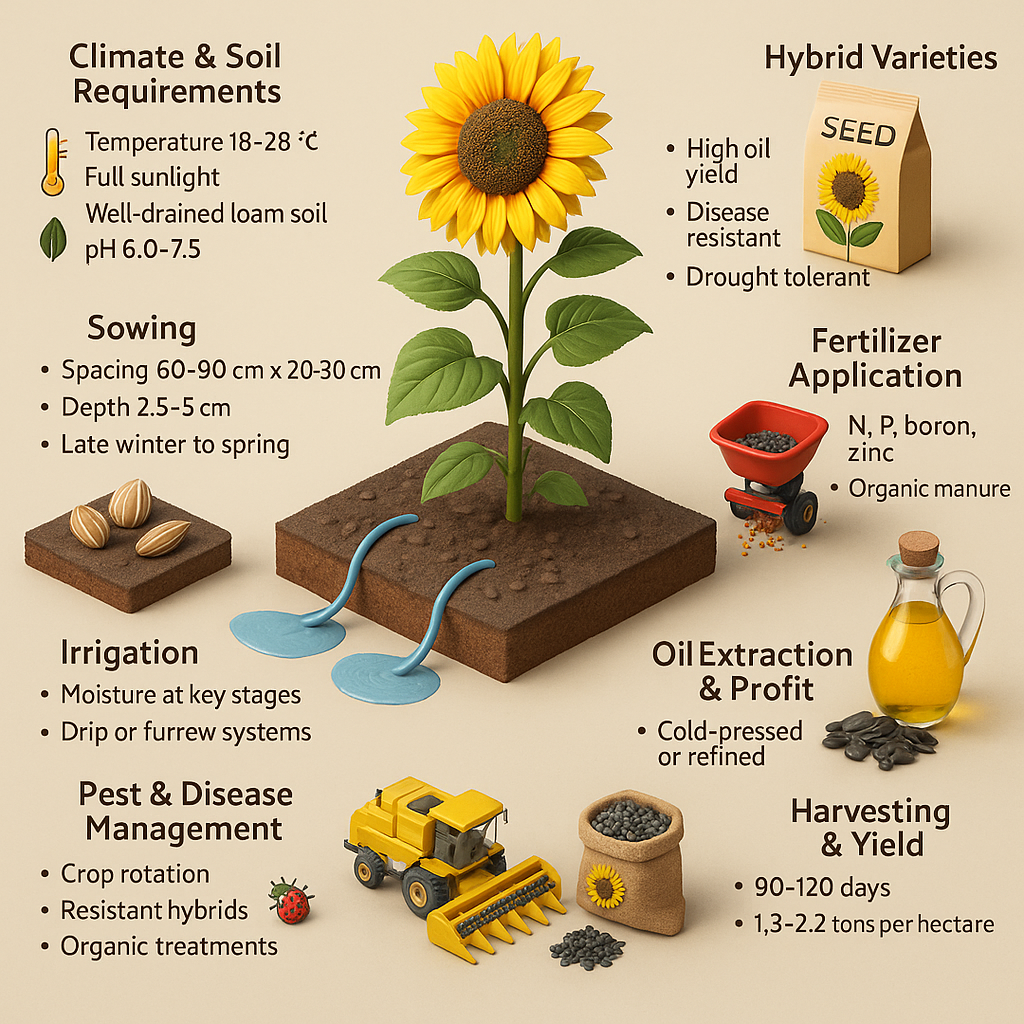
Sunflower thrives in regions with moderate temperatures, long sunshine hours and low-to-moderate rainfall. The ideal temperature for growth ranges between eighteen and twenty-eight degrees Celsius. Temperatures below ten degrees slow germination, while extreme heat above thirty-eight degrees reduces pollen viability and seed formation. Sunlight plays a decisive role in determining oil percentage; fields that receive extended daylight hours produce higher oil content. This is why countries such as Russia, Ukraine, France, Italy, Argentina and parts of the United States remain major sunflower producers. In tropical nations, farmers grow sunflower during cooler seasons to avoid heat stress.
Soil requirements for sunflower farming revolve around drainage, structure and fertility. Loamy soils enriched with organic matter and possessing strong water-holding capacity are ideal. Sunflowers send roots deep into the soil, often reaching more than one meter, enabling them to extract moisture and nutrients better than many crops. The crop adjusts to a wide pH range between six and eight. Heavy clay soils restrict root expansion and increase waterlogging risk, while sandy soils drain too quickly and require consistent irrigation.
Land preparation begins with deep ploughing to open compact layers. The field is leveled thoroughly to ensure uniform moisture distribution. Sunflower seeds need fine tilth for strong germination because they are moderately large but sensitive during early stages. Organic manure, compost or well-decomposed farmyard manure is incorporated before sowing. These organic materials improve soil texture, aeration and microbial life.
Seed selection plays a critical role in sunflower farming. Hybrid varieties dominate global cultivation due to their high yield potential, strong disease resistance and superior oil content. Modern hybrids are bred for drought tolerance, uniform flowering, balanced plant height and high oleic oil profile. Farmers also choose varieties suitable for specific climates and day-length zones. Seed treatments with organic microbial protectants help reduce early fungal infections.
Sowing time varies by region. In temperate countries, sunflower is sown in spring to avoid frost. In tropical nations such as India, farmers sow during late winter or early summer when temperatures are moderate. Proper timing ensures that flowering occurs under dry and stable conditions. Seeds are sown at a shallow depth with a consistent spacing that allows each plant enough room for head development. Farmers maintain row spacing between sixty and ninety centimeters and plant spacing between twenty and thirty centimeters depending on hybrid growth habit.
Irrigation requirements for sunflower depend heavily on climate and soil type. Although sunflower is drought-tolerant, moisture at key stages—germination, vegetative growth, flowering and seed filling—significantly improves yield. Drip irrigation systems provide precise moisture delivery and reduce water wastage. Over-irrigation during flowering causes fungal issues, while moisture stress during seed filling reduces oil content. Balanced irrigation ensures healthy plant development and strong seed formation.
Nutrient management emphasizes balanced feeding. Sunflowers require nitrogen, phosphorus, potassium, sulfur and micronutrients, particularly boron and zinc. Nitrogen supports vegetative growth but must be applied carefully because excess nitrogen delays flowering. Phosphorus strengthens root development and enhances flowering. Potassium increases oil content and seed weight. Boron plays an essential role in pollen viability and seed setting; deficiency leads to poor head filling. Organic farms use compost, bone meal and microbial fertilizers to maintain soil fertility.
Weed control is crucial during early stages because sunflowers grow slowly initially. Manual weeding or shallow cultivation helps maintain clean fields. Once established, sunflower plants grow tall and shade out most weeds. Maintaining a weed-free environment for the first thirty days ensures strong plant vigor.
Pests and diseases vary across regions. The sunflower moth, aphids, leaf miners and caterpillars are common pests. Fungal diseases such as downy mildew, rust, charcoal rot and alternaria blight affect fields under humid conditions. Farmers reduce disease pressure by maintaining field hygiene, following crop rotation and ensuring proper spacing. Organic sprays and biological controls are increasingly used to manage pests without harming beneficial insects.
As the plant matures, the sunflower head enlarges, filling with hundreds of small florets that eventually form seeds. Flowering begins sixty to seventy days after sowing. During this stage, weather stability is crucial, as rainfall or excessive humidity reduces pollen viability. Bees play a significant role in pollination, and fields located near natural habitats experience stronger seed set.
Seed development progresses steadily, with heads turning downward to protect seeds from rain. Farmers monitor seed moisture levels to determine the correct harvest time. Seeds are ready when moisture drops below twenty percent and the back of the head turns brown. Delayed harvesting increases chances of bird damage and fungal infections.
Harvesting is done manually or mechanically depending on farm size. Large-scale farms use specialized sunflower harvesters, while smaller farms cut heads manually and dry them before threshing. Post-harvest, seeds are cleaned, dried to below ten percent moisture, and stored in cool, ventilated conditions. Proper drying prevents fungal contamination and preserves oil quality.
Sunflower oil extraction involves crushing and pressing cleaned seeds. Cold-pressed oil retains strong flavor and nutritional value, while refined oil undergoes filtration and purification for commercial edible oil markets. Sunflower oil is rich in unsaturated fats, vitamin E, antioxidants and has strong global demand. The remaining cake is a protein-rich cattle feed used worldwide in the dairy and poultry industry.
Sunflower markets are influenced by edible oil demand, climate conditions and global production trends. Countries that experience drought or geopolitical challenges often create fluctuations in sunflower oil prices. High oleic sunflower oil fetches premium prices in international markets due to its stability and nutritional value. Global prices range between eight hundred and fifteen hundred USD per ton depending on quality and origin.
Economic returns from sunflower farming remain attractive due to low input costs and strong oil markets. Farmers with access to irrigation achieve higher yields, but even dryland fields produce moderate returns. High-density planting and modern hybrids have significantly improved yield potential. Value addition through on-farm oil extraction and direct marketing greatly increases profitability.
Sustainability in sunflower farming centers on crop rotation, minimal chemical use, soil-building practices and water-efficient irrigation. The crop fits well into rotations with cereals, legumes and fodder crops. Deep roots improve soil structure and reduce erosion. Sunflower’s ability to grow in marginal lands supports climate-resilient agriculture.
In conclusion, sunflower farming stands as a profitable and flexible agricultural venture suitable for diverse landscapes across the world. Its role in edible oil supply, livestock feed and industrial uses ensures consistently strong markets. Farmers who adopt scientific practices—correct sowing time, balanced nutrition, water management and clean harvesting—produce high-quality seeds with excellent oil content and dependable income.
10 FAQ
Growers often ask how long sunflower takes to mature, and most hybrids reach maturity within ninety to one hundred twenty days depending on climate. Another frequent question concerns irrigation, and sunflower requires moisture at germination, flowering and seed filling but performs well with minimal water otherwise. Soil-related queries involve drainage, and sunflowers thrive best in loamy soil with strong aeration. Farmers also ask why heads droop, and downward bending is a natural protection mechanism during seed maturity. Nutrient questions emphasize boron, which is vital for pollen formation and seed setting. Disease concerns often involve downy mildew and alternaria, which reduce significantly with crop rotation and timely sowing. Growers ask about plant spacing, and moderate spacing ensures strong head development. Market timing questions relate to oil demand, and sunflower oil prices rise when other edible oils face supply shortages. Many farmers ask how to increase oil content, and adequate sunlight combined with balanced potassium enhances oil levels. Finally, growers ask about post-harvest drying, and seeds must be dried gently below ten percent moisture to prevent spoilage.
✍️Farming Writers Team
Love farming Love Farmers