- Introduction: Why Blueberry Is One of the Most Profitable One-Acre Crops Worldwide
Blueberry is not just a fruit — it is a global superfood industry.
Rich in antioxidants, vitamin K, polyphenols, and anti-aging properties, blueberry prices stay premium in every international market.
Blueberries are massively grown in:
USA
Canada
Peru
Poland
Netherlands
Spain
Japan
China
And now spreading to:
India (Himachal, Uttarakhand, Kashmir)
Middle East (Controlled farming)
Africa (Kenya, South Africa)
Blueberry demand > Supply
Yeh ek ultra-premium crop hai jo 1 acre me ₹20–35 lakh yearly kama sakta hai agar scientific farming follow ki jaye.
- Climate Suitability for Blueberry Farming (World Regions Classification)
Blueberries need specific climate, so regional accuracy is important.
A. Temperate Climate (Best)
Perfect regions:
USA North
Canada
Europe North
Himalayan belts
Requirements:
Winter chilling hours: 800–1200
Summer: 18–26°C
Frost tolerance: good
B. Sub-tropical (Moderate)
India Northeast
China South
Japan warmer zones
Requirements:
Winter chilling: 400–600
Summer: <30°C
Shade nets required
C. Controlled Environment (Polyhouse)
Areas:
UAE
Qatar
Saudi Arabia
Africa arid regions
India plains (polyhouse only)
Requirements:
Temperature control: 18–28°C
Soil pH adjustment
Drip + fertigation essential
- Soil Requirements (MOST IMPORTANT PART)
Blueberries have very unique soil needs:
pH = 4.5 to 5.5 only (Acidic)
Normal soil pH = 6–8 hota hai → blueberry fail ho jata hai.
Soil must be:
Light sandy
Organic-rich
Moisture-retentive
Well-drained
High peat content
Ideal Soil Mix for Blueberry Beds Per Acre
40% Cocopeat
30% Pine bark / sawdust
20% Sand
10% Compost
Add Sulphur granules to lower pH
Without this mix, blueberries do not grow.
- One-Acre Plantation Layout (Exact Professional Blueprint)
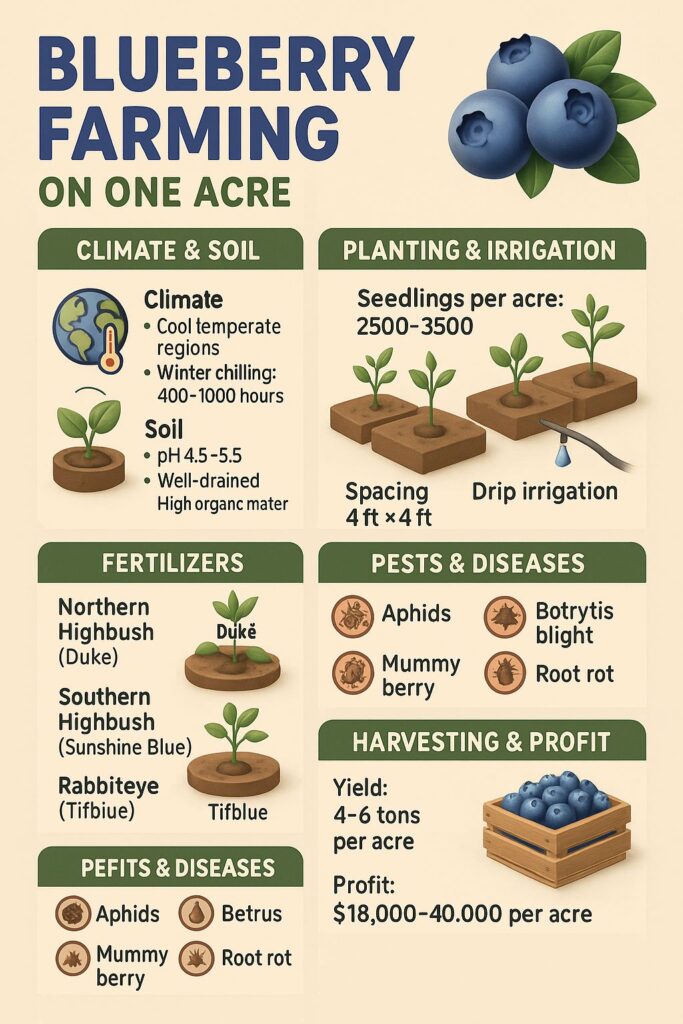
Plant Spacing:
4 ft × 4 ft
OR 4 ft × 3 ft (high density)
Plant Population in One Acre:
Standard density → 2500 plants/acre
High density → 3500 plants/acre
Bed Preparation:
Height: 18–24 inches
Width: 3–4 ft
Length: full row
Mulch: pine bark, dry leaves
Drip Irrigation Layout:
2 lateral lines per bed
4L/hr drippers
Watering twice daily
- Blueberry Varieties (WORLDWIDE SELECTION GUIDE) Northern Highbush
Best for cold climates
Top varieties:
Duke
Bluecrop
Chandler
Southern Highbush
Best for warmer regions
Top varieties:
Misty
Star
Sunshine Blue
Legacy
Rabbiteye Blueberries
Best for hot climates
Top varieties:
Brightwell
Tifblue
Premier
India Special Varieties:
Biloxi
Sharpblue
Misty
- Exact Seedling Requirement & Nursery Guide
One Acre Plantation Needs:
2500–3500 tissue culture plants
Preferably 1-year old
Height: 6–12 inches
Root system: must be fibrous, healthy
Best Planting Time by Countries:
RegionBest Planting TimeUSA/CanadaSpring (Feb–April)EuropeApril–MayIndia (Hills)Feb–MarchIndia (Plains Controlled)Anytime under polyhouseMiddle EastOctober–February
- One-Acre Blueberry Farming Investment Breakdown
A) Land Preparation Cost
Bed formation: $600
pH adjustment chemicals: $200
Soil mixture: $800
B) Plant Cost
2500 plants × $1–$2 = $2,500 – $5,000
C) Drip Irrigation
$350 – $450
D) Mulching Material
$300 – $500
E) Fertilizers + Micro Nutrients
$250 – $400 yearly
F) Pest & Disease Control
$120 – $200 yearly
G) Labor Cost
$300 – $500
Total Investment (1st Year):
$5,000 – $8,000 (₹4.1 – ₹6.8 lakh)
From year 2, cost reduces massively.
- Irrigation Schedule (Exact Water Requirement)
Blueberry roots are shallow → they need constant moisture.
Season-wise irrigation need:
SeasonWater RequirementSummer3–4 L per plant/dayWinter1.5–2 L per plant/dayRainyStop or reduce
Best Techniques:
Drip irrigation (mandatory)
Moisture sensors
Mulching for water retention
- Fertilizer Schedule (Month-by-Month FULL PROGRAM)
Base Feeding (per plant per year)
Vermicompost: 2 kg
Peat moss: 500 g
Sulphur: 30 g
Bone meal: 100 g
NPK Schedule (Year 1–2)
March: NPK 12:10:10 – 40g
April: NPK 19:19:19 – 20g
June: NPK 0:52:34 – 30g
August: NPK 13:00:45 – 30g
Micro Sprays
Boron
Magnesium
Zinc
Calcium nitrate
- Pest & Disease Management (WORLD STANDARD)
Common Pests:
Aphids – Spray Neem oil 3% or Imidacloprid
Thrips – Spinosad
Mites – Abamectin
Stem borer – Copper oxychloride paste
Diseases:
Root rot → Trichoderma
Anthracnose → Copper fungicide
Rust → Mancozeb
Powdery mildew → Sulphur spray
- Flowering to Harvest Timeline (Exact PHASES)
Year 1
Vegetative growth
No fruit
Year 2
Light flowering
Harvest: 0.5–1 ton
Year 3
Good production
2–3 ton
Year 4 onwards
Full production = 4–6 tons per acre
- Harvesting, Grading, Packing (Export Standard)
Grading:
Size 18 mm+ = Premium
Size 14–18 mm = Standard
Below 12 mm = Processing
Packing
125g clamshell
250g premium box
500g family pack
Storage
4°C for 14–21 days
Controlled atmosphere: 30+ days
- Market Selling Guide (Complete World Map Strategy)
A) Local Premium Markets
Supermarkets
Hotels
Resorts
Cafes
Juice bars
B) Online Selling (Direct Profit)
Instagram store
WhatsApp business
Farm website
Amazon (dehydrated)
C) Export Markets (Highest Profit)
Top countries buying blueberries:
USA
Canada
Netherlands
UK
UAE
Kuwait
Singapore
Japan
Export price = $7–$14/kg
- Value Addition = 2X to 5X Profit
You can create:
Blueberry jam
Dried blueberries
Freeze-dried powder
Blueberry juice
Smoothie concentrate
Blueberry wine (Europe/USA legal)
- Insurance & Loan (Worldwide Guide)
India:
PMFBY (Pradhan Mantri Fasal Bima Yojana)
NABARD Horticulture Loan
Agriculture Infrastructure Fund
NHB Subsidy (up to 40%)
USA:
USDA Specialty Crop Insurance
Europe:
CAP Agriculture Fund
UAE/Middle East:
Hydroponic/greenhouse subsidies
- One-Acre Blueberry Profit Calculation
Production:
4–6 tons (4000–6000 kg)
Average price:
Local: $4–$6
Export: $7–$14
Total Revenue:
$25,000 – $55,000 per acre
(₹20 – ₹45 lakh)
Net Profit:
$18,000 – $40,000 per acre
(₹14 – ₹32 lakh)
- Conclusion
Blueberries are among the most profitable farming crops in the world.
One-acre blueberry farming can transform youth into global agripreneurs with:
High demand
High market price
Long-term income
Export potential
Anti-aging superfood industry
Yeh crop future me gold mine ban sakta hai.
- FAQs
Q1: Can blueberries grow in hot regions?
Only in controlled conditions or with Rabbiteye varieties.
Q2: How long do plants survive?
20–25 years.
Q3: Do blueberries need acidic soil?
Yes — strong requirement.
Q4: What is the best fertilizer?
Acidic fertilizers + organic mix.
Q5: Can beginners grow it?
Yes, if soil pH maintained.
Read A Next Post 👇
https://farmingwriters.com/one-acre-stevia-farming-complete-profit-business-guide/
✍️Farming Writers
Love Farming Love Farmers