• Why Modern Farming Is Losing Nitrogen Efficiency Despite Higher Fertilizer Use

    Losing Nitrogen

    For decades, farmers around the world were told one simple truth:
    More nitrogen means more yield.
    This belief shaped modern agriculture. Urea consumption rose sharply. Nitrogen application became routine, sometimes aggressive. Yet today, across continents and crop systems, farmers face a confusing contradiction:
    Yields are not increasing in proportion to fertilizer use.
    In many regions, yields are stagnating or even declining.
    This is not coincidence.
    This is nitrogen efficiency collapse.
    This article explains why nitrogen efficiency is breaking down globally, despite advanced fertilizers, better seeds, and higher input costs.
    1. WHAT NITROGEN EFFICIENCY REALLY MEANS (AND WHAT IT DOES NOT)
    Nitrogen efficiency is not about how much nitrogen you apply.
    It is about how much applied nitrogen is actually converted into harvestable yield.
    In natural systems, plants evolved to use nitrogen slowly, steadily, and biologically. Modern farming disrupted this balance.
    Nitrogen efficiency is lost when:
    Nitrogen leaves the soil faster than roots can absorb
    Roots remain shallow due to surface nutrient availability
    Soil microbes are damaged or inactive
    Nitrogen converts into forms plants cannot access
    Timing mismatches crop demand
    Modern agriculture suffers from all five simultaneously.
    2. THE BIGGEST GLOBAL MISTAKE: SURFACE-BASED NITROGEN FEEDING
    Modern farming feeds soil from the surface, not from within.
    Repeated surface application of fast-release urea creates:
    Nutrient concentration near topsoil
    Minimal incentive for roots to grow deeper
    Weak anchorage and poor drought tolerance
    Dependence on frequent fertilizer input
    Plants become addicted, not nourished.
    Once roots stop exploring deeper soil layers, nitrogen efficiency collapses permanently.
    3. BIOLOGICAL COLLAPSE: THE SILENT NITROGEN KILLER
    Nitrogen does not function alone.
    It depends on soil biology.
    Excessive chemical nitrogen:
    Suppresses beneficial bacteria
    Reduces fungal networks
    Lowers enzymatic activity
    Disrupts carbon–nitrogen balance
    Without active microbes, nitrogen stays chemically present but biologically useless.
    This is why farmers see green leaves early but poor grain filling later.
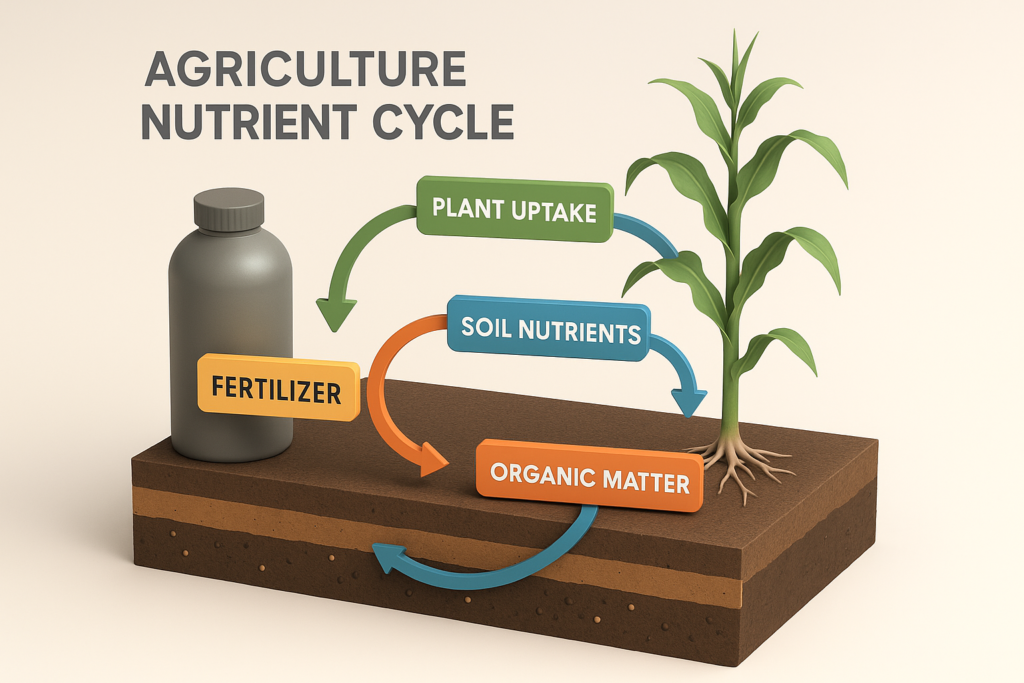
    4. GLOBAL NITROGEN LOSS PATHWAYS (WHERE YOUR MONEY GOES)
    Across all farming systems, nitrogen escapes through four main routes:
    4.1 Volatilization
    Nitrogen converts into ammonia gas and escapes into the atmosphere.
    Common in:
    Hot climates
    Surface-applied urea
    Alkaline soils
    4.2 Leaching
    Nitrogen moves downward beyond root reach.
    Common in:
    Sandy soils
    High rainfall zones
    Over-irrigated fields
    4.3 Denitrification
    Nitrogen converts into gases under low-oxygen soil conditions.
    Common in:
    Waterlogged fields
    Compacted soils
    4.4 Immobilization
    Nitrogen is temporarily locked by microbes feeding on low-carbon residues.
    Common when:
    Crop residues are unmanaged
    Carbon–nitrogen ratio is ignored
    None of these losses are visible.
    But all are financially devastating.
    5. WHY MORE UREA IS MAKING CROPS WEAKER, NOT STRONGER
    Excess nitrogen causes:
    Rapid leaf growth
    Thin cell walls
    Soft tissue vulnerable to pests
    Delayed maturity
    Poor root–shoot balance
    The plant looks healthy early but fails during stress.
    Modern crops fail not due to lack of nitrogen, but due to misplaced nitrogen.
    6. ROOT SYSTEM FAILURE: THE CORE OF THE PROBLEM
    Nitrogen efficiency cannot exist without a strong root system.
    Modern nitrogen practices cause:
    Shallow roots
    Limited lateral spread
    Poor nutrient scavenging
    Reduced mycorrhizal association
    Once roots weaken, no fertilizer can fix yield.
    Roots are the real fertilizer.
    7. WHY SOIL TESTING ALONE IS NOT ENOUGH
    Soil tests measure nutrient presence, not nutrient usability.
    They do not measure:
    Microbial activity
    Root depth potential
    Nitrogen release timing
    Biological buffering capacity
    Farmers apply nitrogen based on numbers, not living soil behavior.
    This gap destroys efficiency.
    8. GLOBAL EVIDENCE OF NITROGEN EFFICIENCY DECLINE
    Across regions:
    Grain size declines despite higher N
    Lodging increases
    Protein content becomes unstable
    Water requirement rises
    Input cost grows faster than yield
    This pattern is visible worldwide.
    9. THE FALSE PROMISE OF “HIGH DOSE, HIGH YIELD”
    Nitrogen follows the law of diminishing returns.
    Beyond a threshold:
    Each extra kg produces less yield
    Loss percentage increases
    Soil damage accelerates
    Modern farming crossed this threshold years ago.
    10. HOW NITROGEN EFFICIENCY CAN BE RESTORED (FOUNDATION PRINCIPLES)
    Restoration is not about more fertilizer.
    It requires:
    Controlled nitrogen release
    Biological support
    Root-driven nutrition
    Timing aligned with crop demand
    Soil structure recovery
    Without these, nitrogen remains waste.
    ABSTRACT (For Research & Authority)
    Nitrogen efficiency in modern agriculture is declining due to surface-based fertilizer practices, biological soil degradation, root system failure, and unmanaged nitrogen loss pathways. This article presents a global analysis of why increasing nitrogen inputs no longer translate into yield gains and outlines the foundational principles required to restore efficiency and long-term productivity.
    FAQ (10 — Mandatory)
    FAQ 1: Why is nitrogen efficiency decreasing worldwide?
    Due to biological soil damage, surface feeding, and uncontrolled nitrogen loss.
    FAQ 2: Does applying more urea increase yield?
    Only up to a limit. Beyond that, efficiency collapses.
    FAQ 3: Can good seeds fix nitrogen inefficiency?
    No. Roots and soil biology matter more than genetics.
    FAQ 4: Is nitrogen loss visible in the field?
    No. Most losses are invisible but financially severe.
    FAQ 5: Why do crops look green but yield poorly?
    Early nitrogen causes leaf growth without root support.
    FAQ 6: Does soil testing guarantee correct nitrogen use?
    No. It ignores biological availability.
    FAQ 7: Are all soils affected equally?
    No. Sandy and compacted soils suffer more.
    FAQ 8: Is nitrogen efficiency a climate issue?
    Yes. Nitrogen loss contributes to greenhouse gases.
    FAQ 9: Can efficiency be restored without reducing yield?
    Yes, but only through system correction.
    FAQ 10: Is nitrogen efficiency a long-term solution?
    Yes. It is essential for sustainable farming.
    ✍️ Farming Writers Team
    Love farming Love Farmers.

    Read A Next Post 👇

    https://farmingwriters.com/global-agriculture-nitrogen-efficiency-loss/

  • Agroforestry Farming: Global Reality, Profit Model, Risks & Long-Term Truth

    Agroforestry Farming

    Opening Reality (Read This Before You Believe the Hype)

    Across the world, agroforestry is often marketed as a “win-win farming system”—trees plus crops, extra income, climate protection, and long-term sustainability.
    What is rarely discussed is this:

    Many farmers adopt agroforestry expecting quick income, then abandon it within five to seven years when returns do not match their cash-flow needs.

    Agroforestry is not a shortcut system.
    It is a time-weighted farming strategy.
    If your financial planning is weak, agroforestry can quietly become a liability instead of an asset.

    This article explains what actually works, what fails silently, and who should never attempt agroforestry.

    What Agroforestry Really Is (Not the Textbook Version)

    Agroforestry is not simply planting trees on farmland.

    In real practice, agroforestry is the planned integration of trees, crops, and sometimes livestock, where:

    • Trees are income assets, not shade providers
    • Crops are adjusted to tree competition, not grown blindly
    • Soil biology becomes the core productivity engine
    • Time becomes the main investment currency

    The biggest mistake farmers make globally is copying models from other regions without adapting them to their own rainfall, soil depth, and market access.

    Major Agroforestry Systems Used Worldwide

    1. Agrisilviculture (Trees + Crops)

    This is the most common system globally.

    Trees are planted in rows or blocks, with annual or perennial crops grown between them during early years.

    Where it works best:

    • Moderate rainfall regions
    • Deep soils
    • Areas with access to timber or fruit markets

    Hidden risk:
    As tree canopy expands, crop yields decline unless spacing and pruning are managed aggressively.

    Many farmers underestimate year-6 onward yield loss.

    1. Silvopasture (Trees + Livestock)

    This system integrates trees with grazing animals.

    Global success zones:

    • South America
    • Australia
    • Parts of Europe and Africa

    Economic truth:
    Livestock income stabilizes cash flow while trees mature.
    However, fencing, rotational grazing, and veterinary costs are often ignored in profit calculations.

    Poor livestock management turns silvopasture into land degradation instead of regeneration.

    1. Agrosilvopastoral Systems (Trees + Crops + Animals)

    This is the most complex and most resilient system—but also the hardest to manage.

    Reality check:
    Only farmers with strong management discipline succeed long-term.

    Small planning errors multiply across crops, trees, and animals, causing cascading losses.

    Crop & Tree Selection: Where Most Farmers Fail

    The most common global mistake is selecting trees first and markets later.

    Correct order is always:

    Market demand

    Rotation timeline

    Tree species

    Crop compatibility

    Farmers who select trees based on government promotion schemes often face harvest-time disappointment due to weak buyers or delayed payments.

    Soil Reality Under Agroforestry

    Agroforestry improves soil only when root systems are managed.

    Unmanaged deep-rooted trees can drain subsoil moisture faster than annual crops can compensate.

    Successful systems rely on:

    • Root pruning
    • Leaf litter management
    • Controlled spacing
    • Microbial balance, not just organic matter

    Blind belief that “trees automatically improve soil” has ruined many farms.

    Water Dynamics: The Untold Truth

    Trees increase water infiltration but also increase total water demand.

    In low rainfall regions, poorly designed agroforestry systems accelerate drought stress.

    Global failures are highest in areas where rainfall dropped after system establishment, trapping farmers with water-hungry trees and declining crops.

    Economics: Short-Term vs Long-Term Reality

    Agroforestry income works in cycles, not seasons.

    Early Years (1–3)

    • Crop income dominant
    • Tree cost only
    • Cash flow pressure high

    Middle Years (4–7)

    • Crop yields decline
    • Tree maintenance costs rise
    • Income gap appears

    Long Term (8–15+)

    • Tree income dominates
    • System stabilizes
    • Profit finally materializes

    Most farmers quit in the middle years, exactly before profitability begins.

    Market Reality No One Mentions

    Tree produce markets are less forgiving than crop markets.

    • Quality standards stricter
    • Buyers fewer
    • Payments slower
    • Storage losses higher

    Agroforestry farmers must think like long-term suppliers, not seasonal sellers.

    Climate Change Impact: Help or Risk?

    Agroforestry increases climate resilience only if species are climate-adaptive.

    Many systems planted 10–15 years ago are failing today due to rising temperatures and shifting rainfall patterns.

    Static species selection in a dynamic climate is a silent risk.

    Who Should NOT Do Agroforestry

    Agroforestry is not suitable if:

    • You depend on yearly farm income for survival
    • You lack access to long-term credit
    • You cannot wait 7–10 years for peak returns
    • You follow trends instead of data

    This system rewards patience, planning, and discipline—not urgency.

    Who Should Do Agroforestry

    Agroforestry fits farmers who:

    • Think in decades, not seasons
    • Have diversified income sources
    • Understand market contracts
    • Are willing to adapt continuously

    For them, agroforestry becomes a land-value multiplier, not just a farming method.

    Global Outlook: Where Agroforestry Is Heading

    Worldwide, agroforestry is shifting from idealism to performance-based models.

    Future systems will focus on:

    • Fewer species, higher efficiency
    • Precision tree spacing
    • Market-linked planting
    • Carbon income only as a bonus, not core income

    The era of “plant trees and hope” is ending.

    Conclusion (Read Carefully)

    Agroforestry is not a miracle solution.
    It is a strategic land-use decision with delayed rewards.

    Farmers who succeed do not romanticize trees.
    They manage them as long-term capital assets.

    If you enter agroforestry without patience, planning, and market clarity, it will punish you silently.
    If you enter with discipline, it will reward you steadily—long after others quit.

    FAQs

    Is agroforestry profitable worldwide?

    Yes, but only in regions with market access and long-term planning.

    How long before profits start?

    Usually 7–10 years for full system profitability.

    Is agroforestry suitable for small farmers?

    Only if supported by alternative income or cooperative models.

    Does agroforestry reduce crop yield?

    Yes, over time, unless managed carefully.

    Is agroforestry climate-safe?

    Only when species are climate-adaptive and water-balanced.

    ✍️Farming Writers Team
    Love farming Love Farmers.

    Read A Next Post 👇

    https://farmingwriters.com/plantation-farming-complete-global-guide/

  • Global Root Collapse Crisis: Scientific Reasons, Soil Degradation, Crop Failure, and Worldwide Solutions

    Root Collapse Crisis

    Across the world from Asia’s rice belts to Africa’s maize zones and Europe’s horticulture regions farmers are witnessing a silent but devastating crisis: root system collapse. Crops that once developed deep, strong, nutrient-absorbing roots are now showing shallow, fragile, and nutrient-deficient root structures. This shift did not happen overnight; it is the cumulative outcome of decades of soil mismanagement, fertilizer imbalance, biological decline, and chemical over-dependence.

    Modern agriculture has unintentionally pushed plants toward weak rooting habits. High nitrogen availability near the surface stops roots from going deep. Soil organic matter has declined because residues are burned or soils remain bare. Heavy machinery has compacted millions of hectares. Chemical dominance has reduced microbial populations that once supported roots naturally.

    This article provides the world’s most comprehensive, original, science-based explanation of why root systems are collapsing globally and what agriculture must change to restore deep-rooted, resilient crops.

    1. THE SCIENCE OF ROOT FORMATION

    Crop roots grow based on five primary forces:

    1. Soil structure
    2. Soil moisture distribution
    3. Nutrient profile
    4. Microbial activity
    5. Chemical stress or support

    Healthy soils encourage roots to explore deeply. But unhealthy soils force the plant to survive only at the surface.

    1. GLOBAL REASONS FOR ROOT COLLAPSE

    2.1 Excess Nitrogen at the Soil Surface

    Continuous surface placement of urea and ammonium fertilizers leads to:

    nitrogen concentration only in top 5–7 cm

    reduced need for deep exploration

    shallow feeder roots instead of structural roots

    weak anchoring

    This is now a global phenomenon.

    2.2 Declining Soil Organic Matter

    Organic matter binds soil, creates pores, and feeds microbes. Its destruction leads to:

    compact, airless soil

    loss of aggregation

    reduced root penetration capacity

    Soils with <1% organic carbon cannot sustain strong root architecture.

    2.3 Chemical Stress on Root Tips

    High salt fertilizers, pesticides, and herbicide residues burn fine root hairs.
    The plant responds by:

    reducing new root formation

    avoiding deeper horizons

    redirecting energy into shallow survival growth

    2.4 Weak Soil Biology

    Healthy soil hosts millions of organisms:

    mycorrhizal fungi

    nitrogen-fixing bacteria

    phosphorus-solubilizing microbes

    These microorganisms enlarge the nutrient-absorbing capacity of roots.
    Their collapse = root collapse.

    2.5 Hardpan Formation

    Mechanical compaction forms a dense layer at 15–25 cm depth.
    Roots hit the barrier and stop immediately.

    2.6 Global Overuse of Nitrogen Fertilizers

    Countries like India, China, Pakistan, Bangladesh, and parts of Africa rely heavily on nitrogen fertilizers.
    This leads to:

    nutrient imbalance

    stunted root elongation

    reduced secondary root branching

    1. WORLDWIDE IMPACT OF ROOT COLLAPSE

    3.1 Yield Instability

    Crops cannot access water below 20 cm, making them highly sensitive to heat and drought.

    3.2 High Fertilizer Requirement

    Shallow roots mean low nutrient foraging → farmers apply more fertilizer.

    3.3 Lodging Increase

    Weak structural roots cannot support plant height.

    3.4 Decline in Crop Quality

    Everything from protein content to fruit size reduces.

    3.5 Poor Response to Irrigation

    Water stays above instead of entering deeper layers.

    1. GLOBAL CASE STUDIES

    4.1 Indian Wheat & Rice Belt

    High urea application → shallow roots → low organic matter → yield stagnation.

    4.2 African Maize Systems

    Soil mining + low organic matter → extremely fragile root systems.

    4.3 European Horticulture

    Chemical dependence → weakened root hair viability.

    1. SOLUTIONS FOR GLOBAL ROOT RESTORATION

    5.1 Deep Nutrient Placement

    Farmers who shift nitrogen 10–15 cm deep gain:

    stronger axial roots

    lower lodging

    higher yields

    5.2 Organic Matter Regeneration

    Additions of compost, manure, cover crops, and crop residues rebuild the soil’s physical structure.

    5.3 Mycorrhizal Recovery

    Restoring mycorrhiza can increase root surface area by up to 500%.

    5.4 Biofertilizers & Biological Inputs

    These re-establish microbial partners.

    5.5 Subsoil Breaking

    Breaking compacted layers increases root depth dramatically.

    1. LONG-TERM GLOBAL STRATEGY

    Countries must shift toward:

    regenerative agriculture

    balanced fertilization

    soil life restoration

    deep nutrient tools

    organic carbon rebuilding

    Only then will root collapse reverse.

    10 FAQs

    Q1. Why are root systems becoming shallow worldwide?

    Because nutrients, especially nitrogen, are concentrated near the soil surface.

    Q2. Does high urea cause root damage?

    It does not damage, but it prevents deep rooting by satisfying the plant at the surface.

    Q3. What is the main sign of root collapse?

    Plants lodge easily, wilt fast, and show nutrient deficiency despite fertilizer use.

    Q4. How does soil organic matter affect roots?

    It improves soil structure, moisture, aeration, and microbial support.

    Q5. Can roots recover after collapse?

    Yes, but requires organic matter rebuilding and biological restoration.

    Q6. How does compaction stop root growth?

    Roots cannot penetrate dense layers; they turn sideways.

    Q7. Why do vegetables suffer more?

    They are sensitive to chemical stress and shallow nutrient patterns.

    Q8. How do microbes help roots?

    They expand nutrient access and protect root tips.

    Q9. What fertilizer practice is most harmful?

    Repeated surface nitrogen application.

    Q10. What global model can fix this?

    Regenerative soil management with deep nutrient placement.

    The global root collapse crisis is one of the biggest hidden threats to modern agriculture. Years of excessive nitrogen, declining organic matter, soil compaction, and biological loss have pushed crops toward shallow, weak root systems. The solution lies in restoring soil structure, rebuilding organic carbon, reviving microbial networks, and rethinking fertilizer placement. Without strong roots, crop yields, climate resilience, and global food security cannot be maintained.

    ✍️ Farming Writers Team
    Love farming Love Farmers.

    Read A Next Post 👇

    https://farmingwriters.com/global-nitrogen-efficiency-complete-guide/

  • Advanced Applications of Cocopeat in Global Agriculture: A Complete Guide

    Cocopeat in Global

    Cocopeat, once treated simply as a by-product of coconut processing, has now become one of the world’s most demanded cultivation substrates. Countries across Asia, Europe, North America, Latin America, Africa, and Oceania now rely on cocopeat as a reliable, renewable, and scientifically stable growing medium. Its unique properties such as high porosity, excellent water-holding capacity, customizable EC, and biodegradable structure allow it to perform in diverse farming systems ranging from open-field amendments to ultra-high-tech controlled environment agriculture.

    This post explores the advanced, commercial, research-level, and future-facing applications of cocopeat in global farming, including systems where cocopeat is not just a medium, but the backbone of precision agriculture.

    1. The Scientific Foundation Behind Cocopeat Performance

    Cocopeat performs exceptionally well due to its natural structural architecture. Each fiber particle contains millions of capillary channels formed through lignocellulosic composition. This allows cocopeat to behave as a dynamic water reservoir, making it ideal for regions facing irrigation limitations.

    1.1 Physical and Chemical Advantages

    Natural pH stability between 5.5 and 6.8

    High air-filled porosity enabling oxygen movement

    Strong cation exchange capacity allowing nutrient retention

    Slow biological degradation due to lignin content

    Reusability when managed through sterilization and buffering

    Light weight for easy transport and vertical installations

    These properties lay the foundation for advanced agricultural systems that depend on predictable substrate performance.

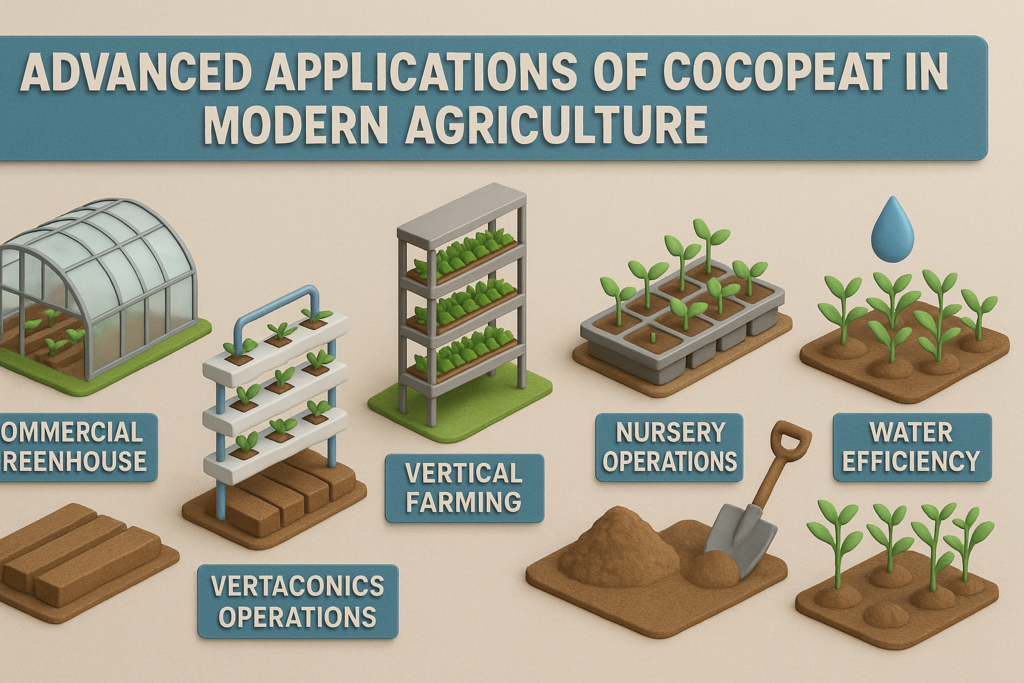
    1. Cocopeat in Commercial Greenhouse Agriculture

    Modern greenhouses—used widely in the Netherlands, Spain, Turkey, India, Australia, Mexico, and Canada—depend heavily on substrate uniformity. Cocopeat slabs, open-top grow bags, and loose-fill trays provide consistent results.

    2.1 Slab and Grow Bag Cultivation

    Cocopeat slabs are used for:

    Tomato

    Cucumber

    Capsicum

    Strawberry

    Lettuce and leafy greens

    Floriculture crops such as gerbera

    Grow bags allow root-zone monitoring, fertigation control, and integrated drainage systems.

    2.2 Precision Fertigation in Cocopeat

    Greenhouses use sensor-driven fertigation to maintain:

    EC between 1.8–2.5 mS/cm (crop dependent)

    pH within 5.8–6.2

    Drainage at 15–30 percent

    These parameters maintain root-zone stability, preventing nutrient lockout or oxygen deprivation.

    1. Cocopeat in Hydroponics and Soilless Systems

    Hydroponic agriculture has grown from niche to mainstream. Cocopeat’s stable water–air ratio is considered one of the most crop-friendly hydroponic media.

    3.1 Deep Root Zone Hydroponics

    Cocopeat is used in containers where constant moisture availability is required.

    3.2 Bucket Hydroponics (Dutch Bucket Systems)

    Used for:

    Brinjal

    Peppers

    Tomatoes

    Melons
    Cocopeat mixed with perlite achieves balanced drainage.

    3.3 Nutrient Film and Drip Hydroponics

    Although the roots are primarily in nutrient-rich water films, cocopeat blocks support seedlings and microbial ecosystems that stabilize early plant life.

    1. Cocopeat in Vertical Farming and Urban Agriculture

    As cities expand and arable land shrinks, cocopeat has become indispensable in vertical farming facilities.

    4.1 Advantages in Vertical Farming

    Lightweight media reduces structural load

    Sterile and pest-free substrate prevents infestations

    Uniformity allows predictable modelling of plant growth curves

    High capillary action supports multi-level drip irrigation

    Compatible with AI and IoT-driven cultivation systems

    4.2 Use in Vertical Towers and Modular Systems

    Vertical towers often use cocopeat as a core medium due to its water movement efficiency, allowing gravity-fed hydration cycles without oversaturation.

    1. Nursery Propagation and Seedling Production

    Cocopeat is now the global standard for nurseries—vegetables, fruit trees, ornamental plants, medicinal herbs, forestry, and plantation crops.

    5.1 Why Nurseries Prefer Cocopeat

    High germination success

    Sterile, pathogen-free environment

    Easy root plug removal

    Balanced moisture for uniform seed hydration

    Root stimulation due to enhanced oxygenation

    5.2 Plug Tray Production

    In vegetable nursery industries of China, India, Japan, the USA, the Netherlands, Chile, and South Africa, plug trays filled with fine-grade cocopeat ensure:

    Controlled root ball formation

    Zero transplant shock

    Faster flowering and fruiting

    1. Soil Amendment in Open-Field Agriculture

    In drought-prone regions such as sub-Saharan Africa, Australia, the Middle East, and Rajasthan, cocopeat is integrated into soil to improve long-term resilience.

    6.1 Benefits in Field Conditions

    Enhances sandy soil moisture retention

    Improves clay soil aeration

    Buffers saline soils when pre-treated

    Supports microbial diversity

    Reduces irrigation frequency by 30–50 percent

    1. Cocopeat for Perennial and Plantation Crops

    Long-duration crops such as:

    Coconut

    Banana

    Papaya

    Cocoa

    Coffee

    Vanilla

    Grapes

    benefit greatly from cocopeat integration.

    7.1 Root-Zone Performance

    Cocopeat increases root mass volume, promoting extensive feeder root formation, improving nutrient uptake efficiency throughout the crop cycle.

    1. Application in Mushroom Cultivation

    Cocopeat serves as a casing layer material for species like:

    Button mushrooms

    Oyster mushrooms

    Shiitake

    Its moisture stability reduces contamination risk and produces uniform flushes.

    1. Cocopeat in Floriculture and High-Value Ornamentals

    Gerbera, roses, orchids, and anthuriums are known to respond strongly to substrate oxygenation. Cocopeat ensures maximum floral diameter, stem elongation, and vase-life improvement.

    1. Global Market Trends and Industry Growth

    The global cocopeat industry exceeded major growth milestones due to:

    High demand from hydroponics

    Rise of vertical farming startups

    Climate-resilient agriculture adoption

    Sustainability regulations limiting peat extraction

    Countries leading cocopeat production:

    India

    Sri Lanka

    Vietnam

    Philippines

    Indonesia

    Countries leading cocopeat consumption:

    Netherlands

    USA

    Japan

    South Korea

    Spain

    Turkey

    Kenya and Ethiopia in floriculture

    1. Quality Parameters for Advanced Use

    To ensure global scalability, the following parameters are monitored:

    11.1 Electrical Conductivity (EC)

    Low EC cocopeat (<0.5 mS/cm) is preferred for sensitive hydroponic crops.

    11.2 Particle Size Distribution

    Fine grade: nurseries

    Medium grade: vegetables

    Coarse grade: vertical farming and hydroponics

    11.3 Fiber Ratio

    Balanced fiber improves drainage and structure.

    11.4 Buffering

    Proper treatment removes excess potassium and sodium.

    1. Environmental Influence and Climate Impact

    Cocopeat supports sustainable agriculture because:

    It is renewable

    It reduces extraction pressure on natural peat bogs

    It improves drought resilience

    It reduces fertilizer leaching

    1. Future of Cocopeat in Global Agriculture

    Emerging innovations include:

    AI-managed root-zone analytics in cocopeat slabs

    Smart cocopeat blends with controlled EC release

    Biochar–cocopeat hybrids for carbon sequestration

    Reusable modular cocopeat blocks for urban agriculture

    Cocopeat will likely remain a cornerstone of sustainable farming for decades.

    Frequently Asked Questions

    1. Can cocopeat replace soil completely?
      Yes, in hydroponics, nurseries, and vertical farms it can fully replace soil. In open fields, it is mostly used as an amendment.
    2. How long can cocopeat be reused?
      1–3 cycles depending on crop type, sterilization, and structural integrity.
    3. Does cocopeat work for fruiting crops?
      Yes, tomatoes, strawberries, cucumbers, melons, and peppers perform exceptionally well in cocopeat-based systems.
    4. Is cocopeat suitable for dry countries?
      Cocopeat reduces water consumption by 30–60 percent, making it ideal for arid regions.
    5. Which grade of cocopeat is best for nurseries?
      Fine-grade, washed, low-EC cocopeat.

    Conclusion

    Cocopeat has transitioned from a simple horticultural amendment to a global agricultural essential. Its compatibility with high-tech, climate-resilient, water-efficient systems makes it one of the most influential substrates in modern farming. From nurseries to vertical skyscraper farms, from hydroponic strawberry units to plantation crops, cocopeat has become the core of precision agriculture.

    ✍️Farming Writers Team
    Love farming Love Farmers.

    Read A Next Post 👇

    https://farmingwriters.com/cocopeat-nutrient-management-complete-guide/

  • Mixed Farming: A Complete Global Guide to Integrated Crop and Livestock Systems

    Mixed Farming
    1. Introduction

    Mixed farming is one of the oldest and most resilient agricultural systems practiced across the world. It refers to a farming system where crop production and livestock rearing are carried out together on the same farm in an integrated and complementary manner. Instead of depending on a single source of income, farmers diversify production by combining crops, animals, fodder, and sometimes fisheries or poultry.

    This system exists in both traditional subsistence agriculture and modern commercial farming models. In Europe, mixed dairy–crop farms dominate rural landscapes. In Asia and Africa, smallholder farmers rely on mixed farming to ensure food security, income stability, and soil fertility. In developed countries, mixed farming is gaining renewed attention as a sustainable alternative to specialized monoculture systems.

    Mixed farming works on a simple but powerful logic:
    “Waste of one component becomes input for another.”

    Crop residues feed livestock, livestock manure fertilizes fields, fodder crops support animals, and animals provide regular income, draft power, and nutrient recycling. This circular approach reduces external input dependency and improves farm resilience.

    1. Core Concept of Mixed Farming

    The essence of mixed farming lies in integration, not just coexistence.

    In a true mixed farming system:

    Crops and livestock are planned together

    Resources are recycled within the farm

    Nutrients flow in a closed loop

    Risk is distributed across enterprises

    Unlike specialized farming, mixed farming avoids total dependence on:

    Market price of a single crop

    Weather-sensitive monocultures

    External fertilizers and feed

    This system becomes especially valuable in uncertain climates and volatile markets.

    1. Components of Mixed Farming

    3.1 Crop Production

    Crops form the backbone of mixed farming. These include:

    Food grains (wheat, rice, maize)

    Pulses and legumes

    Oilseeds

    Vegetables

    Fodder crops

    Crop choice is not random; it is selected based on:

    Livestock feed needs

    Residue availability

    Soil fertility requirement

    Local climate

    3.2 Livestock Component

    Livestock may include:

    Dairy cattle

    Buffalo

    Sheep and goats

    Poultry

    Pigs

    Draught animals

    Animals provide:

    Milk, meat, eggs

    Manure for soil fertility

    Draft power

    Daily cash flow

    3.3 Fodder and Pasture

    Dedicated fodder crops ensure:

    Year-round feed availability

    Reduced feed purchase cost

    Better animal health

    Higher milk and meat output

    3.4 Manure and Nutrient Recycling

    Animal manure is central to mixed farming:

    Improves soil organic matter

    Enhances microbial activity

    Reduces chemical fertilizer requirement

    Improves water retention

    1. Types of Mixed Farming Systems

    4.1 Crop–Dairy Farming

    Most common in Europe and South Asia. Crops supply fodder and residues; dairy provides manure and steady income.

    4.2 Crop–Livestock–Poultry

    Popular among smallholders; poultry provides quick returns with minimal land use.

    4.3 Mixed Farming with Draft Animals

    Still relevant in parts of Africa and Asia where mechanization is limited.

    4.4 Integrated Commercial Mixed Farming

    Large farms combining crops, feedlots, biogas units, and manure processing.

    1. Scientific Basis of Mixed Farming

    Mixed farming is grounded in agricultural science.

    5.1 Nutrient Cycling

    Manure returns nitrogen, phosphorus, potassium, and micronutrients to soil.

    5.2 Soil Biology Improvement

    Organic matter from manure enhances soil microbial diversity.

    5.3 Risk Distribution

    Failure of one enterprise does not collapse the entire farm economy.

    5.4 Energy Efficiency

    Animal power and on-farm feed reduce fossil fuel dependency.

    1. Economic Advantages of Mixed Farming

    6.1 Income Stability

    Multiple income streams reduce risk.

    6.2 Reduced Input Cost

    Lower reliance on:

    Chemical fertilizers

    Purchased feed

    External energy

    6.3 Year-Round Cash Flow

    Livestock generates daily or weekly income, unlike seasonal crops.

    6.4 Employment Generation

    Mixed farming creates continuous on-farm work.

    1. Mixed Farming vs Specialized Farming

    AspectMixed FarmingSpecialized FarmingRiskLowHighInput dependencyLowHighSustainabilityHighOften lowIncome stabilityStrongMarket-dependent

    1. Environmental Benefits

    Improved soil structure

    Reduced nutrient leaching

    Lower greenhouse gas footprint per unit output

    Better biodiversity

    Efficient land use

    1. Challenges in Mixed Farming

    Requires management skills across enterprises

    Higher labor demand

    Disease management complexity

    Initial planning complexity

    1. Mixed Farming in Different Regions

    India

    Crop–dairy mixed systems dominate small farms.

    Europe

    Highly mechanized crop–livestock integration.

    Africa

    Mixed farming ensures survival in marginal environments.

    USA

    Re-integration of crops and livestock for sustainability.

    1. Role in Sustainable Agriculture

    Mixed farming aligns strongly with:

    Climate-smart agriculture

    Regenerative farming

    Organic and natural farming systems

    It improves long-term farm resilience.

    1. Future Scope of Mixed Farming

    Integration with precision agriculture

    Use of nutrient management software

    Automated manure application

    Carbon farming opportunities

    1. Frequently Asked Questions
    2. What is mixed farming?
      A system combining both crop cultivation and livestock rearing on the same farm.
    3. Is mixed farming profitable?
      Yes, due to multiple income sources and lower input costs.
    4. Which farmers benefit most?
      Small and medium farmers in variable climates.
    5. Does mixed farming improve soil fertility?
      Yes, through organic manure and residue recycling.
    6. Is mixed farming sustainable?
      Highly sustainable compared to monoculture systems.
    7. Can mixed farming be commercial?
      Yes, many large farms practice integrated mixed systems.
    8. What are common livestock choices?
      Cattle, buffalo, goats, sheep, and poultry.
    9. Does mixed farming reduce risk?
      Yes, income risk is diversified.
    10. Is mixed farming climate-resilient?
      Yes, it buffers climate and market shocks.
    11. Is mixed farming future-ready?
      Yes, especially when combined with modern technology.
    12. Conclusion

    Mixed farming represents a balanced, resilient, and sustainable approach to agriculture. By integrating crops and livestock, farmers create a self-supporting system where resources circulate efficiently, risks are minimized, and productivity remains stable across seasons. In a world facing climate uncertainty, rising input costs, and environmental stress, mixed farming is not outdated—it is strategically relevant for the future of global agriculture.

    ✍️Farming Writers Team
    Love farming Love Farmers.

    Read A Next Post 👇

    https://farmingwriters.com/precision-farming-complete-global-guide/

  • Crop Waste Management: How Farmers Can Prevent Losses and Earn Income from Damaged Crops

    Crop Waste Management

    Crop waste has silently become one of the biggest hidden causes of farmer loss. Every season, crops are grown with effort, money, water, and hope. Yet when the same crop reaches the market and fails to sell, it is suddenly treated as useless. Farmers dump vegetables on roadsides, burn residues in open fields, or leave produce to rot. What actually gets destroyed is not waste, but the remaining value of the farmer’s investment. The field never failed. The system failed.

    Crop waste is not an accident of farming. It is an expected stage in agriculture that most farmers are never trained to handle. Markets demand appearance, symmetry, timing, and low price. Nature provides variability. The gap between these two creates waste. Farmers who understand this do not panic when prices crash or produce is rejected. They shift direction and start using the crop differently.

    When crop waste is managed correctly, losses do not disappear completely, but they stop bleeding into future seasons. The first benefit of waste management is protection. The second benefit is savings. The third benefit is income generation. Missing any one of these makes farming unstable.

    Crop waste includes unsold vegetables, rejected fruits, surplus produce during market gluts, damaged crops due to transport, and plant residues left after harvest. It does not automatically mean rotten or dangerous material. In most cases, it simply means material that failed one economic use but still holds biological value. Plants do not lose nutrients just because traders reject them.

    The biggest reason farmers lose money from crop waste is delay. Fresh waste has options. Old waste has problems. High-moisture crops such as tomato, banana, leafy vegetables, and fruits start fermenting and decaying rapidly. As hours pass, smell increases, nutrients leak away, and pathogens grow. Farmers who act within one day of crop rejection have many choices. Farmers who wait lose control.

    Another major reason for loss is imbalance. Crop waste is often either too wet or too dry. Wet waste without dry material turns anaerobic and produces harmful gases. Dry waste without nitrogen decomposes extremely slowly. Good waste management is not about dumping everything together. It is about balancing moisture, carbon, and microbial activity.

    Burning crop residues might feel like quick cleaning, but it is actually slow damage. When residues are burned, carbon escapes, micronutrients are lost, soil organisms die, and the field becomes weaker for the next crop. The farmer gets a clean-looking field but carries weaker soil into the next season. This hidden loss is larger than the visible waste.

    Dumping unsold vegetables near fields or water sources creates disease pressure. Insects breed on rotting produce. Fungal spores multiply. Pathogens remain in the environment. When the next crop is planted, problems return. What looks like disposal becomes future crop risk.

    The correct approach to crop waste management starts with understanding what the waste can become. Crop waste does not have one destination. It has multiple possible pathways. Composting converts waste into stable organic matter. Fermentation converts waste into liquid nutrients. Biogas digestion converts waste into energy and manure. Mulching converts residues into soil protection. Processing converts selected waste into secondary products. Each pathway has rules. Mixing pathways without understanding causes failure.

    Compost from crop waste is not ordinary waste dumping. It is controlled biological conversion. When farmers compost properly, temperature rises naturally, pathogens die, odor stops, and nutrients stabilize. Finished compost improves water holding, root growth, and nutrient availability. Using compost does not give instant yield jumps like chemical fertilizers, but it builds soil resistance that protects yields during stress years. Farmers who judge compost only by immediate response miss its real power.

    Liquid organic inputs made from crop waste work faster because nutrients reach plants quickly. Fermented vegetable waste contains potassium, organic acids, and beneficial microbes. When applied properly, it reduces stress, improves flowering, and strengthens plant metabolism. The cost of production is extremely low. The mistake many farmers make is overuse. Dilution and timing matter more than quantity.

    Biogas turns crop waste into two assets. Gas reduces household or farm energy costs. Slurry becomes nutrient-rich manure. Farmers who treat slurry as waste lose value. Farmers who apply slurry correctly replace urea, DAP, and potash partially or fully. The earning here is not from selling gas, but from reducing expenses permanently.

    Mulching is often ignored because it does not look like income. Yet it saves water, reduces weed pressure, and protects soil structure. Straw, stalks, and dry leaves are protective assets. In water-scarce conditions, mulching alone can decide crop survival. The money saved on irrigation and labor is real income, even if it does not pass through the market.

    Animal integration completes the waste cycle. Crop residues become bedding, bedding becomes manure, manure becomes fertilizer. Vegetable and fruit waste can support livestock nutrition in limited quantities. Integrated farmers lose less during crop failure years because waste does not stop working. It simply changes form.

    One of the most dangerous ideas in farming is expecting waste management to produce immediate cash. Crop waste management is not a gambling system. It is a stabilization system. Farmers who adopt it build a safety net. Market prices may fall, but costs remain controlled. Climate shocks may reduce yield, but soil remains alive. This stability is the true earning.

    Climate change has made waste management essential rather than optional. Extreme weather events damage crops suddenly. Farmers who burn residues after floods or droughts weaken soil further. Farmers who recycle residues rebuild resilience. Organic matter increases soil sponge capacity. Microbial life improves nutrient cycling. Crops recover faster after stress.

    Another critical mistake is copying methods blindly. Tomato waste, paddy straw, onion residue, maize stalks, and cotton stems all behave differently. Each has unique moisture, fibre, sugar, and mineral composition. Using one method for all wastes guarantees problems. Real farmers learn differences, not shortcuts.

    Earning from crop waste sometimes means selling compost, liquid inputs, or processed products. More often, it means protecting the farm system. Reduced fertilizer purchase, reduced water use, reduced pest damage, and reduced soil degradation together create long-term financial gain. This gain may not show on one bill, but it shows clearly over seasons.

    Crop waste management changes the farmer’s mindset. Failure stops feeling final. Options appear even during bad years. Knowledge replaces panic. When farmers understand waste, farming stops being fragile and starts becoming strategic.

    Crop waste is not the enemy of farming. Poor handling is. Farmers who learn waste management stop losing twice. They lose only once or not at all.

    FAQs

    Q1. Can crop waste really help farmers earn money?
    Crop waste helps farmers first by reducing loss and costs. Direct income comes later through products like compost, liquid fertilizers, or energy, but the main earning is stability and savings.

    Q2. Is composting safe for disease-affected crops?
    Composting is safe if temperature rises sufficiently during the process. Proper composting destroys most pathogens and makes material safe for soil use.

    Q3. How fast should farmers act after crop damage?
    High-moisture crops should be processed within twenty-four hours. Dry residues can be stored longer, but wet waste must not be delayed.

    Q4. Can farmers use crop waste directly on soil?
    Fresh crop waste should not be applied directly. It must first be composted, fermented, or digested to avoid root damage and disease.

    Q5. Is crop waste management suitable for small farmers?
    It is especially important for small farmers because it reduces dependency on external inputs and protects limited resources.

    Q6. Does waste management require high investment?
    Most waste management methods require low investment. Knowledge and timing matter more than machines.

    Q7. What is the biggest mistake farmers make with waste?
    Burning residues or dumping fresh waste without processing is the biggest mistake because it destroys present and future value.

    Q8. Does crop waste management improve soil fertility?
    Yes. Proper waste management increases organic matter, microbial activity, and long-term soil health.

    Q9. Can waste management replace chemical fertilizers completely?
    In many cases, it can significantly reduce chemical fertilizer use, though total replacement depends on crop and soil conditions.

    Q10. Is waste management only for organic farming?
    No. Waste management benefits conventional farming equally by improving soil structure and reducing input stress.

    Conclusion

    Crop waste is not proof of failure. It is proof of incomplete knowledge. Farmers who learn how to manage waste stop fighting markets and start strengthening their systems. They prevent losses, control costs, protect soil, and recover income ethically and sustainably. In uncertain agriculture, waste management is not an option. It is survival wisdom.

    ✍️ Farming Writers Team
    Love farming Love Farmers.

    Read A Next Post 👇

    https://farmingwriters.com/tomato-crop-waste-utilization-income/

  • Global Nitrogen Loss Crisis in Modern Agriculture: Causes, Soil Science, Yield Impact & Practical Solutions

    Global Nitrogen Loss

    INTRODUCTION: THE INVISIBLE CRISIS DESTROYING FARM PROFITABILITY

    Across the world, farmers share a common experience. Fertilizer use has increased year after year, yet crop response has weakened. Yields no longer rise in proportion to input costs. Fields appear green at first, but productivity remains stagnant.

    This is not an isolated regional issue. It is a global nitrogen loss crisis affecting almost every farming system on the planet.

    Nitrogen is the most important nutrient for crop growth. It drives leaf development, photosynthesis, and biomass formation. For decades, nitrogen fertilizers helped agriculture achieve massive yield gains. However, the same nitrogen has now become inefficient, unstable, and economically damaging when mismanaged.

    This article explains why nitrogen is being lost before crops can use it, why applying more fertilizer worsens the problem, and how farmers worldwide can regain nitrogen efficiency through practical, soil-centered solutions.

    WHAT IS NITROGEN LOSS AND WHY IT MATTERS

    Nitrogen loss means nitrogen exits the soil-plant system without entering the crop. Studies across continents show that only 30–40 percent of applied nitrogen is actually absorbed by crops. The remaining portion is lost to air, water, or immobilized beyond root reach.

    This loss matters because:

    Farmers pay for fertilizer that crops never use

    Soils degrade over time

    Water and air pollution increase

    Yields stagnate despite higher investment

    Nitrogen loss is both an economic failure and an ecological failure.

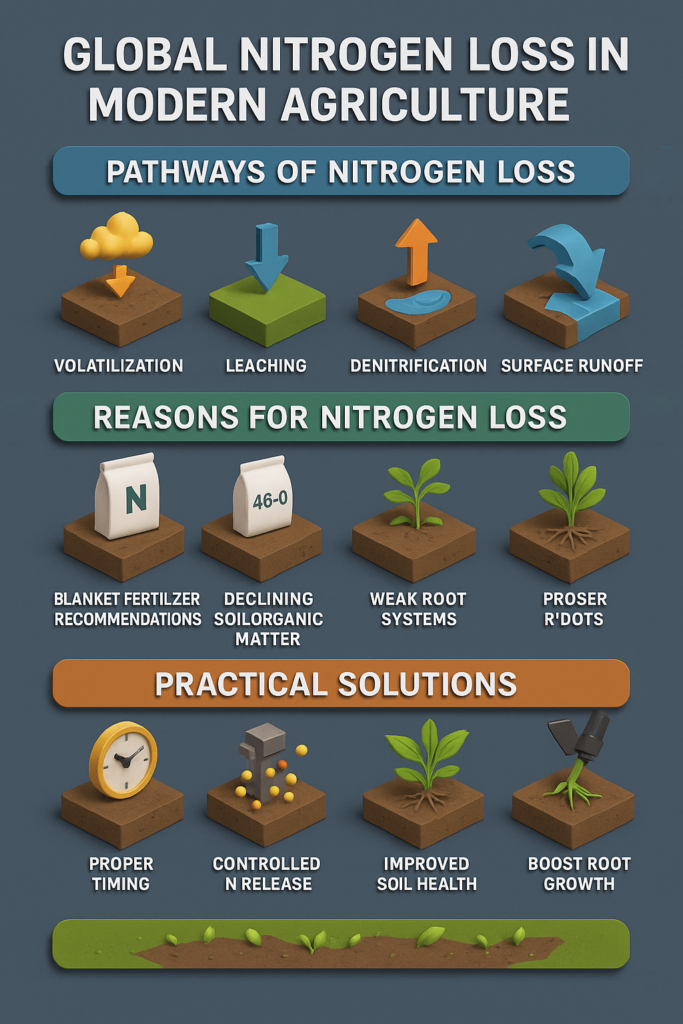
    MAJOR PATHWAYS OF NITROGEN LOSS

    Volatilization

    Nitrogen converts into ammonia gas and escapes into the atmosphere, especially when urea is surface-applied in warm, alkaline conditions.

    Leaching

    Nitrate nitrogen dissolves easily in water and moves downward beyond root zones, common in sandy soils and high rainfall regions.

    Denitrification

    In waterlogged or compacted soils, microbes convert nitrate into nitrogen gases that escape into the air.

    Surface Runoff

    Nitrogen moves with irrigation or rainfall across the soil surface instead of entering the root zone.

    Each pathway is controlled by soil structure, moisture, temperature, and management practices.

    WHY MODERN AGRICULTURE FAILED TO CONTROL NITROGEN

    Blanket Fertilizer Recommendations

    Uniform fertilizer guidelines ignore site-specific soil conditions, crop histories, and climate variations. This leads to overuse in some areas and inefficiency in others.

    Overdependence on Soluble Nitrogen

    Fast-acting fertilizers release nitrogen rapidly, overwhelming soil systems that cannot retain or regulate nutrient flow.

    Declining Soil Organic Matter

    Organic matter acts as nitrogen storage. Globally, soil organic carbon levels are declining, leaving nitrogen vulnerable to loss.

    Mechanization Without Precision

    Mechanized agriculture increased speed but often reduced accuracy. Poor placement and timing increase nitrogen escape.

    THE ROLE OF SOIL IN THE NITROGEN CRISIS

    Soil is not an inert medium. It actively controls nitrogen behavior.

    Soil Texture

    Sandy soils lose nitrogen rapidly

    Clay soils lose nitrogen under poor aeration

    Balanced soils still suffer if organic matter is low

    Soil pH

    Alkaline soils increase volatilization

    Acidic soils reduce nitrogen uptake

    Neutral soils perform best

    Soil Compaction

    Compacted soils restrict oxygen, accelerate denitrification, and limit root access to nitrogen.

    Ignoring soil health converts nitrogen fertilizer into a short-lived input rather than a productive resource.

    ROOT SYSTEM FAILURE: THE MISSING LINK

    Modern farming often feeds soil without building roots.

    Shallow Root Development

    Excess surface nitrogen discourages deep root growth. Crops become dependent on topsoil nutrients only.

    Timing Mismatch

    Nitrogen release often peaks when roots are not fully developed, leading to loss instead of uptake.

    Biological Disconnection

    High nitrogen suppresses beneficial microbes that support nutrient transfer, weakening root-soil synergy.

    A weak root system guarantees nitrogen loss, regardless of fertilizer quantity.

    GLOBAL EXPRESSIONS OF THE NITROGEN LOSS CRISIS

    South Asia

    Heavy urea use, flood irrigation, and warm climates cause severe volatilization and leaching.

    Europe

    Groundwater nitrate contamination forced strict fertilizer regulations.

    North America

    Runoff from large farms pollutes rivers and lakes, reducing nitrogen efficiency.

    Africa

    Low organic matter and sandy soils allow nitrogen to disappear rapidly after application.

    Different regions, same underlying failure: nitrogen moves faster than roots can absorb it.

    WHY MORE FERTILIZER MAKES YIELDS WORSE

    When yields decline, farmers apply more nitrogen. This creates a destructive cycle:

    Excess nitrogen harms soil biology

    Roots weaken

    Nitrogen loss increases

    Yield response declines

    Fertilizer use rises again

    This cycle explains why fertilizer bills increase while productivity remains flat.

    PRACTICAL SOLUTIONS TO THE GLOBAL NITROGEN LOSS CRISIS

    Improve Application Timing

    Split applications aligned with crop growth stages improve absorption.

    Strengthen Soil Organic Matter

    Crop residues, compost, and cover crops stabilize nitrogen.

    Use Controlled Nitrogen Release

    Slowing nitrogen availability improves synchronization with root demand.

    Restore Root Health

    Balanced nutrition, aerated soils, and reduced compaction increase uptake.

    Make Soil-Based Decisions

    Soil testing and site-specific management replace guesswork with precision.

    LONG-TERM BENEFITS OF SOLVING NITROGEN LOSS

    Higher and stable yields

    Lower fertilizer costs

    Improved soil structure

    Cleaner water and air

    Greater climate resilience

    Nitrogen efficiency determines the future profitability of farming worldwide.

    FREQUENTLY ASKED QUESTIONS (FAQs)

    FAQ 1: Why do crops respond poorly even after applying recommended nitrogen doses?

    Because a large portion of nitrogen is lost through volatilization, leaching, or denitrification before roots can absorb it.

    FAQ 2: Is nitrogen loss higher today than in traditional farming systems?

    Yes. Traditional systems had higher organic matter and slower nutrient release, reducing losses naturally.

    FAQ 3: Does soil type really influence nitrogen efficiency?

    Yes. Sandy soils leach nitrogen quickly, while poorly drained soils lose nitrogen through denitrification.

    FAQ 4: Why does adding more urea sometimes reduce yield?

    Excess urea damages soil biology, weakens roots, and creates nutrient shock, lowering long-term productivity.

    FAQ 5: Is irrigation a major driver of nitrogen loss?

    Yes. Poor irrigation management accelerates both leaching and denitrification.

    FAQ 6: How does low organic matter increase nitrogen loss?

    Without organic carbon, soil cannot retain nitrogen, allowing it to move freely out of the root zone.

    FAQ 7: Can nitrogen loss be reduced without increasing fertilizer cost?

    Yes. Proper timing, soil health improvement, and root-focused management often reduce losses without extra expense.

    FAQ 8: Is nitrogen loss only an environmental issue?

    No. It directly reduces farm profitability by increasing input costs without yield gains.

    FAQ 9: Does climate affect nitrogen loss patterns?

    Yes. Heat, rainfall, and moisture conditions strongly control nitrogen behavior.

    FAQ 10: What is the first step to improving nitrogen efficiency?

    Understanding soil condition through testing and observation is the foundation of effective nitrogen management.

    CONCLUSION

    The global nitrogen loss crisis is not caused by insufficient fertilizer supply. It is caused by soil degradation, weak root systems, and careless nutrient management. Increasing fertilizer input without restoring soil function is unsustainable and economically damaging.

    Future yield improvement depends on controlling nitrogen behavior, synchronizing nutrient release with root demand, and rebuilding soil systems that retain nutrients instead of losing them.

    This post establishes the foundation for the Global Farming Problems → Practical Solutions series, where future articles will address soil recovery, root science, and fertilizer truth in depth.

    ✍️ Farming Writers Team
    Love farming Love Farmers.

    Read A Next Post 👇

    https://farmingwriters.com/neem-coated-urea-complete-guide/

  • Neem-Coated Urea Complete Guide: Working, Benefits, Application, Soil Impact & Global Farming Insights

    Neem-Coated Urea

    INTRODUCTION

    Nitrogen is the backbone of modern agriculture. Every farmer—from India to Africa, from Southeast Asia to Latin America—depends on nitrogen fertilizers to produce cereals, vegetables, fruits, pulses, and fodder crops. For decades, urea has been the most widely used nitrogen fertilizer because of its high nutrient percentage (46% N) and affordability. However, traditional urea suffers from a major problem: it is quickly lost from the soil, leading to poor nitrogen utilization, higher fertilizer cost, environmental pollution, and reduced soil fertility.

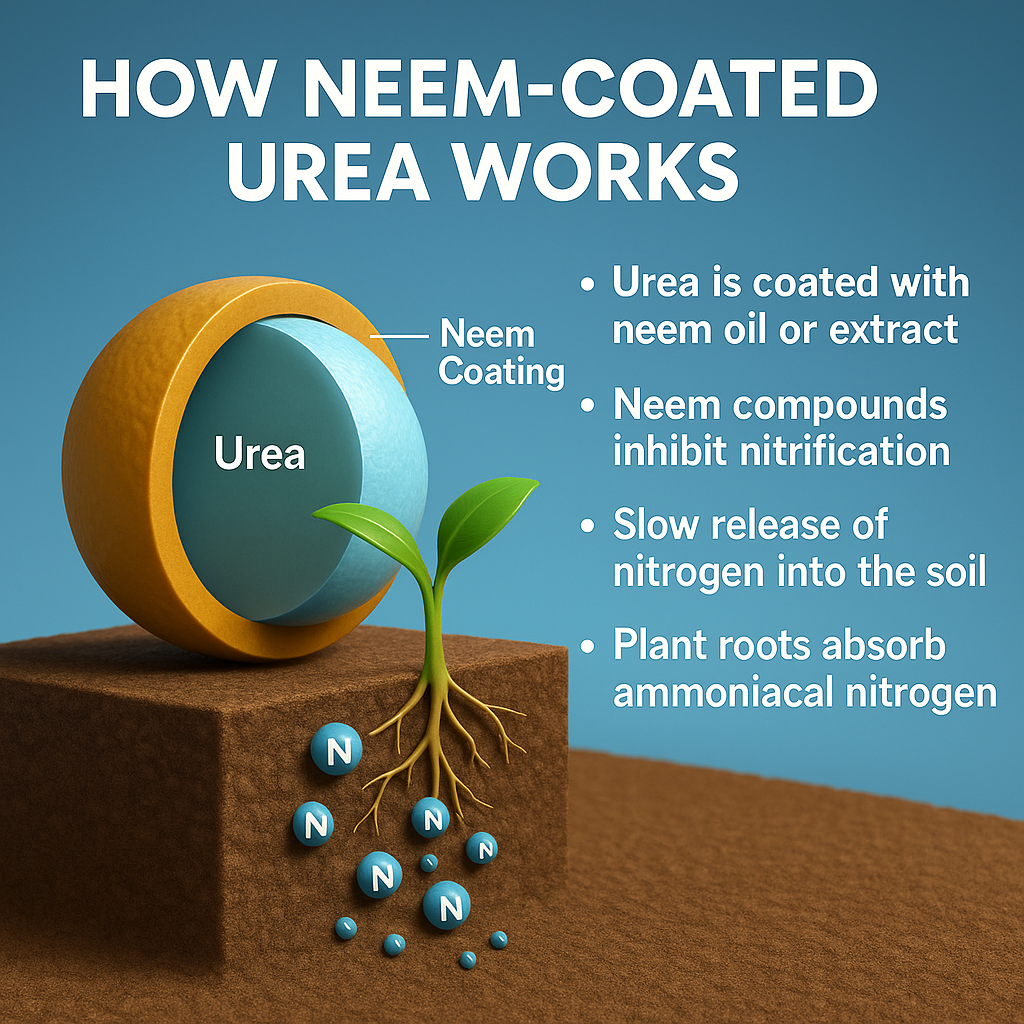
    To solve this issue, a revolutionary but naturally inspired solution emerged: Neem-Coated Urea (NCU). By coating urea granules with neem oil or neem extracts, scientists discovered that nitrogen release could be slowed, efficiency could be increased, and soil health could be restored. India became the first country to mandate neem coating for all agricultural urea, transforming nitrogen management across millions of hectares.

    This word article goes deep into how neem-coated urea works, what scientific principles support its effectiveness, how it improves soil microbiology, why it saves money for farmers, and how it fits into global sustainable agriculture strategies. The goal is to provide a complete, original, human-written farming guide with no AI tone—just real, grounded agricultural writing.

    1. THE ORIGIN & PURPOSE OF NEEM-COATED UREA

    The idea of neem-coated urea did not originate in a research lab but from traditional Indian agricultural wisdom. For generations, farmers used neem leaves in grain storage, compost pits, and pest control due to their antimicrobial and insecticidal properties. Scientists applied this traditional knowledge to modern fertilizers.

    The main problems neem-coated urea intended to solve were:

    1.1 High Nitrogen Loss from Normal Urea

    Normal urea is extremely unstable. Once applied to soil:

    20–40% nitrogen evaporates as ammonia gas

    15–25% leaches down with irrigation water

    A portion converts into nitrous oxide (a greenhouse gas)

    Only 30–35% is actually used by the crop

    This means farmers pay for nitrogen they never receive.

    1.2 Overuse of Urea

    Due to fast loss, farmers developed a habit of applying double or triple the required dose, which further harmed soil structure and crop balance.

    1.3 Soil Fertility Decline

    Continuous urea use reduces:

    microbial diversity

    soil organic carbon

    beneficial fungi

    root strength

    This leads to soil fatigue and yield stagnation.

    1.4 Environmental Damage

    Nitrogen pollution causes:

    groundwater contamination

    algae blooms

    air pollution from ammonia

    climate warming through nitrous oxide

    Neem-coating was designed to solve all these problems without increasing fertilizer cost dramatically.

    1. THE SCIENCE INSIDE NEEM-COATED UREA

    Neem is one of the richest botanical sources of bioactive compounds. When urea is coated with neem oil or extract, several biochemical transformations begin.

    2.1 Bioactive Compounds in Neem

    Neem contains:

    Azadirachtin

    Nimbin

    Salannin

    Gedunin

    Limonoids

    These have natural antimicrobial and enzyme-modulating properties.

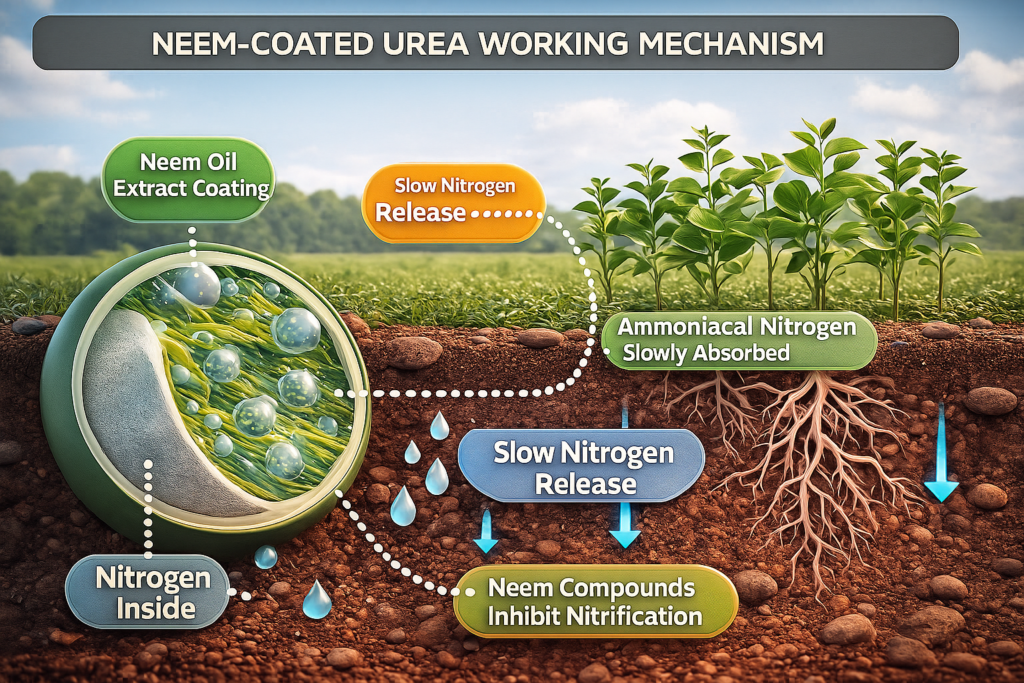
    2.2 How Neem Controls Nitrification

    Urea is normally converted into ammonium and then nitrate by soil bacteria:

    Nitrosomonas

    Nitrobacter

    Neem compounds slow the activity of these bacteria, extending the time nitrogen remains in ammonium form—which plants absorb more efficiently.

    This single action increases nitrogen-use efficiency (NUE) significantly.

    2.3 Slow Release Mechanism

    The neem layer around the urea granule gradually breaks down in soil moisture, releasing nitrogen slowly. This prevents nitrogen “shock” and supports steady plant growth.

    1. WHY NEEM-COATED UREA IS BETTER THAN NORMAL UREA

    3.1 Higher Nitrogen Use Efficiency (NUE)

    Neem-coated urea can improve NUE from 30–35% to 50–65%, depending on soil conditions.

    3.2 Better Root Growth

    Steady nitrogen promotes deeper rooting, which improves:

    drought tolerance

    nutrient absorption

    yield stability

    3.3 Reduced Nitrogen Loss

    NCU reduces:

    volatilization

    runoff

    leaching

    greenhouse emissions

    3.4 Higher Crop Yield

    Most crops show 8–20% yield increase due to balanced nitrogen availability.

    3.5 Less Fertilizer Needed

    Farmers often reduce urea by 10–15% with equal or better results.

    3.6 Improved Soil Microbiology

    Neem naturally supports beneficial microbes that are suppressed by excess urea.

    1. CROP-WISE BENEFITS OF NEEM-COATED UREA

    4.1 Wheat

    Enhances tillering, uniform spike formation, grain filling, and reduces lodging.

    4.2 Rice

    Improves tiller survival, panicle size, and nitrogen retention in flooded fields.

    4.3 Maize

    Supports strong stem growth, reduces nutrient deficiency streaks, and boosts cob weight.

    4.4 Sugarcane

    Steady nitrogen release helps continuous growth in long-duration crops.

    4.5 Vegetables

    Balanced nitrogen prevents excessive leafy growth and improves fruiting.

    4.6 Pulses

    Small but timely nitrogen supports early vegetative growth without suppressing nodulation.

    4.7 Orchards

    Supports long-term fertility and balanced shoot growth.

    1. SOIL IMPROVEMENT THROUGH NEEM-COATED UREA

    Continuous urea misuse is one of the biggest reasons soils have become hard, acidic, and microbially inactive. Neem-coated urea helps reverse this.

    5.1 Neem Promotes Beneficial Microbes

    Neem compounds reduce harmful microbes while encouraging:

    nitrogen-fixing bacteria

    phosphorus-solubilizing microbes

    decomposer fungi

    5.2 Better Soil Structure

    Controlled nitrogen prevents soil crusting, hardpan formation, and compaction.

    5.3 Higher Organic Carbon Over Time

    Steady nitrogen allows plants to produce more root biomass, which decays and increases soil organic carbon.

    5.4 Reduced Salt Build-Up

    Excess urea contributes to salinity. Slow release prevents salt spikes.

    1. GLOBAL SIGNIFICANCE OF NEEM-COATED UREA

    While India made it mandatory, many countries are adopting it voluntarily.

    6.1 South Asia

    Bangladesh, Nepal, Sri Lanka—high rainfall areas benefit from controlled nitrogen release.

    6.2 Africa

    Smallholder farmers with sandy soils get longer-lasting nitrogen.

    6.3 Latin America

    Countries like Brazil, Mexico use neem-coated fertilizers for fruits and cash crops.

    6.4 Europe & USA

    Interest in neem-based organic amendments is rising as a part of sustainable agriculture.

    1. FARM ECONOMICS OF NEEM-COATED UREA

    7.1 Savings

    Farmers save by:

    reducing fertilizer dose

    fewer top-dressings

    better crop yield

    reduced pest and lodging losses

    7.2 Higher Market Value

    Uniform size grains/fruits get higher price.

    7.3 Long-Term Benefits

    Rebuilt soil health reduces future input costs.

    1. COMMON MYTHS AND REALITIES

    Myth 1: Neem-coated urea has more nitrogen.

    Reality: Nitrogen remains 46%.

    Myth 2: It works only in Indian soils.

    Reality: Works globally across all soil types.

    Myth 3: It is harmful to soil.

    Reality: It improves soil biology.

    Myth 4: It is more expensive for no reason.

    Reality: The coating process adds cost, but savings exceed price difference.

    1. BEST PRACTICES FOR MAXIMUM RESULTS
    Neem-Coated Urea

    Apply in splits depending on crop

    Light irrigation after application

    Combine with organic manure

    Use soil testing for exact doses

    Avoid applying too close to plant base

    1. REAL-WORLD FARMER EXPERIENCES

    Across states like Punjab, Haryana, UP, Bihar, Karnataka, and Maharashtra, farmers report:

    steadier crop color

    better plant posture

    improved resistance to dry spells

    more uniform grain filling

    fewer yellow patches in fields

    improved yield even with less fertilizer

    Many farmers also notice that neem-coated urea prevents “luxurious vegetative growth”—where plants grow tall but yield poorly. Instead, plants grow compact, strong, and productive.

    1. FUTURE OF NEEM-COATED UREA IN GLOBAL AGRICULTURE

    11.1 Climate-Smart Farming

    Nitrogen mismanagement is one of the biggest contributors to agricultural emissions. Neem-coated urea directly reduces nitrous oxide.

    11.2 Soil Restoration

    Slow-release nitrogen allows soils to rebuild microbial life.

    11.3 Reduced Dependency on Chemicals

    With better nitrogen balance, plants naturally show better pest and disease tolerance.

    11.4 Integrated Nutrient Management

    NCU fits perfectly with:

    drip fertigation

    organic amendments

    precision agriculture

    regenerative farming models

    1. FREQUENTLY ASKED QUESTIONS

    Q1. Does neem-coated urea reduce total urea requirement?

    Yes, generally by 10–15%.

    Q2. Is neem-coated urea suitable for vegetables?

    Yes, especially for tomato, brinjal, chili, onion, and cucurbits.

    Q3. Does coating affect nutrient percentage?

    No, nitrogen is always 46%.

    Q4. Can NCU be mixed with other fertilizers?

    It can, but avoid very alkaline materials.

    Q5. Does neem coating dissolve in heavy rain?

    It slows release even in high moisture.

    CONCLUSION

    Neem-coated urea is not just a fertilizer innovation—it is a bridge between traditional agricultural wisdom and modern soil science. It brings the best of both worlds: the natural control and microbial support of neem, combined with the efficiency of nitrogen fertilizers. In an era of rising costs, climate uncertainty, and soil degradation, neem-coated urea offers farmers a sustainable, profitable, and scientifically proven solution.

    ✍️ Farming Writers Team
    Love farming Love Farmers.

  • The Future Belongs to Farmers A Powerful Motivational Blog for Agriculture

    The Future Belongs to Farmers


    The Future Belongs to Farmers: Why Agriculture Will Define the Next Generation

    Farming is not just an occupation. It is the foundation of civilization — the art that sustains life on earth. Every seed sown represents hope, every harvest symbolizes victory, and every field reminds us that farmers are the true architects of human survival. Yet, in today’s rapidly changing world, many people forget the deep value of agriculture. Young people, especially, are pushed into a system that celebrates modern jobs but overlooks the heart of all economies: food.

    But the world is changing again — and this time, farming is emerging as the most powerful field of the future. Whether it is global food security, climate change solutions, sustainable development, or economic transformation, the future is in the hands of farmers. This blog is dedicated to inspiring the world’s youth, motivating farmers, and reminding humanity that agriculture is not just necessary — it is noble, profitable, and one of the greatest lifestyles one can choose.

    1. Farming Is the World’s Most Essential Profession

    Every industry exists because farming exists. Doctors save lives, engineers build systems, teachers educate minds — but farmers feed them all. No nation can grow without food security, and no food security can exist without strong agricultural systems.

    Whenever the world faces crisis — war, pandemic, inflation — one profession always stands unshaken: farming.

    While other markets collapse, agriculture stands firm because people will always need food. That is why farming is not a “poor man’s job” — it is a “priority job” for humanity.

    2. Modern Agriculture Is Technological, Intelligent & Profitable

    Gone are the days when farming meant only manual labor and low income. Today, modern farming uses:

    Drones

    Smart irrigation

    Sensors & IoT

    Hybrid seeds

    Vertical farming

    Precision agriculture

    Organic premium markets

    Government subsidies

    Global export opportunities

    The farmers who understand technology are becoming agri-entrepreneurs.

    Youth from cities are now returning to farmlands to start:

    Organic food brands

    Greenhouse projects

    Mushroom farming units

    Hydroponic farms

    Herbal and medicinal crop businesses

    Agri-tourism companies

    Farming is no longer traditional — it is transformational.

    3. Why the World Needs More Young Farmers

    Across the planet, the average age of a farmer is increasing. Many older farmers are retiring, and fewer young people are taking their place. This is dangerous because the future of food cannot depend only on an aging population.

    Young people bring:

    New ideas

    Modern technology

    Ambition

    Innovation

    Energy

    The world needs youth to take charge of agriculture. This generation can produce more food with less land, less water, and better sustainability.

    A young farmer is not just a worker — he is a leader of tomorrow.

    4. Farmers Are Climate Warriors

    Climate change is the biggest global threat. Rising temperatures, droughts, floods, soil loss — these affect farmers first. But they also make farmers the heroes of climate solutions.

    Sustainable farming practices can:

    Restore soil

    Improve carbon capture

    Save water

    Protect biodiversity

    Reduce emissions

    Strengthen food systems

    When a farmer chooses organic farming, plants more trees, adopts drip irrigation, or stops chemical overuse — he becomes a warrior protecting planet Earth.

    The world needs millions more of such warriors.

    5. Hard Work, Discipline, and Courage — The Farmer’s Lifestyle

    Many people admire athletes, entrepreneurs, soldiers, or movie stars — but farmers show their heroism every single day.

    A farmer works:

    without guaranteed income

    against unpredictable weather

    against market fluctuations

    with patience

    with discipline

    with belief

    Farming demands courage. It builds resilience. It teaches the value of time, nature, weather, and faith. No office builds character like farming does.

    A farmer is strong not because he works in the field — but because he works for the world.

    6. Why Farming Is the Best Lifestyle for Peace & Happiness

    Studies worldwide show that people connected to nature experience:

    less stress

    mental clarity

    better physical health

    higher satisfaction

    deeper purpose

    Farming gives exactly that. It connects you with the earth. A seed grows because of your touch, and a field flourishes because of your effort. There is no joy like watching your crops rise from the soil. This satisfaction cannot be downloaded, purchased, or faked.

    Farming gives you a peaceful, meaningful life — something money alone cannot buy.

    7. Agriculture Is the Biggest Opportunity of the 21st Century

    The world population is increasing. Food demand is rising. Climate change is challenging supply. Governments are investing heavily in agricultural technology and innovations.

    This century belongs to:

    Agritech startups

    Organic superfood brands

    Export farming

    Smart farm solutions

    Plant-based industries

    Eco-friendly innovations

    Global farming communities

    The opportunities in farming are unlimited. Those who enter now will become leaders later.

    8. Message to Youth: Farming Is Not Backward — It Is the Future

    If you are a young person reading this, remember:

    The world does not need more followers.
    The world needs creators, innovators, and food providers.

    Farming is not less than any high-paying profession.
    In fact, it has:

    more stability

    more freedom

    more respect

    more potential

    more purpose

    Be proud to step into the fields.
    The world depends on you.

    Final Message: Farmers Are the Real Heroes of Humanity

    Every meal eaten, every life lived, every progress achieved — all begin with a farmer. When the world sleeps, farmers work. When the world celebrates, farmers sow. Farming is not a profession; it is a blessing.

    The future belongs to those who feed the future.

    If you are a farmer — you are a hero.
    If you want to become one — the world is ready for your greatness.

    FAQs

    1. Why is farming the most important profession?
    Because it provides food security, supports all industries, and ensures survival for humanity.

    2. Can farming be profitable today?
    Yes. With modern technology, organic markets, and global export opportunities, farming is more profitable than ever.

    3. Why should youth join agriculture?
    Youth bring innovation, technology, and new ideas needed to solve future food challenges.

    4. Is modern farming difficult?
    It is challenging but highly rewarding. Smart tools make it easier, efficient, and scalable.

    5. What is the future of farming?
    Sustainable, technology-driven, organic, climate-friendly, and globally integrated agriculture.


    ✍️Farming Writers

    Love farming Love farmers

    Read A Next Post 👇

    https://farmingwriters.com/farming-motivation-part-2-global/