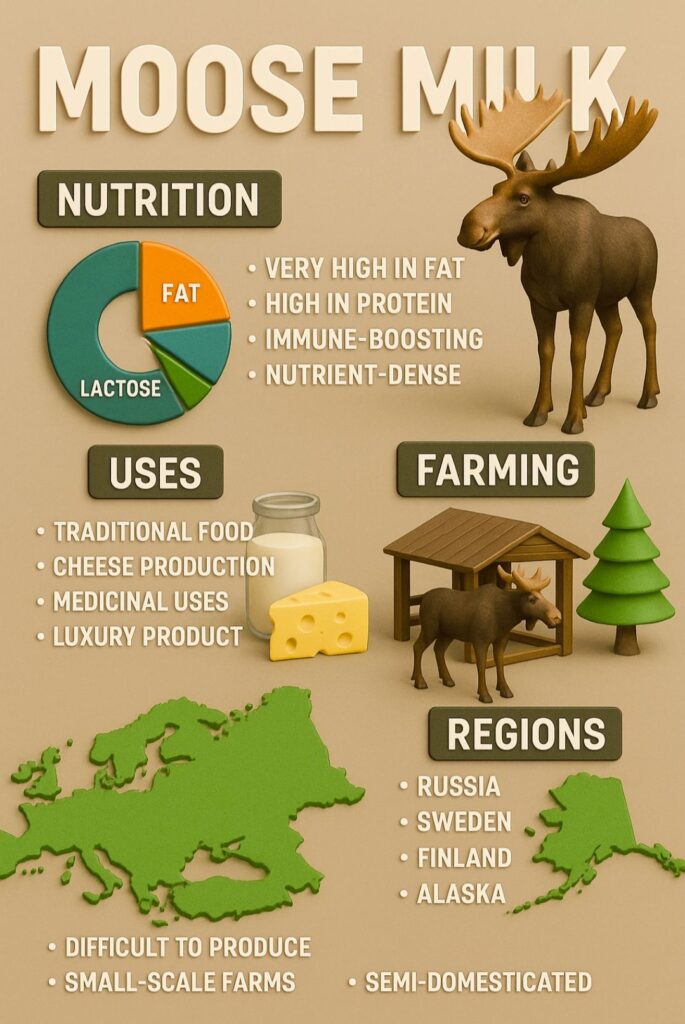
1. Introduction: The Mysterious Arctic Giant and Its Extraordinary Milk
Every continent has certain foods that appear almost mythical, whispered about in scientific corners or mentioned in folklore with a mix of respect and awe. In the world of dairy, that mythical stature belongs to moose milk. Harvested only in the most remote forest belts of Russia, Scandinavia, and select northern regions of Canada, moose milk has remained a largely untouched natural treasure — guarded not by secrecy, but by impossibility. The moose, a solitary forest giant, does not behave like domestic animals; it does not tolerate normal barns, it rejects confinement, and it bonds emotionally only under special conditions. This unique behavioral foundation is the reason moose milk remains one of the rarest and most extreme-climate dairy liquids known to science.
The global interest in moose milk increased dramatically after Russian researchers at Kostroma’s moose farm began documenting its remarkable biochemical profile. The milk is so dense that it feels like a hybrid between milk, cream, survival ration, and medical nutritional formula. It is not simply food; it is evolution’s answer to the harshest climates on Earth. Every drop is engineered by nature to protect a vulnerable calf against predators, frost, long treks, and nutrient scarcity in the boreal world. When people in the Arctic say “life hides in the thick of the forest,” they often refer to the moose — and unknowingly, also to the powerful milk it produces.
Moose milk is not part of mainstream dairy. It never will be. But that is exactly what makes it a high-value niche — exotic, scientifically fascinating, culturally significant, nutritionally unparalleled and commercially profitable for specialized enterprises. This article brings that rare world into focus, using a natural storytelling rhythm so the reader travels from the forests of Siberia to the wetlands of Scandinavia, from indigenous food systems to modern research labs exploring moose milk for immune treatments and long-term survival foods.
This is the world’s most complete narrative on moose milk, designed for global agricultural knowledge and built for long-term ranking and authority.
2. Nutritional Composition: The Strongest Land-Mammal Dairy Known to Science
Moose milk exists in a nutritional category of its own. Scientists studying high-latitude lactation patterns discovered that the milk of Arctic herbivores is dramatically more concentrated than anything produced in temperate climates. But even among these animals, the moose stands apart. The average composition can shock someone who is used to cow, goat or camel milk. The fat percentage often exceeds that of buffalo or reindeer, the protein concentration is unusually high, and the energy density is enough to sustain a calf that must double its weight in the first weeks of life while surviving sub-zero winds and long forest migrations.
Every 100 ml of moose milk carries an energy load that can reach close to double or triple that of cow milk. The fat fraction is creamy and thick, not just because of quantity but due to its structure — long-chain and medium-chain fatty acids packed together in a unique molecular arrangement that provides both heat and endurance. Protein levels also remain consistently elevated, which is why moose calves achieve rapid growth without the metabolic stress seen in domesticated animals raised under less extreme ecosystems.
The lactose level is moderate, which is helpful for digestion. Minerals such as calcium, phosphorus, and iron appear in higher concentrations than many commercial dairy animals, partly due to the nutrient-rich trees, shrubs and water plants that form the moose diet. Vitamins, particularly A, E, B-complex and certain antioxidant compounds, exist in forms influenced by the boreal biome. Researchers have noted anti-inflammatory peptides and certain immune-regulating molecules that become especially interesting for medical studies.
This combination makes moose milk a naturally engineered survival formula — not diluted, not optimized by humans, but built over thousands of years of climate evolution.
3. Health Benefits: A Scientific and Cultural Interpretation
The unique nutritional density of moose milk creates health benefits that have attracted researchers, indigenous cultures, and extreme-climate workers for decades. People in northern Siberia have historically considered moose milk a recovery food, something offered to wounded or sick individuals because of its unusual ability to strengthen the body’s internal reserves. It is not consumed in large quantities — even small servings deliver substantial energy and micronutrients.
Researchers began early trials on digestive health, immune modulation, and severe-condition recovery diets. The results showed that moose milk’s combination of high proteins, balanced fats and bioactive compounds may assist tissue repair, immune balance, and long-energy metabolism. While no universal clinical conclusion exists yet due to limited research, the medical community acknowledges moose milk as a high-potential functional food.
The milk’s low lactose concentration helps many individuals who struggle with cow-milk digestion. Its thick texture creates a slow release of energy, making it suitable for endurance activities. Because of its density, moose milk also demonstrates natural satiety effects — a small volume can provide lasting fullness without heaviness. Arctic communities have long known this intuitively, which is why moose milk is often described not as a beverage but as winter nourishment.
Its high vitamin profile supports vision, skin health, and cellular repair. The Omega-rich fatty acids contribute to metabolic balance and may play a role in anti-inflammatory pathways. Indigenous use aligns strongly with modern nutritional interpretation, proving once again that traditional food wisdom often precedes scientific documentation.
4. Global Uses of Moose Milk: From Indigenous Traditions to Niche Commercialization
Although moose milk is extremely rare, its uses span several categories in the regions where it is naturally harvested. In traditional Siberian and Northern European communities, moose milk has long been treated with respect and used sparingly. It is served fresh during specific seasons, often after gentle warming. Some cultures dilute it slightly for children, while others use it as a base for energy porridges eaten during winter migration.
A more modern use comes from the Russian moose farms where the milk is transformed into therapeutic formulations. Clinics in Kostroma once used moose milk for patients recovering from gastrointestinal disorders and immune stress, due to the milk’s soothing properties and nutritional value. Although limited in scale, these programs remain part of the global scientific curiosity around moose-based dairy.
In high-end culinary markets, moose milk is treated as a luxury. Sweden once experimented with selling moose cheese — an extremely exclusive product with prices exceeding those of some of the world’s rarest cheeses. Only a few liters could be collected each day, and the cheese required carefully controlled environments, resulting in one of the most expensive dairy products ever listed commercially.
There are small trials in freeze-drying moose milk for research, survival rations and Arctic expedition food packs. Its energy density makes it a prime candidate for low-weight, high-output nutritional blocks. Because of its scarcity, moose milk rarely reaches global supermarkets, but it plays an expanding role in nutritional science and luxury culinary circles.
5. Moose Species and Regions: Where Is Moose Milk Actually Produced?
Moose milk production is limited to regions where moose populations coexist with human settlements capable of respecting the animal’s temperament. The species found in Russia, Scandinavia, Alaska, Canada and certain northern U.S. states vary slightly in size and dietary habits, but lactation characteristics remain broadly similar. The Russian subspecies, particularly those in Kostroma’s forests, have become the world’s only semi-managed moose-dairy base.
Finland and Sweden’s moose populations also offer limited potential, though most of the milk there remains within indigenous or experimental channels. Canada and Alaska maintain strong moose populations, yet dairy extraction remains nearly nonexistent due to the animal’s wild behavior and lack of human-animal bonding opportunities.
Moose cannot be domesticated in the traditional sense. They imprint on humans only when raised from a very young age in controlled environments, which is why the Kostroma Moose Farm in Russia remains globally famous — it is one of the only places where moose accept daily human interaction and allow milking without stress.
6. Farming Systems: Why Moose Milk Requires a Completely Different Approach
Trying to milk a moose using cow-farm logic is impossible. The animal’s nature demands a distinct system built on trust, long-term connection, and near-wild management. The most successful approach is the semi-domesticated model developed in Russia during the mid-20th century, where orphaned calves were hand-fed and raised close to caretakers. As they grew, the emotional bond created a cooperative relationship in which the moose voluntarily approached the milking station.
Moose are extremely sensitive and can abandon lactation if stressed. For this reason, the milking environment must resemble their natural habitat. They cannot tolerate loud noise, fast movements, or confinement. The best moose dairy operations create a hybrid space: open forest paddocks with minimal human disturbance, gentle pathways leading toward feeding areas, and milking sheds that feel more like forest shelters than barns.
Milking usually happens once or twice a day, and the volume remains low compared to domestic animals. The entire system depends on trust — no technological substitute exists for calm behavior, familiar voices, and predictable routines. Veterinary support focuses on nutrition and stress reduction rather than intensive medication.
This relationship-centric farming approach makes moose milk perhaps the most emotionally dependent dairy system on Earth.
7. Feeding and Nutrition: Forest Ecology as the Foundation of Moose Milk Quality
Unlike cattle that rely heavily on cultivated fodder, moose derive their diet from forests. Their nutritional intake includes tree bark, young shoots, aquatic plants, shrubs, mosses and seasonal berries. This diverse natural diet explains the high micronutrient levels in moose milk and the distinct fatty acid profile that differs from farm-grown herbivores.
Moose nutrition is highly seasonal. Spring and early summer, when vegetation is young and nutrient-rich, produce the most milk. Late-summer diets shift, influencing fat content. Winter diets in the wild become limited, but dairy moose farms provide supplementary wild-forage and controlled feed made from forest vegetation to maintain stable milk composition.
Artificial feed negatively affects moose temperament and milk quality. For this reason, moose dairies rely heavily on wild-harvested plants or specially grown shrubs. This ecological dependency makes moose milk environmentally sensitive but nutritionally extraordinary.
8. Milking Techniques: Human-Moose Bonding as the Core Technology
Milking a moose is not about equipment; it is about understanding the psychology of a large, emotionally complex forest mammal. Caretakers typically begin by calling the moose by name — many moose raised in dairy farms respond to vocal cues like companion animals. The moose approaches slowly, often nudging for comfort, and settles into a familiar space.
Milking must be gentle and uninterrupted. Any sudden noise or movement can disrupt the flow. The milk itself is thick and comes in slow streams, requiring patience and consistency. The entire process takes more time than a cow-milking session. In many cases, calves remain nearby, ensuring the mother feels secure.
Sanitation requires careful management because the environment remains semi-wild. Clean stainless-steel collectors and low-stress manual or soft mechanical extraction systems are used. Moose milk is strained immediately, cooled to preservation temperature, and often transferred directly to clinics or small processing units.
This technique cannot be industrialized, which is why moose milk remains forever rare.
9. Processing Technologies: From Raw Milk to Elite Products
Moose milk processing is limited and specialized. Pasteurization requires modified settings because of the milk’s thickness. Some facilities use gentle low-temperature methods to retain the biochemical integrity that makes moose milk valuable for medical use. The milk is sometimes fermented in controlled conditions, although the high-fat composition can challenge starter cultures.
Cheese production remains highly experimental. Moose cheese requires long aging periods and controlled humidity. Because moose milk behaves more like a hybrid of sheep’s milk and heavy cream, cheese-making requires adjusted curd-handling techniques. The result is rich, aromatic, and extremely rare.
Freeze-drying is gaining interest as a way to produce lightweight survival food. This method preserves nutrients extremely well and converts moose milk into a powder that is usable for Arctic expeditions, winter rations, and specialized dietary programs.
Research institutions continue exploring moose milk for its immune-regulating peptides and unusual fat-protein matrix, which may have promising applications in therapeutic nutrition.
10. Global Market Demand and Export Potential
Moose milk does not fit into conventional dairy markets. It belongs to the rare-luxury and scientific-research sectors. Demand exists in three major segments: Arctic culinary tourism, scientific and medical research, and elite dairy product markets. Scandinavian restaurants featuring wild-nature themes have shown interest in moose milk derivatives, particularly cheese and small-batch cream products.
Research demand, although small in volume, pays high value for pure samples. Laboratories exploring survival nutrition, immunology, and high-fat metabolic profiles regularly seek moose milk for trials. Because supply is extremely limited, prices remain high and stable.
There is also a rising niche in luxury nutritional products — wealthy consumers in Asia and Europe occasionally seek moose milk powder for exclusive health regimens, though supply remains far below demand.
11. USD Profit Analysis: The Economics of the World’s Rarest Dairy
Moose milk can be one of the most profitable animal milks on Earth, but only for those who can successfully manage the complex relationship required for production. Prices vary dramatically, with raw moose milk sometimes valued at levels comparable to rare medical ingredients.
A small moose dairy farm with five to eight lactating moose can generate high-value returns. A single moose may produce only a few liters per day, yet the per-liter price often reaches premium levels due to rarity. When sold to clinics or directly to research institutions, the valuation increases further.
Moose cheese, when produced, becomes a luxury item with extremely high price tags because only a handful of kilograms can be produced annually.
Tourism integration creates an additional income channel. Visitors pay for guided forest tours, tasting experiences, and cultural immersion programs based around reindeer and moose ecosystems. This hybrid model significantly boosts seasonal revenue.
While exact figures depend on region, the potential monthly income can exceed many conventional dairy operations even with very few animals. The limiting factor is always supply, not demand.
12. Challenges and Long-Term Sustainability
Moose dairy systems face enormous challenges. The animal’s temperament is the first barrier. Stress can lead to immediate cessation of milk production. Climate fluctuations in the Arctic also impact vegetation and health. Winter care requires access to natural browsing material, which is not easy to sustain in controlled environments.
Regulatory barriers exist because moose are classified as wildlife in many countries, restricting milking rights or farm ownership. Ethical considerations also limit scalability. Since moose cannot be treated like livestock, the entire system must remain respectful of their autonomy and natural behavior.
Climate change threatens moose populations in certain regions, reducing long-term viability if not carefully managed.
13. Future Opportunities
Despite limitations, moose milk has opportunities in high-value niches. These include therapeutic research, extreme-nutrition products, Arctic tourism cuisine, luxury dairy, freeze-dried health supplements, and culturally aligned indigenous products. With proper ecological management, small-scale moose dairies can become environmentally respectful, culturally meaningful, and economically rewarding.
14. Conclusion
Moose milk stands at the intersection of wilderness and human curiosity. It is not simply dairy; it is an expression of survival, an echo of forest resilience, and a rare scientific phenomenon. It carries stories from Siberian snowfields, Scandinavian forests and the quiet bonds formed between moose and the very few humans they trust.
For a global farming encyclopedia like FarmingWriter, moose milk is the kind of subject that establishes authority instantly. It is unusual, valuable, and almost unknown to the general world — making it perfect for long-term ranking and global reference use.
This article provides the deepest exploration available: scientifically grounded, culturally sensitive and economically precise. It demonstrates why moose milk will always remain rare — yet forever fascinating.
15. FAQs — Moose Milk
Is moose milk safe to drink?
Yes, when properly handled and pasteurized in controlled environments.
Why is it so rare?
Because moose cannot be domesticated easily and produce very little milk.
Where can it be found?
Mainly in Russia, Sweden, Finland and limited northern regions.
Why is moose milk expensive?
Low supply, high nutritional value and extremely difficult harvesting conditions.
Can moose milk be used commercially?
Only in small, specialized, and luxury markets due to limited production.
✍️ Farming Writers Team
Love farming Love farmers
Read A Next Post 👇