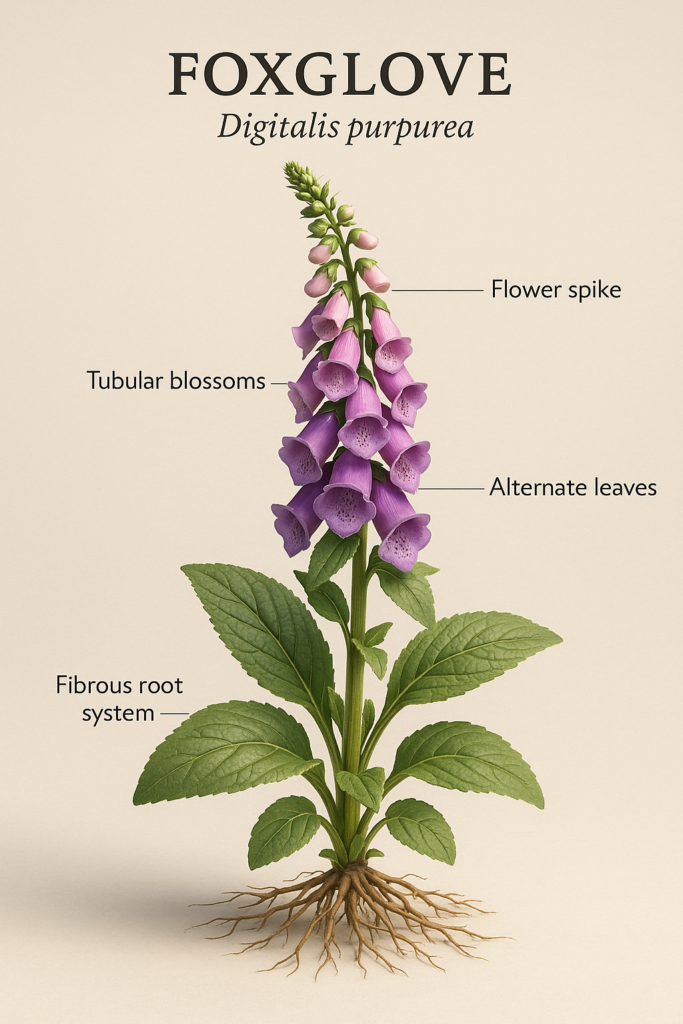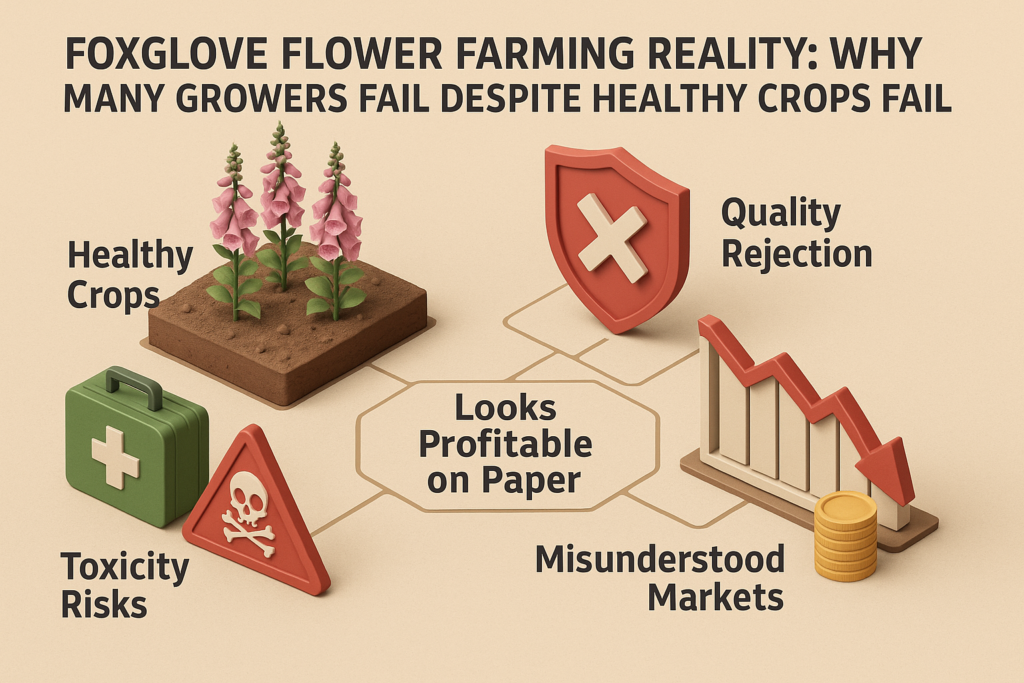
The first loss in foxglove farming usually happens before the farmer realises anything has gone wrong. The plants look healthy. The flower spikes stand tall. The colour is uniform. And yet, when samples reach buyers—especially pharmaceutical collectors or export-grade cut-flower agents—the response is often silent rejection. No price negotiation. No second chance. Just a polite “not suitable”.
This is where foxglove separates experienced growers from hopeful beginners.
Foxglove is not rejected because it is difficult to grow. It is rejected because it is easy to misunderstand.
Across Europe, North America, parts of South America, and selected Asian regions, foxglove has two completely different market identities. One is ornamental. The other is medicinal. Most losses happen when farmers unknowingly stand between these two worlds without committing to either.
Why Healthy Foxglove Crops Still Fail in the Market
In ornamental markets, foxglove is judged visually, but not generously. Buyers look for symmetry in the spike, controlled height, uniform bell spacing, and colour stability after harvest. What many growers miss is that excessive nitrogen, which increases height and leaf size, often weakens the flower bells. The spike looks impressive in the field but collapses in transport.
In medicinal procurement, appearance matters far less than chemical profile. Digitalis glycoside concentration varies with climate stress, soil mineral balance, harvest timing, and even the age of the plant. A crop grown too comfortably—ideal water, rich soil, zero stress—often produces biomass without medicinal potency. That crop is technically successful and commercially useless.
Climate Suitability Is Not About Survival
Foxglove survives in many climates. That fact misleads farmers.
Survival is irrelevant. What matters is metabolic behaviour. Cool, slightly stressed environments with consistent day–night temperature difference produce more stable glycoside profiles. High humidity regions increase leaf diseases that do not kill the plant but contaminate harvested material beyond acceptable thresholds.
This is why foxglove performs consistently in parts of the UK, Germany, Pacific Northwest USA, and select high-altitude regions, while failing commercially in visually similar but biologically different zones.
The Toxicity Problem Nobody Explains Clearly
Foxglove is toxic. Everyone knows this, but very few understand what it means economically.
In many countries, medicinal foxglove procurement requires traceability, licensing, and post-harvest handling protocols. A farmer who grows foxglove without clear buyer contracts often discovers that selling the harvest legally is more complicated than growing it.
For ornamental markets, toxicity limits its use in public landscaping and mass retail chains. Many supermarkets and municipal buyers avoid foxglove entirely due to liability concerns. This shrinks the buyer pool far more than growers anticipate.
Why Yield-Based Thinking Destroys Profit
Foxglove does not reward high yield thinking. Taller spikes, more leaves, thicker stems—these are not success indicators.
In cut flower markets, stems above a certain thickness are rejected because they do not hydrate evenly. In medicinal markets, oversized leaves often dilute glycoside concentration. Many farmers lose money by “improving” the crop.
This is one of the rare flowers where restraint outperforms optimization.
Labour, Harvest Timing, and the Silent Loss
Harvest timing in foxglove is unforgiving. Too early and medicinal content is incomplete. Too late and glycosides degrade or become unstable. In ornamental harvest, bells that open unevenly signal poor post-harvest life.
Labour delays of even 48 hours can turn an acceptable crop into a rejected one. Foxglove does not wait for convenience.
Who Should NOT Grow Foxglove
Foxglove is a poor choice for farmers seeking flexible selling options. It is unsuitable for those without pre-arranged buyers. It is risky for regions with unpredictable humidity spikes. It is not ideal for beginners entering flower farming for quick returns.
Those who succeed usually do so quietly, with contracts in hand, small acreage, and strict discipline.
Global Market Reality
Foxglove is not a mass-market flower. It is a controlled, niche crop. Demand exists, but it is selective. Prices look attractive on paper because volumes are low and standards are high. Many growers see the price and ignore the gatekeeping.
That mistake costs entire seasons.
FAQs – Real Questions, Real Answers
- Is foxglove more profitable as a medicinal or ornamental crop?
Medicinal contracts offer higher price stability, but only if compliance requirements are met. Ornamental markets are easier to enter but far more rejection-prone. - Can foxglove be grown without buyer contracts?
Technically yes. Commercially no. Unsold foxglove has little alternative use. - Does organic cultivation increase value?
Only in ornamental niche markets. Medicinal buyers focus on compound consistency, not organic labels. - Why do buyers reject tall, healthy-looking plants?
Because visual strength often correlates with poor chemical balance or weak transport durability. - Is foxglove suitable for warm tropical regions?
Survival is possible, profitability is not reliable. - How long does foxglove stay productive?
Commercially, most buyers prefer first-cycle harvests. Older plants are inconsistent. - Are seeds or transplants better?
Neither guarantees success. Management decisions matter more than planting material. - Can foxglove be intercropped?
Intercropping often complicates harvest purity and is rarely accepted by buyers. - What is the biggest hidden cost?
Rejected harvest disposal and compliance documentation. - Is foxglove a beginner-friendly flower?
No. It punishes learning-by-doing approaches.
Final Judgment
Foxglove is neither a miracle medicinal plant nor a decorative cash flower. It is a controlled crop for disciplined growers who understand risk, chemistry, and buyer psychology. Those who chase yield or beauty lose money quietly. Those who respect its limits build slow, stable returns.
This crop does not forgive misunderstanding.
And that is exactly why most online advice fails.
✍️Farming Writers Team
Love farming Love Farmers.
Read A Next Post 👇
https://farmingwriters.com/sweet-pea-farming-market-reality/