Tulsi, widely known as Holy Basil, is among the most respected medicinal plants in the world. While it holds religious importance in Indian culture, its real value lies far beyond rituals. Tulsi is a pharmacologically active medicinal herb that has been studied globally for its immunity-supporting compounds, respiratory support action, anti-stress behaviour and antimicrobial nature.
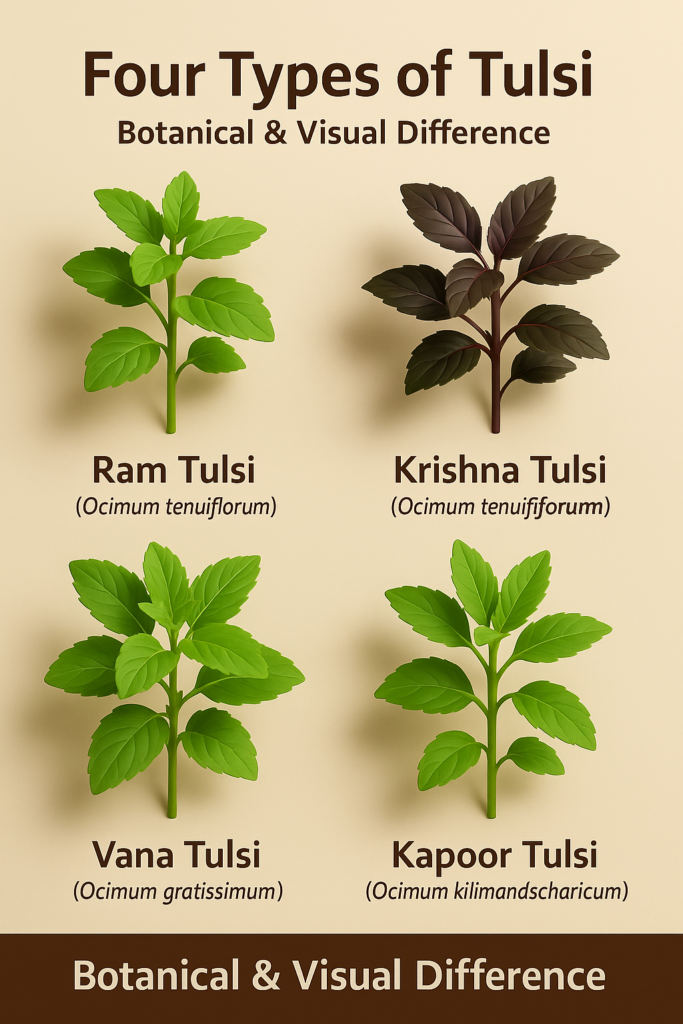
Many online articles treat Tulsi as a single plant with generic benefits. That approach is scientifically incorrect. Ram Tulsi, Krishna Tulsi, Vana Tulsi and Kapoor Tulsi are not identical. They differ in genetics, chemical composition, aroma, medicinal strength, growth pattern and commercial demand. Understanding these differences is essential for correct cultivation, processing and marketing.
This guide explains Tulsi honestly, practically and deeply, without exaggeration or myths.
Botanical Understanding of Tulsi
Tulsi belongs to the genus Ocimum and family Lamiaceae. It is a short-lived perennial or semi-perennial herb depending on climate. The plant produces volatile essential oils concentrated mainly in leaves and flowering tops. These oils define Tulsi’s medicinal behaviour.
Major bioactive compounds seen across Tulsi species include eugenol, ursolic acid, rosmarinic acid, linalool and camphor. The concentration of these compounds varies significantly among the four main types.
Tulsi grows naturally in warm and tropical climates and adapts easily to pot cultivation, open fields and even poor soils, making it farmer-friendly.
Ram Tulsi Detailed Explanation
Ram Tulsi, botanically known as Ocimum tenuiflorum (green variety), is the most commonly grown Tulsi in household gardens. It has soft green leaves, mild aroma and balanced medicinal action.
Ram Tulsi plants grow upright and bushy, with smooth stems and medium leaf thickness. The aroma is gentle, slightly clove-like, but not overpowering. This type of Tulsi grows faster compared to other varieties and regenerates well after harvesting.
Medicinally, Ram Tulsi is suitable for daily consumption. It supports digestion, helps the respiratory system during seasonal illness and contributes to stress balance. Because its chemical compounds are moderate in intensity, it is considered safe for long-term use as herbal tea or fresh leaves.
From a farming perspective, Ram Tulsi is ideal for beginners. It tolerates moisture variations better than Krishna Tulsi and does not demand strict soil conditions. Many Ayurvedic raw herb suppliers prefer Ram Tulsi for fresh leaf supply due to its high biomass production.
Krishna Tulsi Detailed Explanation
Krishna Tulsi is also Ocimum tenuiflorum but with deep purple or dark green leaves. This color difference is not cosmetic. It reflects a higher presence of anthocyanins, which are powerful antioxidants.
Krishna Tulsi has a sharp, peppery aroma and stronger medicinal effect than Ram Tulsi. Its essential oil concentration is higher, particularly eugenol, making it more potent but less suitable for excessive daily raw consumption.
Growth is slower compared to Ram Tulsi, and plants require slightly better sunlight exposure for proper pigmentation. The leaves are thicker, and oil glands are more concentrated.
Krishna Tulsi is widely used in Ayurvedic formulations for immunity enhancement, respiratory strength and inflammation control. Pharmaceutical herbal manufacturers prefer Krishna Tulsi for extract-based products because lower quantities yield stronger extracts.
Farmers growing Krishna Tulsi must focus on soil drainage and controlled irrigation because excess moisture can reduce oil quality.
Vana Tulsi Detailed Explanation
Vana Tulsi, commonly referred to as wild forest Tulsi, is botanically different from Ram and Krishna Tulsi. It is usually identified as Ocimum gratissimum or related wild species.
Vana Tulsi grows taller, with larger leaves and a strong lemon-clove aroma. Unlike cultivated Tulsi, Vana Tulsi is more woody and hardy. It survives harsh conditions and shows better resistance to pests.
Medicinally, Vana Tulsi is highly valued for respiratory health. Its aromatic oil contains higher levels of thymol and eugenol-like compounds, which contribute to antimicrobial activity.
Vana Tulsi is not commonly used for daily tea in households because of its strong taste. It is mainly used in medicinal extracts, herbal steam therapies and essential oil distillation.
From a commercial angle, Vana Tulsi is suitable for large-scale cultivation where essential oil extraction is the target. Biomass production is high, and harvesting intervals are longer, reducing labor cost.
Kapoor Tulsi Detailed Explanation
Kapoor Tulsi, often called camphor basil, is botanically known as Ocimum kilimandscharicum. This type stands apart completely from the previous three.
The most noticeable feature of Kapoor Tulsi is its strong camphor-like fragrance. This aroma comes from camphor as the dominant compound, unlike eugenol-dominant Tulsi types.
Kapoor Tulsi is not commonly used for edible purposes. Its medicinal application focuses on external use, aromatherapy, mosquito repellents, balms, chest rubs and essential oil production.
The plant grows tall, with thicker stems and narrow leaves. Growth is vigorous in warm climates. It requires full sunlight and well-draining soil to develop high camphor content.
From a farming and business perspective, Kapoor Tulsi has export potential for essential oil markets. It is not recommended for traditional raw consumption due to strong camphor concentration.
Climate and Soil Requirements
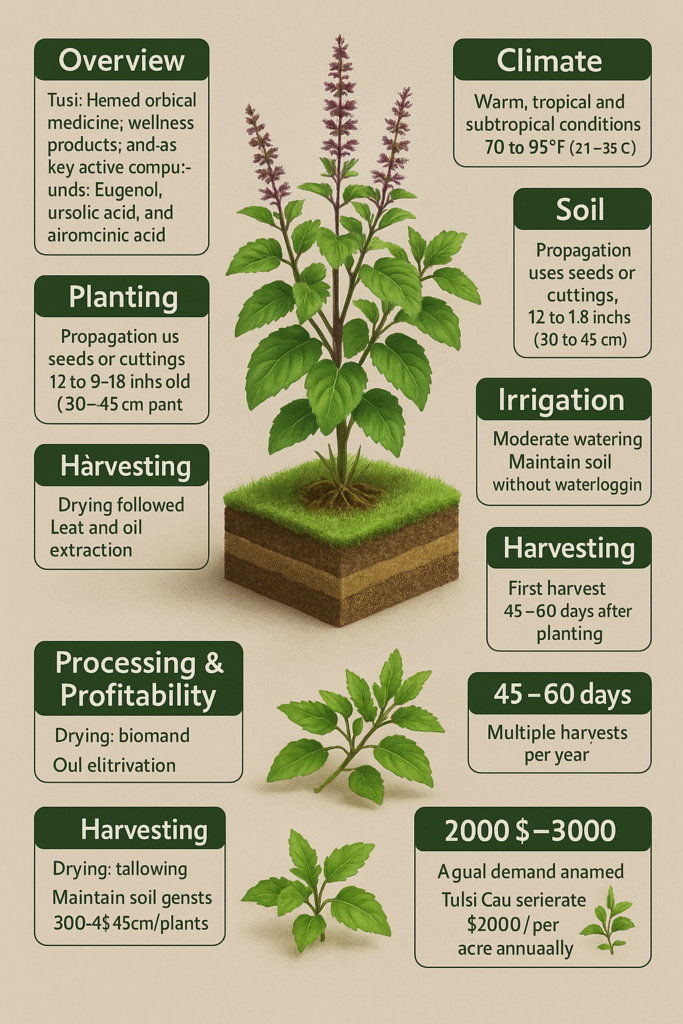
Tulsi prefers warm climates with temperatures between 20 to 35 degrees Celsius. Frost damages the plant severely, so cultivation should avoid cold exposure.
Soil should be well-drained, loamy or sandy-loam. Slightly alkaline to neutral pH works best. Waterlogging must be avoided, especially for Krishna and Kapoor Tulsi.
Organic matter improves leaf biomass and oil quality. Chemical fertilization in excess reduces medicinal concentration, which many blogs ignore.
Propagation and Planting
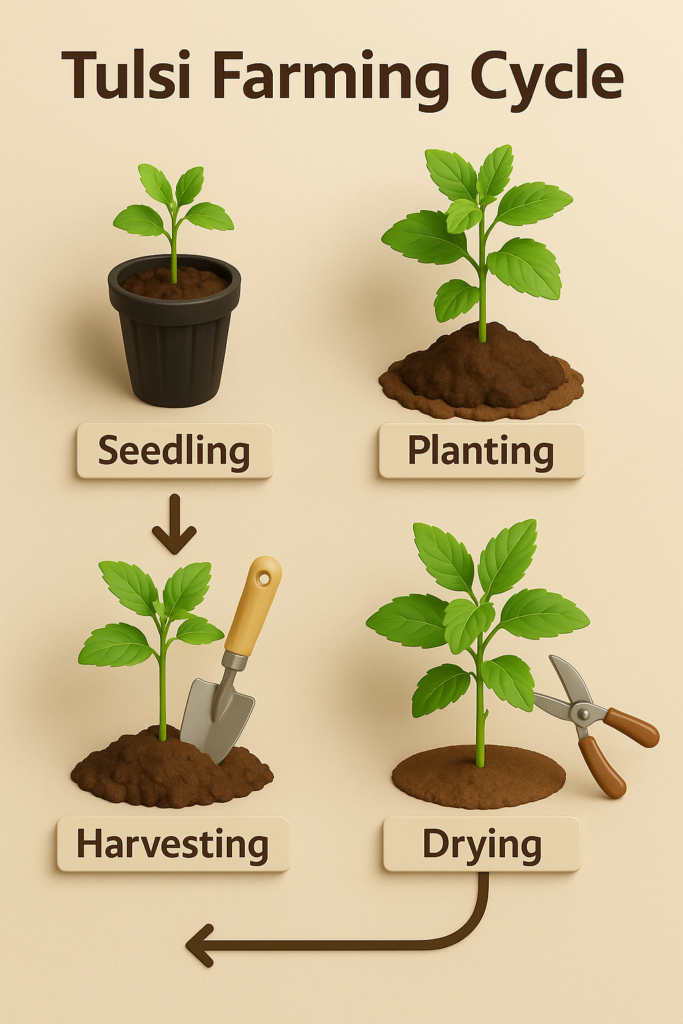
Tulsi can be grown from seeds or cuttings. Seed propagation is more common for farming purposes.
Seeds should be sown shallowly, as Tulsi seeds need light to germinate. Germination usually occurs within 7 to 10 days under warm conditions.
Transplanting is done after four to five weeks. Adequate spacing ensures airflow and healthy leaf growth, which directly impacts oil content.
Irrigation and Crop Management
Tulsi requires moderate irrigation. Overwatering reduces essential oil concentration. Light, frequent irrigation is better than heavy watering.
Manual weed control is recommended. Chemical herbicides are not suitable because Tulsi leaves are directly used for medicinal purposes.
Pinching the top encourages bushy growth and increases leaf yield.
Harvesting and Yield Reality
Harvesting usually starts 60 to 75 days after transplanting. Leaves and tender stems are harvested.
Average yield varies widely based on type, climate and management. Ram Tulsi gives higher fresh leaf yield, while Krishna and Kapoor Tulsi provide higher oil percentage.
Multiple harvests are possible within a year under good management.
Market Reality and Commercial Truth
Tulsi farming is profitable only when linked with buyers. Growing Tulsi without a market plan leads to losses.
Raw leaf market prices are low. Real profit comes from dried leaves, powder, extracts or essential oil.
Kapoor Tulsi and Vana Tulsi are better suited for oil markets, while Ram and Krishna Tulsi serve raw and dried herb markets.
Certification such as organic increases export potential significantly.
Common Myths About Tulsi Farming
One common myth is that all Tulsi types have equal medicinal value. This is incorrect. Each type serves different purposes.
Another myth is that Tulsi grows anywhere without care. While hardy, poor management affects oil quality.
Tulsi is also wrongly promoted as a cure-all. In reality, it supports health but does not replace medical treatment.
FAQs
Is all Tulsi edible daily
No. Ram Tulsi is suitable for daily use. Krishna Tulsi should be consumed in moderation. Kapoor Tulsi is generally not recommended for ingestion.
Which Tulsi is best for immunity
Krishna Tulsi shows stronger immunity-supporting compounds, but proper dosage is important.
Can Tulsi be grown commercially in any country
Yes, Tulsi grows well in tropical and subtropical regions across Asia, Africa and parts of South America.
Does Tulsi need chemical fertilizers
No. Organic nutrition produces better medicinal quality.
Which Tulsi is best for oil extraction
Kapoor Tulsi and Vana Tulsi are best suited for essential oil production.
Final Conclusion
Tulsi is not a simple plant; it is a category of medicinal herbs with distinct types and uses. Ram Tulsi supports daily wellness, Krishna Tulsi strengthens medicinal formulations, Vana Tulsi serves therapeutic extraction markets and Kapoor Tulsi dominates essential oil industries.
Successful Tulsi farming depends on correct species selection, honest expectations and proper market linkage. When grown with understanding rather than myths, Tulsi becomes both a sustainable medicinal crop and a respectable farming business.
Cultivate Tulsi with knowledge, not assumptions.
✍️Farming Writers Team
Love farming Love Farmers.