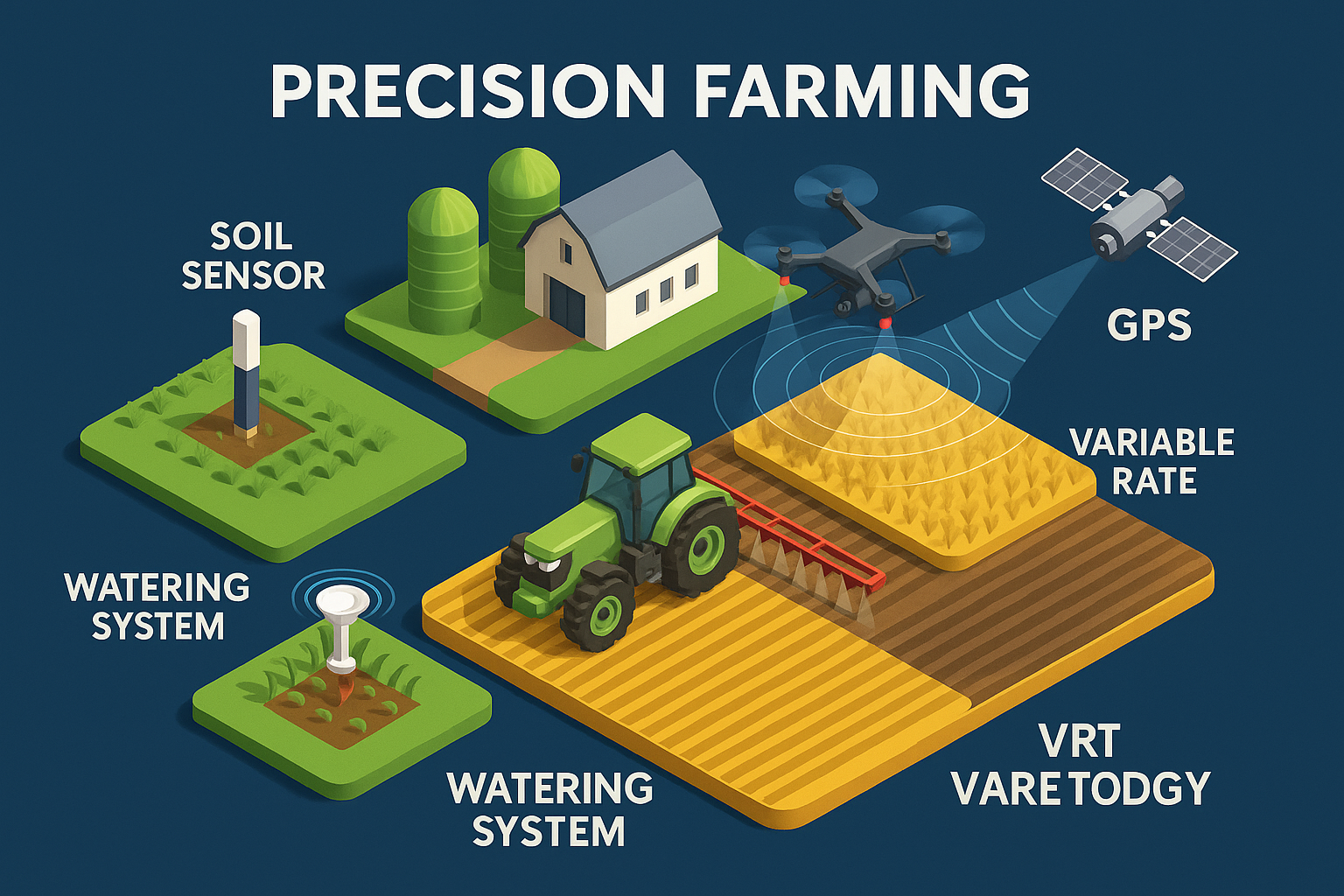
- Agriculture is undergoing a structural transition. For centuries, farmers managed their fields based on experience, observation, and memory. They treated the entire field as one unit, applying uniform amounts of seeds, fertilizers, and water—even though soil, moisture, nutrient levels, and pest conditions varied dramatically from one area to another. Precision farming emerged as the world’s scientific response to these inefficiencies.
Precision farming (or precision agriculture) is a data-driven, technology-enabled agricultural system that identifies intra-field variability and applies inputs with pinpoint accuracy. Instead of assuming every square meter of a field has the same requirement, precision farming measures and manages each micro-zone individually. It is built on satellite monitoring, GPS guidance, sensor networks, drones, automated machinery, AI analytics, and cloud-based farm management systems.
This system allows farmers to:
Reduce fertilizer and pesticide waste
Optimize irrigation
Detect diseases early
Improve yield quality and consistency
Reduce production cost
Protect soil health
Increase climate resilience
Precision agriculture is widely adopted across countries with advanced mechanization, but it is now expanding rapidly into developing nations due to cheaper sensors, government schemes, and drone regulations. As global food demand rises and climate unpredictability intensifies, precision farming is becoming the backbone of next-generation agriculture.
- What Makes Precision Farming Different?
Traditional farming follows a uniform management strategy. Precision farming replaces uniformity with site-specific management. It collects real-time data from the field, converts it into actionable insights, and then uses automated equipment to act precisely on those insights.
Precision farming is based on four fundamental principles:
- Measure everything
Soil nutrients, moisture, temperature, organic carbon, crop growth, pest pressure, weather patterns—everything is captured using sensors, drones, and remote sensing. - Map variability
Every field is divided into management zones with different requirements. - Apply only what is needed
Inputs such as seeds, irrigation, fertilizers, or pesticides are adjusted according to zone-specific data. - Evaluate and refine
Yield maps and data analytics help improve decisions year after year.
This creates a continuous, intelligent cycle of improvement driven by data.
- Core Technologies Driving Precision Farming
Precision farming is a multi-layered technological system. Understanding each technology is essential to understanding the system as a whole.
3.1 Global Positioning System (GPS) and GNSS Navigation
GPS and GNSS enable centimeter-level accuracy for:
Tractor steering
Automated seed drills
Fertilizer spreaders
Sprayers
Harvesters
Modern tractors use RTK correction signals to achieve near-perfect precision. This eliminates overlaps and gaps, reduces fuel consumption, and ensures seeds and fertilizers are placed exactly where needed.
3.2 Remote Sensing and Satellite Imagery
Satellites capture multi-spectral and thermal images to show:
Vegetation health
Chlorophyll concentration
Soil moisture patterns
Temperature variation
Stress zones
Disease spread
Indices such as NDVI (Normalized Difference Vegetation Index) reveal invisible plant stress several days before it becomes visible to human eyes. This allows early intervention.
3.3 Drones and Unmanned Aerial Systems
Drones act as flying diagnostic tools. They produce high-resolution field maps and carry out precise spraying.
Drone applications include:
Plant health analysis
Thermographic imaging
Crop height measurement
Disease detection
Weed identification
Variable-rate spraying
Because drones operate close to the crop canopy, they provide more accurate data than satellites and reduce pesticide drift significantly.
3.4 Internet of Things (IoT) Sensors
IoT devices constantly measure:
Soil moisture
Electrical conductivity
Nitrogen concentration
Temperature
pH
Humidity
Leaf wetness
These sensors transmit data to cloud dashboards that automatically adjust irrigation and nutrient schedules.
3.5 Variable Rate Technology (VRT)
VRT allows real-time adjustment of:
Fertilizer rate
Irrigation volume
Seed density
Pesticide dosage
Machines equipped with VRT ensure that each zone receives the correct amount of input, reducing waste and increasing yield uniformity.
3.6 Data Analytics and Farm Management Software
Precision agriculture generates massive data.
Analytics convert this data into:
Recommendations
Fertility maps
Moisture maps
Disease alerts
Yield predictions
Farmers use mobile apps and dashboards to make informed decisions.
3.7 Automation and Robotics
Automation strengthens precision farming through:
Autonomous tractors
Driverless sprayers
Robotic weeders
Fruit-picking robots
Automated milking systems
These machines increase productivity and reduce human error.
- The Scientific Foundation of Precision Farming
Precision agriculture is not just technology—it is deep agricultural science.
4.1 Soil Variability and Nutrient Distribution
Every field contains natural variability. Soil differs in:
Organic matter
Nitrogen, phosphorus, potassium
Microbial population
Moisture levels
Structure and texture
Precision farming identifies these differences to avoid uniform application that leads to waste and inefficient crop growth.
4.2 Crop Physiology and Stress Patterns
Different crop stages require different nutrient and water levels. By monitoring crop physiology through remote sensing and sensors, precision farming delivers inputs aligned with plant demand curves.
4.3 Pest and Disease Dynamics
Pests and diseases do not affect every part of a field equally. Precision agriculture identifies hotspots early, allowing targeted treatment that saves cost and reduces chemical dependency.
4.4 Water Balance and Microclimate Monitoring
Weather stations and soil sensors help forecast:
Evapotranspiration
Rainfall
Humidity cycles
Heat stress risks
This optimizes irrigation planning.
- Applications of Precision Farming in Different Crops
5.1 Cereals (Wheat, Rice, Maize, Barley)
Precision seeding ensures uniform germination. Remote sensing detects nitrogen deficiency early. Automated harvesters generate yield maps for the next season.
5.2 Vegetables (Tomato, Onion, Capsicum, Cabbage)
Vegetables respond strongly to controlled irrigation, nutrient dosing, and micro-monitoring. Greenhouse automation enhances production.
5.3 Orchards (Apple, Citrus, Mango, Grapes)
Precision farming identifies canopy stress, irrigation needs, and disease outbreaks. Trunk-level sensors guide water management.
5.4 Plantation Crops (Tea, Coffee, Sugarcane, Cotton)
Drones help assess pest pressure, leaf density, and hydration status. Variable-rate spraying reduces chemical use dramatically.
- Economic Impact of Precision Farming
Precision agriculture fundamentally reshapes the economics of farming.
6.1 Cost Savings Through Input Reduction
Precision farming reduces:
Fertilizer usage by 15–40%
Pesticide consumption by 20–60%
Irrigation volume by 25–60%
Fuel consumption by 10–30%
These reductions increase profit margins even before yield improvement.
6.2 Yield Enhancement
Data-driven management increases:
Uniformity
Crop health
Root development
Photosynthesis efficiency
Yield gains range from 10–35%, depending on crop type.
6.3 Profitability Timeline
Large farms recover investment within 1–2 years.
Small farmers recover faster if they use drone and sensor services without purchasing equipment.
6.4 Labor Optimization
Automation reduces labor demand and increases precision, especially in:
Spraying
Weeding
Harvesting
- Environmental and Sustainability Benefits
Precision farming reduces environmental impact:
7.1 Chemical Load Reduction
By applying chemicals only where needed, soil and water contamination drops significantly.
7.2 Water Conservation
Moisture-driven irrigation systems reduce water waste and improve drought tolerance.
7.3 Carbon Footprint Reduction
Fewer tractor passes reduce CO₂ emissions.
7.4 Soil Health Preservation
Controlled-traffic farming minimizes compaction and preserves soil structure.
- Challenges in Precision Farming
Precision farming, despite its benefits, faces barriers.
8.1 High Initial Investment
Drones, sensors, and software are expensive for small farmers.
8.2 Digital Literacy
Farmers need training to interpret data.
8.3 Infrastructure Gaps
Poor internet connectivity affects real-time monitoring.
8.4 Data Overload
Large datasets require specialized data management.
8.5 Land Fragmentation
Small, irregular plots hinder automated machinery.
- Global Adoption Trends
United States
Leader in autonomous machinery and variable-rate systems.
Europe
Focus on carbon-efficient precision practices.
Japan
Robotic rice farming and AI crop management.
Australia
Large-scale satellite-guided farming.
India
Drone policies, FPOs, digital soil cards, and IoT startups accelerating adoption.
- (FAQs)
- What is precision farming?
A data-driven agricultural system that manages fields based on real-time variability.
- Does precision farming increase yield?
Yes, yields typically increase by 10–35%.
- Is precision agriculture expensive?
Initial cost is high, but long-term savings and yield gains make it profitable.
- How do drones help?
They map fields and apply precise spraying.
- What is VRT?
Variable Rate Technology adjusts seed, fertilizer, and pesticide amounts zone-wise.
- Can small farmers use precision farming?
Yes, through service models instead of buying equipment.
- Is precision farming climate-resilient?
Yes, it improves water and nutrient efficiency.
- What data does precision farming use?
Weather, soil, satellite, drone, and sensor data.
- What crops benefit most?
Cereals, vegetables, fruits, cotton, sugarcane, and orchards.
- What is the future of precision agriculture?
AI, robotics, predictive farming, and autonomous systems.
- Conclusion
Precision farming represents the most advanced evolution of agriculture. It empowers farmers to make intelligent decisions based on data instead of assumptions. By identifying variability within fields and using technology to address it, precision farming enhances productivity, reduces cost, and protects the environment. As digital technologies become more accessible and climate challenges intensify, precision farming will define the future of global food production. It strengthens both economic viability and ecological sustainability, making it a cornerstone of 21st-century agriculture.
✍️Farming Writers Team
Love farming Love Farmers.
Read A Next Post 👇