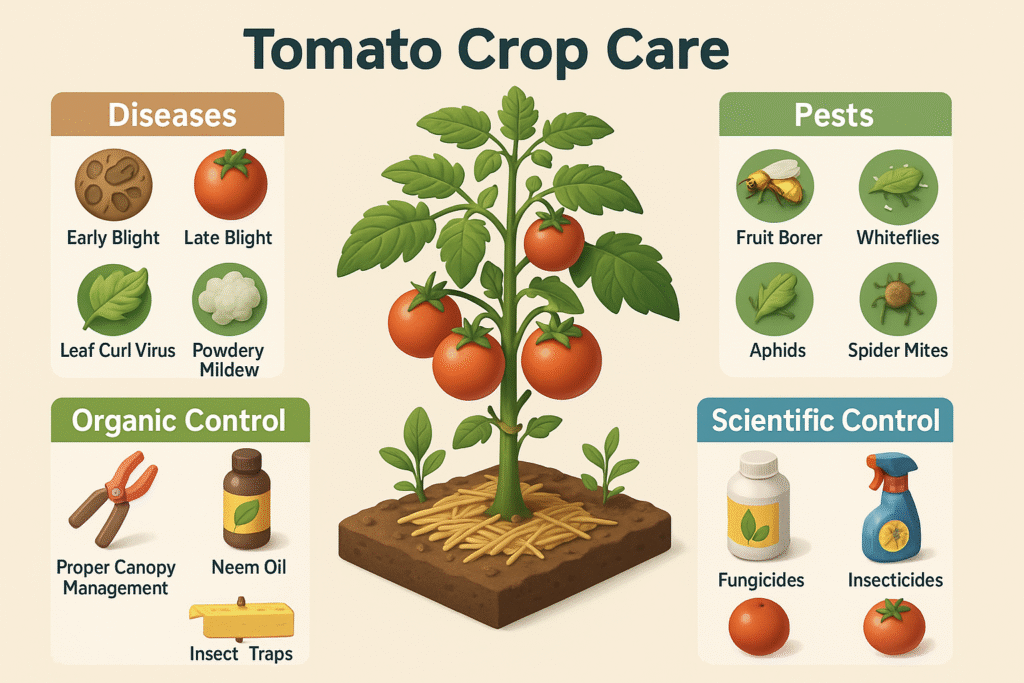
- Introduction: Why Tomato Needs the Highest Care
Tomato is a high-value global crop. But it is also one of the most sensitive plants because:
It has soft leaves and stems.
Its fruits crack easily under stress.
Whiteflies, thrips, aphids and mites love tomato.
Fungal diseases spread very fast in tomato’s micro-climate.
Viral diseases can destroy 100% yield in a week.
This crop rewards farmers only if managed scientifically + organically + preventively.
This guide explains every major risk and every major solution in a single reference article.
- Climate & Temperature Requirements
Tomato needs:
Day temperature: 20–28°C
Night temperature: 15–20°C
Humidity: 50–65%
Sunlight: 6–8 hours
Soil: Sandy loam / loam with good drainage
Temperature below 10°C or above 35°C causes:
Flower drop
Poor fruit set
Pollen sterility
Blossom end rot
Humidity above 75% causes:
Early blight
Late blight
Septoria
Whitefly outbreak
- Soil Preparation & Bed Management
Tomato hates two things:
compacted soil & waterlogging.
Perfect soil structure:
Deep, loose, organic-rich soil
pH 6.0–6.8
At least 2% organic carbon
Zero stagnant water
Recommended soil mixture per acre:
2–3 tons decomposed FYM
200–250 kg neem cake
1 kg Trichoderma mixed with compost
25–30 kg biochar
Good sand ratio for aeration if soil is heavy
Raised beds (4 feet wide) are essential for drainage and airflow.
- Seed, Nursery & Transplanting Care
4.1 Seed Treatment
Best global practice:
Trichoderma viride
Pseudomonas fluorescens
Light neem oil coat
Azospirillum (root development)
4.2 Nursery Management
Raised nursery beds
40–50% shade net
Gentle morning sunlight
Daily light mist irrigation
Zero standing water
Neem spray weekly
4.3 Perfect Seedling Age
25–30 days
Older seedlings reduce yield and cause weak flowering.
4.4 Transplanting Rules
Transplant late afternoon
Water immediately
Use mulch
Maintain airflow by proper spacing (45–60 cm)
- Irrigation Management
Overwatering causes:
Root rot
Bacterial wilt
Late blight
Nutrient washout
Underwatering causes:
Blossom end rot
Fruit cracking
Small fruits
Ideal irrigation method:
Drip irrigation only, never flood irrigation.
Critical irrigation stages:
Flower initiation
Fruit set
Fruit enlargement
- Tomato Nutrient Schedule (Global Standard)
6.1 Basal Dose
Compost/FYM
NPK balanced (12:32:16 or crop stage dependent)
Magnesium sulphate
Boron in micro dose
6.2 Vegetative Stage
Nitrogen + micronutrients
Calcium for stem strength
6.3 Pre-Flowering Stage
Potassium
Calcium
Boron
6.4 Fruit Setting Stage
Potassium heavy feeding
Calcium nitrate foliar
6.5 Fruit Development Stage
Potassium
Magnesium
No excess Nitrogen
Deficiency consequences:
Nitrogen shortage = yellow leaves
Potassium shortage = leaf scorching
Calcium shortage = blossom end rot
Boron shortage = flower drop
Magnesium shortage = interveinal chlorosis
- Tomato Diseases (A–Z Complete Guide)
7.1 Fungal Diseases
Early Blight (Alternaria solani)
Symptoms:
Concentric rings
Lower leaves dry
Premature yellowing
Causes:
High humidity
Poor airflow
Rain splash
Care:
Mulching
Proper pruning
Balanced N & K
Late Blight (Phytophthora infestans)
Most dangerous disease — destroys entire crop in 48 hours.
Symptoms:
Water-soaked patches
Black lesions
Fruit rot
Causes:
Cold + wet climate
Over-irrigation
Dense canopy
Care:
Only drip
Early morning irrigation
Preventive fungicide rotation
Septoria Leaf Spot
Symptoms: Tiny grey spots with dark borders.
Care:
Remove bottom leaves
Mulch
Maintain airflow
Fusarium Wilt
Symptoms:
One-sided yellowing
Plant slowly collapses
Care:
Resistant varieties
Soil drainage
Trichoderma drench
Powdery Mildew
Symptoms: White powder on leaf surface.
Care:
Leaf pruning
Potassium bicarbonate
Sulphur dust
7.2 Bacterial Diseases
Bacterial Wilt
Symptoms:
Sudden wilting
No yellowing
Sticky ooze from stem
Care:
Root-zone drying
Bleaching powder in channels
Avoid overhead watering
Bacterial Speck & Spot
Symptoms:
Tiny black dots
Fruit blemish
Care:
Copper-based sprays
Clean irrigation
7.3 Viral Diseases (No direct cure)
Tomato Leaf Curl Virus
Symptoms:
Leaves curl upward
Severe dwarfing
Zero fruiting
Care:
Whitefly vector control
Silver mulch
Remove infected plants
Tomato Mosaic Virus
Symptoms:
Mosaic leaf pattern
Rough fruit skin
Care:
Tool sterilization
Virus-free seeds
7.4 Nematodes
Root-knot Nematode
Symptoms:
Galls on roots
Poor plant growth
Care:
Marigold intercropping
Neem cake
Pochonia fungus
- Tomato Pests (A–Z Complete Guide)
8.1 Fruit Borer (Helicoverpa armigera)
Damage: Holes in fruit, internal rotting.
Care:
Pheromone traps
Bt spray
Manual picking
8.2 Whiteflies
Damage: Sap sucking + virus spread.
Care:
Yellow traps
Neem spray
Vector management
8.3 Thrips
Damage: Silver streaks, flower drop.
Care:
Blue sticky traps
Neem + garlic
8.4 Aphids
Damage: Curl leaves, virus spread.
Care:
Soap water
Neem oil
8.5 Red Mites
Damage: Webbing, bronzing.
Care:
Sulphur
Increase humidity
8.6 Leaf Miner
Damage: Tunnels inside leaves.
Care:
Remove infected leaves
Neem extract
- Pruning, Training & Canopy Management
Tomato becomes healthy only when:
Lower old leaves removed
Side suckers pruned
Good vertical staking
Airflow maintained
No pruning leads to:
Humidity rise
Whitefly build-up
Blight diseases
- Weed, Mulching & Soil Moisture Care
Mulching is essential because it:
Stops soil splash
Reduces fungus
Maintains moisture
Suppresses weeds
Keeps fruit clean
Weeds host pests like aphids, mites, whiteflies — remove them weekly.
- Harvesting & Post-Harvest Care
Harvest at pink stage (for long transport)
Use clean crates
Avoid harvesting wet fruit
Shade pack only
Grade fruits for uniform ripening
- FAQ
- Why tomato fruits crack?
Due to irregular irrigation or calcium deficiency. - Best time for irrigation?
Early morning before sunlight becomes strong. - Why flowers drop?
Low boron, heat stress, thrips, or heavy nitrogen. - Why plants wilt suddenly?
Bacterial wilt or root rot. - What increases fruit size?
Calcium, potassium, and uniform watering. - Why leaves turn purple?
Phosphorus deficiency. - How to stop early blight?
Mulch + pruning + preventive fungicide rotation. - Why tomato becomes yellow?
Nitrogen or iron deficiency. - Best organic spray?
Neem + garlic + soap base extract. - Best yield booster?
Balanced NPK + calcium + potassium + clean canopy. - Conclusion
Tomato farming succeeds only when the plant remains:
disease-free
virus-free
nutrient-balanced
irrigation-stable
canopy-ventilated
pest-controlled
This complete tomato guide provides world-level care knowledge that helps farmers increase yield, quality, and profitability.
✍️Farming Writers Team
Love farming Love Farmers.
Read A Next Post 👇
https://farmingwriters.com/global-rice-crop-care-complete-guide/


Leave a ReplyShare your thoughts: We’d love to hear your farming ideas or experiences!