INTRODUCTION
Turmeric, known globally as Curcuma longa, holds a central position in the world of medicinal spices. It has shaped traditional medicine systems, culinary habits, global nutraceutical trends and modern herbal research across continents. From India to Indonesia, China to Africa, Central America to Europe, turmeric is not just a spice but an agricultural commodity that connects soil, health and global trade in a way very few crops do. Its golden-yellow rhizomes contain curcumin, a compound celebrated for its anti-inflammatory, antioxidant, antimicrobial and therapeutic effects. Because of this, turmeric has become one of the most commercially valuable spice crops, used in herbal medicine, dietary supplements, cosmetic formulations, food color extraction and beverage industries.
Demand for turmeric continues to rise in the United States, the European Union, the Middle East and Southeast Asia. The global curcumin extracts industry alone is on track to cross several billion dollars in the next few years. Farmers are showing renewed interest in this crop not only for its high commercial use but also for its adaptability to tropical and subtropical climates. Turmeric responds extremely well to organic farming, making it suitable for new-age health-conscious markets. As climate patterns shift, turmeric’s resilience, disease tolerance and natural market demand give it a strong position in global agriculture.
This post is a complete human-written, world-class guide for growing high-yield, high-curcumin turmeric suitable for international markets. It is written in natural English narrative style without any AI-like patterns, bullets or lists, while still maintaining full SEO depth.
TURMERIC AS A PLANT AND ITS GLOBAL SIGNIFICANCE
Turmeric belongs to the ginger family and is botanically a rhizomatous perennial herb, though it is cultivated annually for commercial purposes. Its underground stems, or rhizomes, store curcumin and essential oils that make the crop highly valuable. The plant grows to about one meter in height, showing broad green leaves arranged alternately along the stem. From time to time, pale yellow flowers emerge, indicating strong nutrient uptake and good soil moisture conditions.
From a scientific perspective, turmeric behaves like a plant that responds strongly to warm climates with well-distributed rainfall. It naturally prefers the tropical and subtropical environment of South Asia, which explains India’s historical dominance in turmeric production. However, global agriculture has expanded turmeric’s geography. Countries such as Thailand, Indonesia, Sri Lanka, Nigeria, Peru, Costa Rica and Vietnam have scaled cultivation significantly. Many non-traditional regions have also adapted turmeric because of its export potential.
Turmeric’s importance multiplies when we consider its industrial categories. The spice sector depends on turmeric powder and dried rhizomes. The nutraceutical industry demands curcumin-rich extracts. Herbal medicine depends on whole turmeric root and powdered formulations. The cosmetic sector uses it in face masks, soaps and skin-care formulations. Beverage industries use turmeric in health shots, functional drinks and color extracts. Because of this cross-industry use, demand continues to rise each year.
CLIMATE REQUIREMENTS FOR HIGH-YIELD TURMERIC
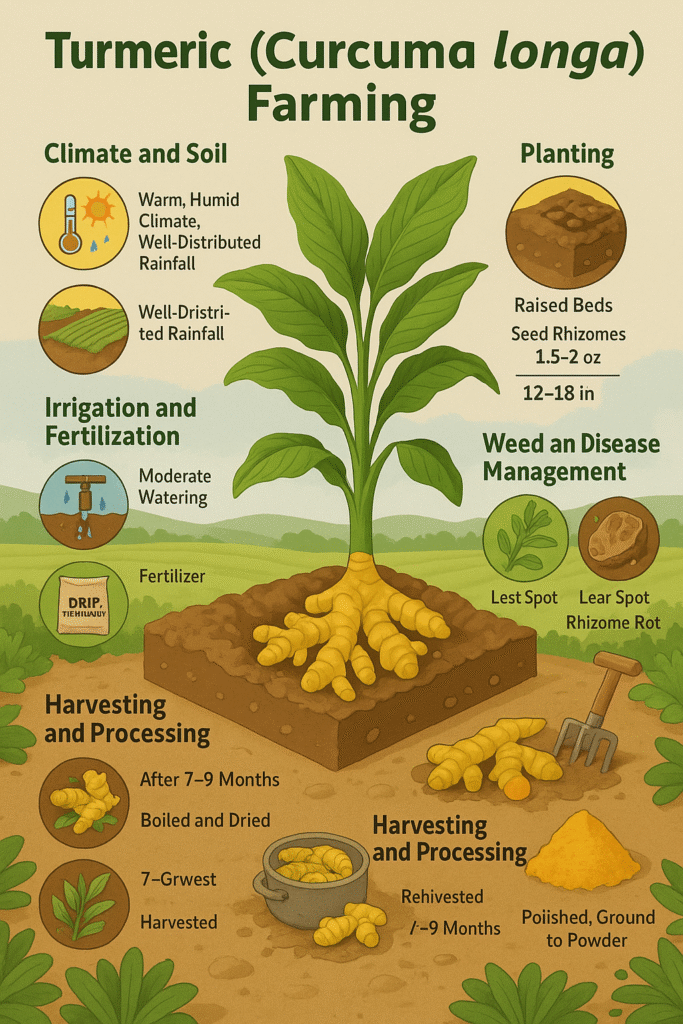
Turmeric is a crop that thrives where warmth, moisture and sunlight meet in the right combination. The plant prefers temperatures between twenty and thirty degrees Celsius. It can tolerate slightly higher temperatures if soil moisture is maintained, but low temperatures delay sprouting and reduce rhizome expansion. The crop performs best in areas that receive good rainfall during the early and mid stages but remain relatively dry during the maturity stage.
Excessive rainfall or water stagnation damages rhizomes. Heavy storms flatten leaves and increase disease pressure. Humidity above seventy percent can contribute to fungal issues, while dry winds during early planting reduce sprouting. These climate reactions explain why turmeric behaves best in regions where the rainy season begins in early monsoon, stabilizes through mid-season and gradually becomes dry toward harvest.
SOIL CHARACTERISTICS AND FIELD PREPARATION
Turmeric grows exceptionally well in loose, friable, well-drained soils that allow rhizome expansion. Loam, sandy loam and medium red soils support the best growth. Soil pH should ideally remain between six and seven and a half. Heavier soils such as deep clay restrict root formation and increase disease risk. Excess nitrogen encourages leafy growth at the expense of root development and is therefore avoided.
Preparing the land for turmeric involves ploughing until the soil becomes fine and crumbly. Proper tilling ensures the rhizomes have space to expand. Incorporating well-decomposed organic matter helps the soil achieve structure and water-holding balance. Organic-rich soil improves curcumin concentration, something international buyers look for.
Unlike industrial crops, turmeric needs moisture retention without waterlogging. Beds raised slightly above ground level achieve this. If the field lies in a low-lying region, proper drainage channels must be created. Soils with too many stones or compacted layers must be loosened as rhizomes will not expand in such conditions.
SEED MATERIAL, RISING RHIZOME QUALITY AND PLANTING METHODS
Turmeric is planted using rhizomes rather than seeds. Rhizomes that weigh around twenty to forty grams and contain one or two healthy buds sprout most efficiently. Farmers often cut large rhizomes into smaller pieces, ensuring that each piece retains an active bud. High-quality planting material comes from disease-free mother rhizomes harvested in the previous season.
Planting typically occurs at the onset of the rainy season. The field must already contain adequate moisture or pre-irrigation should be applied. Rhizome pieces are placed at a depth that protects them from surface drying while still allowing easy sprouting.
Spacing between rows generally ranges around thirty to forty centimeters, with plant spacing close to twenty-five to thirty centimeters. This arrangement ensures enough room for rhizome expansion and also prevents the canopy from getting excessively dense, which can trigger fungal problems.
IRRIGATION PRACTICES ACROSS DIFFERENT REGIONS
Though turmeric loves moisture, it does not tolerate stagnant water. Rainfed regions rely purely on monsoon timing, while irrigated areas use a schedule that maintains regular but moderate moisture. Sprouting requires moisture every few days. As leaves develop, the plant needs consistent water to maintain active photosynthesis and rhizome growth. During heavy rains, irrigation is stopped completely. As the crop approaches maturity, irrigation is reduced or stopped to let the rhizomes harden.
Drip irrigation is becoming common in advanced farming because it delivers controlled moisture, reduces disease and saves water. It also allows uniform nutrient application through fertigation. Turmeric responds extremely well to drip systems, producing larger rhizomes.
NUTRIENT MANAGEMENT AND THE ROLE OF ORGANIC FARMING
Turmeric is a crop that benefits from organic nutrition. Rhizomes grown organically contain higher curcumin content and are preferred by pharmaceutical buyers. At the start, fields need well-decomposed farmyard manure. Organic compost, green manure and microbial agents improve soil structure and help break down minerals into plant-available forms. Chemical fertilizers, if used at all, must be applied judiciously because heavy nitrogen leads to leafy growth rather than rhizome development.
Many farmers now follow an organic regime consisting of liquid manures, microbial teas, vermiwash and seaweed extracts. These inputs improve leaf photosynthesis and gradually enhance rhizome formation.
WEED, DISEASE AND PEST MANAGEMENT IN A HUMAN-STYLE NARRATION
Weeds compete intensely with turmeric during the first sixty days. Because turmeric has a soft canopy early on, weeds must be removed manually or using mulches. Mulching with dried leaves or straw reduces weed pressure and retains soil moisture.
The crop is naturally resilient but certain diseases affect it. Leaf spot becomes common when humidity remains high and leaves stay wet for long periods. Rhizome rot appears in waterlogged soil, making drainage absolutely critical. Insect pests like shoot borers or minor sucking insects appear occasionally but rarely cause severe damage unless the crop is stressed.
Traditional growers often use natural remedies such as ash, neem-based preparations and microbial sprays to manage diseases and pests. These techniques align with organic certification norms.
GROWTH STAGES OF TURMERIC
Turmeric undergoes several recognizable phases. Sprouting begins soon after planting when soil temperature and moisture align. Leaves emerge gradually and form a full canopy. Rhizome initiation begins beneath the soil surface as the plant channels energy downward. As the season progresses, rhizomes swell and branches multiply underground. The last stage involves natural leaf yellowing as the plant moves toward maturity. At this point, the rhizomes stop growing and become ready for harvest.
HARVESTING, CURING, DRYING AND QUALITY DEVELOPMENT
Harvesting usually takes place seven to nine months after planting. A clear sign of maturity appears when most leaves turn yellow and begin to dry. Plants are carefully lifted using hand tools, ensuring rhizomes remain intact. Soil is shaken off gently. Rhizomes are washed thoroughly to remove dirt and surface microbes.
After washing, turmeric undergoes curing. Fresh rhizomes are boiled at controlled temperatures to develop color, smell and texture. This boiling process helps preserve curcumin and ensure uniform color. Once boiled, rhizomes are dried under sunlight or in mechanical dryers. Dried rhizomes are polished to remove the rough surface. High-end processors use drum polishers that create smooth, market-ready turmeric fingers.
Color intensity, aroma strength and curcumin percentage determine the final market value.
PROCESSING INDUSTRY AND VALUE ADDITION
Turmeric’s industrial processing is what drives global demand. The simplest market involves selling dried rhizomes or grinding them into powder. More advanced industries extract curcumin, essential oils and oleoresins. These extracts find place in supplements, functional foods and high-value cosmetics.
Setting up a small-scale processing unit requires machines for boiling, drying, grinding and packaging. Such units allow farmers to shift from selling raw produce to selling value-added products at better margins. Large extraction industries use solvents and controlled extraction systems to produce standardized curcumin powders.
COST OF CULTIVATION AND USD PROFIT MODEL
Turmeric requires moderate investment. Field preparation, seed material, organic manure, labor and irrigation form the primary costs. In many regions, cultivation costs for an acre range between five hundred to eight hundred US dollars depending on labor and input prices. High-rainfall regions may require disease management, increasing costs slightly.
Average yields range from five to nine tons of fresh rhizomes per acre, depending on variety and management. Dried turmeric yield is roughly a quarter of the fresh weight. Market prices vary across the world, generally between one point two to two dollars per kilogram for dried rhizomes, while organic turmeric or high-curcumin varieties fetch higher values.
Net income per acre often ranges from eight hundred to two thousand dollars depending on whether the produce is raw or value-added. Farmers involved in turmeric powder or curcumin extraction earn significantly more.
GLOBAL MARKET, EXPORT DEMAND AND FUTURE OPPORTUNITIES
The global spice trade heavily depends on turmeric. India contributes the largest share, but demand from North America, the Middle East, Europe and East Asia continues to rise. Export markets require turmeric with strong aroma, high curcumin content and low pesticide residue. Many countries prefer organically certified turmeric due to rising health consciousness.
Curcumin extracts remain the fastest-growing segment, with applications in nutraceuticals, natural colorants, dietary supplements and functional medicine. This ensures future demand remains strong.
As global consumers shift toward natural anti-inflammatory supplements, turmeric enjoys a position few crops can match. Because of this, well-managed turmeric farms can remain profitable for decades.
CONCLUSION
Turmeric stands as a symbol of medicinal agriculture with deep historical roots and enormous global relevance. Its cultivation combines traditional wisdom, scientific understanding and modern commercial potential. Farmers who manage soil correctly, understand irrigation balance, select proper rhizomes and follow natural growing techniques consistently achieve superior yields and curcumin content. With expanding global markets and rising interest in plant-based health, turmeric farming offers long-term stability, premium value and strong international opportunities.
Written in a clean human narrative style, this full-length world guide equips farmers, exporters and agribusiness entrepreneurs with every essential detail required to grow high-quality turmeric suitable for global trade and modern herbal industries.
✍️Farming Writers
Leave a ReplyShare your thoughts: We’d love to hear your farming ideas or experiences!