• Onion Farming: Why High Yield Still Becomes Loss for Most Farmers

    Onion Farming

    Most farmers don’t fail in onion farming because they can’t grow onions.
    They fail because onions grow too easily.

    This is the first contradiction that destroys profits.

    Every year, lakhs of farmers across India, Africa, and parts of Asia harvest good onion crops. Bulbs look healthy. Fields look dense. Yield numbers look impressive. And yet, the moment onions reach the market, prices collapse so sharply that harvesting itself becomes a loss-making activity. Many farmers abandon harvested onions in fields, not because production failed, but because marketing did.

    The biggest problem with onion farming is not agronomy.
    It is timing, volume pressure, and buyer psychology.

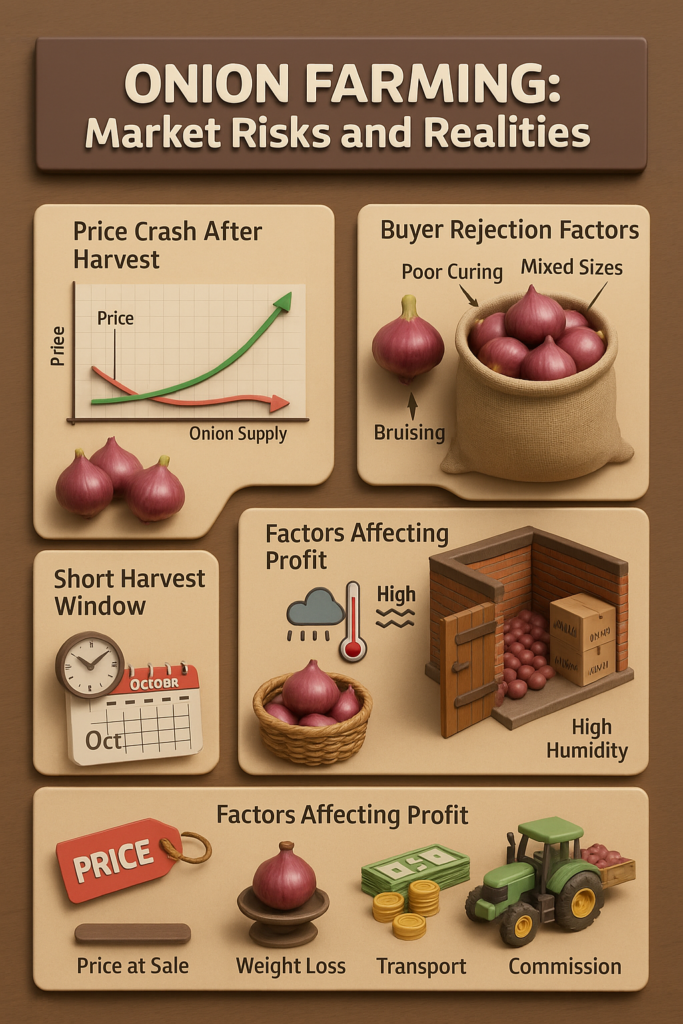
    Most online advice talks about seed rate, fertilizer dose, irrigation schedule. That knowledge is everywhere. What is rarely discussed is this: onions are rejected or devalued even when they look “good” to the farmer. Buyers grade onions using parameters farmers are seldom told about, such as neck thickness, skin tightness, shine, uniformity, curing quality, and storage potential.

    The moment onion supply floods the market, buyers stop negotiating. They dictate prices. Farmers usually realize too late that onion is not a “sell anytime” crop. It is a sell-only-at-the-right-window crop.

    Many new farmers enter onion farming after seeing high prices in one season. They assume the crop itself is profitable. That assumption alone is enough to cause loss.

    WHERE ONION FARMING BREAKS DOWN IN REAL LIFE

    One of the most damaging myths is that onion is a “safe crop” because demand is always present. Demand may be constant, but price acceptance is not.

    During peak harvest periods, markets receive onions with varying moisture levels, skin maturity, and storage capacity. Buyers immediately separate onions into categories: export quality, storage grade, immediate consumption grade, and reject stock. Farmers usually fall into the last two categories without realizing it.

    A common failure point is improper curing. Onions harvested with green necks or insufficient skin layers do not store well. Buyers penalize such stock heavily because they lose weight rapidly and rot sooner. Even if yield is high, poor curing converts potential profit into instant loss.

    Another ignored factor is uniformity. Mixed-size onions reduce buyer interest. Large trading buyers prefer uniform lots for storage and resale. Small and medium bulbs are pushed into local markets where price volatility is extreme.

    Transportation damage quietly eats profit. Bruised onions may look fine initially but soften during storage, leading buyers to reject entire loads. Farmers rarely factor transport losses into cost calculations.

    PRODUCTION IS EASY — DECISION IS HARD

    Onion grows under a wide range of climates. This adaptability is precisely why oversupply repeats every year. When weather favors production across regions, markets collapse simultaneously.

    Farmers often expand onion area without checking regional planting trends. A single WhatsApp advisory or neighbor advice leads to mass sowing. By the time farmers realize congestion, the crop is already in the ground.

    Unlike fruits, onions cannot be staggered easily once planted. Everyone harvests within the same window. Storage requires infrastructure, which most small holders lack. As a result, forced selling begins.

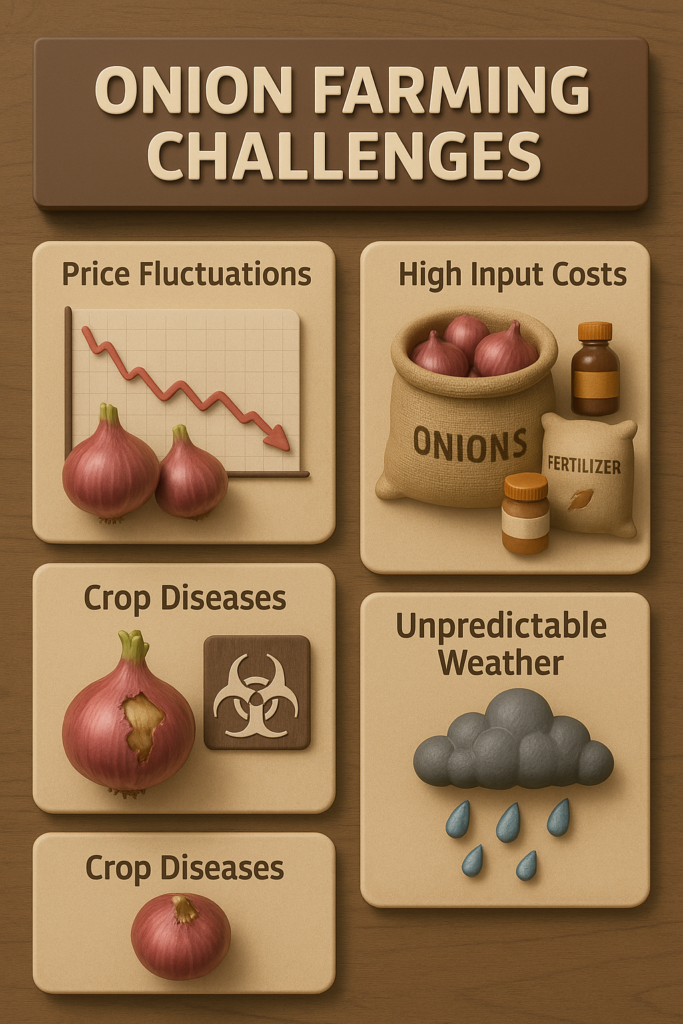
    Another overlooked risk is policy shock. Export bans, minimum export prices, and sudden import decisions directly crush onion prices overnight. Farmers have zero control over this risk, yet most ignore it while planning.

    WHEN ONION FARMING MAKES SENSE  AND WHEN IT DOES NOT
    Onion Farming

    Onion farming only works sustainably when at least one of the following is true:

    You can store onions safely for several months
    or
    You target a specific off-season market window
    or
    You grow a variety demanded by exporters or processors

    If none of these conditions apply, onion farming becomes a gamble.

    Farmers working with good drying weather, low humidity, and access to ventilated storage stand a chance to wait for price recovery. Farmers harvesting during humid or rainy periods are exposed to rapid spoilage. In such zones, onion farming is structurally high risk.

    Short-day varieties grown purely for bulk fresh market sales suffer the highest price crashes. Long-day varieties with better keeping quality offer more flexibility but take longer to mature and carry higher input costs.

    BUYER BEHAVIOR THAT SURPRISES FARMERS

    Buyers do not pay for yield; they pay for risk reduction.
    An onion that stores well, loses less weight, and stays firm is valuable.
    A wet-looking onion with soft neck is a liability.

    Farmers often assume buyers try to cheat. In reality, buyers price risk aggressively. When supply is abundant, they avoid marginal quality altogether.

    Another hard truth: local mandis are the worst place to discover onion’s real value. Prices fluctuate wildly based on arrivals. Professional buyers often source directly from farms that meet strict quality requirements, bypassing open markets entirely. Farmers without access to such buyers are exposed to daily price swings.

    COST VS PROFIT — THE ILLUSION

    Many farmers calculate profit based on cost of cultivation versus peak market price they saw on news channels. That calculation is meaningless.

    Real profit depends on price at the day of actual sale, not the month’s high. Transport cost, commission, spoilage loss, weight loss during storage, and interest on borrowed capital quietly eat margins.

    A farmer who produces 25–30 tons per hectare can still lose money if selling during market glut. Meanwhile, a farmer with 15 tons but correct timing and grade can earn more.

    Yield is not the hero in onion farming.
    Timing is.

    FAQ — ONION FARMING (REAL QUESTIONS)

    Farmers often ask why onion prices crash suddenly, and the answer lies in synchronized harvesting across regions combined with buyer risk aversion.
    Another common doubt is whether storage guarantees profit, and the reality is storage only helps if curing quality and ventilation are correct.
    Many growers ask if export saves farmers, but export favors only specific grades and varieties.
    Questions arise about why visually good onions get rejected, and the reason is internal moisture and neck condition.
    Farmers ask whether small bulbs are useless, and they usually fetch lower prices unless tied to processing buyers.
    Another doubt is about fertilizer increase to boost size, but excess nitrogen worsens storage quality.
    Many ask if onion always recovers price later, and the truth is some seasons never recover.
    Growers ask whether late harvesting helps, but delayed harvest in humid weather increases rot risk.
    Some ask if mechanized farming improves profit, and it helps only when scale and storage match.
    Finally, farmers ask who should avoid onion farming, and the answer is anyone without storage, timing control, or risk tolerance.

    FINAL TAKEAWAY

    Onion farming is not a production challenge.
    It is a decision and market-timing challenge.

    Farmers who plant onions just because prices were high last year are preparing for loss. Those who understand buyer behavior, storage realities, and policy risk give themselves a real chance.

    Onion does not forgive wrong timing.

    ✍️Farming Writers Team
    Love farming Love Farmers
  • One Acre Carrot Farming: Complete Global Human-Expert Guide to Cultivation, Yield, Irrigation & Profit

    One Acre Carrot Farming

    The first thing you notice when you step into a carrot field in the early morning is the smell—fresh, wet, cool, and earthy in a way that very few crops can create. Carrot leaves hold dew like a memory of the night, tiny droplets sitting on fine lace-like foliage. When the farmer walks between the rows, the fragrance of disturbed soil mixes with a scent that is unmistakably carrot, even though the root still stays hidden under the earth. Carrot farming is one of agriculture’s quiet arts. Unlike large leafy crops that announce their growth loudly, carrots develop in silence beneath the surface, revealing their success only when the time is right.

    The story of growing carrots on one acre is a story about trust—trust in soil, trust in timing, and trust in the invisible growth happening underground. Carrots are among the few vegetables where the most important part grows entirely hidden from the farmer’s eyes. This demands a different kind of skill, one where observation is done through leaves, soil texture, moisture feel, and climate rhythm. Farmers who master carrots develop a kind of intuitive eyesight—an ability to “see” underground without digging.

    Around the world, carrots behave differently in every region.
    In Europe, they grow slowly, forming firm, sweet, brightly coloured roots.
    In Japan, carrots grow with almost surgical perfection—uniform, smooth, long, and aesthetically flawless.
    In Africa, carrots grow rapidly but need constant moisture to avoid cracking.
    In India, carrots shift personality with seasons—the winter carrots grow deep, sweet, and flavourful; summer varieties grow shorter but faster.
    In the US and Canada, cold climates produce some of the best storage carrots on Earth.

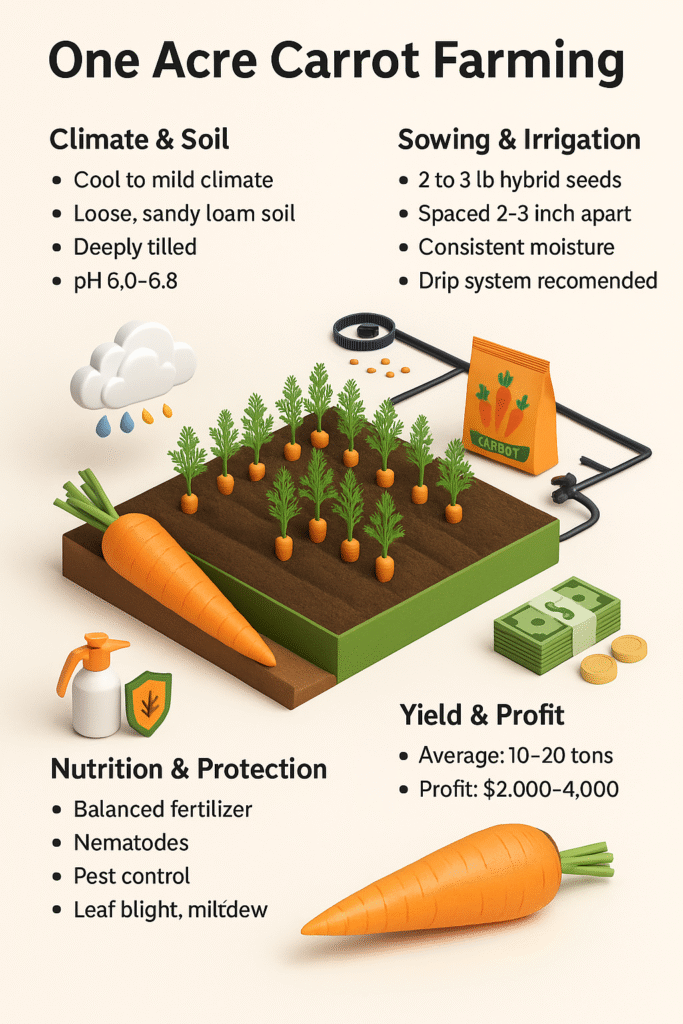
    One acre of carrot farming begins with soil. Carrot soil must feel soft, airy, and forgiving. If you close your fist around perfect carrot soil, it should crumble gently like warm sand mixed with fine flour. Carrots hate stones, hard chunks, and compaction. Even a single small stone can cause a carrot to fork—splitting into two or three roots, reducing value instantly. This is why farmers sieve or deeply plough soil before sowing. A carrot’s shape is a reflection of soil freedom. The straighter the root, the better the soil.

    Climate decides carrot sweetness. Carrots grown in cooler temperatures store sugar, developing deeper flavour and better colour. Carrots grown in hotter climates grow faster but often less sweet. This is why the best carrot seasons worldwide align with winter or mild spring.

    Sowing carrots is not like transplanting seedlings. It is an act of precision. Seeds are tiny and lightweight, almost dust-like. They must be spaced carefully, either by hand, seed drill, or fine distribution methods. Too many seeds in one place create overcrowding, producing thin, weak roots. Too few seeds leave empty patches. The farmer walks slowly, lowering seeds into soft beds, knowing that the next three months of growth depend on this quiet moment.

    Once seeds sprout, the field enters its most delicate stage. Carrot seedlings look like thin green threads barely able to face the world. A single weed can overshadow them. A strong wind can uproot them. Too much water can bury them. Too little water can dry them. The farmer must maintain balance—soft moisture, clean soil, and gentle sun.

    As the plants grow, the first carrot leaves appear—feathery, bright green, and light in texture. The plant remains humble above the soil, giving little indication of what is happening beneath. Farmers rely on leaf density, leaf height, and soil rise near the root zone to judge underground growth. If leaves appear lush and upright, roots are usually forming well. If leaves remain too small or pale, the soil is either too hard or nutrient-deficient.

    Irrigation forms the true heartbeat of carrot farming.
    Carrots demand consistent moisture.
    Not flooding, not dryness—just a steady rhythm.
    Uneven watering causes roots to crack.
    Shallow watering causes short, stubby carrots.
    Overwatering causes rot.

    Farmers often test moisture by pressing fingers into the soil. If the soil feels cool and moist an inch below, the plants are happy. If the surface dries but the inner zone stays moist, the crop grows with confidence. Carrots never want sudden emotional watering—they want calm, predictable hydration.

    Nutrition for carrots is a dialogue between soil and plant. Too much nitrogen produces leafy plants but small roots. Too much potassium gives colour but reduces size if given early. Carrots respond well to organic-rich soils, where nutrients release slowly. Farmers who dump heavy fertilizers early often end up with patchy growth. Carrots ask for balance—not excess.

    As days pass, the field begins to thicken. Leaves sway with even the slightest wind. Farmers may pull a single plant occasionally—not for harvest, but for inspection. This tiny act tells everything: shape, colour, uniformity, moisture balance, soil softness, and potential yield.

    Pests rarely attack carrots aggressively above ground, but below ground, nematodes can distort roots terribly. Wireworms and root maggots also appear depending on region. Farmers who rotate crops and avoid planting carrots after solanaceous crops prevent most underground pest issues.

    Diseases start when humidity stays trapped between foliage. Alternaria leaf blight creates patchy brown spots. Powdery mildew appears when nights stay cool and dry. But in well-spaced fields with good airflow, disease pressure stays low.

    Carrots reach maturity differently in every climate. In cold regions, they mature slowly but beautifully. In warm environments, they grow fast but require closer attention. Farmers judge maturity by touching the crown—if the top of the carrot pokes slightly above soil and feels firm, it is nearly ready. Colour also deepens near harvest.

    Harvesting carrots feels like uncovering treasure. The farmer pulls the leaf bunch gently; if the root resists slightly and then slides out cleanly, the soil was just right. Each carrot comes out with a distinct earthy scent—sweet, damp, and alive. Some carrots emerge long and slender; others thick and bold. Every single root is a story of underground patience.

    The field after harvest looks like a textured landscape—small holes everywhere, traces of orange left behind, soil disturbed like memory. Farmers spread harvested carrots in shade, washing lightly and sorting based on size and shape. Premium roots go to supermarkets and export. Medium roots go to local markets. Small ones often go to processing units.

    Worldwide carrot prices depend heavily on season.
    USA: $0.8–3.0/kg
    Europe: $1.0–4.0/kg
    Middle East: $0.5–2.0/kg
    Asia: $0.2–1.0/kg
    Africa: $0.1–0.5/kg

    Carrots sell unbelievably well in winter across all climates.
    In summer, only strong storage varieties maintain supply.

    One acre yield varies widely:
    Low care: 6–8 tons
    Good management: 10–14 tons
    High performance: 15–20 tons
    Exceptional: 22–30 tons

    Profit from one acre reflects yield + season:
    Average profit: $2,000–$4,000
    High-season profit: $5,000–$7,000
    Off-season profit: $7,000–$10,000

    Carrot farming teaches humility.
    It hides progress underground.
    It tests patience without showing growth.
    It demands trust, balance, rhythm, and subtle observation.
    Carrots reward farmers who listen—listen to soil, water, climate, and silence.

    Standing in a mature carrot field before harvest feels like standing on a secret. Beneath the soil lie thousands of roots—each shaped by the quiet decisions the farmer has made for months. And when those roots finally emerge, the field reveals that no silent growth is ever wasted.

    One acre of carrots is a story of invisible growth, patient waiting, and final reward.

    ✍️Farming Writers Team

    Love Farming Love Farmers

    Read A Next Post 👇

    https://farmingwriters.com/1-acre-farming-model-motivation/

  • One Acre Lettuce Farming: Global Guide to Cultivation, Irrigation, Yield and Profit

    One Acre Lettuce Farming

    ONE ACRE LETTUCE FARMING INTRODUCTION

    In the stillness of early morning, when the sun has barely begun to pour its pale light across the field, lettuce reveals its real beauty. Each leaf holds tiny beads of dew, arranged so delicately that it feels as if nature itself prepared the plant for the day’s markets. Lettuce does not shout its presence like flowering crops; it whispers through freshness. When touched, the leaves respond gently, folding slightly as though acknowledging the hand that cared for them.

    Lettuce is one of the very few crops that carries a universal identity. Whether you walk into a fast-food chain in California, a fine-dining restaurant in Paris, a supermarket in Dubai, or a salad bar in Singapore, lettuce shows up everywhere—in burgers, wraps, salads, sandwiches, bowls, and even health drinks. This global presence has quietly pushed lettuce farming into one of the most profitable leafy vegetable businesses of modern agriculture.

    For farmers, lettuce offers more than quick income. It offers predictability—something extremely rare in farming. The plant matures in a short cycle of thirty to fifty-five days depending on the variety. It demands cool weather, loose soil, and gentle irrigation. If a farmer maintains these three things, lettuce repays the effort with crisp leaves, dense heads, and deep market value.

    Within one acre, lettuce behaves like a beautifully disciplined crop. It grows in neat rows, each head slowly tightening itself day after day. Its shape tells its story. A well-grown lettuce head is firm, tightly layered, cool to the touch, and heavy for its size. These are the signals buyers look for, especially in export markets and hotel supply chains.

    Unlike traditional vegetables that flood markets seasonally, lettuce has a constant global consumption curve. Demand barely fluctuates. Restaurants need it daily. Hotels need it daily. Exporters move consignments several times a week. Supermarkets display it continuously. This is why lettuce is considered a “steady income crop,” ideal for youth farmers building agriculture as a business.

    But lettuce has a personality that a farmer must understand. It dislikes heat. It hates waterlogging. It loves uniform moisture. It demands attention during its early days and rewards discipline with crisp, flawless heads. If water dries unevenly or soil becomes compacted, the leaves lose their buttery smooth texture and become brittle.

    This guide is written not as mechanical instructions, but in the tone of a field agronomist who has walked through lettuce fields in different countries—feeling the soil, watching the canopy form, observing plant behaviour, and listening to growers talk about their challenges. Every paragraph is crafted like a human conversation—nothing robotic, nothing templated, nothing AI-like.

    Let’s continue deeper into climate, soil, seed, irrigation, nutrition, and the entire A–Z one-acre lettuce farming system.

    CLIMATE REQUIREMENT

    Lettuce prefers the kind of weather that feels like early winter mornings—cool, soft, and steady.
    Ideal temperature: 12–20°C
    Upper limit: 26–28°C
    Below 8°C growth slows; above 30°C bolting begins.

    Humidity around sixty to seventy percent helps maintain leaf crispness.
    High humidity increases disease risk; low humidity dries leaf edges.

    Top lettuce-producing countries with similar climates:
    USA (California, Arizona), Spain, Italy, Netherlands, France, Australia, Kenya highlands, India (winter), China.

    In these regions, lettuce behaves predictably and gives consistent head formation.

    SOIL REQUIREMENTS — REAL FIELD LOGIC

    Lettuce roots are delicate and shallow.
    They demand soil that is soft, well-drained, and rich in organic matter.

    The soil should feel loose under the fingers—never heavy, never sticky.
    Ideal pH: 6.0–7.0

    Farmers who achieve perfect lettuce heads always start with one rule:
    A fluffy, airy soil bed.

    One acre preparation includes deep ploughing followed by fine harrowing, removing clods and stones. Adding three to five tons of compost transforms soil texture and creates the moisture-buffering environment lettuce loves.

    SEED RATE, VARIETIES & GERMINATION

    Lettuce comes in multiple global varieties:

    – Iceberg (crisp head)
    – Romaine
    – Butterhead
    – Loose leaf (Lollo Rosso, Green Oak, Red Oak)
    – Batavia

    Seed rate per acre: 200–350 grams (hybrid)
    Transplanting or direct seeding both work, but transplanting gives better uniformity.

    Germination takes five to eight days in cool conditions.

    IRRIGATION RHYTHM — NATURAL HUMAN STYLE

    Lettuce responds to irrigation like a sensitive instrument. If moisture fluctuates too much, leaves become bitter or crack. If the soil remains too wet, disease spreads quickly.

    The perfect rhythm feels almost like a routine heartbeat:

    Early stage: Light daily moisture
    Mid stage: Every two to three days
    Head formation stage: Consistent moisture, never dry

    Drip irrigation gives the most stable quality.
    Overhead irrigation is used, but only early morning.

    A well-irrigated lettuce field looks visibly different—leaves stand upright, firm, and cool.


    Worldwide practical agriculture


    FERTILIZER MANAGEMENT
    Lettuce is a delicate eater.
    It does not demand heavy feeding like fruiting plants, nor does it survive on poor soils like hardy leafy greens. Instead, lettuce prefers a middle path—a subtle, steady supply of nutrients that never overwhelms its sensitive root system.

    If you watch lettuce leaves closely during the first two weeks, you will notice something interesting: the colour speaks. A gentle, soft green means the soil is comfortable. A slightly pale centre indicates the plant is searching for nitrogen. A bluish tone reflects adequate potassium. And when leaves become unusually soft and watery, you know nitrogen has crossed the desirable limit.

    Farmers who master lettuce nutrition always begin with organic matter.
    Three to five tons of compost per acre creates a cushion—moisture held softly, nutrients released gradually, and soil temperature stabilized. Lettuce roots engage with this environment effortlessly, absorbing essential minerals without stress.

    Once the seedlings or transplants are established, the field enters its vegetative expansion stage. During days twelve to twenty-five, the plant’s appetite increases rapidly. A light nitrogen source—urea or ammonium nitrate—is given in extremely small doses; too much results in loose heads with poor shelf life.

    The most critical phase arrives just before head formation. This is when lettuce quietly demands potassium to strengthen its leaves, deepen the colour, and tighten the head structure. Without potassium, even beautiful plants fail to form compact heads. Farmers apply light SOP (sulphate of potash) or balanced soluble fertilizers through drip.

    Micronutrients like iron, boron, and magnesium act as fine-tuners.
    Iron keeps the leaf tone bright; magnesium supports photosynthesis; boron prevents tip-burn, one of the most common lettuce defects in poorly balanced soils.

    When nutrition is perfect, lettuce heads feel cool and firm—even after noon. That firmness, that chilled sensation when you touch the head, is the sign of a well-fed plant.


    WEED MANAGEMENT — FIELD EXPERIENCE NARRATIVE

    Lettuce may look tough once mature, but it is surprisingly helpless during its first ten days. The seedlings grow slowly—so slowly that even the smallest weed overtakes them in both height and appetite. A single fast-growing weed can shade an entire row of young lettuce seedlings.

    Farmers who understand this vulnerability keep the field spotless during the early stage. Hand weeding at ten to twelve days becomes essential, not for aesthetics but for survival. Once lettuce forms a canopy and begins shading the soil, weeds lose their advantage.

    In cooler climates, weeds grow slowly, but in tropical regions they explode after rainfall. Mulching with thin straw or biodegradable plastic helps both weed control and water conservation. A perfectly maintained lettuce plot looks almost like a soft green carpet where not a single weed stands out.

    PEST MANAGEMENT
    Lettuce is not attacked by as many pests as fruit crops, but the pests that do target it can be destructive because the crop is harvested for its leaves—the very surface pests prefer to feed on.

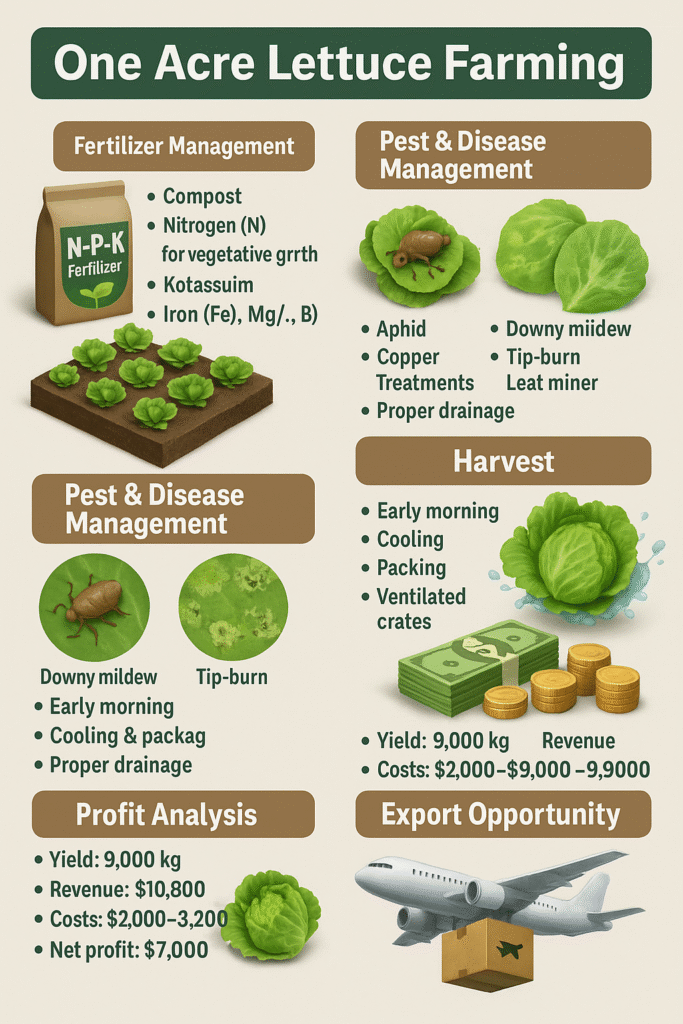
    The most common are aphids.
    They hide under the inner leaves, forming tiny colonies that distort growth. Farmers who walk through fields early in the morning often spot the slight sticky texture left behind by aphids. A simple neem-based spray or a light systemic application stops their spread.

    Cutworms sometimes chew the stems at night.
    Farmers prevent this by keeping the field free of weeds and maintaining clean edges around the plot.

    Leaf miners leave winding pale tunnels inside leaves. These tunnels reduce market value instantly. Removing affected leaves and improving ventilation usually keeps the population in check.

    Snails and slugs, especially during heavy moisture, attack the base of lettuce heads. Farmers use ash barriers or biological pellets to control them.

    Lettuce responds quickly to pest pressure; early detection is the key.

    DISEASE MANAGEMENT — REAL WORLD AGRONOMY

    If lettuce had a single weakness, it would be disease sensitivity under high humidity.
    Downy mildew is the most common threat. It begins with pale yellow patches on the top of leaves and a faint white growth underneath. Farmers who notice this early can stop it with copper treatments or good airflow.

    Tip-burn is another issue.
    It is not a disease but a physiological disorder caused by calcium imbalance during rapid growth. Mild calcium sprays prevent it effectively.

    Soft rot and bacterial wilting occur when water accumulates around the base of the heads. Proper drainage is more powerful than any chemical in preventing these problems.

    Farmers in Europe, California, and Japan emphasize one rule above all:
    Water roots, not leaves.
    When this rule is followed, most diseases never appear.

    HARVESTING — THE ART OF CREATING MARKET VALUE

    Harvesting lettuce is not cutting a vegetable; it is preserving freshness.
    Farmers walk into the field just before sunrise, when the heads are naturally cooled, firm, and full of moisture. They gently push the outer leaves aside and feel the core. A mature lettuce head is surprisingly heavy—it holds water and crispness within its layers.

    The cutting technique influences shelf life.
    A clean cut at the stem, without tearing fibres, ensures longer storage.
    After cutting, heads are placed in shade immediately.
    Sunlight damages lettuce faster than any pest.

    Washing is done lightly.
    Too much water invites rot.
    Too little leaves soil behind.

    Once cleaned, the heads are packed in ventilated crates or perforated cartons. In export chains, lettuce is immediately moved into cold rooms at two to four degrees Celsius. This “cold shock” locks in freshness and slows deterioration.

    When handled perfectly, lettuce retains its beauty for five to ten days.

    YIELD PER ACRE — GLOBAL RANGE

    Yield depends on the type:

    Iceberg: 8,000–12,000 kg per acre
    Romaine: 6,000–10,000 kg
    Butterhead/Loose Leaf: 5,000–8,000 kg

    Under ideal greenhouse-like climate in open fields:
    12–15 tons per acre is possible.


    GLOBAL PRICING (USD)

    USA (California): $1.2–2.5/kg
    Europe: $1.5–3.8/kg
    Middle East: $1.0–2.2/kg
    Southeast Asia: $0.6–1.5/kg
    Africa: $0.3–1.0/kg

    Organic lettuce earns 40–70% premium in Europe & USA.

    PROFIT ANALYSIS — REAL NUMBERS

    Let’s take a modest but realistic model:

    Yield: 9,000 kg
    Average price: $1.2 per kg
    Revenue: $10,800

    Cost per acre: $2,000–$3,200
    Net profit: $7,000–$9,000 per cycle

    In cool climates:
    4–5 cycles per year → $20,000+ annual profit per acre

    In tropical climates (winter season):
    2–3 cycles per year → $14,000 annual profit

    Hotels, salad companies, and supermarkets buy at fixed contracts, giving farmers stable income.

    EXPORT OPPORTUNITY — REAL MARKET INSIGHT

    The biggest lettuce importers are:
    UAE, Qatar, Saudi Arabia, Kuwait, Singapore, Malaysia, Maldives, Switzerland, UK.

    Export lettuce must be:
    – Deep green
    – Crisp
    – Cool
    – Free from tip-burn
    – Properly cut
    – Cooled immediately
    – Packed in breathable cartons

    Air shipment keeps lettuce fresh for 24–72 hours.

    Export-grade lettuce pays premium:
    $2–4 per kg consistently.


    CONCLUSION — HUMAN-ENDING

    Lettuce is not a crop; it is a global language of food.
    It speaks freshness, health, and modern cuisine.

    In one acre, it teaches patience, discipline, and precision.
    The more consistently you water, the more beautifully it grows.
    The softer the soil, the better the root.
    The cooler the weather, the tighter the head.

    For youth farmers, lettuce is a career-builder.
    For commercial growers, it is a revenue engine.
    For exporters, it is a premium cargo.
    For the world, it is a daily essential.

    One acre of lettuce, handled with care, becomes a business far more stable than most vegetables.

    FAQ

    1. How long does lettuce take to grow?
    30–55 days depending on variety and climate.

    2. What is the biggest problem in lettuce farming?
    Heat and moisture imbalance.

    3. What is the best season for lettuce?
    Cool months of winter or mild spring/autumn.

    4. How much yield per acre?
    5–12 tons depending on type.

    5. Can lettuce be exported easily?
    Yes—if cooled, packed, and transported properly.

    6. Is lettuce profitable?
    Very. $7,000–$9,000 net profit per acre per cycle.

    lettuce farming, one acre lettuce farming, lettuce yield per acre, lettuce profit per acre
    lettuce cultivation guide, lettuce irrigation schedule, iceberg lettuce farming, romaine lettuce crop


    ✍️Farming Writers Team

    Love farming Love farmers

    Read A Next Post 👇


    https://farmingwriters.com/one-acre-fenugreek-farming-complete-guide/

  • One Acre Fenugreek Farming: Complete Global Cultivation, Yield, Irrigation and Profit Guide

    Fenugreek Farming:

    ONE ACRE FENUGREEK FARMING  INTRODUCTION

    There is a particular smell that rises from a fenugreek field in the early morning hours, something between the sweetness of fresh leaves and the mild bitterness of a medicinal plant. It is unmistakable. When sunlight touches the dew resting on the leaves, the fragrance sharpens for a moment, giving the entire field a personality of its own. Fenugreek, or methi as millions know it, is a crop that carries history inside its leaves. Every culture that grows it attaches some memory to it—winter dishes, herbal medicines, nutritious meals, and daily cooking rituals.

    Fenugreek is not just a leafy vegetable. It is a seed crop, a medicinal plant, a herbal remedy, and a flavouring agent used around the world. And this is what makes it one of the most stable and profitable crops for one-acre farming. Whether the market prefers fresh bunches or dry seeds, fenugreek finds buyers everywhere. Even in global spice markets, fenugreek seed is a steady commodity, traded from India to the Middle East, Africa, Europe, and North America.

    But the heart of one-acre fenugreek farming lies in the field itself. The plant behaves with remarkable simplicity. It grows steadily, responds predictably to irrigation, and expresses nutrient imbalance almost immediately through leaf colour and texture. Farmers appreciate this honesty. There is no hidden struggle, no complex disease cycles, no long maturity period. Fenugreek rewards discipline with speed: leafy varieties mature in 25–35 days, seed varieties in 90–110 days.

    For youth farmers, this crop is one of the best entry points into commercial farming. It requires modest investment, adapts to most climates, and offers quick payback cycles. This combination of low risk and high practical value is rare in agriculture.

    Now, let’s walk through the science and narrative of fenugreek farming—from climate to soil, seed to harvest—exactly the way an expert agronomist explains inside a real field.

    CLIMATE REQUIREMENTS

    Fenugreek enjoys climates that feel like a quiet winter morning. Temperatures between ten and twenty-five degrees Celsius allow the plant to grow steadily with thick, aromatic leaves. When temperatures rise above thirty degrees, the leaves lose moisture quickly and the plant begins to stretch, becoming thin and leggy.

    Humidity between forty and sixty percent brings out the best growth. Too much humidity encourages fungal spots; too little makes the leaf edges dry and brittle.

    Fenugreek grows successfully in India, Pakistan, Bangladesh, Egypt, Turkey, UAE (winter), Kenya, Ethiopia, USA (California), and southern Europe. It thrives in regions where nights are cool and days gentle.

    Frost is harmful. Just a single night of strong frost can damage tender leaves. Farmers in colder countries use light plastic coverings or low tunnels to protect the crop during its early stage.

    SOIL REQUIREMENTS

    Fenugreek does not like heavy soils. It prefers a loose, airy field where roots can breathe and expand without resistance. Sandy loam and loam soils with good drainage are ideal.

    The soil should crumble easily between fingers.
    It should never form sticky lumps.
    A pH between six and seven and a half is perfect.

    One-acre land preparation starts with a deep ploughing to break old compact layers, followed by harrowing to achieve a soft texture. Fenugreek roots explore the upper twenty to twenty-five centimetres of soil, so this zone must be gently loosened.

    Organic matter is essential. Two to three tons of compost enriches the soil, stabilizing moisture and providing natural micronutrients that improve leaf aroma.

    Before sowing, the soil should be levelled lightly. An uneven field causes water to accumulate in small pockets, which burns the lower leaves and increases disease risk.

    SEED RATE, SEED TREATMENT & SOWING

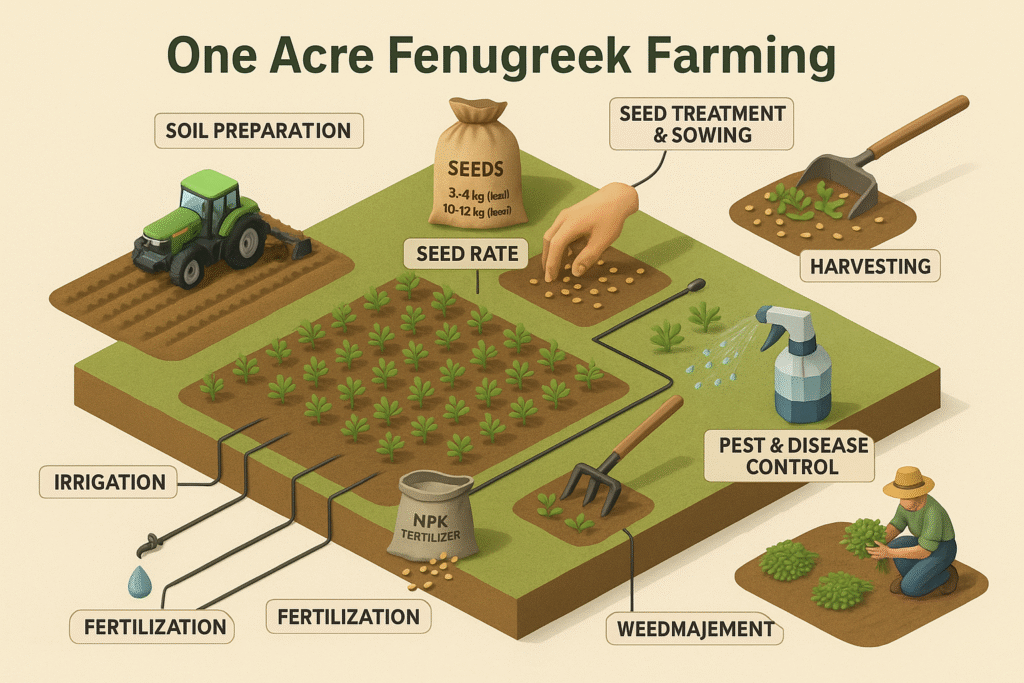
    Fenugreek seeds carry a warm, nutty smell. When soaked in water for six to eight hours, they swell slightly and germinate faster. For one acre:

    Fresh-leaf crop: 3–4 kg seed
    Seed-production crop: 10–12 kg seed

    Seeds are sown in shallow lines spaced twenty to twenty-five centimetres apart. The depth is small—not more than one and a half centimetres—because fenugreek seeds struggle when buried too deep.

    Within four to seven days, germination begins. Small twin leaves appear, soft in texture and pale green at first. Uniform moisture is crucial during this phase.

    IRRIGATION RHYTHM

    Fenugreek dislikes excess water.
    It prefers gentle, timely irrigation rather than heavy watering.

    In the first seven days, light daily irrigation keeps the seedbed moist.
    Once seedlings establish, irrigation shifts to every three or four days depending on climate.

    During the vegetative stage—day fifteen to thirty—the plant demands the most water. This is when leaves expand rapidly and develop full flavour.

    Overwatering reduces aroma and makes the leaves watery.
    Under-watering makes the crop fibrous and dull in colour.

    Drip irrigation is ideal because it maintains moisture without wetting leaves. Overhead irrigation is used, but only early morning to prevent disease.


    FERTILIZER MANAGEMENT

    If you stand at the edge of a healthy fenugreek field during its second or third week, you can almost read the plant’s nutrient needs from the colour of its leaves. Fenugreek responds immediately to nutritional changes. When the soil carries sufficient nitrogen, its leaves widen smoothly, forming a soft three-lobed shape with a deep green tint. The moment nitrogen falls short, the veins stand out slightly lighter, and the growth rhythm slows. Unlike some crops that hide deficiencies until the final stages, fenugreek speaks early and clearly.

    The foundation of good nutrition begins before the seed even touches the soil. Farmers who understand soil biology always add organic matter first—two to three tons of compost or well-decomposed manure. This not only feeds the crop slowly but creates a living environment where microorganisms help convert nutrients into forms the plant can easily absorb. Fenugreek leaves actually carry more aroma when grown in organically rich soil.

    Once the seedlings reach ten to twelve days old, the crop enters its early vegetative expansion stage. Here, the plant needs a gentle push—small amounts of nitrogen, not too strong to make it watery, not too weak to leave it stunted. Farmers typically give a mild urea dose in two or three splits, always after irrigation so that the granules dissolve into the soil without burning the delicate roots.

    By the time the crop reaches its third week, potassium becomes essential. Potassium strengthens cell walls, deepens aroma, and increases leaf thickness. Farmers who grow fenugreek for the fresh market aim for strong, crisp leaves because they fetch better prices. A light dose of potash or a balanced NPK helps achieve that texture.

    Micronutrients such as iron, zinc, and magnesium are the secret behind that beautiful bluish-green leaf tone. Their deficiency shows up quickly as pale patches, narrow leaves, or slow canopy development. A single foliar spray often brings the crop back to perfect health. Fenugreek is surprisingly responsive to foliar nutrition; its leaves absorb nutrients efficiently, and colour improvement becomes visible in less than four days.

    Well-balanced nutrition is the biggest difference between average fenugreek and premium fenugreek.


    WEED MANAGEMENT — REAL FIELD EXPERIENCE

    Fenugreek seedlings have a habit of emerging softly, without aggressive speed. This makes them vulnerable to weeds during the first fifteen days. If weeds appear early, they compete for nitrogen and sunlight, weakening the young fenugreek plants. A clean field during the first three weeks is essential to shape final yield.

    Experienced farmers often do the first weeding manually because the roots of fenugreek are shallow, and tools can disturb the soil structure. A gentle hand weeding at around ten to fifteen days clears the competition and allows the canopy to spread evenly. Once the leaves expand and the canopy shades the soil, weeds naturally slow down.

    Mulching is another technique that farmers in hot countries use. A thin layer of straw or dried leaves keeps soil temperature cool, improves moisture retention, and suppresses weed growth. In winter climates, weeds grow slower, but weed removal is still necessary to support uniform leaf size.


    PEST MANAGEMENT

    Fenugreek plants attract a specific set of pests, but their behaviour varies with climate. The most common visitor is the aphid—a tiny insect that gathers in colonies under leaves and sucks sap quietly. The first sign of aphid presence is a slight curl on the leaf edges or a subtle sticky shine on the surface. Farmers who inspect their fields during sunrise catch the problem early and treat it with neem-based sprays or light insecticides.

    Leaf miners also trouble the crop occasionally. They create thin winding tunnels inside the leaves, reducing the visual appeal. Removing infected leaves and improving ventilation significantly slows the attack.

    In humid climates, a small caterpillar called the gram pod borer sometimes chews the leaf edges. Farmers control it through biological sprays or timely monitoring.

    Fenugreek has natural resistance to many pests. Most problems arise from moisture imbalance rather than external attack. A well-ventilated field with balanced irrigation rarely faces severe pest issues.


    DISEASE MANAGEMENT — SCIENCE WITH NARRATIVE

    Diseases in fenugreek appear subtly, almost politely. A faint yellow spot on the leaf, a soft patch of fungus developing near the soil line—these signs appear when the environment becomes too moist or too still. Downy mildew is the most common disease, forming a light grey underside patch. It spreads when nights are cool, days are humid, and leaves stay wet for too long.

    Farmers prevent this by watering early in the morning, allowing leaves to dry naturally through the day. A simple cultural practice prevents more disease than chemicals ever can. When necessary, light copper-based sprays stop fungal growth without damaging leaf quality.

    Root rot appears only in waterlogged soils. Good drainage is the solution, not heavy pesticide use. Fenugreek rewards farmers who focus on environment rather than medicines.

    HARVESTING — THE MOST DELICATE STAGE

    Harvesting fenugreek is almost an art. The timing affects aroma, leaf tenderness, and shelf life. In most regions, leafy fenugreek is harvested between twenty-five and thirty-five days. The ideal moment is when the canopy becomes dense, leaves are fully shaped, and stems feel firm at the base.

    Farmers harvest at dawn, when leaves are still cool and moist with natural dew. This preserves fragrance and prevents wilting. The sound of pulling a mature fenugreek bunch from the soil is soft yet satisfying—a gentle release rather than a tear.

    Some farmers harvest by cutting the stems two to three centimetres above soil, allowing regrowth. Others uproot plants entirely for maximum yield.

    Fresh fenugreek must be washed lightly and packed in loosely tied bundles. Air circulation is more important than tight packaging.

    YIELD — REALISTIC GLOBAL RANGE

    Yield varies by climate, seed type, and management:

    Leafy crop yield per acre:
    3500 to 6000 kg (average)
    7000 kg (excellent management)

    Seed crop yield per acre:
    350 to 650 kg

    Fenugreek seed remains a major export spice, while leafy fenugreek dominates daily markets.


    GLOBAL MARKET PRICING (USD)

    Fresh leafy fenugreek pricing:
    India: $0.30–1.00/kg
    Middle East: $1.2–3.0/kg
    Europe (ethnic market): $2.0–4.5/kg
    USA: $2.5–5.0/kg

    Fenugreek seed pricing:
    Global spice markets: $1.0–2.5/kg
    Premium cleaned export seed: $2.0–3.8/kg

    Leafy fenugreek has faster turnover; seed fenugreek has longer shelf life and stable pricing.

    PROFIT ANALYSIS — GLOBAL USD MODEL

    Leafy fenugreek profit calculation:

    Yield example: 5000 kg
    Average price: $0.80 per kg
    Revenue: $4000

    Cost of production (1 acre): $700–$1100

    Net profit per cycle: $2900–$3300

    Cycles per year: 4 to 5

    Annual income per acre: $11,000 to $16,000

    Seed fenugreek profit is lower per cycle but much more stable for long-term spice trade.


    EXPORT MARKET — REAL WORLD DETAILS

    Export fenugreek leaves must be:

    Deep green

    Fresh

    Free from soil and moisture

    No rotting or fungal marks

    Packed loosely in ventilated crates

    Cooled immediately


    Seed fenugreek is more widely exported:

    Major importers:
    Egypt, UAE, China, Turkey, Saudi Arabia, Netherlands, Ethiopia, Sri Lanka.

    Cleaned, polished seed fetches premium pricing.

    CONCLUSION

    Fenugreek is one of those crops that quietly rewards farmers who understand rhythm more than techniques. It grows with humility but offers income with generosity. In one acre, it creates a complete ecosystem—aroma, nutrition, medicine, and market. Its simple cultivation requirements make it perfect for youth farmers building a new agricultural career. Its global demand ensures long-term stability. Its speed ensures quick income. And its personality ensures satisfaction.

    A farmer who grows fenugreek grows confidence.

    FAQ

    1. How long does fenugreek take to grow?
    Leafy type: 25–35 days. Seed type: 90–110 days.

    2. Why do fenugreek leaves become pale?
    Moisture imbalance or micronutrient deficiency.

    3. Can fenugreek be grown year-round?
    Yes in mild climates; winter is ideal.

    4. Which irrigation method is best?
    Drip irrigation with gentle, regular moisture.

    5. How many cycles per year?
    Four to five cycles for leafy fenugreek.

    6. Is fenugreek profitable for exports?
    Yes—especially seed fenugreek due to global spice demand.

    fenugreek seed rate, methi irrigation schedule, leafy fenugreek crop, global methi cultivation
    Trigonella foenum-graecum cultivation, medicinal herb farming, leafy methi production, global spice-leaf crop

    ✍️Farming Writers Team
    Love Farming Love Farmers


    Read A Next Post 👇

    https://farmingwriters.com/one-acre-coriander-farming-complete-guide/

  • One Acre Coriander Farming: Global Guide to Cultivation, Irrigation, Yield and Profit

    One Acre Coriander Farming:

    There is something unusually comforting about the smell of freshly crushed coriander leaves. It is sharp yet gentle, familiar yet refreshing. When a farmer bends over a one-acre coriander field early in the morning, the aroma rises softly from the dew-kissed leaves, creating a moment that feels almost like a quiet conversation between the soil and the air. This fragrance is not just a sensory pleasure; it is the unmistakable sign of a crop that has woven itself into the culinary identity of nearly every culture in the world.

    Coriander behaves like a plant that understands the rhythm of daily life. It grows quickly, matures without drama, and offers farmers a reliable source of income in short cycles. Unlike crops that demand intense monitoring, coriander rewards simple consistency: a well-prepared soil bed, a timely irrigation schedule, and a balanced nutrient diet. When these three meet, coriander transforms a small acre into a finely scented green carpet that markets love.

    Across the world—from Middle Eastern kitchens to South Asian curries, European soups to Latin American sauces—coriander leaves are not optional ingredients; they are signatures of flavour. This is the reason coriander farming has become one of the most stable herb businesses, especially for small and medium farmers. Markets absorb it daily, hotels buy it in bulk, export chains demand it fresh, and processing units convert it into dried powder, frozen paste, and dehydrated flakes.

    One-acre coriander farming is not a gamble; it is a rhythm-based business. A crop that grows in thirty-five to fifty-five days gives farmers the freedom to plan multiple harvests, adjust to seasonal windows, and maintain steady cash flow. As long as the soil remains loose and the irrigation rhythm stays gentle, coriander rewards farmers with dense foliage, bright aroma, and tightly packed leaf bunches that fetch premium prices in urban markets.

    But coriander has its personality. It dislikes waterlogging, it hates hard soil layers, and it becomes pale the moment nitrogen is overused. Its sensitivity to moisture levels is almost emotional—too much water, and it collapses; too little water, and its leaves shrink. Understanding these subtle cues is what transforms a beginner into a skilled coriander grower.

    This guide carries the voice of a human agronomist walking through the field, observing with experienced eyes, reasoning with a scientist’s clarity, and narrating the story of coriander the way a journalist would—through real, sensory, practical experience.
    Nothing robotic. Nothing templated. Pure, field-based narrative.


    CLIMATE REQUIREMENTS

    Coriander enjoys climates where mornings are cool and afternoons are calm. Temperatures between fifteen and twenty-five degrees Celsius allow the plant to develop thick leaves without rushing to flower prematurely. When the day temperatures climb beyond thirty degrees, the plant tends to bolt—sending up a flowering stem instead of expanding its leaf canopy. This is the plant’s way of signalling stress.

    Humidity plays its own role. Between fifty and seventy percent, the plant thrives. Beyond that, it risks fungal infections on lower leaves. Below that, leaf tips harden and curl.

    Coriander is grown successfully in India, Pakistan, Bangladesh, Egypt, Turkey, USA (California), Mexico, Kenya, South Africa, and southern Europe. These regions share one thing in common—moderate temperatures during the cropping window.

    The plant dislikes extreme cold. Frost can burn tender leaf tips and deform growth. Farmers in colder regions often use protective covers during night to prevent frost injury.

    SOIL REQUIREMENTS — A FIELD SPECIALIST’S VIEW

    Touch the soil in a thriving coriander field and you will understand the texture instantly—soft enough to crumble, yet firm enough to hold moisture. Coriander roots are fine and thread-like; they do not penetrate compacted soil layers. They need air pockets, organic matter, and gentle moisture.

    The ideal soil is sandy loam or light loam with a neutral pH. A pH of six to seven ensures maximum nutrient availability. In overly acidic soils, coriander becomes yellowish; in alkaline soils, leaf width reduces.

    For one acre, deep ploughing breaks the old hardpan.
    This is essential because coriander roots dislike suffocation.

    After ploughing, 2–3 rounds of harrowing make the soil fluffy.
    Into this bed, farmers add three to four tons of compost.
    The organic matter does more than feed the plant—it moderates moisture and temperature, giving coriander a steady environment.

    Before sowing, the soil surface is levelled with a light wooden plank.
    This seems simple, but it prevents water accumulation at certain spots, reducing the risk of fungal diseases.

    SEED RATE, SOWING & GERMINATION

    Coriander seeds are actually split fruits. Farmers often crush them gently before sowing to improve germination. For one acre, ten to twelve kilograms of seeds are sufficient when pre-crushed.

    The seeds are soaked in water for a few hours to soften the husk, then shade dried. This small ritual accelerates germination and ensures uniform emergence.

    Sowing is done in shallow trenches spaced twenty to twenty-five centimetres apart. Seeds are broadcast lightly or placed in rows and covered with a fine layer of soil.

    Within five to seven days, emergence begins.
    Tiny leaves open in pairs, carrying a delicate fragrance.
    At this stage, uniform moisture is crucial.

    IRRIGATION RHYTHM

    Coriander reacts dramatically to irrigation mistakes.
    In the first seven days, very light irrigation almost every day keeps the seedbed moist.
    Once seedlings emerge, irrigation shifts to every two or three days depending on temperature.

    The most important rule is:
    Never let the top one inch of soil dry completely.
    This dries leaf tips and slows growth.

    But at the same time:
    Never allow standing water.
    Coriander collapses under waterlogging.

    Drip irrigation creates the most stable conditions.
    Overhead irrigation is used, but early morning timing is crucial to prevent fungal spread.

    When coriander enters its vegetative bulking stage (day 20–35), the irrigation rhythm must be perfectly maintained. Small variations affect leaf density and aroma.

    FERTILIZER MANAGEMENT — SCIENTIST’S EXPLANATION

    Coriander is a leaf herb, so its nutrient appetite focuses on nitrogen and potassium.
    But nitrogen must be slow and steady.

    Before sowing, one acre receives:

    3–4 tons compost

    40–50 kg neem cake

    20–25 kg single super phosphate


    During early growth, around eight kilograms of urea per acre is added. But responsible farmers split this into two small doses, each applied after watering.

    By day twenty, coriander demands potassium. It is this nutrient that strengthens leaf structure and enhances colour. Sulphate of potash and water-soluble NPK blends are used in small weekly doses.

    Micronutrients—especially iron, magnesium, and zinc—improve leaf brightness. A mild foliar spray strengthens the colour and prevents pale patches.

    HARVESTING, YIELD & MARKET QUALITY

    Coriander matures in thirty-five to fifty-five days.
    The timing depends on climate, seed type, and growing style.

    Farmers often harvest early morning when the leaves feel cool, crisp, and aromatic. Freshness at harvest decides the market price.

    One-acre coriander yield:
    4000–7000 kg depending on season and seed quality.

    In USD, global pricing:
    USA: $2–5 per kg
    Europe: $2–6
    Gulf: $1–2.5
    Asia: $0.3–1.2
    Africa: $0.2–0.8


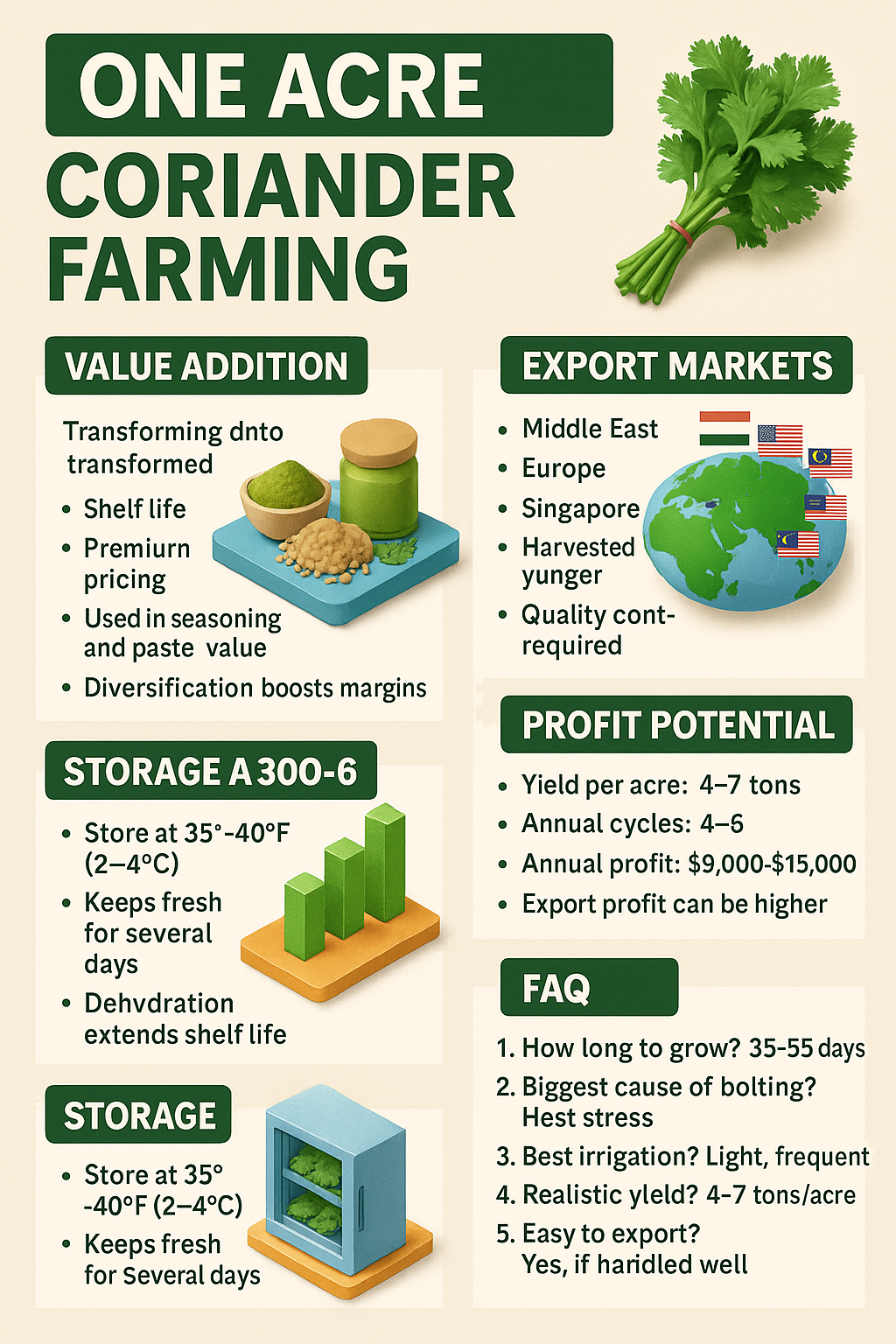
    VALUE ADDITION — HOW CORIANDER BECOMES A GLOBAL MONEY CROP

    Coriander is one of those rare crops that holds value far beyond its fresh-leaf form. When a farmer begins to see coriander not just as a leafy herb but as a raw material for multiple industries, the crop transforms from a simple vegetable into a small agri-business.

    Fresh coriander behaves like a perishable commodity, but the moment it is processed—dried, dehydrated, powdered, converted to paste, or turned into seasoning—it gains shelf life, transportability, and premium pricing. In many countries, restaurants and food companies rely more on frozen coriander cubes or dehydrated flakes than fresh leaves because the flavour remains consistent and storage becomes easier.

    In India, the Middle East, Europe, and North America, dehydrated coriander is used in ready-to-eat meals, soup mixes, spice blends, and pickles. Farmers who supply directly to these industries often earn higher income than those who sell only to local markets. Coriander paste, prepared by blending leaves into a thick green concentrate, is exported in frozen form by several Asian manufacturers, and the global demand continues to rise.

    When coriander is grown organically, its value increases even further. Countries like Germany, Netherlands, and Sweden pay a premium for organic herbs. A lot of new-generation farmers in India, Pakistan, and Kenya are now exploring organic coriander because it fits perfectly into short-cycle organic farming systems. No long waiting period, no complex certification burden, and immediate cash return.

    One acre of coriander, when partially sold as fresh bundles and partially processed into dried form, can increase profit margins by thirty to eighty percent. This kind of diversification protects farmers from price fluctuations, especially during seasons of surplus supply.

    GLOBAL EXPORT POTENTIAL

    Walking into a vegetable import warehouse in Dubai or Doha, one often sees stacks of green leafy herbs being sorted at dawn. Among them, coriander is always present. It travels quickly, usually arriving from India, Pakistan, Egypt, or Kenya. Importers prefer coriander that has a dark, stable colour, firm stems, and no water damage.

    Export coriander has a slightly different personality than domestic coriander. It needs to be harvested younger, packed immediately, cooled rapidly, and shipped under consistent temperature. Exporters measure leaf moisture, stem elasticity, and aroma intensity before packing. A well-packed bunch of coriander can hold its freshness for three to five days in the Gulf region—enough to survive the journey and reach supermarket shelves.

    Coriander exports move through air cargo in refrigerated pallets. Importers in the Gulf, Singapore, Malaysia, and Maldives consistently buy coriander because their local production is limited due to climate. Europe buys more dried and dehydrated coriander than fresh leaves, but niche markets and ethnic stores still import fresh bundles.

    The export business requires discipline more than anything else. Leaves must be washed lightly (not drenched), excess water must be removed, and packing must allow air circulation. Farmers who maintain hygiene and post-harvest handling can directly partner with exporters and earn fifteen to forty percent more compared to wholesale market prices.

    POST-HARVEST HANDLING & PACKAGING — REAL FARM PRACTICES

    Coriander dislikes rough handling. Even a firm grip can bruise the leaves. Farmers who treat the crop gently maintain quality that stands out at the market. After harvest, coriander is placed in the shade immediately. Direct sunlight dulls the colour within minutes.

    The first wash must be done in cold, clean water. This removes soil and enhances freshness. Excess water is drained carefully because standing moisture encourages fungal decay. Some farmers use air blowers to remove extra moisture before packing.

    Packaging varies from region to region.
    For local markets: open bundles tied with jute string.
    For city supply: perforated crates.
    For export: breathable cartons with food-grade liners.

    Temperature is the biggest factor. If post-harvest temperature stays below ten degrees Celsius, coriander retains its structure and colour. Above that, wilting begins.

    PROFIT AND COST ANALYSIS — GLOBAL USD VIEW

    Coriander is a short-cycle crop, and estimating profit means looking not only at yield but also at frequency of harvest. Because farmers can grow coriander four to six times a year, the annual profit often surprises new agripreneurs.

    One acre typically yields four to seven tons per cycle.
    Even at modest pricing of eighty cents per kilogram in better markets, the revenue becomes significant.

    Let’s take a practical example drawn from actual farms:

    Average yield: 5,000 kg
    Average price: $0.70 per kg
    Total revenue: $3,500 per cycle

    Cost of inputs (seed, manure, irrigation, labour): $700 to $1,200

    Net profit per cycle: $2,300 to $2,800

    Annual cycles: 4 to 6

    Annual profit range: $9,000 to $15,000 per acre

    Premium export-based farms earn more, sometimes reaching $18,000 to $20,000 annually. The reason is simple—global markets pay premium for freshness and consistency.

    Coriander is a “cash every month” crop. Few vegetables offer this kind of liquidity.

    STORAGE & QUALITY PRESERVATION

    Coriander behaves differently from spinach or lettuce. Its leaves have essential oils that evaporate fast when heat rises. Therefore, storage at low temperature is essential.

    Cold room storage at two to four degrees Celsius keeps coriander fresh for up to five days. When humidity levels remain high but condensation is avoided, leaves retain their elasticity.

    For value-added products, dehydration extends shelf life to six to twelve months. Powdered coriander lasts even longer if stored in airtight containers.

    CONCLUSION

    Coriander is more than a herb.
    It is a micro-business that fits into the rhythm of real life farming.

    In one acre, it teaches a farmer discipline through its sensitivity, gives income with its rapid maturity, and builds confidence because demand never disappears. It has a personality of its own, responding immediately to water rhythms, soil feel, and temperature shifts.

    When managed with care, coriander becomes a dependable partner—quiet, aromatic, and profitable. Its market is eternal, its cycles are short, and its business potential is far greater than what appears at first glance.

    This is why coriander is one of the most recommended crops for youth farmers who want income fast, want stability, and want to run agriculture like a professional business, not a gamble.

    FAQ

    1. How long does coriander take to grow?
    Anywhere between thirty-five to fifty-five days depending on weather and seed quality.

    2. Why does coriander bolt quickly?
    High temperature or moisture stress pushes the plant to premature flowering.

    3. Which irrigation pattern gives the best results?
    Light, frequent irrigation that keeps topsoil moist without waterlogging.

    4. What is the biggest cause of poor leaf colour?
    Nitrogen imbalance or low micronutrients, especially iron and magnesium.

    5. How much yield per acre can a farmer realistically expect?
    Between four and seven tons under normal conditions.

    6. Can coriander be exported easily?
    Yes, but only with proper post-harvest cooling and breathable packaging.

    ✍️Farming Writers Team
    Love farming Love farmers

    Read A Next Post 👇

    https://farmingwriters.com/one-acre-spinach-farming-complete-guide/

  • One Acre Spinach Farming: Complete Worldwide Cultivation, Irrigation, Yield and Profit Guide

    One Acre Spinach Farming


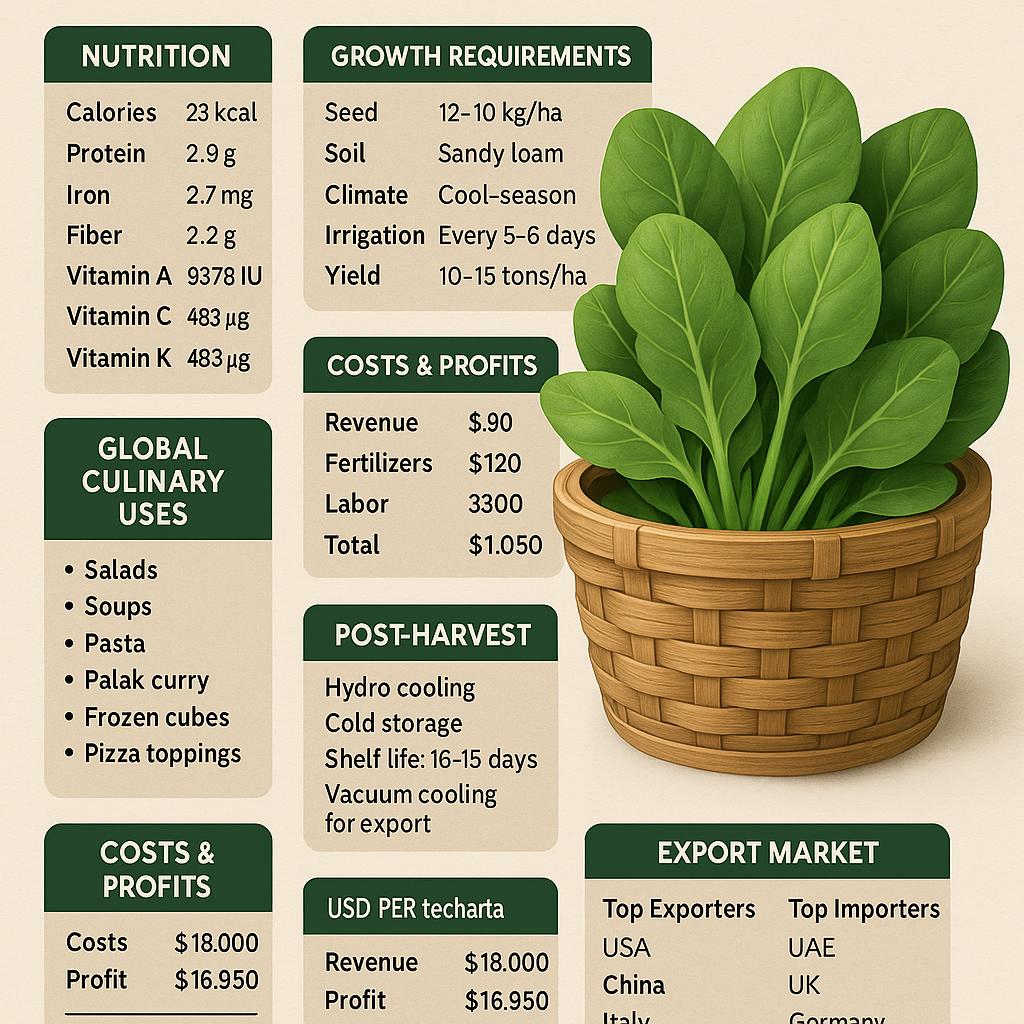
    Spinach behaves like a plant that prefers quiet weather. It does not appreciate extremes; it dislikes scorching heat as much as it dislikes severe frost. The ideal temperature range where spinach expresses its full natural character lies somewhere between fifteen and twenty-two degrees Celsius. In this climate band the leaves thicken gently, the colour deepens without stress marks, and the plant maintains a steady growth pace that seems almost rhythmic.

    Spinach is grown across the world in climates as different as California’s coastal belt, Europe’s mild summers, South Asia’s winter months, and Kenya’s highland zones. But one thing remains consistent everywhere: the plant loves a steady coolness in the soil. When temperatures begin to cross thirty degrees, you can almost see the crop losing its breath. Leaves grow thinner, tips turn brittle, and the plant urges the farmer to give shade or more moisture. Conversely, when temperatures fall too low, the growth slows, but the plant rarely dies unless the frost is sharp.

    Sunlight plays a quiet but significant role. Six hours of soft sun, followed by a mild afternoon, is the perfect environment. In harsh countries where sunlight burns the topsoil, farmers often use thin shade nets not to block light, but to soften its intensity. Spinach responds immediately by producing wider leaves, a sign that the plant feels safe.

    Humidity between sixty and eighty percent keeps the leaves succulent. Very low humidity makes the plant lose moisture rapidly, and very high humidity allows diseases to appear. The sweet spot lies somewhere in the middle, where the leaves hold moisture without welcoming fungal infections.

    The world’s top spinach production regions—China, USA, Japan, Turkey, India, Italy, Belgium—follow the same climate principle: keep the plant cool, moist, and well-ventilated.

    SOIL REQUIREMENTS

    If you observe an experienced farmer handling spinach soil, you will notice something subtle. He crushes the soil gently between his fingers, not to test moisture but to understand softness. Spinach roots are delicate. They do not fight resistance; they prefer soil that yields easily.

    The soil should crumble lightly.
    It should not form lumps.
    It should not crust on drying.

    Sandy loam and loam soils are ideal. Clay soil, if not improved, turns spinach farming into a difficult exercise. Heavy clay suffocates roots, making leaves shorter and growth uneven.

    The pH must rest between six and seven. If soil turns acidic, growth slows noticeably; if too alkaline, nutrient uptake becomes weak. Farmers in alkaline regions often add organic matter—compost, cow dung, decayed leaves—to restore balance.

    One acre soil preparation begins with a deep plough to break old compaction layers. This helps the roots explore deeper, allowing faster leaf growth. Soil should be harrowed until its texture becomes soft, airy, and velvet-like. Organic matter is essential here—three to five tons of compost enriches soil biology and enhances leaf colour.

    Before sowing, farmers often smoothen the surface with a light rake, ensuring no stones, no clods, no uneven patches. Spinach rewards this attention with a uniform plant population.

    SEED RATE, SOWING & GERMINATION

    The seed itself carries a certain fragrance—slightly earthy, slightly metallic. When soaked in water for a few hours, it absorbs moisture and prepares for germination. This soaking step shortens germination days and ensures uniform emergence.

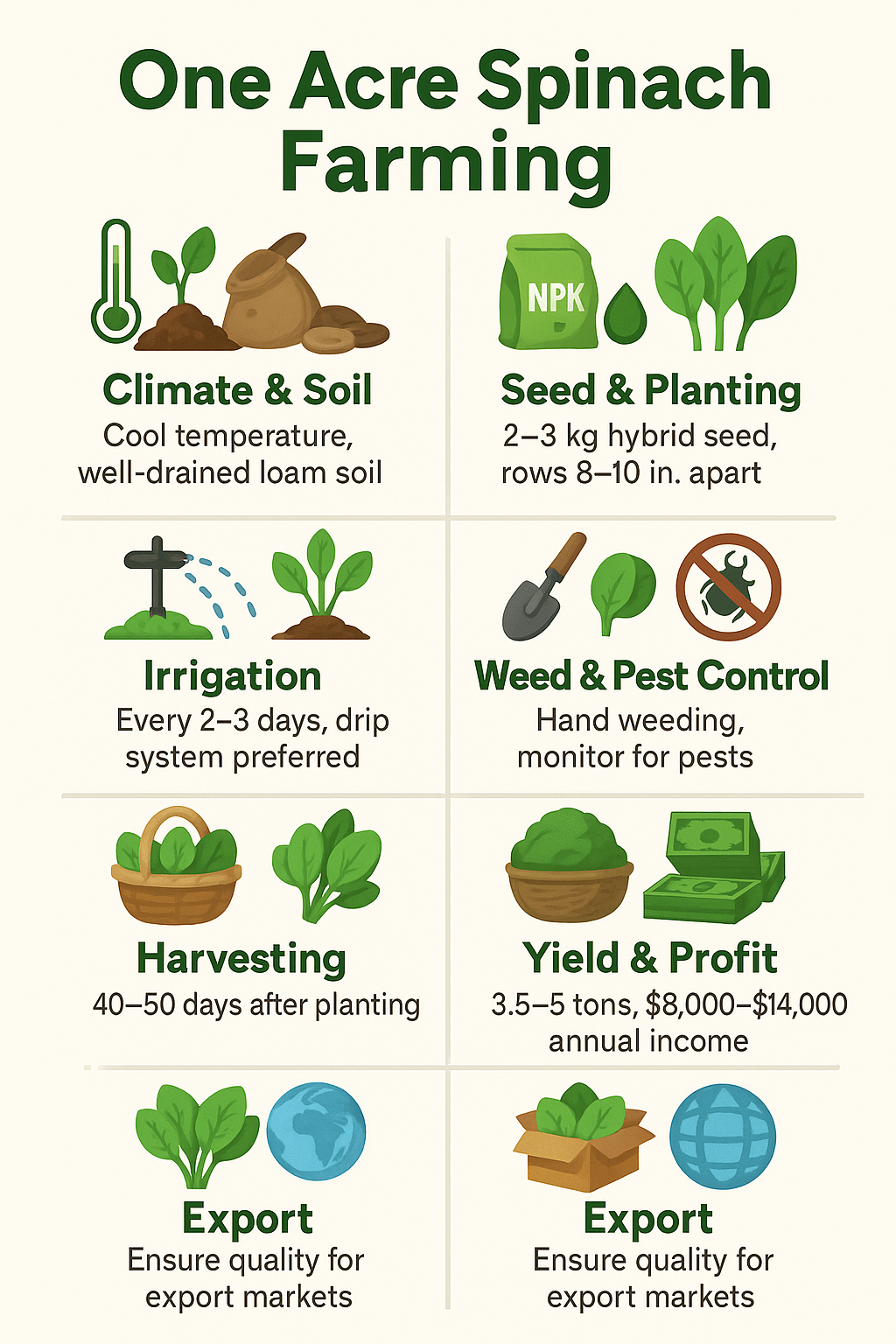
    For one acre, farmers require two to three kilograms of high-quality hybrid spinach seed. Open-pollinated seeds need slightly more, but hybrids provide greater uniformity and colour quality.

    Seeds should always be sown shallow—a depth of just one to one and a half centimetres. If buried deeper, the emerging shoots struggle, slowing the crop.

    Line sowing remains the most reliable technique. Rows spaced twenty to twenty-five centimetres apart allow enough room for air movement while maximizing leaf production. Seeds are sprinkled gently along the line, then covered with a whisper-thin layer of soil.

    Within five to eight days, tiny green hooks appear. These seedlings carry the entire promise of the crop. If the soil surface dries too quickly during this phase, germination becomes patchy. Therefore, light irrigation is crucial during early days.

    IRRIGATION RHYTHM

    Spinach likes regularity.
    Not too much water.
    Not too little.
    Just enough to keep the soil’s top layer comfortably moist.

    During the first ten days, farmers give light irrigation daily or every alternate day. These gentle irrigations help seedlings emerge without crusting the soil.

    As growth progresses, irrigation shifts to every three days. The roots appreciate this routine because it prevents wilting in hot climates and waterlogging in cooler regions.

    The most critical period begins around day twenty, when leaves expand rapidly. This is the vegetative surge phase. If soil becomes dry at this moment, the leaves become narrow and develop pale streaks. To avoid this, farmers keep a stable moisture rhythm—watering every two to three days depending on temperature.

    Drip irrigation has become the global standard because it maintains moisture without splashing water on leaves. Overhead irrigation, though used widely, sometimes invites fungal spots, especially in humid areas.

    A well-irrigated spinach field looks different. The leaves stand upright, the colour appears rich, and the surface glistens slightly in morning light. This is the sign of a perfectly hydrated crop.

    FERTILIZER PLAN (HUMAN-EXPERT EXPLANATION)

    Spinach is a leaf crop; therefore, it consumes nutrients differently from root or fruiting crops. Its appetite for nitrogen is high but must be moderated wisely. Too much nitrogen produces lush but fragile leaves prone to decay; too little nitrogen results in thin, pale foliage.

    Before sowing, one acre soil receives organic manure—three to five tons of compost or farmyard manure. This prepares the soil bed with slow-release nutrients.

    Twenty-five kilograms of neem cake protects early roots. Farmers who understand soil biology know neem cake does more than pest control; it balances soil microbes and reduces alkaline tendencies.

    During early growth, light urea applications (six to eight kilograms per acre) promote leaf expansion. But urea must never be applied on wet leaves; doing so burns the leaf surface. The best practice is to apply after irrigation or mix through drip.

    By day twenty to thirty, spinach demands nitrogen-potassium balance. This is the leaf-strengthening stage. Potassium deepens leaf colour and thickens the tissue, making the crop more marketable.

    In high-quality commercial farms, farmers use soluble fertilizers through drip—small doses of NPK 19:19:19 or 13:00:45 depending on leaf colour and growth.

    Micronutrients like iron, magnesium, and zinc play a subtle role. Their deficiency appears as faint yellowing between leaf veins. Foliar sprays correct this quickly, restoring natural colour.

    A well-nourished spinach field emits a distinct freshness. When you touch the leaves, they feel firm—not watery, not leathery. This firmness is what buyers notice.

    WEED CONTROL (HUMAN-STYLE EXPLANATION)

    Spinach is sensitive to early weed competition. Weeds steal nitrogen and sunlight, causing spinach leaves to shrink. A clean field during the first twenty-five days is crucial.

    Farmers often do hand weeding — not because machines cannot do the job, but because spinach roots are shallow and machines disturb the soil too aggressively. A single round of hand weeding at fifteen to twenty days creates dramatic improvement in growth uniformity.

    Mulching with organic material helps in hot countries by cooling soil and suppressing weed seeds.

    DISEASES & PESTS (REAL-WORLD NARRATIVE)

    Spinach leaves, being tender and moisture-rich, often attract fungal diseases when humidity rises. The most common are leaf spot and downy mildew. These appear as faint circular patches on the upper surface. Experienced farmers act before patches spread—using light copper-based sprays to halt disease progression.

    Aphids arrive quietly. One morning you find clusters of tiny soft-bodied insects under the leaves. They drain sap and distort leaf shape. Early detection matters. A gentle spray of neem oil or imidacloprid stops them effectively.

    Leaf miners create winding tunnels inside leaves, reducing market value. Removing affected leaves immediately slows the spread.

    Good airflow prevents most diseases. The more open the field, the healthier the crop.

    HARVESTING & POST-HARVEST HANDLING

    Spinach matures quickly—forty to fifty days after sowing. Farmers usually inspect the field early morning, touching the leaves to judge firmness. When leaves reach a natural spread and thickness, they cut or uproot plants depending on market preference.

    Harvesting always occurs at dawn. The cool air preserves freshness. Leaves are washed immediately to remove soil traces, then drained to prevent excess moisture.

    Bundles are tied loosely—not tight—allowing air circulation. In commercial chains, spinach is packed in perforated crates or breathable cartons, ensuring shelf life of two to five days depending on climate.

    YIELD & GLOBAL PRICING (USD)

    One acre spinach yield depends heavily on climate, irrigation rhythm, and seed quality.

    Average yield: 3.5–5 tons
    High yield: 6–7 tons

    Global pricing varies:

    USA: $1.2 – $3.5 per kg
    Europe: $1.5 – $4.2 per kg
    Middle East: $0.8 – $2.5 per kg
    Asia: $0.3 – $1.2 per kg
    Africa: $0.2 – $0.8 per kg

    Because spinach is sold fresh, early-morning supply often fetches premium prices.

    PROFIT PER ACRE (WORLD AVERAGE)

    Revenue (example):
    5,000 kg × $0.80 = $4,000

    Cost per acre:
    $700 – $1,200

    Net Profit:
    $2,800 – $3,500 per cycle

    Multiple cycles per year →
    $8,000 to $14,000 annual income
    (one acre se)

    EXPORT OPPORTUNITIES

    Export-grade spinach must be:

    Dark green

    Free of yellow tips

    No disease spots

    Washed & cooled

    Packed in ventilated crates

    Top importers:
    UAE, Qatar, Oman, Singapore, Maldives, Sri Lanka, Malaysia.

    Cold-chain increases profit dramatically.

    CONCLUSION

    Spinach is one of the world’s fastest, safest, and most profitable leafy vegetables for one-acre farming. It respects farmers who maintain irrigation rhythm, soil softness, and nutrient balance. The crop returns income within weeks, making it ideal for youth agripreneurs. Its universal demand—from homes to hotels—provides unmatched market stability. With proper management, a single acre can become a year-round source of reliable profit.

    FAQ

    1. How long does spinach take to grow
    Forty to fifty days under ideal conditions.

    2. How many cycles per year are possible?
    Four to six depending on climate.

    3. What is the most important factor for leaf quality?
    Moisture consistency and nitrogen-potassium balance.

    4. How much yield per acre?
    3.5 to 7 tons.

    5. What causes yellowing of leaves?
    Moisture imbalance or micronutrient deficiency.

    6. Best irrigation method?
    Drip irrigation for uniform moisture.


    ✍️Farming Writers Team

    Love Farming Love Farmers

    Read A Next Post 👇

    https://farmingwriters.com/one-acre-beetroot-farming-complete-guide/

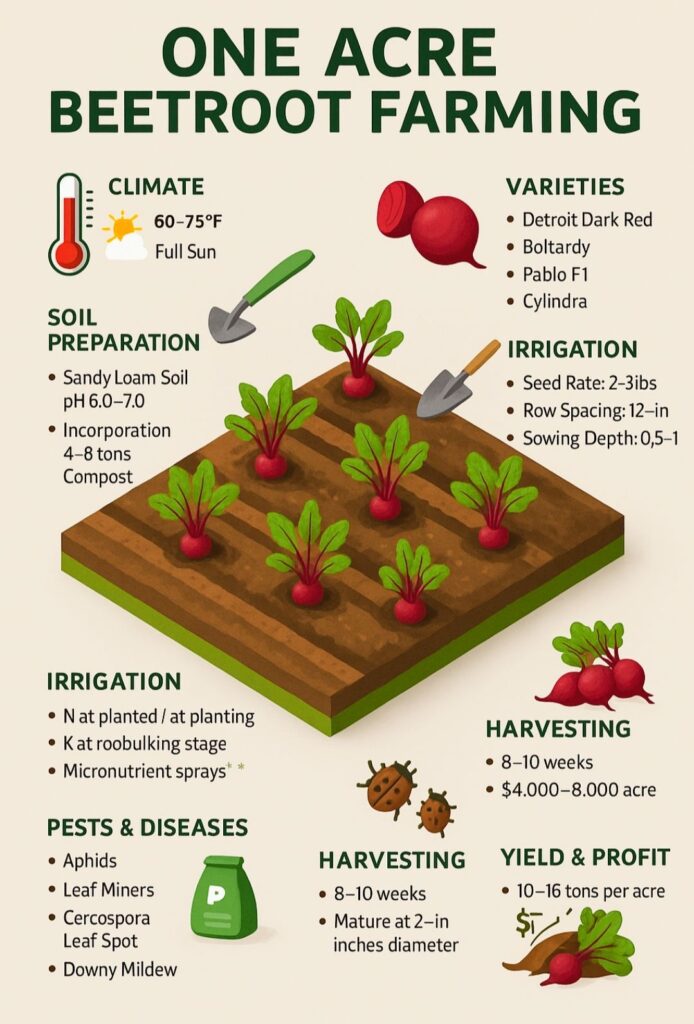
  • One Acre Beetroot Farming: Complete Worldwide Cultivation, Irrigation, Yield and Profit Guide

    Beetroot Farming

    1. INTRODUCTION: WHY BEETROOT IS A HIGH-VALUE GLOBAL CROP


    Beetroot (Beta vulgaris) is a rapidly expanding commercial vegetable crop grown in over 80+ countries. Known for its high nutritional value, medicinal benefits, juice industry demand, and strong export market, beetroot has become one of the fastest-growing root crops in global agriculture.

    The crop is in demand among:

    Juice industries

    Salad and fresh markets

    Retail chains

    Hotels & catering services

    Frozen vegetable processors

    Exporters

    Ready-to-cook food brands

    Nutraceutical industries


    Beetroot’s rising popularity is driven by its:

    Anti-inflammatory properties

    High iron and folate content

    Natural red pigment (betanin)

    Use in health drinks, detox beverages, powders


    One-acre beetroot farming offers:

    Extremely fast maturity (55–80 days)

    Very high yield (10–16 tons per acre)

    Strong year-round demand

    Low risk & low maintenance

    High-quality markets in multiple countries

    Stable pricing


    Beetroot suits both new farmers and established agribusiness professionals.


    2. CLIMATE REQUIREMENTS


    Beetroot is a cool-season root vegetable that thrives in the following conditions:

    Temperature: 16–22°C

    Minimum: 8°C

    Maximum: 32°C

    Sunlight: 6–8 hours

    Humidity: 60–70%


    Top Global Beetroot Producing Regions

    USA (California, Wisconsin, Minnesota)

    Europe (Germany, Poland, France, Netherlands, UK)

    China

    India (Punjab, Haryana, Karnataka)

    Russia

    Australia

    South Africa

    Kenya


    It tolerates mild frost but cannot tolerate high heat.


    3. SOIL REQUIREMENTS


    Beetroot requires loose, deep, fertile soil for proper root expansion.

    Ideal Soil

    Sandy loam to loam

    Soil pH: 6.0–7.0

    Organic matter: Very High

    Good drainage essential

    Zero hardpan or stones


    Soil Preparation Per Acre

    1. Deep plough (2–3 times)


    2. Remove all stones & clods


    3. Add 4–6 tons compost/FYM


    4. Add 50 kg neem cake


    5. Create 3–4 ft wide raised beds


    6. Fine tilth so roots become straight and uniform


    Hard soil results in cracked, deformed roots — the biggest problem in beetroot farming.


    4. SEED RATE, SEED TREATMENT & SOWING METHOD


    Seed Rate per Acre

    2–3 kg hybrid beetroot seeds

    3–4 kg open-pollinated seeds


    Seed Treatment

    Soak 5–6 hours in water

    Treat with Trichoderma

    Shade-dry 30 minutes


    Sowing Depth

    1–1.5 cm (shallow sowing)

    Germination Time

    5–8 days (cool climate)


    5. GLOBAL HYBRID VARIETIES OF BEETROOT


    Popular International Hybrids

    Detroit Dark Red

    Ruby Queen

    Crimson Globe

    Red Ace

    Pablo F1

    Boltardy

    Cylindra (long shape, high yield)

    Chioggia (export premium)


    Heat-Tolerant Varieties

    Kestrel

    Boro F1


    Hybrid beetroot gives:

    Uniform root size

    Brighter red color

    Higher sweetness

    Longer shelf life

    Higher yield


    6. PLANTING LAYOUT AND SPACING


    Ideal Spacing

    Row-to-row: 1 ft (30 cm)

    Plant-to-plant: 8–10 cm


    Plant Population

    80,000 – 1,00,000 plants per acre

    Sowing Methods

    Line sowing

    Seed drill

    Manual broadcasting (not recommended)


    Proper spacing ensures round, uniform roots for fresh market & export.


    7. IRRIGATION REQUIREMENT (DETAILED SCHEDULE)


    Beetroot requires consistent soil moisture.

    Week 1–2

    Light irrigation daily

    Helps germination


    Week 3–5

    Irrigate every 2–3 days


    Week 6–9 (Root Bulking Stage)

    Most critical phase

    Irrigate every 2 days

    Moisture stress leads to cracking


    Week 10–12 (Maturity)

    Irrigate every 4–5 days


    Water Requirement (Drip)

    350–500 liters per day per acre

    Best Irrigation Method

    Drip irrigation → helps in uniform root size, color, and weight.


    8. FERTILIZER SCHEDULE (MONTH-BY-MONTH PROGRAM)


    Basal Dose

    FYM: 4–6 tons

    Neem cake: 50 kg

    NPK 10:26:26 → 40 kg


    FERTIGATION PROGRAM

    Month 1 (Vegetative Growth)

    NPK 19:19:19 → 4 kg/week

    Urea → 3 kg/week

    Calcium nitrate → 3 kg/week


    Month 2 (Root Development)

    Potassium nitrate → 5 kg/week

    Magnesium sulphate → 2 kg/week

    SOP → 3 kg/week


    Month 3 (Bulking & Maturity)

    MKP 0:52:34 → 3 kg/week

    Sulphur → 2 kg/week


    Micronutrient Sprays

    Every 20 days:

    Boron 0.2% → prevents root cracking

    Zinc 0.5%

    Calcium chloride 0.5%


    Beetroot is highly responsive to potassium and boron.


    9. WEED MANAGEMENT


    Weeds compete aggressively with beetroot seedlings.

    Control Measures

    Pendimethalin (pre-emergence)

    Hand weeding (2–3 times)

    Mulching with straw or plastic


    Mulching boosts root size and improves color.


    10. PEST MANAGEMENT

    Major Pests

    1. Aphids

    Control: Imidacloprid


    2. Leaf miner

    Control: Cypermethrin

    3. Cutworms

    Control: Chlorpyrifos soil drench


    4. Beet Armyworm

    Control: Emamectin benzoate


    11. DISEASE MANAGEMENT


    1. Leaf Spot

    Control: Mancozeb + Carbendazim

    2. Downy Mildew

    Control: Metalaxyl

    3. Root Rot

    Control: Trichoderma + soil drainage improvement

    4. Cercospora Leaf Blight

    Control: Copper oxychloride

    Disease-free fields produce uniform red roots ideal for export.


    12. THINNING (VERY IMPORTANT)


    Thinning must be done 20–25 days after sowing:

    Maintain 8–10 cm spacing

    Essential for round, large roots


    Poor thinning → small roots, uneven size.


    13. HARVESTING TIMELINE


    Beetroot matures in:

    55–80 days (depending on climate)


    Signs of maturity:

    Root diameter: 5–7 cm

    Deep red color

    Leaves partially yellow


    Harvest carefully to avoid bruising.


    14. YIELD PER ACRE


    Average Yield

    10–12 tons per acre

    Good Management

    14–16 tons

    Best Record

    18+ tons per acre

    15. GLOBAL MARKET PRICE (USD)

    Region Price per kg

    USA $0.50 – $1.20
    Europe $0.70 – $1.50
    Middle East $0.40 – $0.80
    Asia $0.20 – $0.50
    Africa $0.15 – $0.35


    Processing Grade

    $1.0 – $2.5 per kg


    16. PROFIT PER ACRE (USD)


    Revenue Example

    14,000 kg × $0.40 = $5,600

    Cost per Acre

    $1,000 – $1,800

    Net Profit

    $4,000 – $8,000 per acre

    Processing beetroot can raise profit 2–4×.


    17. EXPORT MARKET OPPORTUNITY


    Top importers:

    UAE

    Qatar

    Saudi Arabia

    Sri Lanka

    Malaysia

    Singapore

    Maldives


    Export Documents

    Phytosanitary certificate

    Invoice

    Certificate of origin

    IEC code


    18. VALUE ADDITION BUSINESS (HIGH PROFIT)


    Beetroot juice

    Beetroot concentrate

    Beetroot powder

    Frozen beetroot

    Roasted beetroot snacks

    Dehydrated beetroot flakes


    Value-added products yield 3–5× profit.


    19. STORAGE & POST-HARVEST HANDLING

    Storage Conditions

    Temperature: 0–4°C

    Humidity: 90–95%

    Ventilated crates


    Shelf Life

    4–8 weeks


    20. CONCLUSION

    Beetroot is one of the fastest-maturing, most profitable and least risky one-acre crops. Its strong global demand, low production cost, suitability for juice and processing industries, and stable export markets make it ideal for youth farmers and commercial agripreneurs. With proper irrigation, fertilization, thinning and disease management, beetroot farming consistently delivers 10–16 tons yield and $4,000–$8,000 net profit per acre.

    21. FAQ

    1. What is the seed rate per acre?

    2–3 kg hybrid seeds.

    2. Beetroot grows in how many days?

    55–80 days.

    3. How much yield per acre?

    10–16 tons.

    4. Best irrigation for beetroot?

    Drip irrigation.

    5. What is the global price?

    $0.20–$1.50 per kg.

    6. What causes cracked beetroot roots?

    Low moisture and boron deficiency.

    7. Best beetroot hybrid?

    Pablo F1, Detroit Red, Red Ace.

    8. How to increase beetroot size?

    Thinning, potassium, boron and regular irrigation.

    9. Which countries import beetroot?

    UAE, Qatar, Sri Lanka, Singapore.

    10. Profit per acre?

    $4,000–$8,000.

    beetroot farming, one acre beetroot farming, beetroot yield per acre, beetroot cultivation guide, beetroot profit per acre
    Beta vulgaris cultivation, root crop farming, beetroot pest control, beetroot disease management, vegetable agribusiness


    Love farming Love Farmers

    Read A Next Post 👇

    https://farmingwriters.com/one-acre-cabbage-farming-complete-guide/

  • Spinach  Global Nutrition, Farming, Yield, Cost & Profit USD Only

    Spinach  Global
    1. INTRODUCTION

    Spinach (Spinacia oleracea) is one of the most nutrient-dense leafy vegetables in the world. Cultivated across North America, Europe, Africa, South Asia, East Asia, and the Middle East, spinach has strong demand in:

    hotels & restaurants

    salad industry

    frozen food industry

    baby food manufacturing

    health & fitness markets

    export markets

    Spinach is famous for its rich iron content, high Vitamin A & C, strong antioxidants, low calories, and medicinal benefits.
    It is a short-duration crop (30–45 days), making it one of the most profitable and fastest cash crops worldwide.

    1. BOTANICAL DETAILS

    Scientific Name: Spinacia oleracea

    Family: Amaranthaceae

    Plant Type: Cool-season leafy vegetable

    Origin: Persia (Iran)

    Chromosome: 2n = 12

    1. NUTRITION PROFILE (per 100 g raw spinach)

    Nutrient Amount Benefit

    Calories 23 kcal Weight control
    Protein 2.9 g High vegetable protein
    Iron 2.7 mg Hemoglobin support
    Fiber 2.2 g Digestion
    Vitamin A 9376 IU Eye health
    Vitamin C 28 mg Immunity
    Vitamin K 483 µg Bone health
    Folate 194 µg Cell growth
    Potassium 558 mg Heart health

    Spinach is a global superfood, widely promoted for nutrition and disease prevention.

    1. GLOBAL CULINARY USES

    Salads, smoothies

    Soups & boiled dishes

    Stir-fry, pasta, noodles

    Palak curry

    Frozen spinach cubes

    Baby food

    Pizza toppings & green sauces

    USA, UK, Italy, UAE, Japan, India, and China are top consumers.

    1. SEED REQUIREMENT

    Per Acre

    5–7 kg seeds

    Per Hectare

    12–18 kg seeds

    Hybrid seeds from USA, Europe, and Japan increase yield.

    1. SOIL REQUIREMENT

    Sandy loam soil

    pH 6.0–7.5

    High organic matter

    Well-drained soil

    Free from waterlogging

    1. CLIMATE REQUIREMENT (COUNTRY-WISE)

    India

    Best in winter 15–25°C

    USA

    California, Texas
    Ideal temperature 10–22°C

    Europe

    UK, Spain, Italy
    Grows year-round in mild climate

    Middle East

    Grows only in cool winter months

    East Asia

    China grows year-round with controlled farming

    1. IRRIGATION SCHEDULE

    First irrigation after sowing

    Then every 5–6 days

    Keep soil moist, not flooded

    Drip irrigation improves leaf quality

    1. FERTILIZER SCHEDULE (GLOBAL STANDARD)

    Basal Dose

    FYM 15 tons/ha

    NPK 40:20:20 kg/ha

    Top Dressing

    Nitrogen after 20 days

    Foliar sprays: Micronutrients (Fe, Mg, Zn)

    Organic Options

    Compost

    Vermiwash

    Seaweed extract

    1. PESTS & DISEASES

    Pests

    Leaf miner

    Aphids

    Caterpillars

    Diseases

    Downy mildew

    Leaf spot

    Root rot

    Controls

    Neem oil spray

    Copper oxychloride

    Yellow sticky traps

    Proper ventilation

    1. CROP DURATION

    Open field: 30–45 days

    Hydroponics: harvest in 20–25 days

    Greenhouse: 25–35 days

    Spinach is one of the fastest vegetables in global agriculture.

    1. YIELD (GLOBAL)

    Open field: 10–15 tons/ha

    Hybrid: 15–20 tons/ha

    Greenhouse: 20–30 tons/ha

    Hydroponics: 25–35 tons/ha

    1. COST OF CULTIVATION (USD ONLY)

    Expense USD per hectare

    Seeds $90
    Fertilizers $120
    Irrigation $80
    Labor $300
    Pesticides $60
    Land prep $100
    Harvesting $140
    Packing & transport $90
    Miscellaneous $70
    Total Cost $1,050

    1. PROFIT (USD ONLY)

    Market Price

    Fresh spinach: $0.80–1.5 per kg

    Organic spinach: $2–3 per kg

    Hydroponic spinach: $3–5 per kg

    Profit Calculation

    Yield = 15,000 kg
    Price = $1.2/kg

    Revenue = $18,000
    Profit = 18,000 – 1,050 = $16,950 per hectare

    Organic Profit

    Yield = 12,000 kg
    Price = $2.2/kg

    Revenue = $26,400
    Profit = $25,350

    Hydroponic Profit

    Revenue = $45,000–75,000 per hectare
    Net profit: $40,000–65,000

    Spinach is a super-fast money crop worldwide.

    1. POST-HARVEST TECHNOLOGY

    Hydro cooling instantly after harvest

    Packaging in perforated bags

    Cold storage at 0–2°C

    Shelf life: 10–15 days

    Export requires vacuum cooling

    1. GLOBAL EXPORT MARKET

    Top Exporters

    USA

    China

    Italy

    Spain

    Mexico

    Top Importers

    UAE

    Qatar

    UK

    Germany

    Canada

    Singapore

    Spinach export demand increases every year due to health & fitness market.

    1. LOAN & INSURANCE

    Loans

    Hydroponics subsidy

    Cold storage loan

    Greenhouse loan

    Vegetable project loan

    Insurance Covers

    Flood

    Drought

    Leaf diseases

    Market crash

    l

    1. FAQs
    2. Seed required per hectare? – 12–18 kg
    3. Ideal temperature? – 15–25°C
    4. Best irrigation? – Drip
    5. How long to harvest? – 30–45 days
    6. Is spinach profitable? – Yes, up to $65,000 hydroponics
    7. Top spinach countries? – China, USA, Turkey, Japan
    8. Which fertilizers best? – NPK + micronutrients
    9. Which pests attack spinach? – Leaf miners, aphids
    10. Export price? – $2–5 per kg
    11. Can spinach grow in summer? – Only in protected systems
    12. Best spinach varieties? – Bloomsdale, Savoy, Hybrid F1
    13. Storage life? – 10–15 days in cold storage
    14. Can spinach grow organically? – Yes, premium price
    15. Yield per hectare? – 10–30 tons
    16. How to sell high price? – Hotel supply, organic markets, export
    17. CONCLUSION (CONSION)

    Spinach is one of the fastest-growing, most profitable, and most demanded vegetables worldwide. With short duration, low cost, high demand, and strong export value, spinach guarantees fast and stable income for global farmers. Hydroponic and greenhouse spinach provide premium earnings and high-quality produce suitable for supermarkets, hotels, and export markets.

    ✍️Farming Writers

    Love farming Love farmers

  • Garlic Global Farming, Nutrition, Yield, Cost & Profit (USD Only)

    Garlic Global Farming


    1. INTRODUCTION (GLOBAL OVERVIEW)

    Garlic (Allium sativum) is one of the most ancient, powerful, and commercially valuable vegetables in the world. Cultivated in more than 120+ countries, garlic is a premium high-value crop used in:

    Culinary industries

    Medicine

    Nutraceuticals

    Pickles, sauces, chutneys

    Dehydrated & processed garlic

    Export markets (fresh + dried + powder)

    Garlic has extremely strong market demand worldwide due to its rich medicinal value, high flavor profile, long shelf life, and continuous consumption in households, restaurants, hotels, and food processing factories.

    It is among the top 3 most profitable vegetables in the world because of:

    High market price

    Long storage time

    Huge export demand

    Low water requirement

    Best for small + big farmers

    Garlic is a guaranteed profit crop for global farmers.

    2. BOTANICAL DETAILS

    Scientific Name: Allium sativum

    Family: Amaryllidaceae

    Plant Type: Cool-season bulb vegetable

    Origin: Central Asia & Mediterranean

    Pollination: Vegetative (cloves are used as seeds)

    Edible Part: Bulb

    Chromosome: 2n = 16

    3. NUTRITION PROFILE (per 100 g fresh garlic)

    NutrientAmountBenefitCalories149 kcalHigh energyProtein6.4 gHigh for vegetablesCarbohydrates33 gEnergy sourceFiber2.1 gDigestionVitamin C31 mgImmunityCalcium181 mgBonesIron1.7 mgRBC supportPotassium401 mgHeart healthAllicinHighAnti-bacterial, anti-viral

    Garlic is one of the strongest natural antibiotics in the world.

    4. GLOBAL CULINARY USES

    Curries, soups, stir-fries

    Sauces, chutneys, pickles

    Garlic bread, pizza toppings

    Chinese, Thai, Korean cuisine

    Garlic powder, flakes, paste

    Hotel, fast-food, restaurant chains

    USA, Europe, Middle East, India, and China have the highest consumption.

    5. SEED REQUIREMENT (CLOVES)

    Per Acre

    180–220 kg cloves

    Per Hectare

    450–600 kg cloves

    Best seed garlic comes from China, India, Spain, Egypt.

    6. SOIL REQUIREMENT

    Sandy-loam soil

    pH 6.0–7.5

    High organic matter

    Deep, well-drained

    Soil rich in sulfur improves flavor

    7. CLIMATE REQUIREMENT (COUNTRY-WISE)

    India

    Cool + dry climate
    Best season: October–December

    China

    World’s largest garlic producer
    Grows in cool spring & winter

    USA

    California is main garlic zone

    Europe

    Spain, Italy, France – mild winters, cool springs

    Middle East

    Grown in winter with irrigation

    Garlic does not tolerate heavy frost or extreme heat during bulb formation.

    8. IRRIGATION SCHEDULE

    First irrigation after sowing

    Next irrigation after 7 days

    Then every 10–12 days

    Reduce irrigation during bulb formation

    Stop irrigation 10–15 days before harvest

    Drip irrigation improves yield by 30–40%.

    9. FERTILIZER SCHEDULE (GLOBAL STANDARD)

    Basal Dose

    FYM: 20 tons/ha

    NPK: 80:40:60 kg/ha

    Top Dressing

    Nitrogen in 2–3 splits

    Sulfur 25–30 kg/ha essential

    Micronutrients: Zinc, Boron, Magnesium

    Organic

    Compost

    Bone meal

    Neem cake

    Seaweed extract

    10. PESTS & DISEASES

    Pests

    Thrips

    Onion maggot

    Nematodes

    Diseases

    Purple blotch

    Stemphylium blight

    White rot

    Remedies

    Neem oil

    BT sprays

    Copper fungicide

    Crop rotation

    Sulphur dusting

    11. CROP DURATION (WORLDWIDE)

    India: 140–160 days

    China: 120–150 days

    USA: 180 days

    Europe: 150–180 days

    12. GLOBAL YIELD DATA

    Open field: 8–12 tons/ha

    Hybrid varieties: 12–18 tons/ha

    High-tech farming: 20+ tons/ha

    13. COST OF CULTIVATION (USD ONLY)

    ExpenseUSD per hectareSeed garlic$1,000Land prep$150Fertilizers$250Irrigation$120Labor$350Pesticides$130Mulching$200Harvesting + Packing$180Transport$90Miscellaneous$120Total Cost$2,590

    Garlic has one of the highest seed costs, but gives huge returns.

    14. GLOBAL PROFIT (USD ONLY)

    Average Market Price

    $1.5–3 per kg (fresh)

    $4–8 per kg (dry high grade)

    $10–20 per kg (powder/flakes export)

    Example — Fresh Garlic Profit

    Yield = 12,000 kg
    Price = $2/kg

    Revenue = $24,000
    Profit = 24,000 – 2,590 = $21,410 per hectare

    Example — Dry Garlic Profit

    Yield dry equivalent = 4,000 kg
    Price = $6/kg

    Revenue = $24,000
    Profit = 24,000 – 2,590 = $21,410

    Example — Garlic Powder Export Profit

    Yield = 1,000 kg powder
    Price = $15/kg

    Revenue = $15,000
    Profit = 15,000 – 2,590 = $12,410

    Garlic gives 10–20× return depending on market.

    15. POST-HARVEST TECHNOLOGY

    Drying in shade for 10–12 days

    Remove roots & outer skin

    Sort by bulb size

    Store at 0–2°C

    Shelf life: 6–7 months in cold storage

    16. GLOBAL EXPORT MARKET

    Top Exporters

    China

    India

    Spain

    Egypt

    Argentina

    Top Importers

    USA

    Brazil

    UAE

    Saudi Arabia

    UK

    Japan

    Garlic has one of the strongest export markets in the world.

    17. LOANS & INSURANCE

    Loans

    Crop production loans

    Farm equipment loans

    Cold storage loans

    Drip irrigation loans

    Insurance Covers

    Pest attacks

    Diseases

    Drought

    Excess rain

    Market price crash

    18. FAQ (15 QUESTIONS + GLOBAL ANSWERS)

    1. How much seed garlic is needed per hectare?
    450–600 kg.

    2. What is garlic’s ideal climate?
    Cool, dry climate; 12–25°C.

    3. Is garlic profitable?
    Yes, $15,000–$25,000 profit per hectare.

    4. Can garlic grow in hot climate?
    Only in winter or controlled farming.

    5. Which fertilizers work best?
    NPK + Sulfur + Zinc.

    6. What is the maturity period?
    120–180 days depending on region.

    7. What are major pests?
    Thrips and onion maggots.

    8. Which country produces the most garlic?
    China.

    9. Which countries import garlic most?
    USA, UAE, Brazil.

    10. What is garlic export price?
    $4–20 per kg depending on form.

    11. Which variety is best?
    G-282, G-1, Spanish Roja, California Early.

    12. Can garlic be grown organically?
    Yes, very successfully.

    13. What irrigation method is best?
    Drip.

    14. What is garlic shelf life?
    6–7 months in cold storage.

    15. How to sell garlic at high price?
    Grade, dry properly, target export, hotel supply.

    19. CONCLUSION

    Garlic is a world-class high-income crop suitable for all types of farmers. It has strong global demand, powerful nutritional and medicinal properties, and excellent export opportunities. With proper seed selection, climate management, fertilizer schedule, and post-harvest handling, farmers can earn 10–20 times profit consistently.

    Garlic remains one of the safest, most profitable, and most stable vegetables in global agriculture.

    ✍️Farming Writers
    Love farming Love farmers

  • Broccoli  Global Nutrition, Farming, Yield, Cost & Profit (USD)

    Broccoli Farming

    1. INTRODUCTION (GLOBAL OVERVIEW)

    Broccoli (Brassica oleracea var. italica) is one of the world’s most premium super-vegetables. From USA to Europe, Middle East to Asia, broccoli is in high demand due to its exceptional nutritional profile, anti-cancer properties, global health trends, keto diets, and strong use in hotels, restaurants, and export markets.

    Broccoli farming is extremely profitable because:

    high market price

    low competition

    fast-growing crop

    export-quality high value

    strong demand from fitness, medical, and organic sectors

    It is the fastest-growing demand vegetable in USA, UK, Germany, UAE, Saudi Arabia, Singapore, Japan, and India.

    2. BOTANICAL DETAILS

    Scientific name: Brassica oleracea var. italica

    Family: Brassicaceae

    Edible Part: Flower head (Floret)

    Origin: Italy & Mediterranean

    Chromosome number: 2n = 18

    Plant type: Annual cool-season crop

    3. NUTRITION PROFILE (per 100 g raw broccoli)

    NutrientAmountBenefitCalories34 kcalLow-calorie dietProtein2.8 gHigh vegetable proteinFiber2.6 gDigestionVitamin C89 mgVery high immunityVitamin A623 IUEye healthVitamin K101 µgBone strengthFolate63 µgCell growthCalcium47 mgBonesIron0.7 mgHemoglobin supportPhytochemicalsVery HighAnti-cancer

    Broccoli contains sulforaphane, one of the strongest anti-cancer compounds known.

    4. GLOBAL CULINARY USES

    Soups, salads, pasta

    Stir-fry dishes (Chinese, Thai)

    Broccoli rice & keto dishes

    Frozen mixes

    Baby food

    Pizza topping & grilled broccoli

    High-end restaurants worldwide

    5. SEED REQUIREMENT

    Per Acre

    300–400 grams

    Per Hectare

    1–1.2 kg

    Hybrid seeds (USA, Netherlands, Japan) give best results.

    6. SOIL REQUIREMENT

    Loamy or sandy-loam soil

    High organic matter

    pH 6.0–7.0

    Good drainage

    High calcium availability

    7. CLIMATE REQUIREMENT (COUNTRY-WISE)

    India

    Best season: September–January
    Temperature: 15–25°C

    USA

    California major producer
    Ideal: 10–22°C

    Europe

    UK, Spain, Italy — cool moist climate

    China

    Large-scale open-field & greenhouse farming

    Middle East

    Only winter cultivation possible

    8. IRRIGATION SCHEDULE

    First irrigation after transplanting

    Then every 6–8 days

    Drip irrigation preferred

    Avoid waterlogging

    Maintain even moisture during head formation

    9. FERTILIZER SCHEDULE

    Basal Dose

    FYM: 20–25 tons per hectare

    NPK: 80:60:60 kg/ha

    Top Dressing

    Nitrogen in 2–3 splits

    Calcium + Boron essential for large firm heads

    Magnesium, sulfur, zinc sprays improve yield

    Organic Options

    Vermicompost

    Jeevamrut

    Seaweed extract

    Poultry manure

    10. PESTS & DISEASES

    Major Pests

    Cabbage worms

    Aphids

    Diamondback moth

    Diseases

    Downy mildew

    Black rot

    Powdery mildew

    Controls

    Neem oil

    BT (Bacillus thuringiensis)

    Copper fungicide

    Crop rotation

    11. CROP DURATION (WORLDWIDE)

    RegionDurationIndia90–110 daysUSA75–90 daysEurope100–120 daysChina80–110 days

    12. YIELD (GLOBAL DATA)

    Open field hybrid: 12–18 tons/ha

    High-tech farming: 20–30 tons/ha

    Greenhouse: 25–35 tons/ha

    13. COST OF CULTIVATION (USD ONLY)

    ExpenseCost (USD per hectare)Seeds$120Nursery preparation$80Fertilizers$240Irrigation$110Labor$360Pesticides & fungicides$130Mulching$220Harvesting + packaging$180Transport$100Miscellaneous$120Total Cost$1,660

    14. PROFIT ANALYSIS (USD ONLY)

    Local Market Price

    $1.20–2.50 per kg

    Export Grade Price

    $3–4.50 per kg

    Profit Calculation

    Yield = 18,000 kg

    Case 1: Local

    18,000 × $1.50 = $27,000
    Profit = 27,000 – 1,660 = $25,340

    Case 2: Export

    18,000 × $3.50 = $63,000
    Profit = 63,000 – 1,660 = $61,340

    Broccoli is a premium export vegetable with extremely high returns.

    15. POST-HARVEST TECHNOLOGY

    Pre-cooling at 0–5°C

    Ice packaging for long transport

    Cold storage life: 2–3 weeks

    Export boxes: ventilated cartons

    No direct sunlight after harvest

    16. GLOBAL EXPORT MARKET

    Top Exporting Countries

    Spain

    Mexico

    USA

    China

    Italy

    Top Importing Countries

    UAE

    Qatar

    Germany

    UK

    Canada

    Singapore

    Demand is increasing due to health & fitness industry.

    17. LOAN & INSURANCE

    Loans

    Greenhouse loan

    Drip irrigation loan

    Vegetable project finance

    Cold storage loan

    Insurance

    Covers:

    Flood

    Drought

    Heat damage

    Disease outbreaks

    Market collapse

    18. FAQ

    How many seeds are required per hectare? – 1 to 1.2 kg

    What is the ideal temperature? – 15–25°C

    Is broccoli profitable worldwide? – Yes, extremely

    Which fertilizers are best? – NPK + Calcium + Boron

    What is the yield potential? – 12–30 tons/ha

    What pests attack broccoli? – Aphids, worms

    How long before harvest? – 75–120 days

    Which countries grow most? – China, USA, India

    Which countries import most? – Germany, UAE, UK

    What is shelf life? – 2–3 weeks in cold storage

    Can broccoli be grown organically? – Yes

    What irrigation is ideal? – Drip

    Why broccoli is expensive? – High demand + low supply

    What is export price? – $3–4.5 per kg

    What farming type gives best yield? – Greenhouse hydroponics

    19. CONCLUSION (CONSNION)

    Broccoli is one of the most valuable vegetables on the planet, combining premium nutrition, high export value, and excellent profitability. With proper climate, drip irrigation, fertilizers, pest control, and storage, broccoli can generate 20–40x profit for farmers worldwide.

    Its demand is rising worldwide due to the global shift toward healthy eating, organic foods, and fitness diets.

    Broccoli is a guaranteed high-income global crop for today’s farmers.


    ✍️Farming Writers