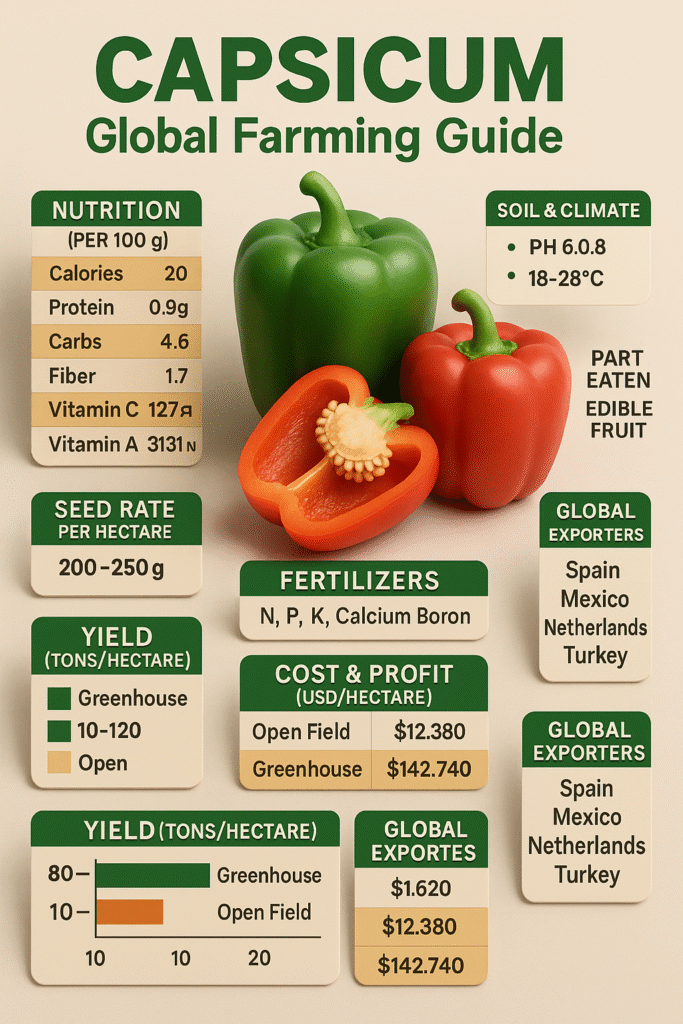
• Capsicum  Global Farming Guide, Nutrition, Yield, Cost & Profit

    Capsicum Farming


    1. INTRODUCTION

    Capsicum (Capsicum annuum) also known as bell pepper, sweet pepper, or Shimla Mirch, is one of the most commercially valuable vegetables worldwide. Grown in more than 160 countries, capsicum is considered a premium greenhouse vegetable due to its high demand, strong export market, excellent shelf life, and suitability for protected cultivation.

    Capsicum farming is extremely profitable in North America, Europe, Middle East, Africa, South Asia, China, Mexico, and Southeast Asia because of:

    continuous supermarket demand

    huge hotel & restaurant consumption

    processed food industry demand

    strong export value

    Due to various colors (green, red, yellow, orange), capsicum has a higher market price than most vegetables.

    2. BOTANICAL & AGRONOMIC DETAILS

    Botanical Name: Capsicum annuum

    Family: Solanaceae

    Chromosomes: 2n = 24

    Plant Type: Annual/perennial depending on climate

    Pollination: Mostly self-pollinated

    Origin: Central & South America

    3. NUTRITION PROFILE (per 100 g raw capsicum)

    NutrientAmountBenefitCalories20 kcalIdeal for weight lossProtein0.9 gBody repairCarbs4.6 gEnergyFiber1.7 gImproves digestionVitamin C127 mgExtremely high immunity boosterVitamin A3131 IUEye healthVitamin B60.29 mgNerve healthPotassium211 mgHeart healthAntioxidantsVery HighAnti-inflammatory

    Red capsicum contains lycopene • Yellow contains lutein • Green contains chlorophyll compounds.

    4. GLOBAL CULINARY USES

    Salads, pizza toppings, sauces

    Stir-fried dishes (Chinese, Thai, Korean)

    Stuffed capsicum, pasta, fajitas

    Frozen mixed vegetables

    Pickles and dips

    Hotel, café & fast-food industry

    Export quality peppers are used heavily in European & Middle Eastern cuisines.

    5. SEED REQUIREMENT

    Per Acre

    80–100 grams hybrid seeds

    Per Hectare

    200–250 grams hybrid seeds

    Protected farming uses premium seeds (Netherlands, Israel, Japan).

    6. SOIL REQUIREMENT

    Sandy-loam to clay-loam soil

    pH 6.0–6.8

    High organic matter

    Proper drainage

    Raised beds recommended

    7. CLIMATE REQUIREMENT (COUNTRY-WISE)

    India

    20–30°C, best season: October–February

    USA

    California, Florida, Arizona
    Ideal temperature: 18–26°C

    Europe

    Spain, Netherlands, Italy
    Greenhouse production is dominant

    Middle East

    UAE, Saudi Arabia, Qatar
    Mostly greenhouse / cooling pad systems

    China

    Largest producer with open + greenhouse farms

    8. IRRIGATION SCHEDULE

    Drip irrigation is mandatory for best results.

    First irrigation after transplanting

    Then every 3–4 days

    Avoid waterlogging

    Maintain 60–70% soil moisture

    9. FERTILIZER SCHEDULE (GLOBAL STANDARD)

    Basal Dose (Before planting)

    FYM: 20–25 tons/ha

    NPK: 60:40:40 kg/ha

    Top Dressing via Drip (Fertigation)

    Nitrogen weekly dose

    Potassium during flowering

    Calcium + Boron for fruit setting

    Micronutrients

    Magnesium

    Sulfur

    Zinc

    10. PESTS & DISEASE MANAGEMENT

    Major Pests

    Whiteflies

    Thrips

    Aphids

    Fruit borer

    Diseases

    Powdery mildew

    Bacterial leaf spot

    Damping-off

    Mosaic virus

    Controls

    Neem oil sprays

    Copper fungicide

    Sticky traps

    Disease-free nursery

    Resistant hybrids

    Proper ventilation in greenhouse

    11. CROP DURATION (WORLDWIDE)

    RegionDurationIndia (open field)100–120 daysIndia (greenhouse)150–200 daysEurope150–250 daysUSA120–150 daysMiddle East140–170 days

    Greenhouse capsicum continues fruiting for 6 months.

    12. GLOBAL YIELD DATA

    Farming TypeYieldOpen Field10–15 tons/haHybrid15–25 tons/haGreenhouse80–120 tons/haDutch/Israeli high-techUp to 180 tons/ha

    Greenhouse capsicum gives 10x yield compared to open farming.

    13. COST OF CULTIVATION (USD ONLY)

    Open Field Capsicum (Per Hectare)

    ExpenseCost (USD)Seeds$80Land Prep$120Fertilizers$220Irrigation$120Labor$350Pesticides$140Mulching$200Harvesting + Packaging$180Transport$100Misc.$110Total Cost$1,620

    Greenhouse Capsicum (Per Hectare)

    ExpenseUSDHybrid Seeds$150Greenhouse Setup (share)$5,000Fertilizers$500Pesticides$260Drip + Cooling$350Labor$600Others$400Total Cost$7,260

    14. PROFIT (USD ONLY)

    Open Field Profit

    Yield: 20,000 kg

    Price: $0.70/kg

    Revenue: $14,000

    Cost: $1,620

    Net Profit = $12,380 per hectare

    Greenhouse Profit

    Yield: 100,000 kg

    Price: $1.50/kg

    Revenue: $150,000

    Cost: $7,260

    Net Profit = $142,740 per hectare

    Capsicum is one of the most profitable vegetables worldwide.

    15. POST-HARVEST TECHNOLOGY

    Pre-cooling: 7–10°C

    Waxing for longer shelf life

    Grading by size & color

    Cold storage life: 3–5 weeks

    Export uses ventilated crates

    16. GLOBAL EXPORT MARKET

    Top Exporters

    Netherlands

    Spain

    Mexico

    China

    Turkey

    Top Importers

    USA

    Germany

    UAE

    UK

    Canada

    Demand keeps rising due to supermarkets + fast food chains.

    17. LOAN & INSURANCE WORLDWIDE

    Available Loans

    Greenhouse subsidy loans

    Drip irrigation loans

    Vegetable production loans

    Cold storage loans

    Insurance Coverage

    Crop disease

    Temperature stress

    Drought

    Storm

    Market crash

    18. FAQ

    1. How many seeds needed per hectare?
    200–250 grams hybrid seeds.

    2. Which climate is best?
    18–28°C cool climate.

    3. Is capsicum profitable?
    Yes, up to $140,000 profit in greenhouse farming.

    4. What irrigation method is ideal?
    Drip irrigation.

    5. How long does capsicum take to mature?
    100–200 days depending on climate.

    6. Which fertilizers give best yield?
    NPK + Calcium + Boron + Micronutrients.

    7. Which pests affect capsicum?
    Whitefly, thrips, fruit borer.

    8. How many harvests per plant?
    8–14 harvest cycles in greenhouse.

    9. Best countries for capsicum export?
    Netherlands, Spain, Turkey.

    10. Best countries for capsicum import?
    USA, Germany, UAE.

    11. Can capsicum grow in heat?
    Yes, with shade nets or greenhouse cooling.

    12. Which varieties are best?
    Indra, Bomby, Inspiration, California Wonder.

    13. What is shelf life?
    2–5 weeks in cold storage.

    14. Can organic capsicum be grown?
    Yes, with neem + compost + biofertilizers.

    15. What marketing channels are best?
    Supermarkets, exporters, restaurants, processors.

    19. CONCLUSION

    Capsicum is one of the highest-profit vegetables globally, especially in protected cultivation systems. With proper seed selection, climate control, drip irrigation, fertigation, pest management, and global market targeting, farmers can earn 10x to 50x profits in a single season.

    For worldwide farmers, capsicum is a low-risk, high-return, export-friendly vegetable with strong year-round demand.


    ✍️Farming Writers
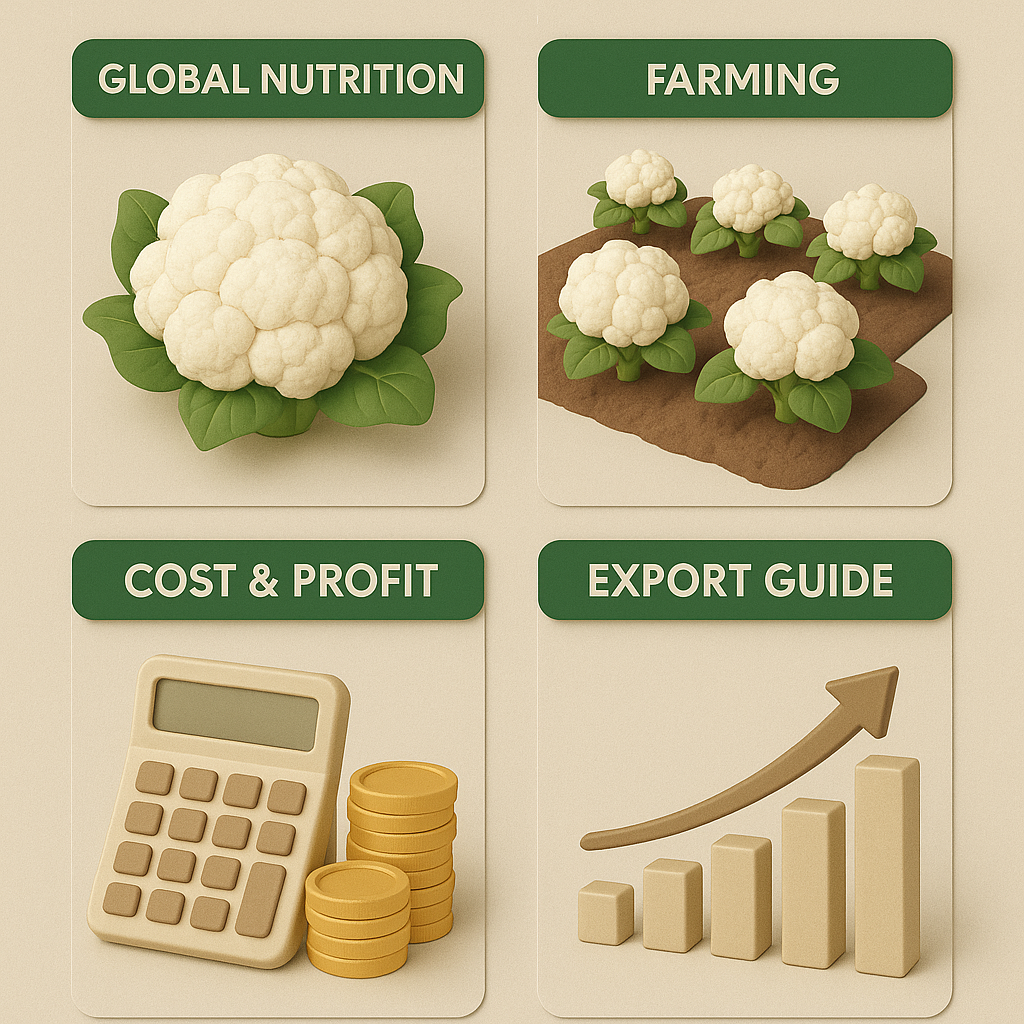
  • Cauliflower Global Nutrition, Farming, Cost, Profit & Export Guide

    Cauliflower Global Nutrition


    1. Introduction (Global Vegetable Overview)

    Cauliflower (Brassica oleracea var. botrytis) is one of the most commercially important vegetables in the world. Cultivated across Asia, Europe, Africa, and North America, cauliflower is considered a premium vegetable due to its high nutritional value, long shelf life, suitability for export, and excellent profitability.

    It is a cool-season crop, highly responsive to fertilizers, irrigation management, and modern agriculture technologies such as mulching, drip irrigation, fertigation, and controlled environment farming.

    Global demand for cauliflower is increasing sharply due to rising consumption of healthy foods, keto diets, and cauliflower-based processed products such as cauliflower rice, pizza crust, pasta alternatives, and frozen cuts.

    2. Botanical Details

    Botanical Name: Brassica oleracea var. botrytis

    Family: Brassicaceae

    Plant Type: Cool-season, annual vegetable

    Edible Part: Curd (flower head)

    Origin: Mediterranean region

    Pollination: Mostly cross-pollinated

    Chromosome: 2n = 18

    3. Nutrition Profile (per 100 g raw cauliflower)

    NutrientAmountHealth BenefitCalories25 kcalLow-calorie foodProtein1.9 gMuscle repairCarbohydrates5 gEnergyFiber2 gDigestionVitamin C48 mgImmunity boosterVitamin K15 µgBone healthFolate57 µgCell growthPotassium300 mgHeart healthAntioxidantsHighAnti-cancer properties

    Cauliflower contains glucosinolates, known to reduce risk of cancer and inflammation.

    4. Global Culinary Uses

    Cauliflower is used in over 120 countries in:

    Curries, soups, stir-fries

    Cauliflower rice, pizza crust

    Pickles, roasted cauliflower

    Kimchi, fermented foods

    Frozen vegetable mixes

    Baby food puree products

    Premium hotel & restaurant menus

    5. Seed Requirement (Worldwide Standard)

    Per Acre

    250–350 grams

    Per Hectare

    1–1.5 kg

    Hybrid varieties need slightly higher seed quality for uniform curd formation.

    6. Soil Science

    Ideal soil for cauliflower:

    Loamy or sandy-loam soil

    pH 6.0–7.0

    Rich in organic matter

    High calcium and boron availability

    Deep, well-drained soil (to avoid root rot)

    7. Climate Requirement (Country-wise)

    India

    Best season: October–February

    Temperature: 15–25°C

    USA

    California, Arizona – winter crop

    Temperature: 10–22°C

    Europe

    UK, Spain, Italy – cool moist climate

    Temperature: 8–20°C

    China

    Grown year-round in controlled environments

    Middle East

    Winter-only crop

    Requires irrigation management due to heat

    8. Irrigation Schedule

    First irrigation immediately after transplanting

    Next irrigation after 4 days

    Then every 7–10 days

    Avoid water logging

    Maintain uniform moisture during curd formation

    Drip irrigation recommended for highest yield

    9. Fertilizer Schedule (Global Standard)

    Basal Dose

    20–25 tons FYM per hectare

    NPK 60:40:40 kg per hectare

    Top Dressing

    Nitrogen split into 2–3 doses

    Boron + Calcium essential for curd quality

    Micronutrient sprays increase yield

    Organic Farming

    Vermicompost

    Fish amino acid

    Seaweed extract

    Trichoderma for soil health

    10. Pests & Disease Management (Scientific Names Included)

    Major pests

    Cabbage worm (Pieris brassicae)

    Aphids (Brevicoryne brassicae)

    Diamondback moth (Plutella xylostella)

    Diseases

    Black rot (Xanthomonas campestris)

    Downy mildew (Peronospora parasitica)

    Clubroot (Plasmodiophora brassicae)

    Controls

    Neem oil

    Bacillus thuringiensis (BT)

    Copper oxychloride

    Crop rotation (3 years)

    Drip fertigation to reduce humidity

    11. Crop Duration (Country-wise)

    India: 90–120 days

    USA: 80–110 days

    Europe: 100–130 days

    Cold regions: 140 days

    Hybrid fast-maturing: 75–90 days

    12. Yield (Worldwide Data)

    Normal Yield: 25–30 tons per hectare

    Hybrid Yield: 35–50 tons per hectare

    Controlled environment: Up to 60 tons/ha

    13. Cost of Cultivation (USD Only)

    ExpenseUSD (Per Hectare)Seeds$120Nursery Preparation$80Manure & Fertilizers$250Irrigation$110Labor$350Pesticides & Fungicides$120Mulching + Drip System$220Harvesting + Packaging$150Transport$90Miscellaneous$100Total Cost$1,590

    14. Profit Analysis (USD Only)

    Market Prices

    Local wholesale: $0.40–0.70 per kg

    Export grade: $1.00–1.70 per kg

    Revenue Calculation

    Hybrid yield = 40,000 kg

    Case 1: Local Market

    40,000 × $0.50 = $20,000

    Profit = $20,000 – $1,590 = $18,410

    Case 2: Export Market

    40,000 × $1.50 = $60,000

    Profit = $60,000 – $1,590 = $58,410

    Cauliflower is one of the highest-profit vegetables worldwide.

    15. Post-Harvest Technology

    Precooling at 0–2°C

    Grading by size & color

    Modified atmosphere packaging (MAP)

    Cold storage life: 3–4 weeks

    Export requires strict quality grading

    16. Global Selling Channels

    Wholesale markets

    Supermarkets

    Hotels & restaurants

    Frozen food processors

    Exporters

    Online grocery platforms

    17. Loans & Insurance (Worldwide)

    Agriculture Loans

    Equipment loan

    Crop loan

    Greenhouse loan

    Drip/mulching subsidy loan

    Crop Insurance

    Covers:

    Drought

    Flood

    Disease outbreak

    Cyclone

    Market crash

    18. FAQs (With Consion Added)

    1. What is the global cost of cauliflower farming per hectare?
    Around $1,500–$1,700 depending on country.

    2. How much profit can farmers earn?
    $18,000–$58,000 per hectare depending on market and export price.

    3. How many seeds are required?
    1–1.5 kg per hectare.

    4. Which fertilizers give maximum yield?
    NPK + boron + calcium + organic manure.

    5. How long does cauliflower take to mature?
    75–130 days depending on climate.

    6. What is the ideal irrigation schedule?
    Every 7–10 days with drip irrigation recommended.

    7. What diseases affect cauliflower?
    Black rot, downy mildew, clubroot.

    8. Which countries export most cauliflower?
    China, India, Spain, USA, Netherlands.

    9. What is the best temperature for curd formation?
    15–20°C.

    10. How to increase curd size?
    Balanced nitrogen + boron + calcium + uniform watering.

    11. What are the top hybrid varieties?
    Snowball, White Freedom, Amazing, Hybrid 60.

    12. What is the shelf life?
    3–4 weeks in cold storage.

    13. Is cauliflower profitable worldwide?
    Yes, extremely profitable due to high demand.

    14. Can it be grown organically?
    Yes, yields slightly lower but price higher.

    15. How to sell cauliflower for export?
    Need grading, cold chain, export certification.

    19. Conclusion (Consion)

    Cauliflower stands as one of the most reliable, profitable, and globally demanded vegetables. Its strong export market, high nutritional value, and suitability for modern technologies make it an ideal commercial crop for any country. With properly managed seeds, irrigation, fertilization, pest control, and global marketing channels, farmers can earn exceptional profits in USD.

    Cauliflower is a world market vegetable with the capability to give 10–40× returns. For global farmers, it remains one of the best vegetables for sustainable, high-income agriculture.

    ✍️Farming Writers

    Love farming love farmers

    Read A next Post 👇

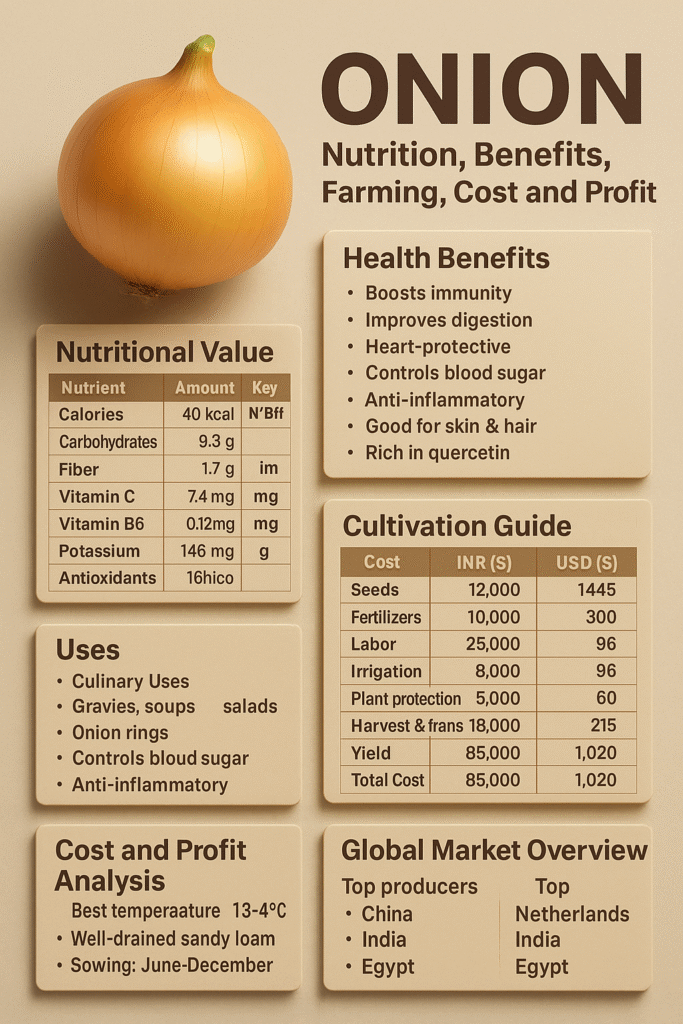
  • Onion Nutrition, Benefits, Farming, Cost, Profit and Market Farming Writers

    Onion Nutrition Benefits Farming

    Onion – Nutrition, Benefits, Farming, Cost, Profit and Global Market | Farming Writers

    1. Introduction

    Onion (Allium cepa) is one of the most essential vegetables in the world, used in almost every cuisine. Whether it is Indian curries, Chinese stir-fries, European salads, Middle Eastern dishes, or American fast food, onion forms the base of flavor and aroma.

    Onions are cultivated in more than 170 countries and are considered a high-profit commercial crop. They have long shelf life, high demand throughout the year, and strong export markets. Apart from culinary importance, onions are rich in antioxidants, vitamins, minerals, and medicinal compounds like quercetin.

    1. Nutritional Value (per 100 g raw onion)

    NutrientAmountKey BenefitCalories40 kcalLow-calorie vegetableCarbohydrates9.3 gEnergy sourceFiber1.7 gDigestive healthProtein1.1 gBody repairVitamin C7.4 mgImmunity boosterVitamin B60.12 mgNerve & brain healthPotassium146 mgHeart healthAntioxidantsHighAnti-inflammatory

    1. Health Benefits of Onion

    Boosts immunity due to antioxidants and Vitamin C.

    Improves digestion because of fiber and prebiotics.

    Heart-protective – controls blood pressure and cholesterol.

    Controls blood sugar – helpful for diabetes management.

    Anti-inflammatory properties reduce infections.

    Good for skin & hair – improves collagen production.

    Rich in quercetin, a strong antioxidant that prevents cancer and chronic diseases.

    1. Uses of Onion

    Culinary Uses

    Gravies, curries, soups

    Salads, stir-fries

    Onion rings, sandwiches, burgers

    Pickles and chutneys

    Industrial Uses

    Dehydrated onion flakes/powder

    Onion oil and extracts

    Frozen onion products

    Medicinal/Home Uses

    Onion juice for cold and cough

    Anti-inflammatory packs

    Skin and hair care

    1. Cultivation Guide

    Climate

    Best temperature: 13–24°C

    Requires dry climate at maturity

    Soil

    Well-drained sandy loam soil

    pH 6–7

    Seed Requirement

    8–10 kg per hectare

    Sowing Time

    Kharif: June–July

    Rabi: October–December

    Irrigation

    First irrigation immediately after sowing

    Then every 7–12 days

    Fertilizers

    FYM: 20 tons/ha

    NPK: 100:50:50 kg/ha

    Diseases

    Purple blotch, downy mildew, thrips

    Control: crop rotation + organic sprays

    Yield

    25–35 tons per hectare

    1. Cost and Profit Analysis (INR & USD)

    Cost of Cultivation (per hectare)

    ItemCost (INR)Cost (USD)Seeds₹12,000$145Fertilizers₹10,000$120Labor₹25,000$300Irrigation₹8,000$96Plant protection₹5,000$60Harvest & transport₹18,000$215Miscellaneous₹7,000$85Total Cost₹85,000$1,020

    Yield

    30,000 kg (30 tons) per hectare

    Market Price

    India: ₹15–35 per kg

    International: $1–2 per kg

    Profit

    India (average ₹20/kg):

    Revenue = 30,000 × ₹20 = ₹6,00,000

    Profit = ₹6,00,000 – ₹85,000 = ₹5,15,000

    Export ($1.5/kg):

    Revenue = 30,000 × $1.5 = $45,000

    Profit = $45,000 – $1,020 = $43,980 per hectare

    Onion is among the most profitable vegetables globally.

    1. Global Market Overview

    Top Producers

    China

    India

    USA

    Turkey

    Russia

    Top Exporters

    Netherlands

    India

    Egypt

    Mexico

    Spain

    Key Importers

    Bangladesh

    Malaysia

    Middle East (UAE, Saudi Arabia)

    UK

    Europe

    Onion demand is stable all year, making it a high-value commercial crop.

    1. Marketing & Selling Strategies

    Sell in local wholesale markets

    Supply to restaurants, hotels, and retail chains

    Contract supply to food companies

    Storage for off-season high price

    Export to Middle East & Europe

    Sell dehydrated onions to FMCG industry

    1. Frequently Asked Questions (FAQs)

    Q1. How long does onion take to mature?
    110–130 days depending on variety.

    Q2. What is the best season for onion farming?
    Rabi season gives the highest yield and quality.

    Q3. Is onion farming profitable?
    Yes, farmers can earn ₹5 lakh+ profit per hectare.

    Q4. Can onions be exported?
    Yes, India is among the top onion exporters.

    Q5. Which onion variety is best?
    NHRDF Red, Pusa Red, Bhima Super, Agrifound Light Red.

    1. Conclusion

    Onion is a globally significant vegetable with vast nutritional, medicinal, and commercial value. It is an evergreen market crop that gives excellent returns to farmers. Due to its high demand, long shelf life, and export opportunities, onion farming remains one of the most profitable agricultural ventures.

    With proper cultivation practices, input management, and market timing, farmers can easily earn high profit margins. Its consistent demand ensures income stability throughout the year.

    Onion is a complete package: nutritious for consumers and highly rewarding for farmers.

    ✍️Farming Writers

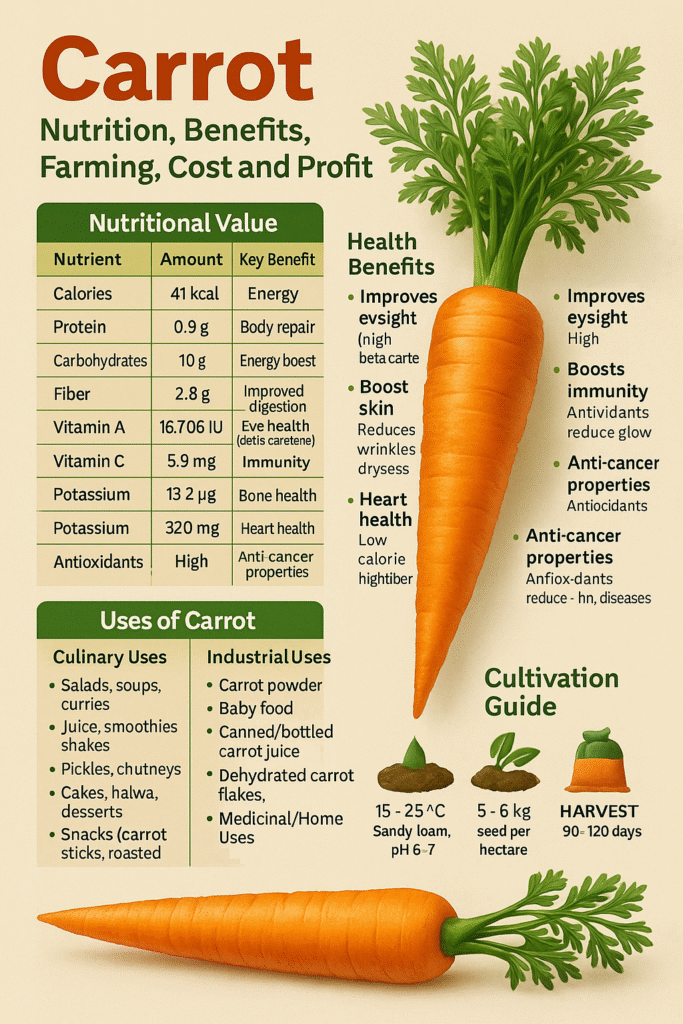
  • Carrot – Nutrition, Benefits, Farming, Cost, Profit and Uses  Farming Writers

    Carrot farming


    1. Introduction

    Carrot (Daucus carota) is one of the most widely cultivated root vegetables in the world, known for its bright orange color and high nutritional value. Originating from Central Asia, carrot is now grown across Europe, Asia, and North America.

    It is widely consumed in salads, juices, curries, pickles, soups, desserts, and snacks. Carrot is especially famous for being rich in beta-carotene, which supports eye health, immunity, and overall wellness. Its short maturity period and high market demand make it a profitable choice for farmers.

    2. Nutritional Value (per 100 g raw carrot)

    NutrientAmountKey BenefitCalories41 kcalEnergy & low-fat dietProtein0.9 gBody repairCarbohydrates10 gEnergy boostFiber2.8 gImproved digestionVitamin A16,706 IUEye health (beta-carotene)Vitamin C5.9 mgImmunityVitamin K13.2 µgBone healthPotassium320 mgHeart healthAntioxidantsHighAnti-aging & disease protection

    3. Health Benefits of Carrot

    Improves eyesight – Extremely rich in beta-carotene (Vitamin A).

    Boosts immunity – Antioxidants and Vitamin C protect against infections.

    Good for skin – Reduces wrinkles, dryness, and improves glow.

    Heart health – Potassium regulates blood pressure.

    Supports weight loss – Low-calorie, high-fiber vegetable.

    Improves digestion – Fiber enhances bowel movement.

    Controls diabetes – Low glycemic index helps stabilize blood sugar.

    Anti-cancer properties – Antioxidants reduce risk of chronic diseases.

    4. Uses of Carrot

    Culinary Uses

    Salads, soups, curries

    Juice, smoothies, shakes

    Pickles, chutneys

    Cakes, halwa, desserts

    Snacks (carrot sticks, roasted carrots)

    Industrial Uses

    Carrot powder

    Baby food

    Canned/bottled carrot juice

    Dehydrated carrot flakes

    Medicinal/Home Uses

    Improves digestion

    Natural skin cleanser

    Strengthens vision

    5. Cultivation Guide

    Climate

    Cool-season crop

    Ideal temperature: 15–25°C

    Soil

    Deep sandy-loam soil

    pH: 6–7

    Soil must be stone-free for smooth carrot growth

    Land Preparation

    Fine tilth required

    2–3 ploughings, followed by leveling

    Seed Requirement

    5–6 kg per hectare

    Sowing Time

    North India: October–December

    South India: August–October

    Irrigation

    Light irrigation after sowing

    Then every 7–10 days

    Fertilizer Requirement

    FYM: 15–20 tons/ha

    NPK: 60:40:40 kg/ha

    Harvest

    90–120 days after sowing

    Hand harvesting recommended

    Average Yield

    25–30 tons per hectare

    6. Cost and Profit Analysis (INR & USD)

    Cost of Cultivation (per hectare)

    ItemCost (INR)Cost (USD approx.)Seeds₹6,000$72Fertilizers₹10,000$120Labor₹25,000$300Irrigation₹8,000$96Land preparation₹12,000$144Miscellaneous₹9,000$108Total Cost₹70,000$840

    Yield and Revenue

    Yield: 25,000–30,000 kg per hectare

    Average Market Price:

    India: ₹20–40 per kg

    International: $1.2–2.0 per kg

    Profit Calculation (India)

    At ₹25 per kg:

    Revenue = 25,000 kg × ₹25 = ₹6,25,000

    Profit = ₹6,25,000 – ₹70,000 = ₹5,55,000 per hectare

    Profit Calculation (Export)

    At $1.5 per kg:

    Revenue = 25,000 × $1.5 = $37,500

    Profit = $37,500 – $840 = $36,660 per hectare

    Carrot is one of the most profitable root vegetables for both domestic and export markets.

    7. Global Market Overview

    Major Producers

    China

    India

    Uzbekistan

    USA

    Russia

    Major Exporters

    Netherlands

    China

    Spain

    USA

    Mexico

    Demand Drivers

    Health-conscious consumers

    Juice and beverage industry

    Baby food industry

    Fast-growing salad market

    Global carrot demand increases every year due to its nutritional value and culinary versatility.

    8. Marketing and Selling Strategies

    Sell fresh in local markets

    Supply to restaurants & hotels

    Packaging for supermarkets

    Processing into juice/powder

    Export to Middle East & Europe

    Sell to online grocery chains (Blinkit, BigBasket, Amazon Fresh)

    9. Frequently Asked Questions (FAQs)

    Q1. Are carrots profitable to grow?
    Yes, extremely profitable with up to ₹5.5 lakh profit per hectare.

    Q2. How long does carrot take to mature?
    About 90–120 days.

    Q3. Which variety is best?

    Pusa Rudhira

    Nantes

    Pusa Kesar

    Imperator

    Q4. What climate is best for carrots?
    Cool climate with temperatures between 15°C–25°C.

    Q5. Can carrots be exported?
    Yes, India exports large quantities to UAE, Bangladesh, Sri Lanka, and Europe.

    10. Conclusion

    Carrot is a high-value vegetable that offers strong health benefits and excellent market potential. Its rich content of Vitamin A, fiber, and antioxidants makes it one of the most nutritious vegetables in the world.

    For farmers, carrot farming is profitable due to its low cost, short duration, and strong market demand. Its global presence ensures farmers receive consistent income throughout the year.

    Carrot farming is suitable for beginners and professionals alike, offering great returns in both local and export markets.


    ✍️Farming Writers


    Love farming Love farmers

    Read A Next Post 👇

    https://farmingwriters.com/caraway-seeds-farming-guide/

  • Zucchini vs Cucumber What’s the Difference Uses, Benefits, Farming, and Nutrition Compared

    Introduction

    In the world of green vegetables, two members of the Cucurbitaceae family often cause confusion: zucchini and cucumber. At first glance, they may appear nearly identical—long, green, and cylindrical—but their taste, texture, culinary use, and nutritional profile are vastly different.

    Whether you’re a gardener, a chef, a health enthusiast, or a farmer, knowing the real difference between zucchini and cucumber can help you choose the right one for your needs. In this detailed guide, we’ll explore everything from appearance, taste, farming methods, nutritional value, and common uses to market demand and storage tips.

    Zucchini vs Cucumber: Quick Comparison Table

    Feature Zucchini Cucumber

    Family Cucurbitaceae Cucurbitaceae
    Scientific Name Cucurbita pepo Cucumis sativus
    Texture (Raw) Firm and dry Crisp and juicy
    Taste (Raw) Mild, slightly bitter Cool, refreshing
    Culinary Use Cooked (stir-fry, grill, bake) Mostly raw (salads, juice)
    Skin Slightly rough, matte Smooth and waxy
    Seeds Tiny and soft Slightly larger and crunchy
    Common Color Dark green, yellow Light to dark green
    Growth Season Summer Summer
    Harvest Time 45–55 days after planting 50–70 days after planting
    Calories (per 100g) ~17 kcal ~15 kcal
    Water Content ~94% ~96%
    Farming Style Warm weather, well-drained soil Warm weather, consistent watering
    Shelf Life 3–5 days (refrigerated) 1–2 weeks (refrigerated)

    1. Origin and Botanical Difference

    Zucchini:

    Native to Central America, later developed in Italy.

    Zucchini is a type of summer squash.

    Grown mostly for cooking and culinary dishes.

    Cucumber:

    Originated in South Asia (India), cultivated for over 3,000 years.

    Belongs to a different genus (Cucumis).

    Grown for raw consumption and hydrating properties.

    2. Visual and Textural Differences

    At first glance, both may appear similar, but a close inspection reveals:

    Zucchini has a dull matte skin with a firmer feel.

    Cucumber has smoother, shinier skin, sometimes with bumps (especially pickling cucumbers).

    Cucumber’s texture is cool, watery, and crisp, while zucchini is dry and meaty when raw.

    3. Taste and Culinary Use

    Zucchini:

    Has a bland to slightly bitter taste.

    Rarely eaten raw.

    Ideal for cooking—grilled, stir-fried, stuffed, baked, or spiralized into noodles (zoodles).

    Often used in savory dishes, fritters, and even sweet recipes like zucchini bread.

    Cucumber:

    Has a light, refreshing, and mildly sweet taste.

    Commonly eaten raw in salads, sandwiches, smoothies, or pickled.

    Ideal for hydration and cooling the body.

    4. Nutritional Differences

    Both are low in calories and rich in water, but some differences exist.

    Cucumber Nutrition (per 100g):

    Calories: 15

    Water: 96%

    Vitamin K: 16 mcg

    Potassium: 147 mg

    Antioxidants: Cucurbitacin, lignans

    Zucchini Nutrition (per 100g):

    Calories: 17

    Water: 94%

    Vitamin C: 17.9 mg

    Vitamin A: 200 IU

    Potassium: 261 mg

    Fiber: 1 g

    Key Difference:

    Zucchini is richer in Vitamin C, A, and potassium.

    Cucumber excels in hydration and Vitamin K.

    5. Health Benefits

    Zucchini Benefits:

    Supports weight loss (low-calorie, fiber-rich)

    Promotes heart health (potassium & antioxidants)

    Aids digestion

    Supports eye health (vitamin A)

    Anti-inflammatory properties

    Cucumber Benefits:

    Excellent hydration source

    Promotes skin health (silica and water content)

    Helps control blood pressure

    Natural detoxifier

    Reduces inflammation and bloating

    6. Farming: Zucchini vs Cucumber

    Zucchini Farming:

    Climate: Requires warm climate, 22–30°C

    Soil: Well-drained loamy soil, pH 6.0–7.5

    Planting: Direct seeding or transplant

    Harvesting: Within 45–55 days

    Yield: 6–10 tons/acre (depending on care)

    Pests/Diseases: Powdery mildew, aphids

    Cucumber Farming:

    Climate: Grows best in warm, humid conditions

    Soil: Sandy loam soil with good moisture retention

    Planting: Direct seeding

    Harvesting: 50–70 days

    Yield: 10–15 tons/acre

    Pests/Diseases: Mosaic virus, fruit fly, downy mildew

    Organic Tip:

    Use neem-based sprays, companion planting (e.g., marigold), and crop rotation for organic pest control in both crops.

    7. Market Value and Demand

    Zucchini:

    High demand in European and American gourmet kitchens.

    Used in value-added products (zoodles, chips, baked goods).

    Seasonal price fluctuations: Rs. 20–50/kg in India; $1.5–2.5/lb in the US.

    Cucumber:

    Constant demand due to its refreshing quality.

    Preferred in salads, juices, spa use.

    Stable price range: Rs. 10–30/kg in India; $1–2/lb in the US.

    Higher export potential in organic cucumber varieties.

    8. Storage and Shelf Life

    Zucchini: 3–5 days in fridge, gets soft quickly.

    Cucumber: Lasts 1–2 weeks in crisper drawer, but sensitive to cold (do not freeze).

    Store both unwashed and wrapped in paper towel or perforated bag.

    9. Common Mistakes People Make

    Using cucumber in recipes meant for zucchini (like baked dishes).

    Storing cucumbers in very cold temperatures (causes chilling injury).

    Confusing raw edibility: Zucchini can be bitter raw and may cause digestive discomfort.

    10. Fun Facts

    Zucchini flowers are edible and used in Italian dishes like stuffed blossoms.

    Cucumber is 96% water—great natural coolant in summer.

    Zucchini was once called “courgette” in Europe.

    Cucumber slices are widely used in skincare and facials for reducing puffiness.

    11. Zucchini vs Cucumber in Gardening

    If you’re a home gardener looking to grow one of these, consider the following:

    Zucchini:

    Needs more space due to bushy plant growth.

    Quick grower—ideal for small harvest windows.

    Requires regular harvesting to keep plant productive.

    Cucumber:

    Can be grown vertically on a trellis to save space.

    Produces longer over time.

    Pickling cucumbers grow faster than slicing ones.

    12. Which One Should You Choose?

    Preference/Use Best Choice

    Cooking (grilling, baking) Zucchini
    Salads and juices Cucumber
    Hydration and skincare Cucumber
    Baking/savory dishes Zucchini
    Beginner gardening Cucumber
    High Vitamin A/C Zucchini
    Longer shelf life Cucumber

    Conclusion

    Though they may appear similar, zucchini and cucumber are two very different vegetables in terms of taste, texture, nutrition, and culinary use. Understanding their differences helps farmers grow better, chefs cook smarter, and health-conscious people make more informed choices.

    Whether you’re choosing what to plant in your garden or what to pick from the grocery aisle, now you know exactly how to distinguish between these two green heroes of the vegetable world.

    FAQs:

    Q1: Can you eat zucchini raw like cucumber?

    Yes, but it’s usually cooked because raw zucchini can be slightly bitter and hard to digest.

    Q2: Are zucchini and cucumber interchangeable in recipes?

    Not always. Zucchini is better for cooking, while cucumber is better raw.

    Q3: Which is healthier—zucchini or cucumber?

    Both are healthy. Zucchini is slightly richer in vitamins A and C, while cucumber is great for hydration.

    ✍️Farming Writers

    Love farming Love farmers

    https://farmingwriters.com/sunflower-farming-guide/

  • Kalonji vs Onion Seeds vs Nigella  Differences, Uses, and Benefits Explained

    Kalonji vs Onion Seeds vs Nigella

    Kalonji, Onion Seeds, Nigella, Kalonji vs Onion Seeds, Nigella Seeds, Kalonji Benefits, Onion Seeds Uses, Nigella sativa

    Introduction

    In many parts of the world, especially South Asia and the Middle East, various black seeds are commonly used in cooking and traditional medicine. Among these, Kalonji, Onion Seeds, and Nigella are terms that often confuse people because they sound similar and sometimes look alike.

    This article aims to clarify the differences between these seeds, explain their culinary and health uses, and address why many people mix them up. By the end of this post, you’ll have a clear understanding of what Kalonji, Onion Seeds, and Nigella actually are and how to use them correctly.

    What is Kalonji?

    Kalonji, also known as black seed or black cumin, comes from the plant Nigella sativa. These tiny black seeds have been used for centuries in cooking, herbal remedies, and religious texts.

    Characteristics of Kalonji:

    Appearance: Small, black, slightly triangular seeds.

    Flavor: Slightly bitter, peppery, and pungent with a hint of onion-like flavor.

    Uses: Widely used as a spice in Indian, Middle Eastern, and North African cuisines. Often sprinkled on bread like naan or used in pickles and vegetable dishes.

    Health Benefits: Known for boosting immunity, aiding digestion, reducing inflammation, and treating respiratory issues.

    Other Names: Black seed, Black cumin, Nigella sativa seeds.

    Kalonji is celebrated not only for its flavor but also for its powerful medicinal properties in Ayurveda, Unani, and traditional medicine worldwide.

    What are Onion Seeds?

    Here’s where confusion often arises.

    True Onion Seeds

    True onion seeds are the seeds of the Allium cepa plant (common onion). These seeds:

    Are larger than Kalonji seeds.

    Usually light-colored — white, cream, or pale brown.

    Are mainly used for planting and growing onions, not as a spice or cooking ingredient.

    Are not commonly eaten.

    Onion Seeds in Cooking (Misnomer)

    In many markets, especially in India, the term “Onion Seeds” is sometimes used to refer to Kalonji seeds because Kalonji has a mild onion-like flavor. This leads to people buying Kalonji thinking they are buying onion seeds for cooking.

    So, when people say “onion seeds” in a culinary context, they often mean Kalonji, but botanically, true onion seeds are different and not typically used as spices.

    What is Nigella?

    Nigella is actually a genus name encompassing several species of plants. The most commonly referred to species is Nigella sativa — the same plant that produces Kalonji seeds.

    Nigella sativa: Produces Kalonji seeds used in cooking and medicine.

    Nigella damascena: Also called “Love-in-a-mist,” mostly an ornamental plant whose seeds are sometimes confused with Kalonji but are not commonly used for cooking.

    So, Nigella seeds usually refer to Kalonji seeds (Nigella sativa seeds) in culinary contexts.

    Key Differences Between Kalonji, Onion Seeds, and Nigella Seeds

    Feature Kalonji (Nigella sativa) Onion Seeds (True seeds of Allium cepa) Nigella (Genus Nigella)

    Botanical Name Nigella sativa Allium cepa Genus Nigella (various species)
    Seed Appearance Small, black, slightly triangular Larger, white/cream/light brown Nigella sativa seeds same as Kalonji
    Taste/Flavor Bitter, pungent, slightly onion-like No significant culinary flavor, mostly planting use Same as Kalonji for N. sativa seeds
    Culinary Use Widely used as a spice Not commonly used as food, mainly for cultivation Mostly N. sativa seeds used in cooking
    Health Benefits Immunity booster, anti-inflammatory, digestive aid No culinary health use Same as Kalonji for N. sativa seeds
    Common Confusion Called onion seeds in some regions, often mistaken for true onion seeds Different from Kalonji; not a cooking spice Multiple species, N. sativa equals Kalonji

    Why Are People Confused?

    1. Naming Confusion:

    Kalonji is often called “onion seeds” in Indian markets because of its onion-like flavor.

    Nigella is a genus name that includes Kalonji but also other species not commonly used for cooking.

    1. Visual Similarity:

    Kalonji and Nigella sativa seeds look alike — small, black, and slightly triangular.

    True onion seeds are quite different in color and size, but because they aren’t widely used as spices, most people don’t see or recognize them.

    1. Flavor Similarity:

    Kalonji’s mild onion-like taste leads people to associate it with onion seeds, reinforcing the misnaming.

    1. Market Labeling:

    Packaging sometimes labels Kalonji as “onion seeds,” causing buyers to think they are the same.

    Culinary Uses of Kalonji, Onion Seeds, and Nigella

    Kalonji Uses:

    Added to naan, parathas, and flatbreads for flavor and texture.

    Used in pickles, chutneys, and spice blends like panch phoron (Bengali five-spice mix).

    Sprinkled over vegetable dishes and lentils.

    Sometimes used in baking for a nutty, spicy aroma.

    Onion Seeds (True):

    Primarily used for sowing onions in agriculture.

    Not commonly used as a spice or culinary ingredient.

    Nigella (Mostly Kalonji Seeds):

    Same culinary uses as Kalonji since Nigella seeds generally mean Kalonji seeds.

    Health Benefits of Kalonji (Nigella sativa)

    Immune Support: Contains thymoquinone, a powerful antioxidant.

    Digestive Health: Helps with indigestion, bloating, and gas.

    Respiratory Health: Traditionally used to relieve asthma, cough, and bronchitis.

    Anti-inflammatory: May reduce inflammation and pain.

    Blood Sugar Regulation: Studies suggest benefits in controlling blood glucose levels.

    Skin Health: Used topically for eczema and acne.

    How to Identify Kalonji Seeds Correctly

    Color: Deep black.

    Shape: Small and slightly triangular with rough texture.

    Size: Smaller than sesame seeds but bigger than poppy seeds.

    Aroma: Pungent, slightly peppery and onion-like when crushed.

    Taste: Bitter and pungent with a warm spice note.

    How to Differentiate True Onion Seeds from Kalonji

    True onion seeds are larger and lighter in color (white to cream).

    They have a smooth surface and are not used as spices.

    Kalonji seeds are smaller, black, and have a rough texture.

    Culinary “onion seeds” sold in markets are often actually Kalonji seeds.

    Nigella Varieties and Their Uses

    Nigella sativa: The source of Kalonji, edible and medicinal seeds.

    Nigella damascena: Ornamental plant, seeds not commonly eaten.

    Other Nigella species: Mostly used as decorative plants, not culinary.

    Common Myths and Facts

    Myth Fact

    Kalonji and onion seeds are the same Kalonji is often called onion seeds, but true onion seeds are different.
    Nigella seeds are only used as spices Nigella sativa seeds (Kalonji) have medicinal uses as well.
    All black seeds labeled “onion seeds” are true onion seeds Most are Kalonji seeds; true onion seeds are light colored and used for planting.

    Tips for Buying and Using Kalonji and Onion Seeds

    Always check the botanical name or scientific name on packaging: Nigella sativa for Kalonji.

    Buy from trusted suppliers to avoid mix-ups.

    Store seeds in airtight containers away from sunlight to preserve flavor and potency.

    Use Kalonji seeds in moderation — their flavor is strong and slightly bitter.

    Summary

    Seed Type Botanical Name Appearance Use Common Confusion

    Kalonji Nigella sativa Small, black, triangular Culinary & medicinal Called onion seeds sometimes
    Onion Seeds (True) Allium cepa Larger, white/cream Planting only Not used as cooking spice
    Nigella (Genus) Various Varies Mostly Kalonji seeds used in cooking Some species ornamental only

    Understanding these differences can help you use the right seeds in your cooking and health routines, avoiding confusion and making the most of their benefits.

    Frequently Asked Questions (FAQs)

    1. Are Kalonji and Nigella seeds the same?
      Yes, Kalonji seeds are the seeds of Nigella sativa, so they are essentially the same.
    2. Can true onion seeds be used as a spice?
      No, true onion seeds are not typically used in cooking and are mainly for growing onions.
    3. Why do some people call Kalonji “onion seeds”?
      Because Kalonji has a slight onion-like flavor and is black, some regions market it as “onion seeds,” causing confusion.
    4. What are the health benefits of Kalonji?
      Kalonji is known to boost immunity, improve digestion, reduce inflammation, and support respiratory health.
    5. How should I store Kalonji seeds?
      Store in an airtight container, away from heat and sunlight, to maintain freshness.

    Conclusion

    Though Kalonji, Onion Seeds, and Nigella seeds are terms sometimes used interchangeably, they are different seeds with distinct origins, appearances, and uses. Kalonji (Nigella sativa) is a flavorful spice and medicinal seed, often misnamed as onion seeds. True onion seeds are completely different and mainly used in agriculture.

    Knowing these differences ensures you get the right seed for cooking, health, or planting, and avoid confusion in markets or recipes.

    ✍️Farming Writers

    Love farming Love Farmers

    Read A Next Post 👇

    https://farmingwriters.com/kalonji-benefits-farming-uses/